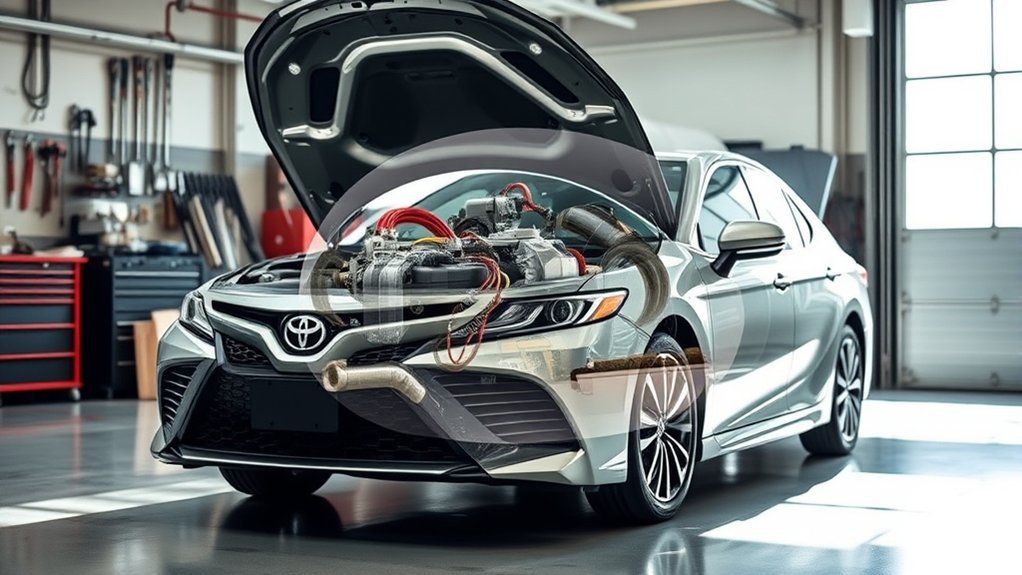
The Toyota Camry Hybrid’s eCVT is a power-split hybrid transaxle that coordinates gasoline and electric power without a conventional belt-and-pulley CVT or stepped gear changes. MG1 primarily starts the gasoline engine, generates electricity, and helps control engine speed, while MG2 supplies electric drive torque and recovers energy during regenerative braking. A planetary power-split arrangement connects these functions so the hybrid controller can continuously coordinate engine speed, motor speed, and wheel output.
Quick Answer
The Toyota Camry Hybrid eCVT is a power-split transaxle, not a belt-driven CVT. MG1 primarily starts the gasoline engine, generates electricity, and helps control engine speed; MG2 provides electric drive torque and regenerative braking. A planetary power-split arrangement coordinates the engine and motor-generators to provide smooth, continuously variable operation without conventional gear shifts.
Key Takeaways
- Toyota’s eCVT does not use the variable belt-and-pulley mechanism found in many conventional CVTs.
- MG1 primarily handles engine starting, electricity generation, and engine-speed control; MG2 primarily provides traction and regenerative braking.
- Electric-only driving is possible under suitable conditions, but there is no universal speed or distance that applies to every Camry Hybrid.
- Regenerative braking recovers some energy during deceleration, while conventional friction brakes remain essential.
- Maintenance requirements and fluid specifications vary by model year, so owners should follow Toyota documentation for their exact vehicle.
Note: This article explains the general Toyota Camry Hybrid power-split system. Component layouts, fluid specifications, controls, warranties, and service requirements can vary by model year, drivetrain, and country. The 2025 and 2026 U.S. Camry lineups are hybrid-only, but older and non-U.S. Camrys may differ.
Last updated: September 19, 2026 — rechecked 2025–2026 U.S. Camry hybrid-system details, maintenance guidance, source links, and schema.
What Is an eCVT and How Does It Work?
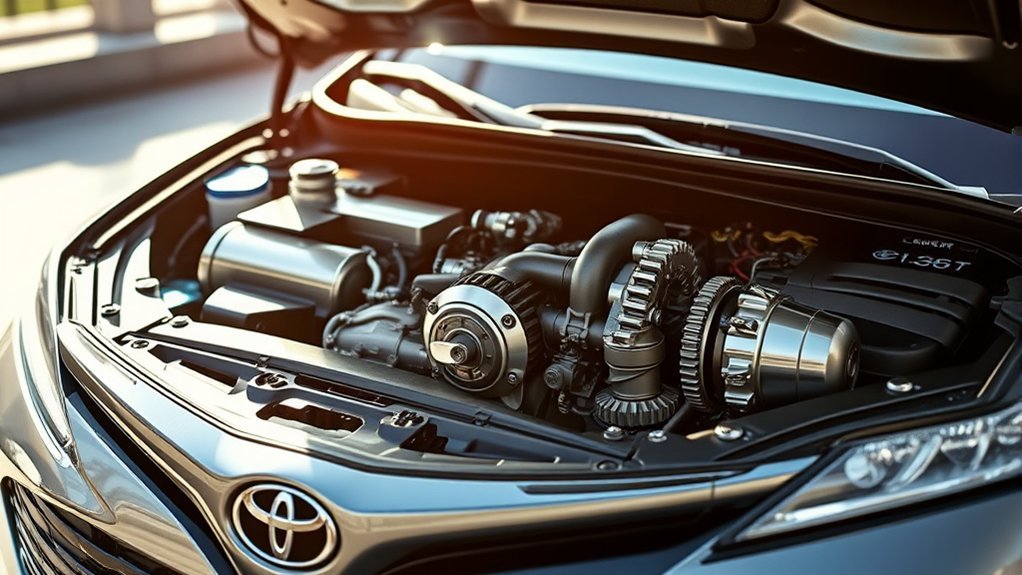
In Toyota terminology, eCVT means electronically controlled continuously variable transmission. The name describes the smooth, continuously changing relationship among engine speed, motor-generator speed, and vehicle speed. It does not mean the unit contains a conventional CVT belt that slides between variable pulleys.
The eCVT is integrated into the hybrid transaxle. Its electronic control system coordinates the gasoline engine, front motor-generators, hybrid battery, inverter, and final drive. By changing how quickly the motor-generators rotate and how much torque each one supplies or absorbs, the system can adjust the effective operating ratio without selecting a series of fixed gears.
A planetary power-split arrangement mechanically links the engine with the electrical machines and output path. The exact internal layout varies among Toyota hybrid generations, but the established design allows engine power to reach the wheels mechanically, generate electricity, or do both at the same time. Oak Ridge National Laboratory’s technical analysis of Toyota hybrid transaxles provides a detailed example of this architecture in its Toyota hybrid-system evaluation.
| Component | Primary Job |
|---|---|
| Gasoline engine | Supplies mechanical power and can help produce electricity when the control system requests it. |
| MG1 | Starts the gasoline engine, generates electricity, and helps control engine speed through the power-split system. |
| MG2 | Provides much of the electric drive torque and recovers energy during regenerative braking. |
| Hybrid battery and inverter | Store electrical energy and control its flow between the battery and motor-generators. |
| Power-split gearset | Coordinates the mechanical relationship among the engine, motor-generators, and final drive. |
| Rear electric drive motor | On applicable electronically controlled AWD models, powers the rear wheels without a conventional driveshaft from the front transaxle. |
Because the system can vary these inputs continuously, acceleration does not require the distinct upshifts associated with a conventional stepped automatic. Engine rpm may rise, fall, or remain steady without matching road speed in the way a driver expects from fixed gears. That behavior is normally a result of the hybrid controller selecting an efficient combination of engine and electric power.
The Role of Toyota Camry Hybrid Motor-Generators in Performance
The front hybrid transaxle uses two principal electrical machines commonly called MG1 and MG2. They are more accurately described as motor-generators because each can convert electrical energy into mechanical motion or convert mechanical motion into electricity.
The eCVT’s effective “ratio” is created by coordinating engine and motor-generator speeds—not by moving a belt between variable pulleys or shifting through fixed gears.
- MG1 starts the engine: Instead of relying on a conventional starter motor during normal hybrid operation, MG1 can spin the gasoline engine when the system decides it is needed.
- MG1 generates electricity: Engine power can rotate MG1 to supply electricity for MG2, recharge the hybrid battery, or support both functions.
- MG1 helps manage engine speed: Its speed and electrical load influence how the engine operates through the power-split gear arrangement.
- MG2 propels the vehicle: MG2 supplies immediate electric torque to the drive wheels, assisting launch and acceleration.
- MG2 recovers braking energy: During suitable deceleration, it acts as a generator and converts some vehicle motion back into electricity.
- AWD models add rear electric drive: Applicable current Camry AWD versions use an additional electric motor to power the rear wheels when needed.
The roles are not completely fixed. Depending on battery charge, vehicle speed, engine temperature, acceleration demand, and other conditions, the control system can change whether an electrical machine is motoring, generating, or rotating with little electrical load.
Exploring the Power-Split Device and Its Impact on Performance
The power-split device is a planetary gear arrangement that connects multiple rotating components. A simple planetary gearset contains a center sun gear, planet gears mounted on a carrier, and an outer ring gear. Toyota uses the relationship among these members to coordinate the engine and motor-generators.
In the widely documented Toyota power-split architecture, MG1 is connected to the sun-gear path, the gasoline engine is connected to the planet-carrier path, and the ring-gear path is associated with MG2 and the transaxle output. The precise gears and reduction stages can differ by generation, so this description should be treated as the operating principle rather than a repair diagram for every Camry.
No member is simply locked to the housing during ordinary hybrid driving to combine the two power sources. Instead, the speeds and torque of the engine, MG1, and MG2 are controlled together. This makes several operating modes possible:
- Starting and light-load movement: MG2 may move the vehicle using battery power while the engine remains off, when system conditions permit.
- Engine-assisted cruising: The engine can provide mechanical power while MG1 and MG2 balance electricity generation and motor assistance.
- Strong acceleration: Engine power and battery-supplied electric torque can work together to meet higher demand.
- Battery charging: The engine can drive MG1 as a generator when additional battery charge is needed.
- Deceleration: MG2 can generate electricity while slowing the vehicle, supplemented by the friction brakes as necessary.
How Does Power Flow in Common Driving Situations?
| Driving Situation | Engine / MG1 / MG2 Behavior | What the Driver May Notice |
|---|---|---|
| Starting or very light load | The engine may remain off while MG2 moves the car from battery power. MG1 is available to restart the engine when needed. | Quiet movement with no conventional shift. |
| Steady cruising | The engine can send power mechanically toward the wheels while MG1 and MG2 balance electrical generation and assistance. | Engine rpm can change without a corresponding gearshift. |
| Strong acceleration | The engine supplies power while MG2 can add battery-supplied torque. MG1 helps control engine speed and electrical power flow. | Engine rpm may rise quickly and remain elevated while road speed builds. |
| Deceleration or braking | MG2 can operate as a generator while the friction brakes add stopping force when required. | Regenerative braking may feel different from a conventional car, especially as speed decreases. |
| Battery charging while driving | The gasoline engine can drive MG1 to generate electricity when the control system needs additional battery charge. | The engine may run even when accelerator demand is modest. |
This coordinated control lets the engine operate nearer an efficient speed-and-load range more often than a fixed-gear transmission would allow. It does not guarantee that the engine will always remain at one ideal rpm, because cabin heating, battery condition, emissions controls, acceleration demand, and other factors can change the operating strategy.
Boosting Efficiency With Regenerative Braking
During suitable deceleration, the Camry Hybrid can use MG2 as a generator. The resistance created while generating electricity helps slow the vehicle, and the recovered electrical energy is sent toward the hybrid battery instead of being lost entirely as heat at the brakes.
The U.S. Department of Energy explains that regenerative braking in a hybrid uses an electric motor as a generator to capture energy that would otherwise be dissipated during braking. The gasoline engine can also help charge a non-plug-in hybrid’s battery. See the DOE’s explanation of how hybrid electric vehicles work.
The Camry uses blended braking, which means regenerative and friction braking work together. Conventional brake pads and rotors still provide stopping force when stronger braking is requested, at very low speeds, when traction conditions require it, or when the battery cannot accept as much recovered energy.
- Energy recovery: Some kinetic energy is converted into electricity during deceleration.
- Reduced friction-brake use: Regeneration can reduce how often the pads and rotors provide all the braking force, although it does not eliminate normal brake wear or maintenance.
- Stop-and-go efficiency: Frequent opportunities to slow and recover energy can benefit urban fuel economy.
- Smooth integration: Electronic controls coordinate regenerative and friction braking as pedal demand changes.
Pro Tip: When traffic and safety allow, gradual deceleration generally gives the hybrid system more opportunity to recover energy than a late, hard stop. Always prioritize safe braking distance and road conditions over maximizing the energy display.
Does a Toyota Camry eCVT Need Maintenance?
Yes. The hybrid transaxle still contains gears, bearings, seals, lubrication, electrical components, and related cooling systems. The safest maintenance strategy is to follow the owner’s manual and scheduled-maintenance guide for the vehicle’s exact year, drivetrain, and market. Toyota provides model-specific documents through its owner manuals and warranty portal.
As one concrete U.S. example, Toyota’s 2025 Camry maintenance guide lists periodic transmission-fluid inspection and calls for fluid replacement at 60,000 and 120,000 miles only under its specified special-use condition of primarily driving while towing, using a car-top carrier, or carrying heavy vehicle loads. That example should not be treated as a universal interval for every Camry Hybrid. See the official 2025 Camry Warranty & Maintenance Guide.
For model-year-specific fluid examples and why the required fluid can differ between Camry Hybrid generations, see the Toyota Camry Hybrid transmission fluid guide.
Warning: A Camry Hybrid contains high-voltage components and wiring. Do not open the hybrid transaxle, inverter, battery enclosure, orange high-voltage connectors, or related internal components without the required training and safety equipment. Have internal faults and high-voltage warnings diagnosed by a qualified hybrid technician.
- Use the specified fluid: If transaxle-fluid inspection or service is required, use only the fluid specification and procedure listed for the exact model.
- Do not invent a universal interval: Fluid replacement schedules can differ by model year and operating conditions. A generic mileage recommendation should not replace Toyota’s maintenance guide.
- Check for leaks: Have unexplained fluid beneath the transaxle area inspected rather than repeatedly topping up an unknown fluid.
- Respond to warning messages: A hybrid-system, master-warning, overheating, or reduced-power message requires diagnosis rather than a maintenance-light reset.
- Protect cooling airflow: Follow the manual’s directions for keeping hybrid-system cooling inlets unobstructed and clean.
- Document service: Keep invoices and note the exact fluid and parts used, especially when work is performed outside a Toyota dealership.
Normal Behavior Versus Warning Signs
Some behavior that feels unfamiliar in an eCVT-equipped hybrid can be normal:
- A light electric whine that changes with acceleration or regeneration
- The gasoline engine starting or stopping while the vehicle is moving
- Engine rpm increasing before road speed catches up during strong acceleration
- Changes in regenerative-braking feel as speed and battery conditions change
Arrange an inspection when you notice any of the following:
- A red or persistent hybrid-system warning
- Loss of propulsion, repeated reduced-power operation, or failure to select a drive range
- Grinding, clunking, harsh vibration, or a new loud mechanical whine
- A burning smell, smoke, or an overheating warning
- A visible fluid leak near the transaxle
- Symptoms that return after the vehicle has been restarted
If the vehicle loses power, displays a red warning, overheats, produces smoke, or smells as though something is burning, move to a safe location when possible, stop driving, and arrange professional assistance.
Advantages of the Toyota Camry Hybrid eCVT System
The power-split eCVT supports several practical advantages:
- Smooth acceleration: There are no normal stepped upshifts interrupting power delivery.
- Immediate electric torque: MG2 can assist from low vehicle speeds without waiting for an engine downshift.
- Flexible engine operation: The hybrid controller can vary engine speed independently of a fixed gear ratio.
- Regenerative braking: Some energy can be recovered during deceleration and reused.
- Integrated engine starting: MG1 can restart the gasoline engine smoothly as operating conditions change.
- Fewer conventional shifting elements: Toyota’s power-split unit does not rely on the same sequence of gear changes and clutch applications as a stepped automatic.
The system also has tradeoffs. Engine sound may rise without a corresponding gear shift, which some drivers initially interpret as slipping. Electric-only operation is conditional and limited by battery charge, temperature, power demand, climate-control needs, and other operating conditions; the standard Camry Hybrid is not designed to provide plug-in-EV driving range. Internal repairs also require technicians familiar with hybrid transaxles and high-voltage safety.
How Is Toyota eCVT Different From a Belt CVT or Automatic?
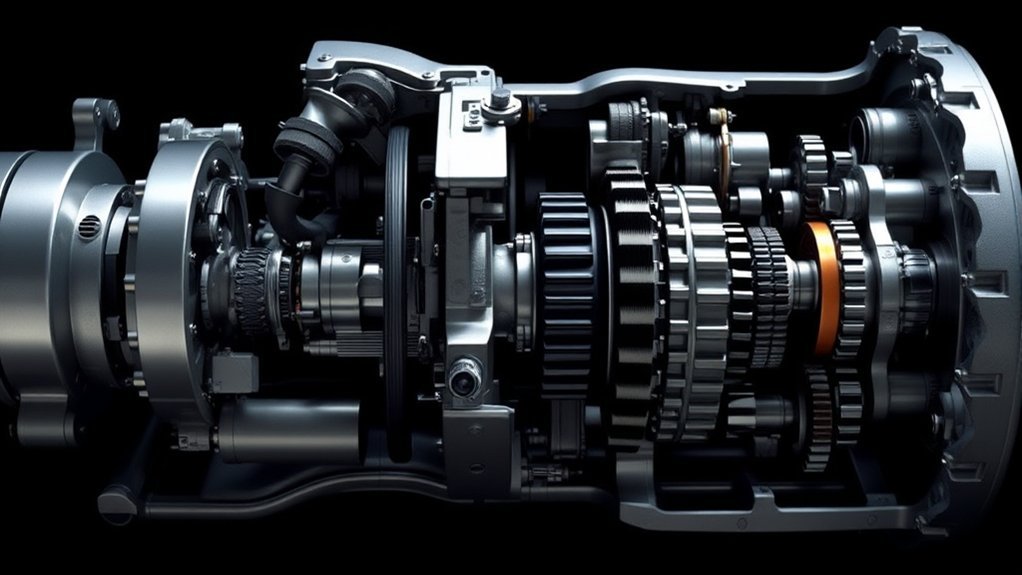
“CVT” and “eCVT” sound similar, but the mechanisms are substantially different. It is also important not to group every non-eCVT transmission into one category.
eCVT Mechanism Explained
Toyota’s hybrid eCVT uses electronic control, motor-generators, and a power-split gear arrangement. It creates continuously variable operation by coordinating the rotational speeds and torque of connected components. It does not change ratio by squeezing a belt higher or lower between variable pulleys.
A common conventional CVT usually varies its ratio through adjustable pulleys connected by a metal belt or chain. A conventional stepped automatic normally uses multiple fixed gear ratios, clutch packs, and often a torque converter. Hybrid functions such as electric-only movement and regenerative braking can be integrated with more than one transmission design, so those functions should not be used as the sole definition of an eCVT.
eCVT, Belt CVT, and Automatic Comparison
| Feature | Toyota Power-Split eCVT | Common Belt/Chain CVT | Stepped Automatic |
|---|---|---|---|
| Ratio control | Motor-generator speed plus a power-split gear arrangement | Variable pulleys connected by a belt or chain in common designs | Multiple fixed gear ratios and shifting elements |
| Normal shift points | No conventional stepped shifts | Usually no fixed shifts, although simulated steps may be programmed | Distinct gear changes |
| Electric machines integral to ratio control | Yes | Not in a conventional non-hybrid CVT | Not in a conventional non-hybrid automatic |
| Typical driving feel | Smooth electric assistance; engine rpm may vary independently of road speed | Smooth ratio changes; engine may hold a steady rpm during acceleration | Engine rpm rises and falls through individual gear changes |
| Regenerative braking | Integrated as part of the Camry hybrid system | Depends on whether the vehicle is a hybrid | Depends on whether the vehicle is a hybrid |
| Service requirements | Model-specific fluid and hybrid-system procedures | Model-specific belt, pulley, fluid, and control requirements | Model-specific fluid, clutch, valve-body, and control requirements |
What Does a Toyota Camry eCVT Feel Like to Drive?
In a stepped automatic, drivers often use gear changes as a cue that the vehicle is accelerating normally. The eCVT removes that cue. Under strong acceleration, the engine may quickly rise to an effective operating speed and remain there while vehicle speed builds. This can sound like a conventional transmission is holding a gear or slipping, even when the eCVT is functioning normally.
At low loads, the engine may shut off and restart with little driver input. During deceleration, the energy-flow display may show electricity returning to the battery. These changes are controlled automatically; the driver does not need to choose a mechanical ratio.
Common Toyota eCVT Myths
Myth: The eCVT Has a Belt That Can Slip
Toyota’s power-split eCVT is not the common variable-pulley CVT design. A high engine speed during acceleration is therefore not evidence that a CVT belt is slipping. A new burning smell, harsh vibration, loss of drive, or grinding noise still requires inspection.
Myth: The eCVT Has No Gears
The Toyota eCVT does contain mechanical gears. Its power-split device uses planetary gearing, and the transaxle also uses reduction and final-drive gearing to transmit power. What it does not use is a belt-and-variable-pulley mechanism to create its continuously changing ratio, or the normal sequence of clutch-selected stepped ratios found in a conventional automatic.
Myth: EV Operation Always Works Up to One Set Speed
Electric-only operation depends on battery charge, temperature, power demand, climate-control needs, vehicle speed, and the hybrid controller’s strategy. The engine may start at any speed when its power, heat, emissions operation, or charging capability is needed.
Myth: An eCVT Never Needs Attention
The design avoids many conventional shift components, but the transaxle still contains bearings, gears, seals, lubrication, electrical windings, sensors, and cooling-related systems. Leaks, collision damage, electrical faults, contamination, or wear can still require diagnosis and repair.
Model-Year and AWD Differences
For the U.S. market, Toyota introduced the 2025 Camry as an all-hybrid lineup using the fifth-generation Toyota Hybrid System. The 2026 lineup remains exclusively hybrid, with Toyota rating front-wheel-drive models at 225 net-combined horsepower and AWD-equipped versions at 232 net-combined horsepower. Toyota describes the current system in its official 2026 Camry product announcement.
On front-wheel-drive versions, the primary hybrid motor-generators are integrated with the front transaxle. Applicable AWD versions add a separate electric motor that can drive the rear wheels when additional traction or acceleration support is requested. This means a simple statement that every Camry Hybrid has “two electric motors” can be incomplete when discussing an AWD model.
Older Camry Hybrids use earlier generations of the system, and non-U.S. specifications can differ. Always identify the model year, drivetrain, market, and vehicle identification number before ordering fluid, parts, or service information. For a broader year-by-year overview of eCVT and conventional automatic applications, see the Toyota Camry transmission types guide.
Frequently Asked Questions
How does the Toyota Camry eCVT transmission work?
The eCVT coordinates a gasoline engine, motor-generators, electronic power controls, and a planetary power-split arrangement. Changing motor-generator speed and torque alters the relationship among engine speed, electrical generation, and wheel output, providing continuously variable operation without conventional stepped shifts.
How is an eCVT different from a conventional CVT?
A common conventional CVT changes ratio with variable pulleys and a belt or chain. Toyota’s hybrid eCVT instead coordinates motor-generators through a power-split gear arrangement. The two systems can produce a similar smooth driving sensation, but their internal mechanisms are different.
Does the Toyota Camry eCVT have a transmission belt?
Toyota’s power-split hybrid eCVT does not use the variable metal belt and pulley arrangement associated with many conventional CVTs. It still contains gears, bearings, seals, lubrication, electrical machines, and other components that can require diagnosis or service.
Does a Toyota eCVT have gears?
Yes. Toyota’s power-split eCVT contains mechanical gearing, including a planetary power-split device plus reduction and final-drive gears. It does not use a belt and variable pulleys to change ratio, and it does not shift through conventional clutch-selected gear steps like a normal stepped automatic.
Can a Camry Hybrid drive on electricity alone, and is there a fixed EV speed?
The Camry Hybrid can move with the gasoline engine off when battery charge, temperature, vehicle speed, acceleration demand, and other conditions permit. There is no universal EV-only speed or distance that applies to every model and situation, and the engine may start whenever the hybrid controller determines it is needed.
Does Toyota Camry eCVT fluid need to be changed?
Requirements vary by model year, market, and operating conditions. As one U.S. example, Toyota’s 2025 Camry maintenance guide specifies transmission-fluid replacement at 60,000 and 120,000 miles for its listed special-use condition of primarily towing, using a car-top carrier, or heavy vehicle loading. That interval is not universal, so follow the maintenance guide and fluid specification for the exact vehicle.
How long will a Toyota eCVT last?
There is no guaranteed mileage. Service life depends on operating conditions, cooling, fluid condition, corrosion, collision history, manufacturing variation, and the health of related hybrid components. Many units provide long service, but warranty coverage and owner reports should not be treated as a fixed lifespan promise.
Is eCVT whine or changing engine rpm normal?
A light electric whine, automatic engine starts and stops, and engine rpm that does not follow conventional shift points can be normal. A new loud whine, grinding, clunking, harsh vibration, burning smell, warning message, or loss of propulsion should be inspected.
Conclusion
The Toyota Camry Hybrid eCVT is a power-split hybrid transaxle rather than a conventional belt-driven CVT. By coordinating the gasoline engine, MG1, MG2, battery, inverter, and planetary gear arrangement, it can provide smooth acceleration, electric assistance, engine starting, electricity generation, and regenerative braking without normal stepped shifts.
Its operation can feel different from a conventional automatic, particularly when engine rpm changes independently of road speed. That behavior is often normal, but warning messages, loss of drive, leaks, harsh vibration, grinding, overheating, smoke, or burning odors require professional attention. For maintenance, fluid specifications, and service intervals, the exact model-year Toyota documentation should take priority over generic online advice.
Sources
- Toyota: 2026 Camry Product Announcement — current U.S. hybrid system, FWD/AWD configuration, horsepower, and fifth-generation Toyota Hybrid System information.
- Toyota: 2025 Camry Goes Exclusively Hybrid — fifth-generation Toyota Hybrid System, motor-generator, eCVT, efficiency, and warranty information.
- Toyota Global: Toyota Hybrid System Explanation — planetary power-split device, mechanical and electrical power paths, motor operation, and regenerative braking.
- Toyota Owner Manuals and Warranty Information — model-specific operating, maintenance, fluid, safety, and warranty documentation.
- Toyota: 2025 Camry Warranty & Maintenance Guide — scheduled maintenance, transmission-fluid inspection, special-operating-condition replacement guidance, and high-voltage safety information.
- U.S. Department of Energy Alternative Fuels Data Center — hybrid components, battery charging, motor-generator operation, and regenerative braking.
- Oak Ridge National Laboratory Toyota Hybrid-System Evaluation — technical analysis of Toyota motor-generators, planetary power-split architecture, and hybrid transaxle operation.
