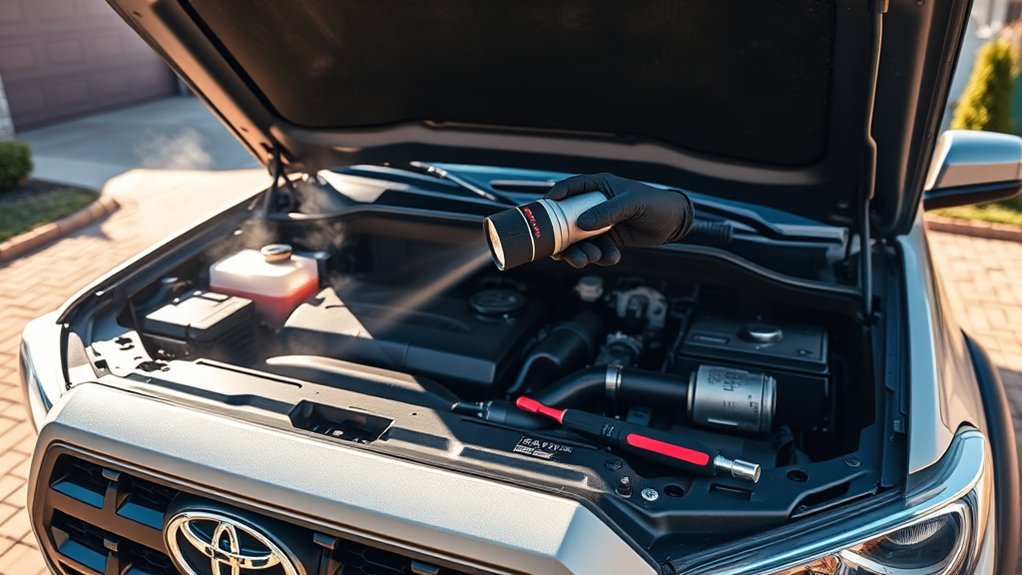
If your Toyota Tacoma is overheating, treat it as a warning that the cooling system is no longer controlling engine temperature correctly. Low coolant, an external leak, a thermostat problem, restricted radiator airflow, a failing water pump, trapped air, fan problems, or an internal engine leak can all be responsible. The safest approach is to stop driving when the temperature warning appears, let the truck cool fully, and diagnose the system in a logical order instead of replacing parts at random.
Quick Answer
A Toyota Tacoma usually overheats because coolant is low or leaking, coolant is not circulating correctly, or the radiator cannot release enough heat. Stop driving if the temperature warning appears. Once the engine is completely cold, check coolant level, leaks, radiator airflow, fan operation, thermostat behavior, water-pump condition, and signs of an internal engine leak.
Key Takeaways
- Never remove a radiator or pressurized coolant-system cap while the engine is hot.
- A repeatedly dropping coolant level usually deserves leak testing rather than repeated topping-off.
- Overheating mainly at idle often points toward an airflow or fan problem; overheating under load can point toward coolant circulation, radiator capacity, or internal engine problems.
- Thermostat temperatures, bleeding procedures, fan strategies, and cooling-system layouts vary by Tacoma model year and engine.
- Use the coolant and maintenance interval specified for your exact Tacoma rather than relying on a universal color or mileage rule.
At a Glance
| Time Required | 15–30 minutes for basic cold-engine checks; longer for pressure testing, bleeding, or component diagnosis |
| Difficulty | Beginner for visual checks; intermediate to advanced for pressure, thermostat, pump, electrical, or internal-engine diagnosis |
| Tools Needed | Gloves, flashlight, correct coolant; optional OBD-II scanner, infrared thermometer, cooling-system pressure tester, and combustion-gas tester |
| Cost | Basic visual inspection costs little or nothing; testing equipment, coolant service, parts, and shop diagnosis vary by model and cause |
Warning: Never remove the radiator cap or another pressurized cooling-system cap while the engine is hot. Hot coolant and steam can escape under pressure and cause severe burns. If steam is coming from under the hood, keep clear until it has stopped and the vehicle has cooled.
Common Causes of Overheating in Your Tacoma
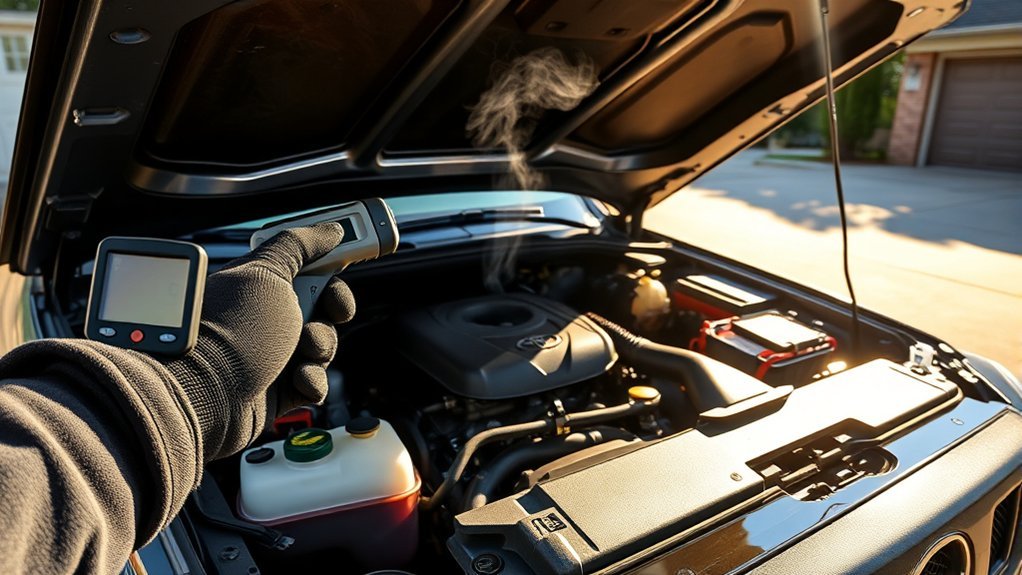
When a Toyota Tacoma overheats, begin with the basic jobs of the cooling system: holding coolant, circulating it through the engine, and moving heat through the radiator. A failure in any of those areas can raise engine temperature.
Common causes include:
- Low coolant or a coolant leak: Coolant can escape from hoses, clamps, the radiator, reservoir connections, water pump, heater core, gaskets, or other cooling-system components.
- Thermostat restriction: A thermostat that does not open correctly can reduce coolant flow to the radiator.
- Water-pump problems: A leaking pump, worn bearing, damaged impeller, or other pump problem can reduce coolant circulation.
- Radiator restriction: Internal deposits can reduce coolant flow, while dirt, bugs, bent fins, or debris can restrict airflow through the radiator and condenser.
- Cooling-fan or fan-clutch problems: Inadequate airflow becomes especially important during idling and low-speed driving.
- Air trapped after cooling-system service: Air pockets can interfere with circulation and cabin-heater performance if the system is not filled and bled according to the correct procedure.
- Faulty pressure control: A damaged cap or leak can prevent the cooling system from maintaining its designed pressure.
- Internal engine leakage: A failed head gasket, cracked cylinder head, or another internal problem can introduce combustion gas into the cooling system or allow coolant to enter the engine.
Note: Tacoma cooling systems differ by generation, engine, and hybrid/non-hybrid configuration. Use the Toyota owner-manual library to confirm procedures and specifications for your exact model year.
How to Recognize Overheating Symptoms in Your Tacoma
Recognizing an overheating problem early can reduce the chance of cylinder-head, gasket, oil, hose, or other engine damage. Watch for several clues rather than relying on one symptom.
- High temperature indication: The gauge may enter the hot or red area, or the truck may display a high-coolant-temperature warning.
- Loss of engine power: The engine may feel weak as temperature rises or the powertrain protects itself.
- Warning message: Newer Tacomas can display “Engine Coolant Temp High Stop in a Safe Place See Owner’s Manual”.
- Steam or coolant vapor: Steam from under the hood indicates an urgent cooling-system problem.
- Heater output suddenly becomes cold: Loss of cabin heat while the engine temperature rises can occur when coolant is very low or circulation through the heater core is interrupted.
Fluctuating temperature, repeated coolant loss, a sweet coolant odor, dried coolant residue, or puddles under the truck also deserve investigation.
What to Do if Your Tacoma Starts Overheating
- Move to a safe place as soon as practical and stop the vehicle.
- Turn off the air conditioning and follow any warning displayed on the instrument panel.
- If steam or coolant is escaping, shut the engine down and stay clear of the pressurized cooling system.
- Do not remove the radiator or coolant cap while the engine is hot.
- After the engine has completely cooled, inspect the coolant reservoir level and look for obvious leaks.
- If a large leak is present, the warning returns, coolant disappears rapidly, or the engine continues overheating, do not keep driving. Arrange repair or towing.
An overheating warning is not a maintenance reminder. It is a stop-and-diagnose condition because continued driving can turn a relatively small cooling-system fault into major engine damage.
Initial Diagnostic Steps to Identify Cooling Issues
Begin with checks that are safe, inexpensive, and likely to reveal the cause before replacing a thermostat, radiator, pump, or gasket.
Check Coolant Levels
Check coolant only after the engine is cold. The reservoir level should sit between its low and full markings. If it is low, use coolant that meets Toyota’s specification for your Tacoma.
Toyota’s current Tacoma documentation specifies Toyota Super Long Life Coolant or a compatible high-quality ethylene-glycol coolant using long-life hybrid organic acid technology. Do not use plain water as the normal fill.
A level that repeatedly falls after being topped up needs investigation. Look for wet areas, pink or whitish dried residue, stained hose connections, radiator seepage, or evidence around the water pump.
Pro Tip: Photograph the cold reservoir level after topping it up. Checking the same cold level over the next several drives can make a slow loss easier to confirm.
Inspect Cooling System
With the engine cold, inspect radiator hoses, hose joints, the reservoir, radiator seams, thermostat housing or water outlet, and the water-pump area. Check the radiator and condenser face for leaves, mud, insects, plastic bags, or damaged fins that restrict airflow.
If no external leak is obvious but coolant keeps disappearing, a cooling-system pressure test can expose small leaks that are difficult to see when the engine is cold. Pressure must be limited to the specification for the vehicle and test equipment.
Also inspect the cap and sealing surfaces for obvious damage. The cap is part of the pressure-control system, so a damaged seal or incorrect cap can contribute to cooling problems.
Check Cooling Fan Operation
Cooling-fan design varies across Tacoma generations. Some older Tacomas use an engine-driven fan and fluid coupling or fan clutch, while newer designs use electrically controlled cooling-fan hardware.
Look for damaged blades, a missing or damaged shroud, wiring problems, blown fuses where applicable, fan-motor failure, or a fan clutch that does not provide adequate airflow. Do not place hands, clothing, tools, or test leads near a fan that can start unexpectedly.
Test Thermostat Functionality
A thermostat stuck closed or partially restricted can reduce coolant flow and cause rapid temperature rise. A thermostat stuck open more commonly causes slow warm-up and weak heat rather than severe overheating.
If the thermostat is removed for testing, use a controlled container of water and an accurate thermometer. Heat the water gradually and compare the valve-opening behavior with the specification stamped on the thermostat or listed for your exact engine.
Do not assume that every Tacoma thermostat uses one opening temperature or one installation orientation. Those details vary by powertrain and generation.
Overheating at Idle vs. While Driving
The conditions under which the truck overheats can narrow the search significantly.
| Pattern | More Likely Areas to Check | Why |
|---|---|---|
| Hot mainly at idle or in slow traffic | Cooling fan, fan clutch, fan controller, shroud, radiator/condenser airflow | There is less natural airflow through the radiator at low vehicle speed. |
| Hot mainly on hills, towing, or highway load | Low coolant, radiator restriction, thermostat, water pump, internal engine leak | Higher engine load produces more heat and demands more cooling-system capacity. |
| Temperature rises soon after a coolant repair | Low fill level, trapped air, incorrect bleeding, leak | Opening the system can leave air pockets if the specified refill procedure is not followed. |
| Repeated overheating with unexplained coolant loss | Hidden external leak, heater core, head gasket, cylinder-head problem | Coolant may be escaping only under pressure or entering the engine internally. |
An OBD-II scan tool that displays engine coolant temperature can also help you see whether temperature rises steadily, spikes rapidly, or changes with vehicle speed and fan operation. Do not use scan-data numbers as a substitute for the specifications for your exact Tacoma.
[Amazon Products Picked for You]

Powerful Cooling System Cleaner: Thoro-Flush effectively removes rust, scale, grease, oil, and sludge from your vehicle’s cooling system, restoring optimal coolant flow and preventing overheating.

Design Engineering Radiator Relief Cooling System Flush is a powerful 16 oz treatment designed to clean and flush your engine’s cooling system, removing rust, scale, and deposits to improve radiator efficiency and overall cooling performance.

Clear Out Cooling System Buildup: Orion Motor Tech's coolant system flush gun combines compressed air and water flow to help remove rust, scale, sludge, and debris from radiators, heater cores, and cooling passages, helping coolant move more freely
The Importance of Regular Coolant Maintenance
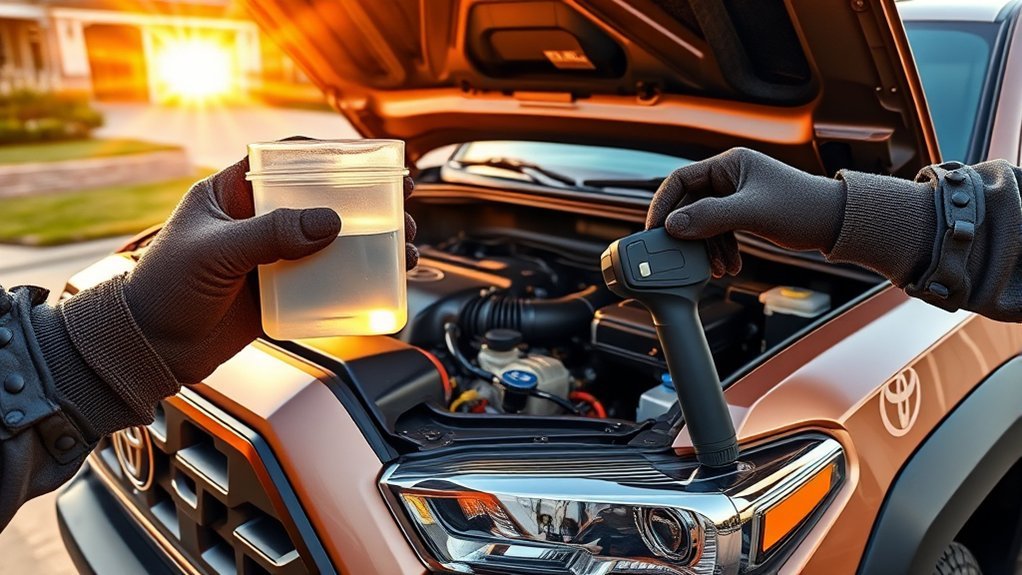
Coolant transfers heat, protects against freezing, lubricates compatible cooling-system components, and contains corrosion inhibitors. Old, contaminated, diluted, or incorrect coolant can reduce those protections.
Toyota specifies Toyota Super Long Life Coolant or a compatible coolant meeting the vehicle’s stated chemistry. Do not choose coolant by color alone because color is not an industry-wide specification.
Factory Toyota Super Long Life Coolant is sold premixed. Toyota documentation commonly identifies a 50% coolant/50% deionized-water premix for U.S. applications, while some Canadian applications use a different premix. Follow your exact owner’s manual and coolant-container instructions instead of adding water to premixed coolant by habit.
Inspect coolant level and condition during routine maintenance. If you see oil contamination, heavy deposits, recurring low level, or unexplained discoloration, diagnose the cause rather than simply flushing the system.
[Amazon Products Picked for You]

【THERMOSTAT REPLACEMENT】90916-A3003, 90916A3003, 90916-03129, 9091603129 Engine Thermostat For Toyota Is 100% Rigorously Tested Before Shipping. Check The Part Number To Confirm The Compatibility Before Purchase. High Quality Materials, Engine Thermostat Is Constructed Of Premium Material For Long Lasting Durability And Reliability. Direct Replacement, Easy Installation.

【Engine Coolant Thermostat Replacement】 9091603093,90916-03123. Check The Part Number Before Your Order, It saves you the time of buying back and forth, and also helps you save money.

AISIN OE matched engine coolant thermostats are designed for efficient, consistent performance
Flushing Your Cooling System
Cooling-system replacement intervals are model-specific. Do not use a universal 30,000-mile flush rule for every Tacoma. Toyota maintenance guides for many Tacoma applications specify a substantially longer initial engine-coolant interval, followed by shorter subsequent intervals.
For example, Toyota Tacoma maintenance guidance has commonly listed an initial engine-coolant replacement around 100,000 miles or 120 months, followed by replacement every 50,000 miles or 60 months. Always verify the schedule for your exact model year, engine, and hybrid/non-hybrid configuration in the Toyota Warranty & Maintenance Guide.
If the system is contaminated or a component has failed, service may be needed earlier than the normal interval.
A chemical radiator-cleaning product should only be used when its instructions and the vehicle service information allow it. Avoid mixing incompatible chemicals with Toyota coolant.
If a heater-core restriction is confirmed, disconnecting the heater hoses and backflushing can sometimes remove debris, but use low pressure and a model-appropriate procedure. Blasting a heater core with uncontrolled household-water pressure can damage an aging core or connection.
After draining or flushing, refill with the specified coolant and follow the correct bleeding procedure. Air left in the system can cause unstable temperature, low heater output, noise, or apparent coolant loss as trapped air works its way into the reservoir.
[Amazon Products Picked for You]

Long-lasting Performance: Made from premium materials, the belt kit offers excellent toughness and wear resistance, low transmission resistance, and good synchronization. Additionally, it undergoes rigorous pre-sale testing to guarantee its performance and quality before it reaches customers, ensuring a top-notch experience.

[Vehicle Fitment]: Compatible with 4Runner 1999-2002, T100 1995-1998, Tacoma 1999-2004, Tundra 2000-2004 --- [Fits DOHC Engine V6 3.4L Only]
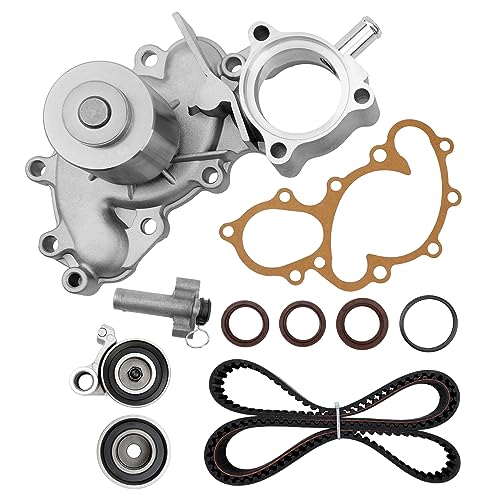
【REPLACEMENT】If you are experiencing the situations with unsmooth running, water overheating issues, leak coolant, having noise in engine, a failed pump might be the problem. Replacing Toyota timing belt kit is a safety measure that needs to be performed regularly to prevent engine damage before complete failure.
How to Test Your Thermostat for Proper Operation
A thermostat is designed to regulate coolant flow as the engine warms. Testing it outside the engine can help confirm whether the valve begins opening and reaches the required lift at the temperatures specified for that exact thermostat.
- Remove the thermostat only after the engine is fully cold and coolant has been safely drained as required.
- Place it in a container of water with an accurate thermometer without allowing it to rest directly on the hottest surface of the container.
- Heat the water gradually while watching the valve.
- Compare opening temperature and valve movement with the service specification for your engine.
- Replace the thermostat if it fails its specified opening, lift, or closing test.
Older Tacoma engines and later Tacoma engines can use different thermostat specifications, so a generic 180–200°F rule is not precise enough for diagnosis.
During installation, follow the model-specific gasket, torque, connector, and orientation instructions. Some older thermostats use a jiggle valve with a specified position, while later assemblies can use a different construction.
After installation, refill and bleed the cooling system exactly as specified and check for leaks.
How to Diagnose Water Pump Issues in Your Tacoma
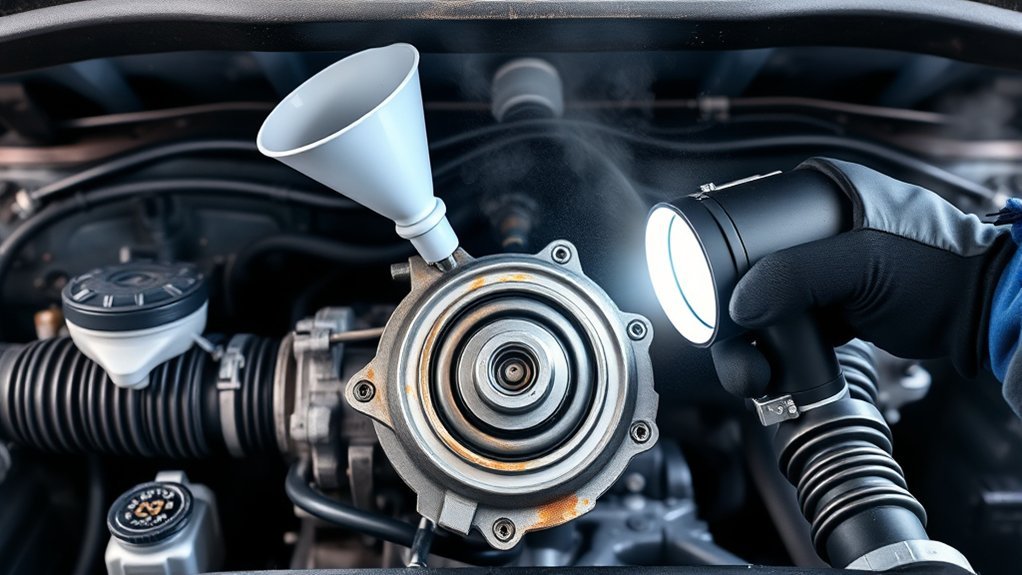
A water pump circulates coolant through the engine and radiator. A pump can fail through leakage, bearing wear, mechanical damage, electrical failure on applicable designs, or an impeller problem.
Signs of Water Pump Failure
- Coolant leakage: Look for fresh coolant, dried residue, or dripping around the pump and nearby components.
- Abnormal noise: Grinding, rumbling, or whining from the pump area can indicate bearing or drive problems.
- Poor circulation with overheating: If other causes have been eliminated, inadequate pump output can allow temperature to rise, especially as engine load increases.
Remember that a little dried residue does not always prove that the pump is currently leaking. Determine whether the area is actively wet and follow the inspection procedure for the exact pump design.
Testing Water Pump Functionality
Start with a cold-engine visual inspection. Check the pump area, drive belt where applicable, pulley or bearing condition, electrical connections on electrically driven pumps, and the surrounding area for coolant residue.
A cooling-system pressure test can help identify a leaking pump seal. On mechanically driven pumps, excessive bearing play or rough, noisy rotation can indicate failure.
Do not remove the radiator cap from a hot engine to watch coolant flow. If coolant-circulation testing is required, use the model-specific service procedure after the system is safe to open.
Monitor actual coolant temperature with a scan tool if available. Persistent overheating after verifying coolant level, thermostat operation, radiator condition, and airflow can strengthen the case for a circulation problem, but it does not prove that the pump is the cause.
Common Replacement Considerations
Before replacing a water pump, confirm that the symptom is not being caused by a coolant leak elsewhere, trapped air, a restricted radiator, a thermostat problem, or inadequate fan airflow.
Oil or sludge in the coolant is not a specific water-pump symptom. Contamination can come from an internal engine leak or another fluid-to-coolant heat exchanger depending on the vehicle configuration, so investigate the contamination separately.
When pump replacement is required, use the specified gasket or seal, tightening sequence, torque values, coolant, refill method, and bleeding procedure for the exact engine.
The Cooling Fan’s Role in Preventing Overheating
The radiator needs airflow to release heat. At highway speed, vehicle movement supplies much of that airflow. At idle or low speed, the cooling fan becomes far more important.
Tacoma fan systems vary by model year. Some older trucks use an engine-driven fan with a fluid coupling or fan clutch. Newer Tacoma designs use electrically controlled cooling-fan components. For that reason, there is no single “fan must turn on at 200°F” rule that applies to every Tacoma.
| Cooling Setup | What to Inspect | Possible Failure Clue |
|---|---|---|
| Mechanical fan / fan clutch on applicable older models | Fan clutch or fluid coupling, fan blades, shroud and drive system | Weak airflow or overheating mainly at low speed |
| Electric fan on applicable newer models | Fan motor, controller, fuse, wiring, commands and related sensors | Fan fails to run when the control system commands cooling |
| Radiator/condenser airflow | Debris, bent fins, mud, damaged shrouding or obstructed airflow | Temperature rises in traffic or with high heat load |
Because an electric fan can start unexpectedly, keep fingers, loose clothing, hair, and tools away from the fan whenever the engine or ignition system is active.
How to Know if Your Head Gasket Is Failing?
A head-gasket failure is one possible cause of persistent overheating, but symptoms alone do not prove the gasket has failed. According to Fel-Pro’s head-gasket technical guidance, common warning signs can include coolant loss without an obvious external leak, white exhaust vapor after the engine is fully warm, bubbling in the coolant reservoir, milky oil, overheating, and reduced power.
- Unexplained coolant loss: Coolant may enter a combustion chamber or another internal passage.
- Persistent bubbles or rapid pressure buildup: Combustion gas can enter the cooling system through an internal sealing failure.
- Milky oil or oily coolant: Fluid cross-contamination can occur, although condensation and other component failures can sometimes create similar symptoms.
- White exhaust vapor after warm-up: Coolant entering a cylinder may be burned as vapor.
- Misfire or rough running: Coolant or compression leakage can affect combustion.
A combustion-gas test can help identify exhaust gases in the cooling system. A technician may also use cooling-system pressure testing, cylinder leak-down testing, compression testing, spark-plug inspection, or other checks depending on the symptoms.
Note: A negative combustion-gas test does not rule out every possible head-gasket failure, and one symptom such as milky residue should not be used by itself to condemn the gasket.
When to Stop DIY Diagnosis
Arrange professional diagnosis or towing rather than continuing to drive if any of the following occurs:
- The temperature warning returns shortly after the truck cools.
- Steam or significant coolant loss is present.
- The reservoir becomes empty again quickly after being correctly filled.
- The engine misfires, knocks, loses substantial power, or runs poorly while overheating.
- Oil and coolant appear to be mixing.
- A pressure test reveals a leak that requires major disassembly.
- You cannot determine whether the cooling fan, thermostat, water pump, sensor, or control circuit is operating correctly.
Repeated overheating should never be treated as normal. Every overheating event adds thermal stress to the engine and cooling system.
Top Tips to Prevent Overheating in Your Tacoma
Preventing overheating starts with catching coolant loss and airflow problems before engine temperature rises.
- Check coolant level when the engine is cold. Investigate unexplained loss instead of repeatedly adding coolant.
- Use the correct coolant. Follow Toyota’s chemistry specification and the instructions for your market and model year rather than choosing by color alone.
- Follow Toyota’s maintenance interval. Do not automatically flush every 30,000 miles unless your specific service information calls for it.
- Keep the radiator and condenser clean. Remove external debris carefully without crushing the fins.
- Inspect hoses and connections. Look for swelling, cracking, abrasion, wetness, or dried coolant residue.
- Pay attention to low-speed overheating. It can be an early clue that radiator airflow or fan operation is inadequate.
- Use model-specific thermostat and bleeding procedures. Small procedural differences matter when air is being removed from the system.
- Respond quickly to warning messages. Stopping early can prevent a cooling-system fault from becoming an engine repair.
Frequently Asked Questions
What Are 10 Common Causes of Overheating on a Toyota?
Ten common causes are low coolant, an external coolant leak, a thermostat that does not open correctly, a failing water pump, a restricted radiator, blocked radiator airflow, a failed electric fan or fan controller, a weak mechanical fan clutch on applicable models, trapped air after cooling-system service, and an internal engine leak such as a failed head gasket.
Why Is My Toyota Tacoma Overheating?
Start with coolant level and leaks, then check radiator airflow and fan operation. If those are normal, investigate the thermostat, water pump, radiator restriction, trapped air, pressure control, and possible internal engine leakage. The conditions under which it overheats—idle, highway speed, hills, towing, or immediately after coolant service—can help narrow the cause.
How to Tell if It’s a Bad Thermostat or Water Pump?
A thermostat problem often changes how quickly coolant begins flowing to the radiator and can cause rapid overheating if it remains closed. A water-pump problem may produce coolant leakage, bearing noise, pulley problems, or poor circulation. Test the thermostat against its model-specific temperature specification and inspect the pump according to the service procedure instead of diagnosing either part from temperature alone.
How to Diagnose an Overheating Problem?
Let the engine cool completely. Check the reservoir level, inspect for leaks, examine radiator airflow, and verify the fan system. A pressure test can reveal hidden leaks. Next, evaluate thermostat operation, water-pump condition, trapped air, and scan-tool coolant-temperature data. If coolant disappears without an external leak or the cooling system becomes abnormally pressurized, test for an internal engine leak.
Can I Drive My Tacoma if It Is Overheating?
You should not continue normal driving with an overheating warning. Move to a safe place, follow the owner’s-manual warning procedure, and allow the truck to cool. Continued operation can warp components, damage gaskets, reduce oil protection, and turn a cooling-system repair into major engine damage.
Why Does My Tacoma Overheat at Idle but Cool Down While Driving?
That pattern often points toward inadequate radiator airflow. Check the electric fan and its controller on applicable models, or the mechanical fan clutch on models that use one. Also inspect the fan shroud and the radiator/condenser face for blockage. Road speed can temporarily hide an airflow problem by forcing more air through the radiator.
Conclusion
Toyota Tacoma overheating is best diagnosed systematically rather than by replacing the thermostat, pump, or radiator on a guess. Start with coolant level, visible leaks, radiator airflow, and fan operation after the engine has completely cooled. Then move to pressure testing, thermostat checks, water-pump diagnosis, bleeding, and internal-engine testing as the evidence requires.
Most importantly, never open a hot pressurized cooling system and do not continue driving a Tacoma that repeatedly shows an overheating warning. Use the specifications and procedures for your exact model year and powertrain so coolant type, thermostat testing, fan diagnosis, and refill procedures match the truck you are working on.
Sources
- Toyota 2024 Tacoma Owner’s Manual — Warning Messages — backs the high-coolant-temperature warning and stop-in-a-safe-place guidance.
- Toyota 2024 Tacoma Maintenance Data — backs Toyota coolant chemistry and cooling-system specifications.
- Toyota 2024 Tacoma Warranty & Maintenance Guide — model-specific maintenance reference.
- Toyota Genuine Super Long Life Coolant — Toyota’s official coolant product information.
- Fel-Pro — Signs of a Blown Head Gasket — backs common internal-leak and head-gasket warning signs.
