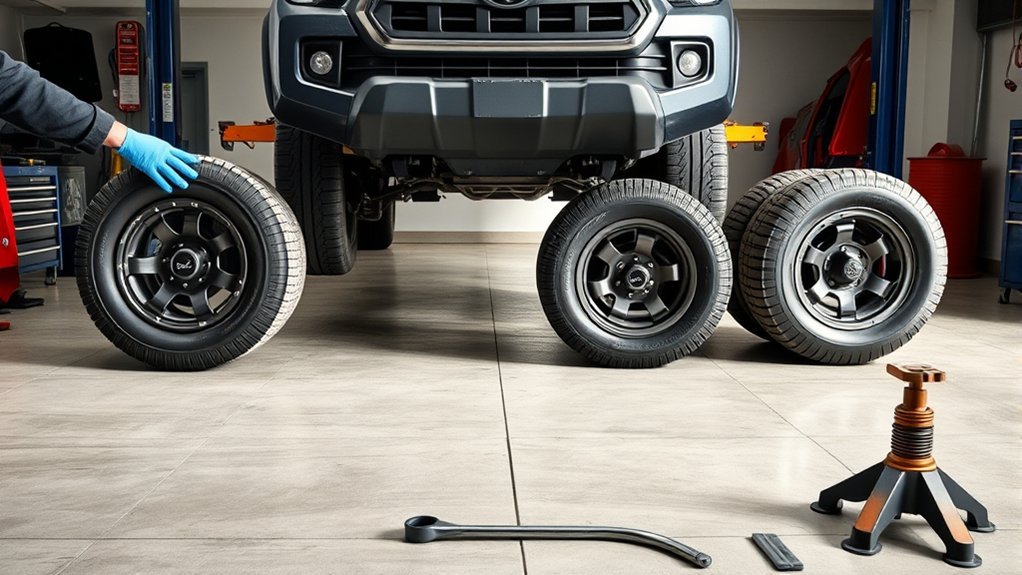
The correct Toyota Tacoma tire rotation pattern depends first on the owner’s manual for your exact model year, then on your tire directionality, front/rear sizing, and spare-wheel setup. For the 2024 Tacoma, Toyota’s manual shows a same-side front-to-rear rotation. For 2025, 2026, earlier years, or a different tire-and-wheel setup, confirm that model year’s diagram before moving any wheel.
Use a simple three-check rule before you start: verify the Toyota model-year pattern, confirm that all four wheel-and-tire assemblies can move to the intended positions, and review the required cold pressures, spare-tire restrictions, and TPMS procedure.
Quick Answer
For the 2024 Toyota Tacoma with four compatible tires, Toyota shows a straight same-side front-to-rear rotation: swap the left-front and left-rear assemblies, then swap the right-front and right-rear assemblies. For 2025, 2026, earlier model years, and modified tire or wheel setups, confirm the diagram in that exact model-year owner’s manual instead of relying on a generic 2WD or 4WD chart. Toyota’s 2025 Tacoma Hybrid maintenance guide schedules tire rotation at 5,000-mile service intervals, with scheduled maintenance every 5,000 miles or six months, whichever comes first.
Key Takeaways
- Use your Tacoma’s exact model-year owner’s manual before relying on a generic rear-wheel-drive or four-wheel-drive rotation pattern.
- The 2024 Tacoma owner’s manual shows a same-side, front-to-rear rotation rather than a generic rearward cross.
- Directional tires normally remain on the same side, while different front and rear tire or wheel sizes may prevent axle-to-axle rotation.
- Toyota’s 2025 Tacoma Hybrid maintenance chart includes tire rotation at each 5,000-mile service interval, with scheduled maintenance every six months for low-mileage drivers.
- After rotating, adjust cold pressure, tighten every wheel to the specification for your exact Tacoma, and complete any TPMS procedure required by that model year.
Last updated: September 19, 2026
At a Glance
| Time Required | Varies; allow enough time for safe lifting, tire inspection, wheel torque, pressure adjustment, and any required TPMS procedure |
| Difficulty | Moderate; safe lifting and accurate wheel torque are required |
| Tools Needed | Wheel chocks, approved jack, properly rated jack stands, lug wrench or breaker bar, torque wrench, tire-pressure gauge, tread-depth gauge, and chalk or wheel labels |
| Cost | No parts cost if you already own the required tools; professional-service pricing varies |
Understanding Tire Rotation and Its Importance for Your Tacoma
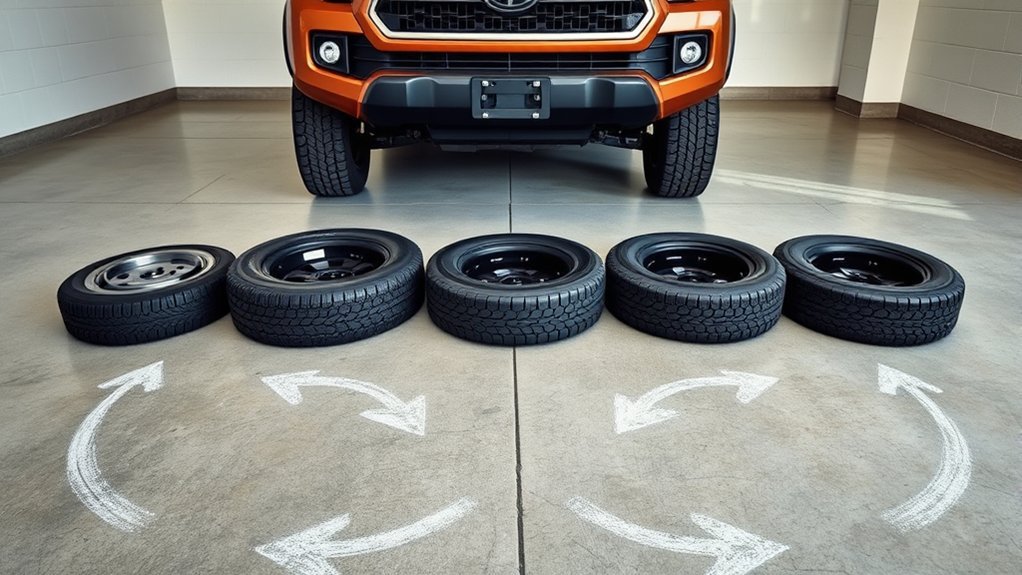
Tire rotation means moving complete wheel-and-tire assemblies to different positions on your Tacoma. Each position exposes a tire to different steering, braking, cornering, load, and drive forces. Periodic rotation helps distribute those normal differences more evenly.
Regular rotation may extend usable tread life and help keep handling more consistent. It also gives you an opportunity to inspect each tire for punctures, cracking, bulges, uneven tread, embedded objects, and wheel damage.
Toyota’s 2025 Tacoma Hybrid maintenance chart places tire rotation at each 5,000-mile service interval. The same guide says scheduled maintenance should be performed every 5,000 miles or six months, whichever comes first. The owner’s manual for your exact model year remains the controlling source for the movement pattern and model-specific procedures.
Rotation redistributes normal tread wear. It does not correct low pressure, misalignment, wheel imbalance, bent wheels, damaged tires, or worn steering and suspension parts.
Recommended Tire Rotation Pattern for the Toyota Tacoma
The correct pattern starts with your Tacoma’s exact model-year owner’s manual, not a general rule based only on two-wheel drive or four-wheel drive. The 2024 Tacoma manual shows a straight front-to-rear rotation in which each tire remains on the same side. For 2025, 2026, earlier model years, or modified tire-and-wheel setups, verify the diagram for that exact vehicle before service.
Use Toyota’s manuals and warranties portal to locate the guide for your exact model year and configuration.
| Tacoma or Tire Setup | Pattern to Use | Important Restriction |
| 2024 Tacoma with four compatible tires | Straight front-to-rear on the same side | Follow the owner’s-manual diagram and model-specific TPMS instructions |
| 2025 or 2026 Tacoma | Use that exact model-year Toyota diagram | Do not assume the 2024 diagram is unchanged without checking the applicable manual |
| Earlier Tacoma model year | Use that year’s Toyota diagram | Do not assume later-generation guidance applies |
| Directional tires | Normally front-to-rear on the same side | Do not reverse the direction-of-rotation arrow |
| Different front and rear tire or wheel sizes | Side-to-side only if permitted, or no rotation | Front and rear assemblies may not be interchangeable |
| Matching, non-directional full-size spare | Five-tire pattern only when Toyota and the tire maker permit it | The spare must match the installed tires and wheel specifications |
| Temporary-use spare | Do not include it | Temporary spares are not normal service tires |
[Amazon Products Picked for You]
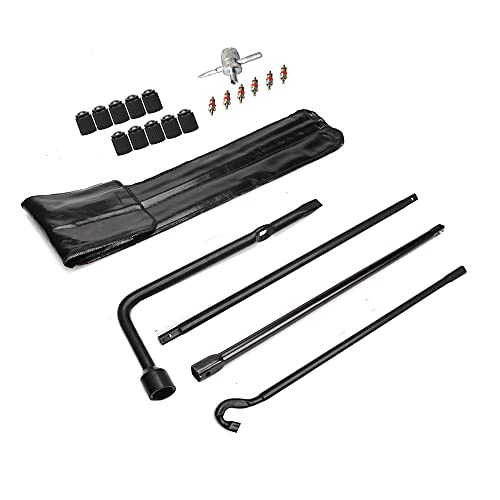
Premium OEM Upgraded Quality Spare tire tool: Stable strong rustproof automotive grade steel,tubing instead of soil designed made it more light,not only stong but also convenient.
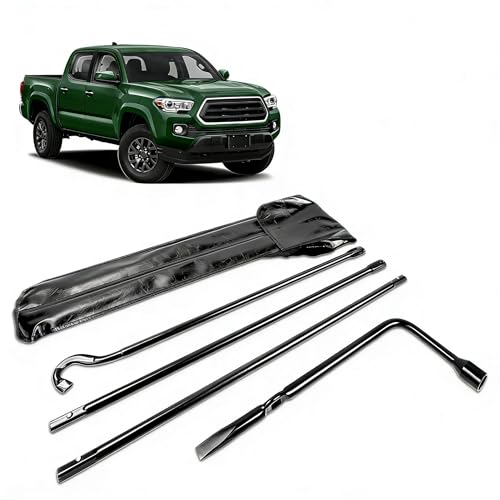
【Applicable Models】:Compatible with 2005-2022 Tacoma

Durable construction - made of tough, durable materials and coated with corrosion-resistant finish,and material testing to ensure a quality fit and long service life
Front-To-Back Rotation Method
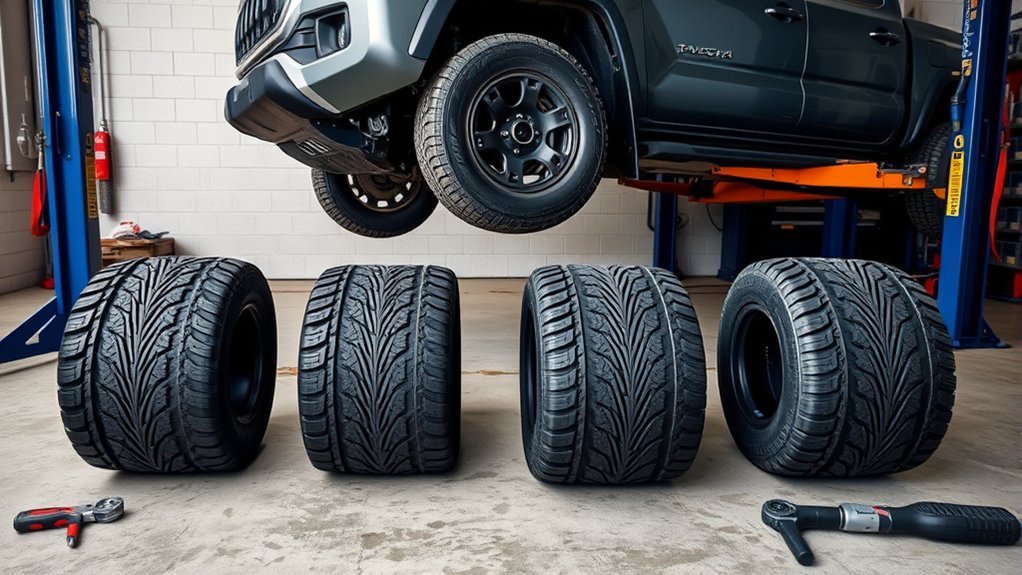
In a straight front-to-back rotation, the left-front and left-rear tires exchange positions. The right-front and right-rear tires also exchange positions. No tire crosses to the opposite side.
- Left front moves to left rear.
- Left rear moves to left front.
- Right front moves to right rear.
- Right rear moves to right front.
This pattern is compatible with same-size directional tires because each tire continues rolling in its intended direction. It is also the pattern shown in the 2024 Tacoma owner’s-manual guidance cited for this article.
When Can a Tacoma Use a Cross-Rotation Pattern?
A cross pattern changes both the axle and side on which a tire operates. It should be used only when the Tacoma owner’s manual, tire construction, wheel sizes, and tire manufacturer all permit that movement. Do not choose a cross pattern solely because the truck is rear-wheel drive or four-wheel drive.
A rearward cross moves the rear tires straight to the front and crosses the front tires to the opposite rear corners. A forward cross moves the front tires straight back and crosses the rear tires to the opposite front corners. An X-pattern moves every tire diagonally.
Note: A generic rearward-cross or X-pattern chart does not override Toyota’s model-specific instructions. Use a cross pattern only when the applicable Tacoma manual and the installed tire-and-wheel setup permit it.
How to Rotate Toyota Tacoma Tires Safely
Before lifting your Tacoma, confirm the required pattern and inspect each sidewall for a direction-of-rotation arrow, “Outside” marking, size, load index, and other fitment information. Stop if the front and rear assemblies are not interchangeable.
[Amazon Products Picked for You]

Pair of 3 Ton (2.7 metric Ton) jack stands with 6,000-pound capacity

Lightweight jack stands are used to support your vehicle after lifting with a jack; Wide pyramid foot base provides added strength and stable support
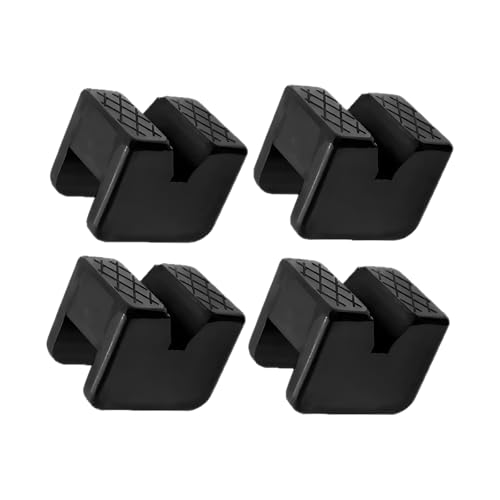
High Quality Material: This product is crafted from high-quality rubber. The rubber material offers good wear resistance and ageing resistance, reduce the possibly of cracking or deformation from prolonged use. Additionally, the rubber's anti-slip properties enhance friction between the jack and vehicle body, improving stability during lifting operations and reducing the likelihood of slippage, thereby adding an extra layer of operational safety.
60-Second Pre-Rotation Check
- Model year: Open the Toyota owner’s manual for the exact year and confirm its rotation diagram.
- Tire size: Confirm that the front and rear assemblies are the same size before planning an axle-to-axle swap.
- Tread direction: Look for a directional arrow or other sidewall mounting instruction.
- Spare: Include a spare only when it is a compatible full-size assembly and the applicable guidance permits a five-tire pattern.
- Pressure: Note the cold front and rear pressures on the driver-side Tire and Loading Information label.
- TPMS: Check whether your model requires initialization or wheel-position relearning after the tires move.
Warning: Never work beneath or beside a raised Tacoma supported only by its emergency jack. Park on firm, level ground and support the truck with properly rated jack stands at the lift and support points specified in your owner’s manual.
Step-by-Step Tire Rotation
- Confirm the pattern. Use Toyota’s diagram for your exact model year. For a 2024 Tacoma with four compatible tires, the cited Toyota guidance shows a same-side front-to-rear swap. For other model years, confirm that year’s diagram before continuing.
- Prepare the truck. Park on firm, level pavement. Shift into Park or first gear, apply the parking brake, turn off the engine, and chock the wheels that will remain on the ground.
- Mark each position. Label the wheels LF, RF, LR, and RR with chalk or removable tape. This prevents mistakes and gives you a useful rotation record.
- Loosen the wheel nuts. Break each nut loose slightly while the tire is still touching the ground. Do not fully remove the nuts at this stage.
- Raise and support the Tacoma. Follow the model-specific jack-positioning instructions in the Toyota owner’s manual. Place properly rated jack stands before removing a wheel.
- Remove and inspect each assembly. Check the tread, sidewall, valve stem, wheel, and mounting surface. Look for punctures, bulges, cuts, cracking, exposed cords, cupping, one-sided wear, or loose components.
- Move the tires to their new positions. Follow the confirmed diagram without reversing a directional tire or placing an incompatible wheel on the wrong axle.
- Install the wheel nuts by hand. Start each nut by hand to avoid cross-threading. Snug them gradually in a crisscross or star sequence.
- Lower and torque the wheels. Lower the truck until the tires cannot spin, then tighten the nuts in a star pattern to the specification listed for your exact model year and wheel setup. Do not guess the torque or rely on an impact wrench for final tightening.
- Set cold tire pressure. Adjust each tire to the pressure shown on the driver-side Tire and Loading Information label. Do not use the maximum pressure molded into the tire sidewall as the vehicle setting.
- Complete the TPMS procedure. If your model requires pressure initialization or wheel-position learning after rotation, follow the procedure in the owner’s manual or Multi-Information Display.
- Record the service. Note the date, mileage, measured tread depths, pattern used, and any wear concerns.
Pro Tip: Measure tread depth at the inner edge, center, and outer edge of every tire before moving it. Comparing those measurements can help reveal pressure, alignment, balance, or suspension problems that a rotation will not repair.
Why the Manual Matters More Than Crossing
When a cross pattern is permitted, moving a tire to both a different axle and a different side can redistribute some normal wear patterns across a set of compatible, non-directional, same-size tires.
Crossing is not automatically better for every Tacoma. The correct pattern is the one specified for the vehicle and permitted by the installed tires and wheels. Following a consistent, documented pattern also makes changes in tread wear easier to compare from one service to the next.
How to Know When to Rotate Your Tires?
Follow the maintenance interval for your exact model year. Toyota’s 2025 Tacoma Hybrid maintenance chart schedules tire rotation at 5,000-mile increments and tells low-mileage drivers to obtain scheduled maintenance every six months.
If wear is severe, strongly one-sided, cupped, or accompanied by pulling or vibration, diagnose the cause instead of treating another rotation as the solution. Rotate sooner or arrange an inspection when you first notice a developing difference between tire positions.
- One-sided shoulder wear: Possible alignment, steering, or suspension problem
- Wear on both shoulders: Possible underinflation or overloading
- Excessive center wear: Possible overinflation
- Cupping or scalloped dips: Possible imbalance, worn shocks, loose suspension parts, or wheel damage
- Feathered or saw-tooth edges: Possible toe-alignment issue or delayed rotation
- Steering-wheel vibration: Possible wheel imbalance, bent wheel, tire damage, or loose component
- Pulling on a level road: Possible alignment, pressure, brake, or tire-construction issue
Visible cords, a bulge, deep cracking, tread separation, or severe impact damage requires immediate professional inspection. Moving a damaged tire to another corner does not make it safe.
[Amazon Products Picked for You]

1. Accuracy: Accurately measure your tire tread depth in both inches and millimeters with depth gauge. Range: 0-25.4mm/0-1inch, Accuracy: 0.01mm/0.0005inch.

1.Accurate and Efficient: Different colors on the bar represents different scopes, the red range on bar: 0 - 3/ 32; Yellow range on bar: 3/ 32 - 6/ 32; Green range on bar: 6/ 32 - 32/ 32, allowing you easy and fast to read and calibrated

1. Accurately measures tire tread depth gauge, Calibrated from 0 to 1 inch in 1/32 inch
How Regular Tire Rotation Benefits Your Vehicle Performance
Rotation helps reduce the differences caused by steering, braking, cornering, acceleration, load, and road conditions. More uniform tread depth can support predictable handling across the tire set.
It may also help preserve tread life and maintain tire-related efficiency by limiting irregular wear. The result still depends on correct inflation, alignment, wheel balance, driving conditions, and the tire itself.
Every rotation also creates a scheduled inspection opportunity. Finding a nail, damaged valve stem, worn suspension part, or developing wear pattern early can prevent a small issue from becoming more expensive.
Debunking Common Tire Rotation Myths
- Myth: Every four-wheel-drive Tacoma should use a rearward cross.
Fact: Toyota’s model-specific diagram comes first. The 2024 Tacoma manual shows a same-side front-to-rear pattern; owners of other model years should verify the applicable manual rather than substitute a generic 4WD chart. - Myth: Crossing any modern radial tire is always safe.
Fact: Many non-directional tires can cross, but directional tires, staggered fitments, wheel offsets, and manufacturer instructions may restrict movement. - Myth: A rotation fixes vibration or pulling.
Fact: Rotation may change how a symptom feels, but imbalance, misalignment, tire damage, bent wheels, brakes, and suspension faults require diagnosis. - Myth: TPMS means manual pressure checks are unnecessary.
Fact: TPMS is a warning system, not a substitute for regular cold-pressure checks with a gauge. - Myth: Two new tires should always go on the front.
Fact: If only two tires are replaced, tire-industry guidance recommends placing the newer pair on the rear to support wet stability. On a four-wheel-drive Tacoma, also confirm allowable tread-depth or circumference differences before mixing new and worn tires.
What Toyota Recommends for Tire Maintenance
Toyota’s 2025 Tacoma Hybrid Warranty and Maintenance Guide schedules tire rotation at each 5,000-mile service interval. The guide also instructs owners to follow the rotation pattern in the owner’s manual and inspect the tires for damage and uneven wear during service.
The 2024 Tacoma Hybrid Owner’s Manual provides model-specific tire, TPMS, wheel, and lifting guidance. For a different powertrain or model year, locate the matching Toyota manual instead of assuming every Tacoma uses identical instructions.
After rotation, adjust the tires for their new positions if Toyota specifies different front and rear pressures. The driver-side Tire and Loading Information label provides the correct cold inflation values for the original tire setup.
Note: On models that display individual tire positions, rotation may require TPMS initialization or a relearning process. Set the cold pressures first, then follow the instructions for your instrument display and exact model year.
Tire Rotation Tips for Tacoma Owners
- Use the pattern shown in your exact model-year manual instead of choosing solely by drivetrain.
- Rotate at the scheduled interval even when the tread appears normal.
- Check pressure when the tires are cold and use the driver-side Tire and Loading Information label.
- Measure tread depth at several points across each tire.
- Keep all four installed tires compatible in size, type, load rating, and construction.
- Do not include a temporary-use spare in the rotation.
- Include a full-size spare only when it fully matches and the applicable vehicle and tire guidance permits a five-tire pattern.
- Have the alignment checked if the truck pulls, the steering wheel sits off-center, or one edge wears faster.
- Request balancing if you feel speed-related vibration or see cupping.
- Record the mileage and wheel positions after every service.
If you replace only two tires, USTMA replacement-tire guidance recommends placing the newer pair on the rear axle. On a four-wheel-drive Tacoma, also confirm Toyota’s allowable tire-size, tread-depth, or circumference differences before mixing new and worn tires.
Frequently Asked Questions
How should I rotate my Toyota Tacoma tires?
Follow the diagram in the owner’s manual for your exact model year. For the 2024 Tacoma with compatible tires, Toyota shows a straight same-side front-to-rear rotation. For other model years, verify that year’s Toyota diagram before moving the wheels.
What does Toyota recommend for tire rotation intervals?
Toyota’s 2025 Tacoma Hybrid maintenance chart schedules tire rotation at 5,000-mile service intervals. The guide also calls for scheduled maintenance every six months when the mileage interval has not been reached. Check the maintenance guide for your exact model year.
What tire rotation pattern should I use for a Tacoma 4×4?
Use Toyota’s model-year pattern rather than choosing a pattern solely because the Tacoma is a 4×4. Rearward cross and X-pattern rotations are generic options for some compatible setups, but they do not override the Toyota owner’s manual.
Does Toyota explain why it specifies a front-to-back pattern on the 2024 Tacoma?
The cited Toyota manual specifies the rotation movement but does not state a design rationale for choosing that pattern. A same-side front-to-rear swap is compatible with same-size directional tires because it preserves their rolling direction, but that compatibility point should not be treated as Toyota’s stated reason for the pattern.
Can I cross directional tires during a rotation?
Not while they remain mounted in the same orientation. A directional tire must continue rolling in the direction shown by its sidewall arrow, so it normally moves only between the front and rear positions on the same side.
Should I include the Tacoma’s spare tire in the rotation?
Include it only if it is a compatible full-size tire and wheel and the applicable Toyota and tire guidance permits a five-tire pattern. Never include a temporary-use spare, and do not mix a spare with incompatible size, load, construction, or directional specifications.
Do I need to reset TPMS after rotating Tacoma tires?
Some Tacoma configurations require tire-pressure initialization or position relearning after rotation. Adjust every tire to the specified cold pressure first, then follow the TPMS procedure in the owner’s manual or vehicle settings for your exact model year.
Sources
- 2024 Toyota Tacoma Hybrid Owner’s Manual — model-specific tire, TPMS, wheel, rotation, and lifting guidance
- 2025 Toyota Tacoma Hybrid Warranty and Maintenance Guide — 5,000-mile maintenance chart and tire-rotation requirement
- Toyota Maintenance Schedule — Toyota’s vehicle-specific maintenance lookup and interval guidance
- Toyota Tire Rotation Guide — general rotation guidance and instruction to follow vehicle-specific recommendations
- NHTSA TireWise — tire pressure, tread, rotation, alignment, balance, and TPMS safety information
- USTMA Care and Service of Passenger and Light Truck Tires — rotation patterns, tire restrictions, pressure adjustment, and spare-tire guidance
- USTMA Replacing Tires — replacement-tire compatibility and rear-axle placement guidance
Conclusion
For a 2024 Toyota Tacoma with four compatible tires, the cited Toyota guidance shows a same-side front-to-rear rotation rather than an automatic rearward cross. For a 2025, 2026, earlier-year, or modified Tacoma, check the owner’s manual for that exact vehicle before moving the wheels.
Rotate at the applicable maintenance interval, inspect every tire, support the truck safely, use the specified wheel-nut torque, and adjust cold pressure afterward. A correct rotation can help distribute normal wear, but abnormal wear, vibration, pulling, or visible tire damage calls for diagnosis rather than another rotation.
