
Regular tire rotation can help your Toyota Camry’s tires wear more evenly, but the correct interval and pattern depend on the model year, drivetrain, tire design, and wheel sizes. Rotation is preventive maintenance—not a cure for vibration, damaged tires, poor alignment, or tread that is already unsafe.
Quick Answer
Many recent Toyota Camrys call for tire rotation at the 5,000-mile or six-month maintenance visit, but your exact model-year guide takes priority. Same-size, non-directional tires on a front-wheel-drive Camry generally use a forward-cross pattern. Always confirm the pattern, tire pressures, lifting points, and wheel-nut torque in the owner’s manual.
Key Takeaways
- Check the maintenance guide for your exact Camry model year instead of relying on one universal mileage interval.
- Use a forward-cross pattern only when the tires are compatible, the same size, and not restricted to one direction of travel.
- Vibration, pulling, rapid pressure loss, severe wear, or poor wet grip should be diagnosed rather than treated with rotation alone.
- A safe DIY rotation requires approved lifting points, stable vehicle supports, wheel chocks, and a torque wrench.
- Record the mileage and inspect tread, sidewalls, wheels, pressure, and wear patterns every time the tires are moved.
What Is Tire Rotation and Why Is It Important for Your Toyota Camry?

Tire rotation means moving the tires to different wheel positions according to an approved pattern. The goal is to manage normal differences in tread wear between the front, rear, left, and right positions.
On a front-wheel-drive Camry, the front tires handle steering, much of the braking load, and the force that moves the car. They may therefore wear differently from the rear tires. Moving compatible tires at scheduled intervals can help the four tires develop more similar tread depths and wear patterns.
Toyota’s maintenance guidance also treats rotation as an inspection opportunity. When the tires are removed or repositioned, check the tread, sidewalls, valve stems, wheels, inflation pressures, and lug-nut seating surfaces. Toyota’s 2025 Camry Warranty & Maintenance Guide, for example, instructs owners to check for damage and uneven wear during rotation.
Rotation can manage normal position-related wear, but it cannot repair a damaged tire, correct wheel alignment, balance a wheel, or restore tread that has already worn away.
How Often Should You Rotate Toyota Camry Tires?
Use the maintenance schedule for your exact model year, trim, drivetrain, wheel package, and market. Toyota’s general maintenance information commonly mentions a range of about 5,000 to 8,000 miles, while many recent Camry maintenance charts list rotation at every 5,000-mile service interval.
For example, the 2025 Camry maintenance guide calls for scheduled maintenance every 5,000 miles or six months, whichever comes first, and lists tire rotation at each 5,000-mile interval. Older Camrys and replacement-tire warranties may use different wording, so the guide supplied with your vehicle remains the controlling source.
- Normal starting point for many recent Camrys: Every 5,000 miles or six months.
- Earlier inspection: If unusual wear, vibration, pulling, pressure loss, impact damage, or a steering change appears.
- Replacement tires: Follow the tire manufacturer’s interval when it is more restrictive than the vehicle schedule.
- Low-mileage vehicles: Follow the time interval in the maintenance guide rather than waiting indefinitely to reach the mileage limit.
Note: A generic mileage range is not a substitute for the maintenance guide. Toyota has produced many Camry generations with different drivetrains, wheels, tires, and service schedules.
Signs That Your Camry’s Tires Need Attention
It is better to rotate tires on schedule than to wait for a symptom. Once a strong wear pattern has developed, rotation may not reverse it. Some symptoms also point to problems that rotation cannot fix.
Uneven Tire Wear
Compare tread depth at several points across all four tires. A small front-to-rear difference may reflect normal use, but one-sided wear, cupping, feathering, flat spots, or rapid wear on one tire can indicate incorrect pressure, misalignment, imbalance, worn suspension parts, or tire damage.
Have the cause corrected before assuming rotation is the complete solution. Moving a tire with an unresolved wear problem can spread the symptom to another wheel position.
Steering-Wheel or Seat Vibration
Vibration is a reason for inspection, not proof that a rotation is due. Depending on when and where it occurs, the cause may include wheel imbalance, separated tire construction, an out-of-round tire, a bent wheel, packed debris, loose hardware, brake problems, suspension wear, or a wheel-bearing fault.
Reduced Traction or Longer Wet-Weather Stops
Rotation cannot restore worn tread. If a tire is at the treadwear indicators, has inadequate wet-weather performance, or contains cuts, bulges, exposed cords, or structural damage, it may need replacement. The National Highway Traffic Safety Administration’s tire-safety guidance recommends regular pressure and tread checks and replacement when tread reaches the minimum safe limit.
Pressure Loss or Visible Damage
Repeated pressure loss, a sidewall bubble, deep cracking, a puncture near the sidewall, exposed material, or impact damage requires prompt professional evaluation. Do not rotate a visibly unsafe tire to another position and continue driving.
Warning: Stop driving and obtain professional help if a tire has a bulge, exposed cords, severe cracking, rapid air loss, major impact damage, or tread separation. Rotation does not make a structurally damaged tire safe.
Choose the Correct Toyota Camry Tire Rotation Pattern
Do not select a pattern from drivetrain type alone. First confirm that all four tires are the same size and compatible with side-to-side movement. Check the owner’s manual, the tire sidewalls, and the tire manufacturer’s instructions.
Front-Wheel-Drive Camry With Same-Size, Non-Directional Tires
A common pattern is the forward cross:
- Move the left-front tire straight back to the left-rear position.
- Move the right-front tire straight back to the right-rear position.
- Move the left-rear tire diagonally to the right-front position.
- Move the right-rear tire diagonally to the left-front position.
This is the pattern shown for typical front-wheel-drive vehicles in the U.S. Tire Manufacturers Association Tire Care and Safety Guide. Your Camry’s manual or tire instructions may specify a different pattern.
Directional, Asymmetric, and Staggered Tires
- Directional tires: These have an arrow showing the required direction of rotation. They normally move front to rear on the same side unless they are removed from the wheels and remounted correctly.
- Asymmetric tires: These have an “inside” and “outside” orientation. Many can move side to side when properly mounted, but follow the tire manufacturer’s instructions.
- Staggered sizes: If the front and rear tires or wheels are different sizes, front-to-rear rotation may be prohibited. Side-to-side rotation may also be restricted by tire direction, wheel offset, or manufacturer instructions.
All-Wheel-Drive Camry
Follow the pattern in the exact AWD Camry owner’s manual. AWD systems can be sensitive to large tread-depth or circumference differences between tires, and the appropriate pattern may depend on tire type and wheel configuration. Do not assume that a rear-wheel-drive or generic AWD diagram applies to every Camry.
Should the Spare Tire Be Included?
Do not include a compact temporary spare in the rotation. A matching full-size spare may be included only when the vehicle and tire manufacturers provide a five-tire pattern and the spare matches the road tires in size, type, construction, and usable tread.
How to Rotate Tires on a Front-Wheel-Drive Toyota Camry
A home rotation is possible for an experienced owner with the right equipment and a safe support method. Because jack points, support locations, wheel-nut torque, TPMS functions, and underbody layouts vary by model year, keep the owner’s manual open throughout the procedure.
Tools Required for Rotation
- A properly rated floor jack or automotive lift
- Properly rated jack stands suitable for the vehicle and support locations
- Wheel chocks
- Correct-size wheel-nut socket and breaker bar
- Calibrated torque wrench
- Tire-pressure gauge and air source
- Tread-depth gauge
- Gloves, eye protection, and a light
- Owner’s manual and maintenance guide
At a Glance
| Time Required | About 45–75 minutes for a careful DIY rotation and inspection |
| Difficulty | Intermediate because the vehicle must be lifted and supported safely |
| Tools Needed | Floor jack or lift, approved stands, chocks, socket, breaker bar, torque wrench, pressure gauge, and tread gauge |
| Cost | No separate service charge if you already own suitable equipment; professional pricing varies and may be included with tire purchases or maintenance plans |
Warning: Never work under or place any part of your body beneath a vehicle supported only by a jack. Use level, solid ground, engage the parking brake, chock the wheels, and support the Camry only at locations approved for your exact model year. Obtain professional service if you cannot create a stable support arrangement.
Front Tire Positioning Method
For a forward-cross rotation on compatible FWD tires, move each front tire straight back on the same side. The left-front tire goes to the left rear, and the right-front tire goes to the right rear.
Rear Tire Positioning Method
Move the rear tires diagonally to the front. The left-rear tire goes to the right front, and the right-rear tire goes to the left front. Do not cross a directional tire unless it is being professionally removed from the wheel and remounted in the correct direction.
Step-by-Step DIY Tire Rotation
- Confirm the pattern. Verify the model-year instructions, tire sizes, directional arrows, inside/outside markings, wheel specifications, and whether a spare belongs in the rotation.
- Prepare the work area. Park on firm, level ground away from traffic. Shift to Park, turn off the vehicle, set the parking brake, remove passengers, and chock wheels that remain on the ground.
- Check the tires before lifting. Record tread depth and cold pressure at all four positions. Look for bulges, cuts, exposed cords, cracking, embedded objects, irregular wear, or a tire that is visibly low.
- Loosen the wheel nuts slightly. With the tire still touching the ground, loosen each nut only enough to break it free. Do not remove the nuts yet.
- Raise and support the vehicle. Follow the owner’s manual for the approved lifting and support points. Do not improvise with suspension parts, the battery enclosure, plastic shields, or unapproved underbody locations.
- Remove the wheels. Keep the nuts clean and organized. Mark the original wheel positions if that will help you follow the pattern and maintain service records.
- Inspect exposed components. Check the inner tread, wheel condition, valve stems, brake area, and visible suspension components. Stop if you find a damaged tire, loose part, fluid leak, severe brake wear, or abnormal wheel movement.
- Move each wheel to its new position. Follow the confirmed pattern without changing tire direction or placing a different-size wheel on the wrong axle.
- Install and hand-start every nut. Clean obvious dirt from the mating surfaces without applying lubricant unless Toyota specifically requires it. Thread each nut by hand to avoid cross-threading.
- Snug the nuts in a star pattern. Center the wheel by tightening opposite nuts gradually rather than fully tightening one nut at a time.
- Lower the vehicle correctly. Remove the stands and lower the Camry according to the jack or lift instructions.
- Apply final torque. Use a calibrated torque wrench and the wheel-nut specification for your exact model year and wheel. Do not guess or use an impact wrench as the final torque tool.
- Set cold tire pressure. Adjust each tire to the driver-door placard or owner’s-manual specification for its new position. Do not use the maximum pressure molded on the tire sidewall as the normal vehicle setting.
- Complete the final check. Remove all tools and chocks, confirm that the wheel nuts are installed, inspect the vehicle’s stance, and take a slow test drive while listening and feeling for anything abnormal.
Pro Tip: Write the mileage, date, tread depths, pressure readings, and rotation pattern on the service invoice or in a maintenance log. These records make wear trends easier to spot and may help support a future tire mileage-warranty claim.
Checks to Perform After Rotation
- Confirm that the tire-pressure warning light goes out after pressures are corrected and the vehicle is driven as directed by the manual.
- Follow any model-specific procedure for registering wheel positions if the Camry displays individual tire locations.
- Do not initialize or reset the tire-pressure system merely to hide a continuing low-pressure warning.
- Investigate new vibration, pulling, noise, steering changes, or a loose-wheel sensation immediately.
- Follow any wheel-nut recheck instruction supplied by Toyota, the wheel manufacturer, or the service provider.
Benefits of Regular Tire Rotations for Your Toyota Camry

Correctly timed rotation can help manage normal differences in wear among the four wheel positions. Its practical benefits include:
- More uniform tread wear: Compatible tires spend time in positions that place different loads on the tread.
- Potentially longer useful tire life: A set may remain serviceable longer when one position does not reach its wear limit far ahead of the others.
- More predictable handling: Similar tread depths can support more consistent behavior among the four tires, although rotation cannot compensate for unsafe tires.
- Earlier problem detection: Regular inspection can reveal punctures, pressure problems, alignment wear, sidewall damage, bent wheels, or suspension concerns.
- Better maintenance records: Documented rotations may be required for certain mileage or treadwear-warranty claims.
Balancing is not automatically part of every rotation. A technician may recommend balancing when vibration, uneven weight distribution, missing wheel weights, or other evidence of imbalance is found.
Consequences of Skipping Tire Rotations
Skipping scheduled rotations does not guarantee immediate tire failure, but it can allow position-related wear differences to grow. Possible consequences include:
- Earlier replacement of part or all of the set: One axle may reach its wear limit before the other tires have used their available tread.
- More noticeable road noise or vibration: Some irregular wear patterns become louder and harder to correct over time.
- Less consistent handling: Large differences in tread depth or wear pattern can affect how the tires respond, especially in wet conditions.
- Reduced warranty-claim support: A tire manufacturer may deny a mileage or treadwear claim when required rotation records are missing.
- Missed inspection opportunities: Damage, low pressure, or mechanical wear may go unnoticed longer.
Missing one rotation does not automatically cancel every tire warranty. Review the warranty supplied by the tire manufacturer and keep receipts or maintenance records showing dates, mileage, pressures, and rotation service.
Tire Rotation vs. Alignment vs. Balancing
| Service | What It Does | Common Reasons |
| Rotation | Moves compatible tires to different positions | Scheduled maintenance and management of normal position-related wear |
| Balancing | Corrects uneven rotating mass in a wheel-and-tire assembly | Speed-related vibration, lost wheel weights, or tire installation |
| Alignment | Adjusts wheel angles to vehicle specifications | Pulling, off-center steering, feathering, or one-sided tread wear |
| Tire replacement | Removes a worn, aged, or damaged tire from service | Minimum tread, structural damage, unrepairable puncture, severe cracking, or poor condition |
DIY vs. Professional Tire Rotation: Which Is Best for You?
The best choice depends on your tools, experience, physical ability, work area, wheel package, and confidence in safely supporting the vehicle.
[Amazon Products Picked for You]

🛠【Compact & Powerful】AOBEN cordless impact wrench gets size, weight and performance well balanced. The compact design and LED light make it easier to get in tight and dark places; the powerful motor can deliver 600 N.m(450 FT/LBS) of max torque in forward mode, and 800N.m inreverse, max 3500 IPM impact rate and max 2400 RPM rotation speed. Save your time and effort during work.

【Car Jack Capacity】Maximum lifting weight 2 Ton (4409 lbs),This Jack for Car Lifting Range from 4.33" (11cm) to 15.75"(40cm). The scissor lift jack provides a wider range to reach under low chassis sedans or elevate high-body SUVs effortlessly.

🚗2023 UPDATED FOR WIDER COMPATIBILITY: Specifically designed to work with most GM vehicles 2006-2023 (Chevy / Buick / GMC / Opel /Cadillac and more) equipped with 315/433 MHz. Your vehicle deserves the best tire pressure sensor reset tool.(It is not suitable for heavy trucks with more than 4 tires or vehicles with an external TPMS system.)Tip:Based on factory and customer-tested models shown in A+, please refer to the car model list to confirm compatibility with the VXDAS TPMS tool.
Cost Savings Considerations
A DIY rotation avoids a separate labor charge when you already own a suitable jack, stands, torque wrench, chocks, and measuring tools. Buying safe equipment solely for one rotation may cost more than professional service.
Professional pricing varies. Some tire retailers include lifetime rotations with a tire purchase, while dealership maintenance plans or service packages may cover scheduled rotations. Ask what the quoted service includes because rotation, balancing, alignment, repair, and TPMS diagnosis are separate operations unless the shop states otherwise.
Skill Level Requirements
DIY service is appropriate only when you can:
- Identify the exact tire pattern and restrictions
- Use the approved lift and support points
- Keep the vehicle stable with multiple wheels removed
- Recognize unsafe tread, sidewall, wheel, brake, or suspension conditions
- Use a torque wrench correctly
- Set pressure and follow any TPMS procedure
Choose professional service if the vehicle has wheel locks you cannot remove, directional or staggered tires you do not understand, damaged hardware, heavy corrosion, oversized aftermarket wheels, persistent vibration, abnormal wear, or no safe place to lift the car.
How Tire Rotation Supports Performance and Safety
Rotation supports performance by helping compatible tires maintain more similar tread depths and wear characteristics. This can contribute to predictable steering response, consistent road feel, and more even use of the tire set.
The safety value also comes from inspection. A technician or careful owner can catch low pressure, punctures, sidewall damage, loose or damaged hardware, unusual tread wear, and wheel problems before they become more serious.
Rotation does not guarantee traction or safety. Tire condition, tread depth, pressure, weather suitability, vehicle loading, alignment, balance, brakes, and suspension condition remain equally important.
Can I Rotate My Tires Myself?

Yes, an experienced owner can rotate Camry tires at home when the tires are eligible for rotation and the vehicle can be raised and supported at Toyota-approved points. The task is not simply a matter of swapping wheels with the emergency jack supplied for a roadside flat.
Use a proper service jack or lift, suitable stands, wheel chocks, and a calibrated torque wrench. Consult the manual before lifting because jack points and underbody components differ among gasoline, hybrid, front-wheel-drive, and all-wheel-drive Camrys.
Stop and use a professional service center if you cannot support the car securely, cannot identify the correct pattern, find damaged wheel studs or nuts, or discover irregular wear that requires diagnosis.
[Amazon Products Picked for You]

Pair of 3 Ton (2.7 metric Ton) jack stands with 6,000-pound capacity

Practical Design: Ergonomically designed with a 360° rotating head and positive/reverse buttons for quick directional switching, this jack ratchet wrench facilitates easy operation and quick tire changes in emergencies, making it a travel essential
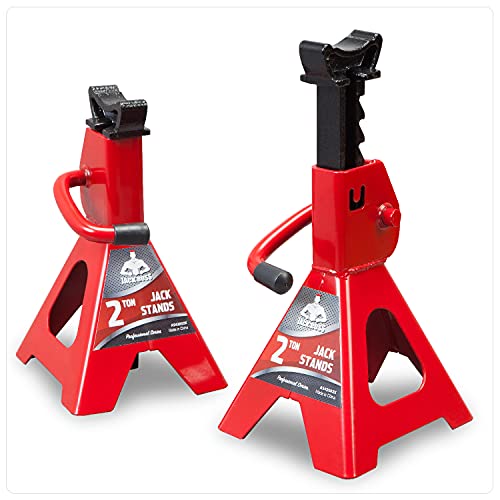
Specifications:2 ton (4,000 lb) capacity for single jack stand; Lifting range from min 9.8 " to max 15"; Net weight: 10.5 lb, which suitable for most 2 Ton Low profile autos, not recommendable for Pick-Up, Truck, too big SUVs etc. whose automobile chassis higher than 15".
Scheduling Your Tire Rotation at a Toyota Service Center
You do not have to use a dealership for routine tire rotation unless a particular maintenance plan or warranty arrangement requires it. A Toyota dealer or qualified tire shop should be able to perform the service and document the results.
- Check the exact interval. Look up the Camry’s model year in the owner’s manual, maintenance guide, or Toyota owner resources.
- Describe any symptoms. Mention vibration, pulling, pressure loss, impact damage, noise, or unusual wear so the shop does more than simply move the wheels.
- Confirm the work requested. Ask whether the service includes pressure adjustment, tread measurements, visual inspection, TPMS-position registration, or a torque recheck.
- Keep the invoice. Retain the date, mileage, tire positions, tread readings, and findings with the vehicle records.
Toyota states that scheduled maintenance is generally due every 5,000 miles or six months, but the exact service items are listed in the vehicle-specific guide. Toyota’s current general guidance is available through its scheduled-maintenance support page.
[Amazon Products Picked for You]

✿IMPORTANT NOTE: ❶ GM VEHICLES ONLY: ONLY for Chevrolet, GMC, Cadillac and Buick, Check Compability List before buying. NOT support Ford, Toyota, Nissan, Honda and other non-GM brands; ❷ SENSOR REQUIREMENTS: Optimized for OE/OEM sensors. Most aftermarket sensors can work BUT some may fail if their frequency or parameters do not match the OEM original. NOT for UNIVERSAL TPMS sensors.❸ Requires a 9V battery for operation BUT NOT included.❹NOTE: If one or some sensors can't be activated after multiple attempts (because they were dead, low power or damaged, not our tool's not work), please replace them with new sensors then try again.

STEEL-IRON TIRE SPOONS: Each tire lever is constructed of hardened steel-iron with curved tips that provides strong toughness and reliable durability.

Frequently Asked Questions
How often should I rotate my Toyota Camry tires?
Many recent Camrys list tire rotation at the 5,000-mile or six-month maintenance visit. The correct interval is the one in the maintenance guide for your exact model year. Replacement-tire instructions may require an earlier interval.
Does Toyota recommend rotation every 5,000 or 8,000 miles?
Toyota’s general consumer guidance uses a range of approximately 5,000 to 8,000 miles, while many model-specific Camry maintenance charts schedule rotation every 5,000 miles. Use the model-year maintenance guide rather than the broad general range.
What is the rotation pattern for a front-wheel-drive Toyota Camry?
For compatible, same-size, non-directional tires, a common forward-cross pattern moves the front tires straight back and crosses the rear tires to the opposite front positions. Directional, asymmetric, or staggered tires may require a different pattern.
Do AWD Camry tires use the same pattern as FWD tires?
Not necessarily. Follow the AWD Camry owner’s manual and tire instructions. The correct pattern depends on tire construction, wheel sizes, and model year, and AWD vehicles can be sensitive to large tread-depth differences.
Will rotating my tires fix steering-wheel vibration?
Not reliably. Vibration can come from imbalance, tire damage, a bent wheel, brake or suspension problems, or a wheel-bearing fault. Have the cause diagnosed instead of assuming rotation will correct it.
Do I need to reset the TPMS after rotating Camry tires?
It depends on the model year and TPMS display. Always set cold pressure to the driver-door placard. Some Camrys may automatically recognize wheel positions, while others may require a position-registration or initialization procedure described in the owner’s manual.
Can missing tire rotations void my warranty?
A missed rotation does not automatically void every tire warranty. However, a tire manufacturer may require documented rotations and inspections for a mileage or treadwear claim. Review the applicable warranty and keep service records.
Conclusion
For many Toyota Camrys, tire rotation belongs at the 5,000-mile or six-month maintenance visit, but the exact model-year schedule and tire instructions always take priority. Use the correct pattern for the tire design and wheel package, inspect the tires rather than merely moving them, and treat vibration or abnormal wear as a diagnostic issue.
A DIY rotation can be worthwhile when you have a safe lifting system, suitable tools, and the correct specifications. Otherwise, professional service is the safer choice. Whichever method you use, record the mileage, set the correct cold pressures, torque the wheel nuts to the model-specific specification, and investigate anything that feels abnormal after the service.
Sources
- Toyota 2025 Camry Warranty & Maintenance Guide — maintenance intervals, scheduled tire rotation, and inspection guidance.
- Toyota Scheduled Maintenance Support — Toyota’s general 5,000-mile or six-month maintenance guidance.
- Toyota Basic Car Maintenance Checklist — general tire-rotation interval and maintenance information.
- NHTSA TireWise — tire pressure, tread, inspection, rotation, and replacement safety information.
- U.S. Tire Manufacturers Association Tire Care and Safety Guide — standard rotation patterns and directional, staggered, inflation, and spare-tire restrictions.
- Toyota Tire Warranty Guide — tire service-record and rotation requirements associated with certain warranty claims.
