Last updated: September 22, 2026
How this guide was prepared: This is a source-based diagnostic guide cross-checked against Toyota’s current wheel-alignment guidance, Toyota T-SB-0063-20 for 2002–2021 model-year Toyota vehicles, the 2026 Camry Warranty and Maintenance Guide, NHTSA TireWise, and Michelin tire guidance. It does not claim hands-on testing or a universal Camry alignment interval.
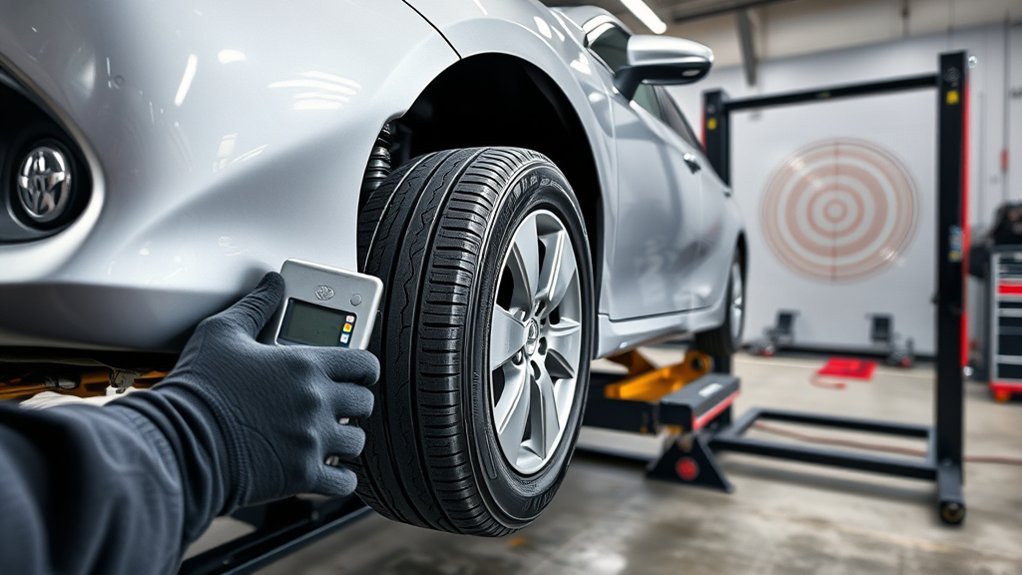
A Toyota Camry wheel alignment should be checked when the steering wheel remains off-center on a level road, the car repeatedly pulls after tire pressure is corrected, or one tire edge wears faster than the rest. Those signs do not prove the alignment is out of specification: road crown, tire conicity, wheel imbalance, brake drag, damaged tires, and worn steering or suspension parts can create similar behavior. Start with tire and safety checks, then use a professional alignment measurement before approving adjustments.
Quick Answer
Book an alignment measurement—not an automatic adjustment—if your Camry’s steering wheel stays crooked while the car travels straight, the vehicle consistently pulls on a level road after tire pressures are corrected, or one tire edge wears faster. Speed-related vibration more often points first to balance, tire damage, wheel runout, or worn parts, so inspect the whole tire, wheel, brake, steering, and suspension system before changing alignment settings.
Key Takeaways
- A crooked steering wheel, repeatable pulling on a level road, and one-sided tread wear are the strongest alignment clues.
- Speed-related vibration usually points first to wheel imbalance, tire damage, wheel runout, or worn suspension parts.
- Check cold tire pressure, tire size, visible damage, and tread wear before assuming your Camry needs an alignment.
- Toyota does not publish one universal alignment interval for every Camry; use symptoms, impacts, tire wear, and model-year service information as inspection triggers.
- For 2026 U.S. Camry models, Toyota lists wheel alignment and balancing coverage for 12 months or 12,000 miles when the condition qualifies under the New Vehicle Limited Warranty.
At a Glance
| Time Required | Basic tire and steering checks are quick; professional diagnosis and adjustment time varies with the condition found |
| Difficulty | Easy visual inspection; professional equipment is required to measure and adjust wheel angles |
| Tools Needed | Tire-pressure gauge, flashlight, and tread-depth gauge or small ruler |
| Cost | Varies by location, model year, measurements, and related repairs. As of September 3, 2026, RepairPal listed a U.S. Toyota Camry wheel-alignment estimate of $223–$326 before taxes, fees, location adjustments, and related repairs. |
Toyota Camry Wheel Alignment Symptoms to Check First
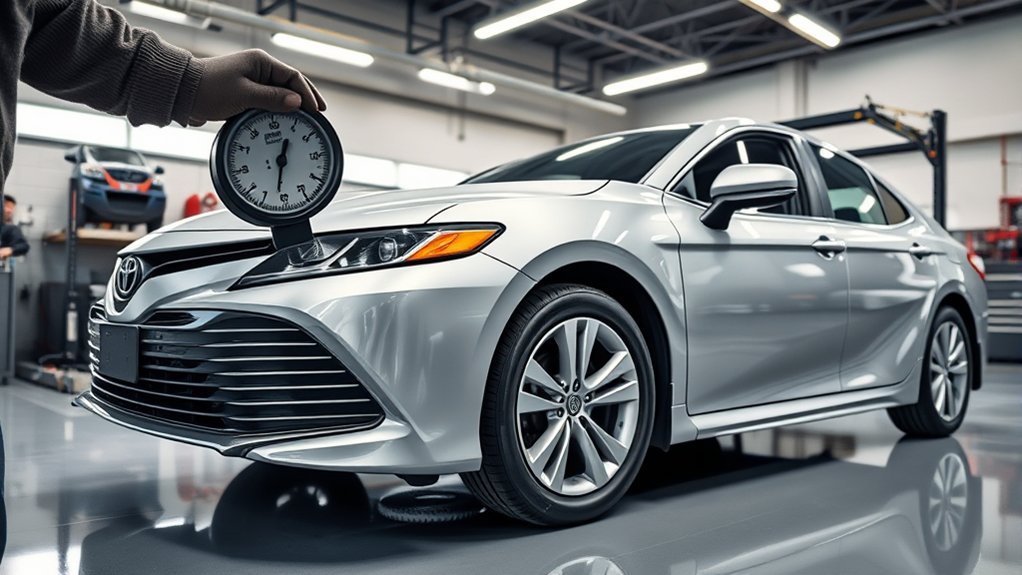
Wheel alignment describes the direction and angle at which the wheels sit relative to the vehicle and road. Toyota’s current wheel-alignment overview identifies caster, camber, and toe as the key angles and lists pulling, an off-center steering wheel, and uneven tire wear among common warning signs. A shop should measure the relevant angles against specifications for your Camry’s exact model year and configuration.
Off-Center Steering Wheel
Your steering wheel should appear close to centered when the Camry travels straight on a level road. A wheel that stays tilted left or right may indicate an alignment or steering-wheel-centering issue, especially after a curb strike, pothole impact, collision repair, suspension work, or tire replacement.
An off-center wheel does not always mean the car is pulling. Toyota’s T-SB-0063-20 vehicle-pull and alignment bulletin, which applies to 2002–2021 model-year Toyota vehicles, separates a vehicle that tracks straight with a crooked steering wheel from one that actually moves sideways. Use it as diagnostic background only for later Camrys; a technician should use the current repair information for your exact model year before making adjustments.
Vehicle Pulling to One Side
A Camry that repeatedly needs steering correction on a flat, straight road may have an alignment problem. A slight drift on one road does not confirm misalignment. Roads often slope for drainage, and that road crown can make a properly aligned car drift toward the lower side.
Tire construction, unequal tire pressure, brake drag, impact damage, worn steering parts, and suspension problems can also cause pulling. Toyota’s bulletin tells technicians to inspect those causes before changing alignment settings because an unnecessary adjustment can create new tire-wear problems. For a pull-specific diagnostic sequence, see Toyota Camry steering pulls to one side.
Uneven Tire Wear Patterns
Compare the inner, center, and outer tread across all four tires. Alignment-related wear often appears more heavily along an inner or outer edge, but tread shape alone cannot identify the exact cause.
- One-edge wear: May relate to camber or toe settings, worn parts, impact damage, or repeated hard cornering.
- Wear on both shoulders: Often points to low tire pressure or overloading.
- Center wear: Can occur when a tire runs overinflated for its load and use.
- Feathered tread blocks: Can indicate excessive toe, although worn joints or bushings may contribute.
- Cupping or scalloped patches: More often suggests imbalance, tire or wheel runout, weak dampers, or loose suspension components.
Tire rotation may even out normal wear, but it cannot correct an out-of-spec alignment angle or repair a worn component. Toyota’s 2026 Camry Warranty and Maintenance Guide tells owners to check tire pressure and inspect tires for damage and uneven wear.
Vibration at Speed
Do not treat vibration as proof of bad alignment. Steering-wheel shake at highway speed commonly points to wheel imbalance, while vibration through the seat or floor may involve a rear wheel, tire damage, wheel runout, or another rotating component. Michelin’s alignment and balancing guide explains that a vehicle can be aligned correctly and still vibrate because a wheel is out of balance. For a symptom-specific checklist, see Toyota Camry vibration at highway speed.
Squeaking, clunking, grinding, loose steering, or dashboard warning lights are not standard alignment indicators. They may point to a tire, brake, steering, suspension, tire-pressure monitoring, or electronic-system problem that needs separate diagnosis.
Warning: Stop driving and arrange an inspection if a tire has a bulge, exposed cords, rapid air loss, severe shaking, grinding, a sudden strong pull, or loss of steering control. An alignment will not repair a damaged tire or a failed steering, suspension, wheel, or brake component.
Alignment vs. Balancing: Which Service Matches the Symptom?
Alignment and balancing are different services. The following comparison can help you describe the problem accurately, but more than one fault can exist at the same time.
| Symptom | Likely First Check | Possible Service |
|---|---|---|
| Steering wheel stays crooked while driving straight | Road test, tire pressure, steering centering, wheel angles | Alignment or steering-wheel-centering correction |
| Consistent pull on a level road | Pressure, tire condition, road crown, brake drag, steering and suspension | Cause-specific repair; alignment only if measurements support it |
| Vibration that changes with speed | Balance, tire damage, wheel runout, loose or worn parts | Balancing or repair of the damaged component |
| Inner or outer edge wears faster | Tread-depth comparison, pressure, suspension inspection, alignment measurement | Alignment and any required steering or suspension repair |
[Amazon Products Picked for You]

【Caliper Removal Not Required】 Unlike traditional wheel alignment tools, our upgraded alignment tool eliminates the need for brake caliper removal. The inclusion of versatile extension pieces allows for direct and immediate use, streamlining the entire process for a truly efficient DIY experience.
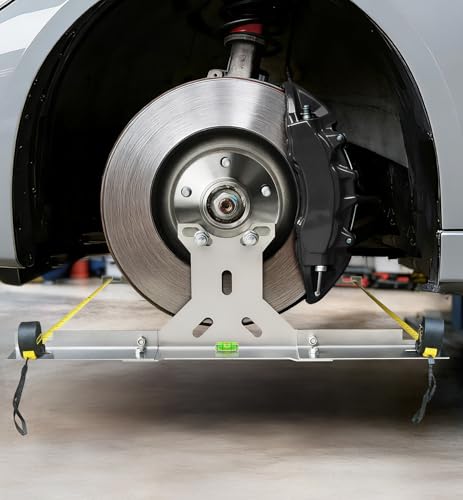
DIY front‑end toe adjustment for home garages - Designed for car owners and home garages who want tocheck front-end toe and assist with basic adjustments between professional visits. Use after minor suspension, steering, or tire work to verify toe settings and keep steering stable without a costly shop trip.

Precision Toe Angle Measurement: Please remove the tire first and then mount our wheel alignment tool on the wheel hub for toe angle measurement. This measurement method minimizes inaccuracies caused by tire bumps or sidewall inscriptions. Included two 5m tape measures with 1/32" increments, delivering high-accuracy measurement data.
What Can Mimic a Wheel-Alignment Problem?
Checking other causes first prevents unnecessary adjustments and helps the shop repair the real fault.
- Incorrect tire pressure: A low tire can increase drag on one side and change steering feel. Use the cold pressure on the driver’s door-jamb placard, not the maximum pressure molded into the tire sidewall.
- Road crown: Toyota T-SB-0063-20 describes most roadways as having about a 1–2% drainage slope. A mild pull that changes when you move to a lane sloped in the opposite direction may therefore be environmental rather than an alignment fault.
- Tire conicity: Small differences in tire shape can create a lateral force. A trained technician may confirm this by repositioning suitable tires and retesting.
- Wheel imbalance or runout: Imbalance commonly causes speed-related vibration without changing the alignment angles.
- Brake drag: A sticking brake can pull the car and requires prompt inspection, especially if one wheel becomes unusually hot or you smell overheated brakes.
- Worn or bent parts: Loose tie rods, damaged control arms, weak bushings, bent wheels, worn wheel bearings, or collision damage can affect tracking.
- Unequal tires: Mixed sizes, different tread depths, mismatched tire types, or incorrect wheel fitment can change how the Camry follows the road.
- Vehicle loading: A heavy or uneven load can change ride height and steering feel. Remove unusual cargo before comparing behavior.
Note: Fuel economy can change for many reasons, including tire pressure, temperature, traffic, speed, load, and driving style. A small MPG change by itself is not a reliable alignment test.
How to Check Your Camry Before Booking an Alignment
These checks can document symptoms, but they cannot confirm wheel angles. Park on a stable surface, set the parking brake, and do not crawl under the vehicle or loosen suspension parts.
[Amazon Products Picked for You]
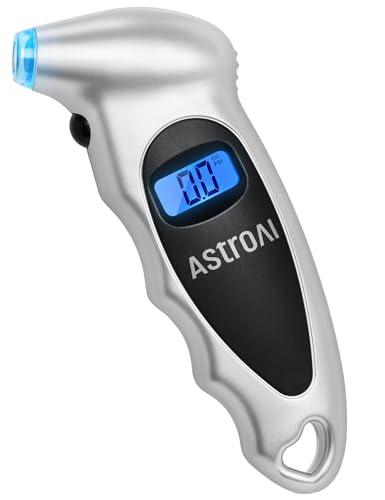
Accurate, Dependable Readings: Factory‑calibrated to ±1 PSI, so you can confidently match your vehicle’s recommended PSI (check the door jamb sticker). Ideal for monthly checks and road trips — consistent results every time, cold or warm.

RUGGED DESIGN: The stainless steel components prevent rust and corrosion while the precision-crafted nozzle seamlessly seals onto the valve stems for highly accurate readings (±2% span). We also provide 4 valve stem caps for convenient replacement.

PROCESS LEVEL ACCURACY: This heavy duty tire pressure gauge is calibrated manually to ANSI B40.1 Grade A (±1% of span)
1. Check Cold Tire Pressure
Park the Camry for at least three hours, then measure all four tires with a reliable gauge. Inflate them to the model-specific cold pressures shown on the driver’s door-jamb tire label. The NHTSA TireWise guide explains why you should use the vehicle label rather than the number on the tire sidewall.
Do not rely on the tire-pressure warning light as your only check. The system warns when pressure is already significantly low and does not prove that all tires are correctly matched.
2. Inspect the Tread and Tire Condition
Turn the steering wheel enough to view the front tire surfaces while the car is parked, switched off, and secured. Use a flashlight and compare several points across each tread. Look for an inner or outer edge that is visibly smoother, feathered tread blocks, cupping, cuts, punctures, bulges, exposed cords, or objects in the tread.
Measure tread depth at the inner, center, and outer grooves. A difference across the same tire gives the technician more useful information than a quick glance at one spot. NHTSA says tires should be replaced when tread reaches 2/32 inch.
3. Verify Tire and Wheel Match
Check that the tire sizes match the driver’s door label or your model-year owner’s manual and that paired tires use compatible types. Note any recent wheel change, tire replacement, repair, rotation, or seasonal swap. Mismatched dimensions, tread depths, or wheel fitment can imitate an alignment complaint. If the symptom started after changing wheels or tires, review Toyota Camry wheel and tire fitment before assuming the alignment is the only cause.
4. Observe Steering Behavior Safely
Choose a familiar, level road in good weather and keep both hands ready on the steering wheel. Notice whether the wheel remains off-center while the car tracks straight or whether the vehicle needs steady correction in the same direction. Compare more than one suitable road so a single crowned lane does not mislead you.
Do not release the wheel, perform a hands-off test in traffic, disable driver-assistance systems, or copy Toyota’s technician tire-swapping procedure at home. A controlled shop road test is safer and more repeatable.
5. Record Recent Events
Tell the shop about pothole or curb impacts, collision repairs, new tires, steering or suspension work, unusual loads, and when the symptom began. Also note the speed at which vibration starts and whether pulling changes during braking. These details help separate alignment from tire, brake, wheel, and suspension faults.
Pro Tip: Photograph each tire’s tread before service and ask for the before-and-after alignment printout. The printout should show measured angles, specification ranges, and the vehicle data used for your Camry’s model year.
When Should a Toyota Camry Alignment Be Checked?
Toyota’s 2026 Camry maintenance guide does not list a recurring wheel-alignment service interval. It does call for tire-pressure, damage, and uneven-wear checks. Guidance can differ by model year, tire design, road conditions, and repair history, so use your model-year manual and measured symptoms rather than an automatic mileage rule. Toyota provides a searchable owner’s manual and warranty library for model-specific information.
Ask for an alignment inspection when:
- The steering wheel remains off-center on more than one level road.
- The Camry consistently pulls after you correct tire pressures and remove unusual loads.
- The inner or outer tread wears faster than the rest of the tire.
- You hit a deep pothole, curb, or road debris hard enough to change steering feel or damage a wheel or tire.
- You install new tires and the old set showed irregular wear.
- A shop replaces steering or suspension parts that affect wheel angles.
- The car has collision or wheel-impact damage.
- A previous alignment did not center the steering wheel or stop the complaint.
You can also ask the technician to measure alignment during tire service if your driving includes frequent potholes or rough roads. A measurement is more useful than automatically paying for an adjustment when all angles already meet specification.
Check Warranty Coverage on a Newer Camry
For 2026 U.S. Camry models, Toyota’s New Vehicle Limited Warranty lists wheel alignment and wheel balancing coverage for 12 months or 12,000 miles, whichever comes first, when repairs or adjustments are needed to correct a covered defect. Normal wear, impact damage, misuse, and maintenance needs may not qualify. Check the warranty guide for your model year and ask the dealer to document the coverage decision before authorizing paid work.
What Should a Professional Camry Alignment Service Include?
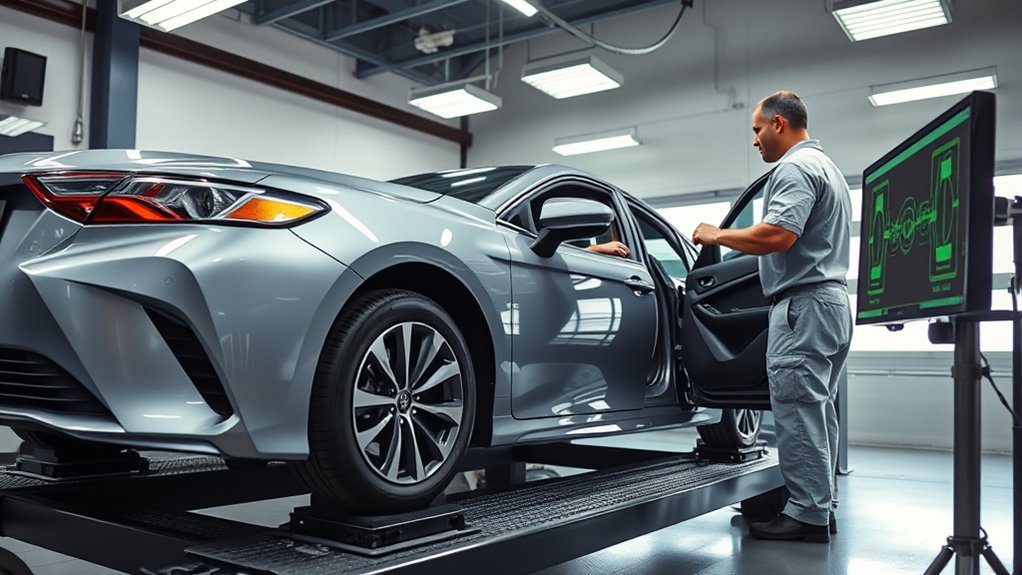
A qualified shop uses an alignment rack and calibrated sensors to measure wheel angles. The technician should inspect tires, wheels, steering, suspension, ride height, and related damage before adjusting anything. Alignment cannot safely compensate for a bent, loose, or worn part.
[Amazon Products Picked for You]

【Easy to Use DIY Front-end Toe Adjustment】Attach the toe plates to the brake rotor after removing the tire, in conjunction with digital angle finder, then hook dual tape measure to compare wheel distances directly. This mechanical design requires no complex calibration or electronics, lowering the skill threshold for DIY enthusiasts to perform quick and effective front-end adjustments

SAVE TIME & MONEY ON TOE CHECKS - Check toe-in and toe-out at home and make basic adjustments before seeking professional service, helping save time and reduce costly shop visits. Built-in tape-measure slots help keep the tape in place and reduce slipping during use.

Wide Compatibility:upgraded wheel alignment tool accommodates a wider range of vehicles, including models with low ground clearance or unique caliper bracket positioning.this wheel alignment kit suitable Car, Truck, SUV,ATV. wheel alignment tool can be used directly without removing the caliper.
Pre-Alignment Inspection
The shop should verify tire size and pressure, inspect tread and wheel condition, check for looseness or damage, confirm the complaint on a road test, and identify brake drag or tire-generated pull. If a component cannot hold an adjustment, it should be repaired before final alignment.
Toe, Camber, and Caster
- Toe describes whether the tires point slightly inward or outward when viewed from above. Incorrect toe can scrub the tread and create feathered wear.
- Camber describes the wheel’s inward or outward tilt when viewed from the front. Excessive camber or a large side-to-side difference can contribute to edge wear or pulling.
- Caster describes the steering-axis angle when viewed from the side. It affects straight-line stability and how the steering returns toward center.
The correct values depend on the Camry’s year, trim, suspension, tire and wheel configuration, and service specifications. Avoid a shop that uses a generic target without confirming the vehicle data.
Front-End Versus Four-Wheel Measurement
Ask the shop which procedure Toyota specifies for your exact Camry. Toyota T-SB-0063-20 discusses front-wheel alignment for its 2002–2021 applicability range and directs technicians to the applicable model-year repair manual because adjustment methods differ. For newer Camrys, use current model-year service information rather than assuming the older bulletin’s adjustment procedure applies. Many modern alignment racks measure all four wheels, which can reveal rear-angle or thrust-line concerns, but not every angle is adjustable on every model.
The goal is not to buy the service with the broadest label. It is to measure the relevant angles, repair damaged parts, use Toyota’s specifications, and center the steering wheel without forcing any setting outside its approved range.
Before-and-After Printout and Road Test
A good service should provide the starting measurements, final measurements, and specification ranges. The shop should then road-test the Camry and confirm that the steering wheel is centered and the original complaint has improved.
If the car still pulls while the measured angles remain within specification, the technician should investigate tire conicity, road crown, brake drag, wheel or tire damage, loading, or hidden structural damage instead of forcing the settings outside the approved range.
How to Read an Alignment Printout
Use the printout as a decision record, not just a red-or-green scorecard. Confirm that the vehicle selection matches your Camry’s model year and configuration, then compare the initial measurement, the final measurement, and the listed specification range for each angle the machine reports.
- Before: The angle measured when the car first went on the rack.
- After: The angle measured after any approved adjustment or repair.
- Specification range: The acceptable range loaded for the selected vehicle. Ask the shop to confirm the correct vehicle data if the result seems inconsistent.
- Still out of range: Ask whether that angle is adjustable on your Camry and whether worn, bent, shifted, or damaged parts are preventing correction.
A printout can document wheel angles, but it does not by itself prove which part caused the problem. The final road test and inspection still matter.
Questions to Ask Before Approving Service
- Did you inspect the tires, wheels, brakes, steering, and suspension before adjusting alignment?
- Which model-year specifications are you using?
- Which angles are out of range, and which are adjustable on this Camry?
- Are any parts bent, loose, or worn enough to prevent a lasting adjustment?
- Will I receive a before-and-after printout and a road test?
- Are balancing, rotation, repairs, or any required calibrations priced separately?
How Does Misalignment Affect Tire Wear and Fuel Efficiency?
Incorrect wheel angles can make a tire slide slightly instead of rolling squarely on the tread. That scrub concentrates wear on certain areas and can shorten useful tire life. NHTSA says a qualified technician’s wheel alignment helps maximize tire life and prevents veering on a straight, level road.
The clearest benefits of correct alignment are controlled tracking and more even tread wear—not a guaranteed percentage increase in tire life or fuel economy.
Misalignment may add rolling drag, but the real fuel effect varies with the severity of the problem, tire pressure, tire design, speed, road conditions, load, weather, and driving habits. Avoid fixed savings claims unless they come from a test that matches your vehicle and conditions.
Proper inflation remains one of the most direct tire-related fuel and safety checks. Alignment service will not correct an underinflated tire, and adding air will not correct an out-of-spec wheel angle.
How to Help Your Camry Stay Properly Aligned
- Slow down for potholes, speed bumps, and broken pavement when traffic allows.
- Avoid striking curbs while parking.
- Maintain the cold tire pressures listed on the door-jamb placard.
- Rotate tires according to your model-year manual and inspect tread and damage at each service.
- Replace worn steering or suspension parts before requesting final alignment adjustments.
- Use matching tire sizes and compatible tire types on the same axle.
- Request an alignment measurement after repairs that disturb steering or suspension geometry.
- Have a hard wheel impact inspected even when no warning light appears.
- Return to the shop if the steering wheel remains crooked or pulling continues after service.
Regular visual checks help you catch wear early, but you cannot confirm alignment by sight. Only calibrated equipment can compare the wheel angles with Toyota’s model-specific specifications.
Sources
- Toyota T-SB-0063-20: Vehicle Pull, Steering Wheel Off Center, and Alignment Best Practices — pull diagnosis, road crown, tire conicity, road testing, and alignment guidance for 2002–2021 model-year Toyota vehicles
- Toyota: Wheel Alignment & Why It Matters — current Toyota consumer guidance on caster, camber, toe, common symptoms, and alignment versus balancing
- NHTSA TireWise — cold tire pressure, tread checks, balancing, alignment, rotation, and tire safety guidance
- Toyota 2026 Camry Warranty and Maintenance Guide — tire inspection guidance and U.S. alignment and balancing warranty coverage
- Michelin: Wheel Alignment and Balancing Explained — differences between alignment and balancing and their common symptoms
- Toyota Manuals and Warranties — model-year-specific owner and warranty information
- RepairPal: Toyota Camry Wheel Alignment Cost — dated U.S. cost estimate used as a current benchmark
Frequently Asked Questions
What are the main signs of bad alignment on a Toyota Camry?
The strongest signs are a steering wheel that stays off-center while the car travels straight, consistent pulling on a level road, and rapid wear along an inner or outer tire edge. Confirm tire pressure and inspect for tire, brake, wheel, steering, and suspension problems before assuming alignment is the only cause.
How can you tell at home if your Camry may be out of alignment?
Check all four tire pressures when cold, compare tread depth across the inner, center, and outer grooves, verify matching tire sizes, and observe whether the steering wheel remains crooked or the car needs steady correction on more than one level road. These checks reveal symptoms, but only professional equipment can confirm wheel angles.
How much does a Toyota Camry alignment cost?
Prices vary by country, city, shop, model year, measured angles, and related repairs. As of September 3, 2026, RepairPal listed a U.S. Toyota Camry wheel-alignment estimate of $223–$326 before taxes, fees, location adjustments, and related repairs. Request a written estimate that separates alignment from balancing, tire rotation, replacement parts, and any calibration work.
How often should you get a wheel alignment on a Toyota Camry?
No single mileage interval fits every Camry and road condition. Check alignment when you notice steering or tread-wear symptoms, after a significant pothole or curb impact, after relevant steering or suspension repairs, or when installing tires after the old set developed irregular wear. Follow your model-year manual and service information.
Can you drive a Camry with bad alignment?
A mild, stable symptom may allow a careful trip to a repair shop, but continuing to drive can accelerate tire wear and make the car harder to control. Stop driving if the pull is sudden or severe, the steering feels loose, the car shakes heavily, a tire is damaged, or you hear grinding or other alarming noises.
Is vibration caused by alignment or wheel balance?
Speed-related vibration more often points to wheel imbalance, tire damage, wheel runout, or worn suspension components. Misalignment more commonly causes pulling, an off-center steering wheel, and uneven edge wear. A shop should inspect both systems because more than one problem can exist.
Does a Toyota Camry need a four-wheel alignment?
The correct procedure depends on the Camry’s model year and suspension design. Many shops measure all four wheels, but Toyota’s diagnostic and adjustment procedures may focus on specific front or rear angles. Ask the technician to use the exact model-year repair specifications and explain which angles were measured and adjusted.
Can tire pressure make a Camry pull to one side?
Yes. Unequal or low tire pressure can change rolling resistance and steering feel. Check all four tires cold and inflate them to the pressures on the driver’s door-jamb label. If the pull remains, have the tires, wheels, brakes, steering, suspension, and alignment inspected.
Should you get an alignment when installing new tires?
New tires should be balanced when installed. An alignment measurement is especially worthwhile if the old tires had edge wear, the steering wheel is off-center, the car pulls, or the vehicle recently hit a pothole or curb. Do not pay for an adjustment automatically if all measured angles are already within specification.
Is Toyota Camry wheel alignment covered under warranty?
Coverage depends on model year, country, mileage, time in service, and the cause. Toyota’s 2026 U.S. Camry guide lists wheel alignment and balancing coverage for 12 months or 12,000 miles, whichever comes first, when the work corrects a covered defect. Impact damage, normal wear, or maintenance needs may not qualify.
Conclusion
Watch for an off-center steering wheel, repeatable pulling on a level road, and uneven edge wear on your Camry’s tires. Start with cold tire-pressure, tire-match, and tread checks, but do not assume every vibration or drift means misalignment. A qualified technician should inspect the tires, wheels, brakes, steering, and suspension, measure the angles required for your exact model year, and use Toyota’s specifications before making adjustments. If the symptom remains after the basic checks, book an alignment measurement and ask for the before-and-after printout before authorizing additional work.
