
Toyota Camry wheel fitment is vehicle-specific: a wheel fits only when its diameter, width, bolt pattern, offset, center bore, load capacity, lug-seat design, brake clearance, TPMS setup, and tire size work for your exact year, trim, drivetrain, sales market, and brake package. Start with the driver-side Tire and Loading Information Label and the markings on an original wheel, then compare the candidate wheel against a vehicle-specific application guide before buying.
Last updated: September 11, 2026 — reviewed against Toyota model-year documentation and current NHTSA tire guidance.
Quick Answer
For a direct replacement, start with the original wheel-and-tire specification for your exact Camry. A matching diameter or bolt pattern alone is not enough: the wheel must also clear the brakes and suspension, center correctly on the hub, carry the required load, use compatible lug hardware, support the vehicle’s TPMS setup, and accept an approved tire size.
Key Takeaways
- Do not buy wheels based only on diameter or bolt pattern.
- Verify fitment for your Camry’s exact year, trim, drivetrain, market, and factory brake package.
- Use the driver-side Tire and Loading Information Label for the original tire size and recommended cold pressure.
- Match the wheel load rating, tire load index, tire dimensions, and lug-seat design to the application.
- Inspect used wheels and tires for structural damage, repairs, age, recalls, and mismatched specifications.
- Have uncertain aftermarket fitments test-fitted and installed by a qualified tire or wheel technician.
Fitment Decision: Pass All Four Checks
| 1. Identify the car | Match the exact model year, trim, drivetrain, sales market, factory brake package, and original tire placard. |
| 2. Match wheel geometry | Confirm diameter, width, bolt pattern, offset, center bore, and the wheel manufacturer’s vehicle application. |
| 3. Confirm load and clearance | Verify wheel load capacity plus brake, strut, suspension, steering, liner, and fender clearance at the front and rear. |
| 4. Match tire and hardware | Use an approved tire size and suitable load/speed rating, compatible lug-seat hardware, and the correct TPMS arrangement. If any item is uncertain, test-fit before mounting tires. |
Toyota Camry Wheel Fitment: Information to Collect Before Shopping
Start with the vehicle rather than a wheel advertisement. Record the Camry’s model year, trim, drivetrain, sales market, vehicle identification number, factory tire size, recommended cold pressure, and any factory wheel or brake package.
Next, inspect the back of an original wheel for its diameter, width, offset, manufacturer marking, and part number. If the car has been modified or the current wheels are not original, confirm the factory equipment through a Toyota parts department or service source using the VIN.
- Identify the exact Camry year, trim, drivetrain, market, and brake configuration.
- Record the tire size and cold pressure from the driver-side Tire and Loading Information Label.
- Read the size, offset, and part number from an original wheel when available.
- Obtain the candidate wheel’s complete specifications and vehicle application listing.
- Confirm an approved tire size, load index, speed rating, and TPMS arrangement.
- Test-fit the front and rear before mounting tires when the application is uncertain.
- Use compatible lug hardware and the correct vehicle-specific torque specification.
Pro Tip: Save a photo of the door-jamb label and the markings on the back of an original wheel. Those two records make it easier to compare listings without relying on memory or a seller’s assumptions.
What Wheel Size Fits a Toyota Camry?

A wheel’s advertised size normally includes its diameter and width, such as 18 × 8 inches. These dimensions describe the tire bead-seat area rather than the wheel’s full outside measurement.
Toyota Camry wheel sizes vary by generation, trim, market, and factory package. A diameter that fits one Camry may not clear the brake caliper on another. The wheel must also accept an approved tire size that preserves adequate load capacity and clearance.
For a current U.S.-market example, Toyota lists 16-inch alloy wheels on the 2026 Camry LE, 18-inch alloys on the SE and XLE, and 19-inch alloys on the Nightshade and XSE. These are trim-level factory diameter examples, not a universal interchange chart for older Camrys or vehicles sold in other markets. See the official 2026 Toyota Camry page for the current U.S. lineup.
2026 Toyota Camry Factory Wheel Size Example (U.S.)
| Trim | Toyota-Listed Standard Wheel |
|---|---|
| LE | 16-inch 10-spoke silver-painted alloy |
| SE | 18-inch multi-spoke black-finished alloy |
| Nightshade | 19-inch satin black-finished alloy |
| XLE | 18-inch two-tone machined and black-finished alloy |
| XSE | 19-inch smoked gray and black-finished alloy |
This table confirms factory wheel diameters for one U.S. model year; it does not establish wheel width, offset, center bore, brake clearance, lug hardware, or interchangeability with another Camry. Verify those separately before ordering.
Larger-diameter wheels normally use lower-profile tires to keep the complete tire’s outside diameter near the factory specification. This combination can produce quicker steering response, but it may also increase wheel weight, road noise, impact harshness, replacement cost, and the risk of pothole damage.
Smaller wheels with taller tire sidewalls may improve ride comfort and wheel protection. However, you cannot reduce the diameter unless the wheel clears the brakes and the resulting tire is approved for the vehicle.
Wheel diameter is only one part of fitment. Width, offset, center bore, brake clearance, load capacity, lug hardware, and tire dimensions must work together.
Toyota Camry Wheel Fitment Checklist
| Specification | What to Confirm |
|---|---|
| Diameter and width | The wheel accepts an approved tire and clears the brakes, suspension, steering components, and body. |
| Bolt pattern | The number of mounting holes and pitch-circle diameter match the vehicle exactly. |
| Offset | The complete wheel-and-tire assembly sits correctly without contacting the strut, suspension, liner, or fender. |
| Center bore | The wheel fits over the hub and uses the wheel manufacturer’s approved centering method. |
| Wheel load capacity | Each wheel is rated to carry the required share of the vehicle load. |
| Tire rating | The tire size, load index, speed rating, construction, and approved rim-width range suit the vehicle. |
| Lug hardware | Thread size, lug-seat shape, shank or washer design, length, and engagement match the wheel and hub. |
| Brake clearance | The barrel and spoke profile clear the caliper and other brake components. |
| TPMS | The wheel accepts compatible sensors, and the sensors can be registered or relearned when required. |
Fitment rule: Treat a candidate wheel as a “no” until every row in the checklist is confirmed. One matching specification never cancels a mismatch in another.
What Bolt Pattern Fits Your Toyota Camry?
Many recent U.S.-market Toyota Camrys are commonly cataloged with a five-lug 5 × 114.3 mm bolt pattern, also written as 5 × 4.5 inches. Treat that measurement as a starting point rather than a universal specification across every Camry generation, trim, market, or related Toyota model.
Confirm the pattern for your exact model year and trim through a vehicle-specific wheel catalog, Toyota parts department, service information, or a professional fitment database. A seller’s statement that a wheel “fits Toyota” or “came from a Camry” is not enough.
The first number in a bolt pattern is the number of mounting holes. The second is the diameter of the imaginary circle passing through the center of those holes. A 5 × 114.3 wheel therefore has five holes arranged on a 114.3 mm pitch circle.
Warning: Never force a wheel onto the studs, elongate its lug holes, or use wobble-style hardware unless the wheel and hardware manufacturers explicitly approve that exact application. A nearly matching bolt pattern is not a safe fit.
What Wheel Offset Does a Toyota Camry Need?
Wheel offset is the distance between the wheel’s centerline and its hub-mounting surface. It affects how far the wheel sits inward toward the suspension or outward toward the fender.
Offset is measured in millimeters and is commonly stamped on the back of the wheel with an “ET” marking. For example, ET45 indicates a positive 45 mm offset.
Understanding Wheel Offset Importance
A positive offset places the mounting surface closer to the wheel’s street-facing side. A lower positive offset moves the wheel farther outward, while a higher positive offset moves it farther inward.
No single offset range is safe for every Toyota Camry. The acceptable offset changes with wheel width, tire width, spoke design, brake shape, suspension geometry, and body clearance.
A wheel that is wider than the original may need a different numerical offset to keep its inner and outer edges in suitable positions. Comparing offset alone can therefore be misleading.
Impact on Vehicle Handling
A significant offset change can alter steering feel, scrub radius, wheel-bearing load, suspension clearance, and the likelihood of tire rubbing. It can also place the tire outside the fender or too close to the strut.
For a street-driven Camry, the safest approach is to remain close to the original wheel position or use a wheel documented for the exact vehicle application. Appearance should come after clearance, load capacity, and predictable handling.
Pro Tip: Ask the wheel supplier for the complete fitment, including diameter, width, offset, center bore, load rating, recommended tire size, lug hardware, and brake-clearance confirmation. A diameter-and-offset recommendation alone is incomplete.
What Center Bore Fits a Toyota Camry?
The center bore is the opening in the middle of the wheel. It must be large enough to fit over the Camry’s hub pilot and must use an approved method to keep the wheel centered during installation.
Do not assume that 73.1 mm is the Camry’s hub-bore specification. That measurement is used by some aftermarket wheels as a larger universal center opening. The vehicle’s hub size and the wheel’s center-bore size are separate measurements.
An original-equipment wheel normally has a center bore designed for its intended hub. An aftermarket wheel may have a larger opening and use a vehicle-specific hub-centric ring. Use rings only when the wheel manufacturer approves them for that wheel and vehicle.
A center bore that is smaller than the vehicle hub will not fit. A poorly centered wheel may cause vibration even when the tire is balanced correctly.
Note: Hub-centric rings help center a compatible aftermarket wheel during installation. They do not correct the wrong bolt pattern, offset, wheel width, load rating, brake clearance, or lug-seat design.
New vs. Used Toyota Camry Wheels: What You Need to Know
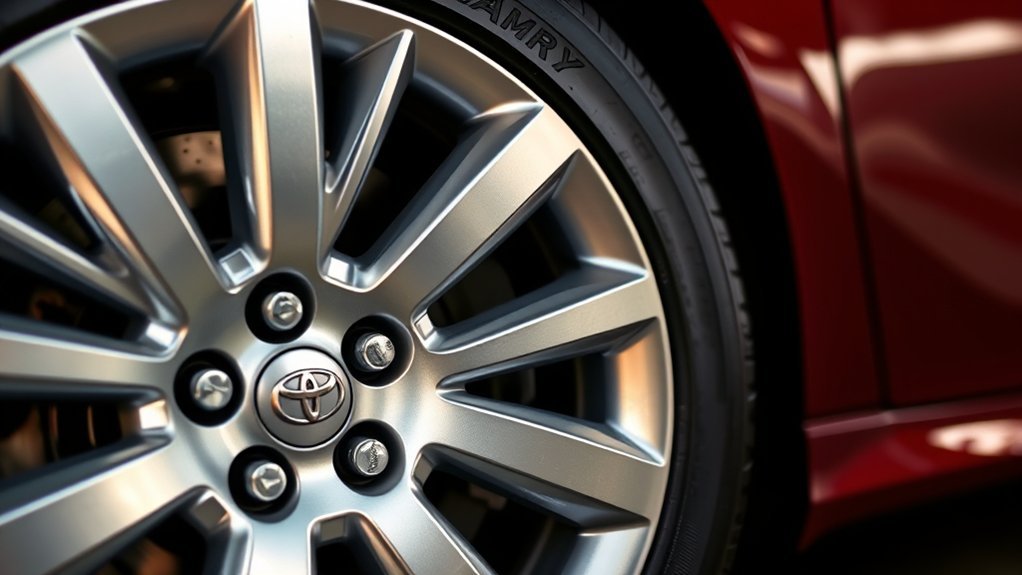
New wheels usually provide clearer fitment documentation, a known service history, and some form of manufacturer or seller warranty. They also give you more choices in finish, diameter, width, construction, and design.
Used wheels can reduce the purchase cost, but their condition matters more than their appearance. A wheel may look acceptable from the front while hiding a bent inner barrel, repaired crack, corrosion around the bead seat, or damaged lug holes.
Whether a wheel is steel, cast alloy, flow-formed, or forged does not determine compatibility by itself. The wheel still needs the correct dimensions, application approval, load rating, manufacturing quality, and compatible hardware.
| Factor | New Wheels | Used Wheels |
|---|---|---|
| Fitment records | Usually available from the manufacturer or retailer | May be incomplete or based only on the previous vehicle |
| Condition | Normally unused and easier to evaluate | Requires inspection for bends, cracks, repairs, corrosion, and damaged mounting surfaces |
| Warranty | May include structural or finish coverage | Often sold without meaningful coverage |
| Total cost | Affected by size, construction, finish, shipping, tires, sensors, and installation | May require straightening, refinishing, new sensors, replacement hardware, or replacement tires |
How to Inspect Used Camry Wheels
- Check the inner and outer barrel for cracks, flat spots, and bends.
- Look for welds, grinding marks, filler, or fresh paint hiding a repair.
- Inspect each lug hole for elongation, cracking, or damaged seating surfaces.
- Check the hub-mounting pad and center bore for damage or heavy corrosion.
- Check the bead-seat area for corrosion, impact damage, or material loss.
- Confirm the wheel’s stamped size, offset, part number, manufacturer, and load rating.
- Have the wheel spun on balancing equipment to check radial and lateral runout.
- Reject any wheel whose structural condition or repair history is uncertain.
How to Inspect Used Tires Sold With Wheels
A used wheel-and-tire package requires two separate inspections. A sound wheel does not make an old, damaged, recalled, or incorrectly sized tire safe.
- Confirm that all tires use an approved size, load index, speed rating, and construction.
- Read the Tire Identification Number and determine the manufacturing date.
- Search the tire brand, line, and size through the NHTSA recall database.
- Inspect the tread and sidewalls for cords, bulges, cracks, cuts, punctures, separations, and irregular wear.
- Ask where and how any puncture was repaired; reject questionable sidewall or shoulder repairs.
- Measure tread depth across several points rather than relying on the seller’s estimate.
- For AWD models, confirm that all four tires satisfy Toyota and tire-manufacturer requirements for size, construction, circumference, and remaining tread.
- Have a tire professional inspect any used tire whose age, storage history, repair history, or internal condition is uncertain.
How to Measure Your Current Wheels for Accurate Fitment
The most reliable starting point is the size and offset stamped or cast into the back of the existing wheel. You may see a marking such as “18 × 8J ET45,” along with a manufacturer name or part number.
Wheel diameter is measured across the bead-seat area where the tire mounts, not across the full outside edges of the rim. The outer-lip measurement will be larger than the advertised wheel diameter.
Wheel width is also measured between the inner bead seats rather than from the outer face of one lip to the other. Removing the tire provides the clearest access for a direct measurement.
A five-lug bolt pattern is difficult to confirm accurately with a simple edge-to-edge measurement because no two studs sit directly opposite each other. Use a bolt-pattern gauge, documented wheel specifications, or a professional fitment tool instead of estimating.
Offset is measured from the wheel centerline to the mounting pad. Calculating it accurately requires the true wheel width and backspacing, so reading the stamped ET value is usually easier and less prone to error.
Where to Find Your Camry Specifications
- The driver-side Tire and Loading Information Label
- The applicable Toyota owner’s manual
- The original wheel’s cast or stamped markings
- A Toyota parts department using the vehicle identification number
- A wheel manufacturer’s vehicle-specific application guide
- A qualified tire or wheel retailer’s professional fitment database
You can access Toyota’s model-year manual library through the Toyota Manuals and Warranties portal.
What Tire Size Fits Your Toyota Camry?
Use the tire size printed on the driver-side Tire and Loading Information Label as your primary reference. The label also provides the manufacturer’s recommended cold inflation pressure. For the pressure-setting procedure, see our Toyota Camry recommended tire pressure guide.
Do not use the maximum pressure molded into the tire sidewall as the normal inflation target. That number relates to the tire’s rated limits, while the vehicle placard lists the pressure Toyota selected for the vehicle’s load, ride, and handling requirements.
The National Highway Traffic Safety Administration recommends buying the original tire size or another size approved by the vehicle manufacturer.
Understanding a Tire Size
In a size such as 235/45R18, “235” is the nominal section width in millimeters, “45” is the sidewall height as a percentage of the width, “R” indicates radial construction, and “18” is the wheel diameter in inches. For a full sidewall-code breakdown, use our Toyota Camry tire-size decoding guide.
The tire manufacturer also specifies a permitted rim-width range for each tire size. A tire may share the correct wheel diameter yet still be unsuitable for a wheel that is too narrow or too wide.
Load Index, Speed Rating, and Wheel Load Capacity
The tire must carry a suitable load index and speed rating. Replacement tires should meet or exceed the vehicle manufacturer’s load requirement. Ask a qualified tire professional before reducing a speed rating, changing tire construction, or substituting a different load range.
The tire load index and wheel load rating are separate requirements. A high-capacity tire does not compensate for an under-rated wheel, and an adequately rated wheel does not compensate for a tire with insufficient load capacity.
An XL or reinforced marking does not automatically make a tire the correct choice. Its size, inflation requirements, load index, ride characteristics, and vehicle approval still need to suit the Camry.
Overall Diameter and Clearance
A replacement tire’s complete outside diameter affects ground clearance, fender clearance, speedometer accuracy, odometer readings, gearing, and driver-assistance calculations. A tire can fit the wheel yet still be unsuitable for the car.
Any alternative size should be part of a documented fitment that accounts for wheel width, load capacity, brake and body clearance, and overall diameter. Do not rely only on a generic percentage calculator or an online visualizer.
For an all-wheel-drive Camry, keep all four tires matched according to Toyota and tire-manufacturer requirements for approved size, construction, circumference, and remaining tread depth. Ask a qualified technician before replacing fewer than four tires when a significant difference may result.
Plus-Sizing Your Camry Wheels
Plus-sizing means increasing wheel diameter while selecting a lower-profile tire intended to preserve a suitable overall diameter and load capacity. A correct plus-size package must also protect brake clearance, suspension clearance, full-lock steering clearance, ride quality, and fender clearance under load.
There is no universal percentage rule that proves a package is safe. Two tires with similar calculated diameters can differ in actual measured dimensions, approved rim widths, load ratings, shoulder shape, and clearance. Use a documented vehicle application and test-fit uncertain combinations.
Note: A speedometer reading that appears close does not prove that the wheel clears the brakes, carries enough load, uses the correct lug seat, or remains clear of the body through steering and suspension movement.
TPMS Compatibility
Many Camry wheels use tire-pressure monitoring sensors mounted inside the wheel. Replacement wheels must accept compatible sensors without interfering with the valve stem or tire bead.
New sensors may need to be registered, programmed, or relearned. Sensor frequency, communication protocol, valve-stem design, and service-kit requirements can vary by vehicle and market.
A steadily illuminated TPMS warning commonly indicates that one or more tires are significantly underinflated. A warning that flashes for roughly 60–90 seconds and then remains illuminated can indicate a system or sensor malfunction on vehicles covered by the applicable federal standard. Check pressure with a gauge and have a persistent malfunction inspected. NHTSA explains both warning conditions in its TPMS guidance.
Which Tire Type Is Best for a Toyota Camry?

Your climate, local laws, road conditions, storage options, and driving needs should guide the tire category you choose.
All-Season Tires
All-season tires suit many drivers who encounter dry roads, rain, and occasional light winter conditions. They provide a practical balance of tread life, noise, comfort, and year-round usability.
However, an all-season label does not mean the tire performs like a dedicated winter tire on ice or in deep snow. Compare the tire’s actual intended conditions rather than relying only on a category name.
Winter Tires
Winter tires use tread patterns and compounds designed for cold weather, snow, slush, and ice. NHTSA notes that winter tires are more effective than all-season tires in deep snow.
Install winter tires as a complete set of four. Mixing substantially different seasonal tire types can create an unstable difference in front-to-rear grip, especially during braking or an emergency maneuver.
Confirm that the winter wheel package clears the brakes and uses an approved tire size, suitable load rating, compatible sensors, and correct hardware. A smaller winter wheel is acceptable only when the complete documented package fits the specific Camry.
Summer and Performance Tires
Summer tires can provide strong dry- and wet-road response in warm conditions. They are not designed for freezing temperatures, snow, or ice.
Performance tires may improve steering response and dry grip, but some models trade away tread life, cold-weather ability, ride comfort, noise, or rolling efficiency. Check the tire manufacturer’s intended temperature range and usage.
How Do You Install Aftermarket Camry Wheels Safely?
Before mounting tires, test-fit at least one front and one rear wheel. Front brake clearance is often the limiting factor, while rear suspension and fender clearance can differ.
Turn the steering from lock to lock and check the tire’s distance from the strut, spring perch, brake hose, wiring, liner, and fender. The vehicle should also be checked at normal ride height and through expected suspension movement and loading.
Use lug nuts that match the wheel’s required seat shape. Common seat styles include conical, ball, and flat or mag-style seats. The wrong seat can damage the wheel or prevent proper clamping even when the thread fits the stud.
Tighten the lug nuts in a crossing pattern with a calibrated torque wrench. Use the torque specification for the exact Camry model, wheel, and hardware setup. Do not rely on an impact wrench as the final tightening tool. For model-year examples and the verification method, see our Toyota Camry lug nut torque guide.
Wheel Spacers and Bolt-Pattern Adapters
A spacer moves the wheel outward and changes its effective position. A bolt-pattern adapter adds another set of mounting interfaces and may also change offset. Neither part should be used automatically to rescue a wheel with the wrong specifications.
Any spacer or adapter must be engineered and approved for the exact vehicle, wheel, hub, and hardware. It must preserve proper centering, thread engagement, clamping, load capacity, brake clearance, and body clearance. Local inspection, registration, or insurance rules may also apply.
Warning: Do not stack spacers, improvise longer hardware, grind brake components, or use an adapter to conceal an otherwise incompatible wheel. Have any spacer or adapter system evaluated and installed by a qualified professional.
Post-Installation Checks
- Set all tires to the vehicle’s specified cold pressure unless Toyota provides a different instruction for the approved package.
- Confirm that every lug nut is seated correctly and tightened to the required torque.
- Verify that TPMS sensors communicate normally and that no valve stem leaks.
- Turn the steering fully in both directions and inspect for contact.
- Drive slowly at first and listen for scraping, clicking, or other new noises.
- Increase speed gradually while checking for vibration, steering pull, or instability.
- Follow the vehicle, wheel, hardware, and installer instructions for any required fastener recheck.
Warning: Stop driving and have the installation inspected if you notice new vibration, scraping, steering pull, loose-lug symptoms, a flashing TPMS light, air loss, or contact between the tire and vehicle. Severe rubbing or loose hardware can cause tire failure or wheel separation.
How Do You Maintain Camry Wheels and Tires?
Regular pressure checks, rotation, balancing, alignment inspection, cleaning, and damage checks help protect your tires and wheels. They also make developing problems easier to identify before a roadside failure or ruined tire.
Regular Tire Rotation
Follow the rotation interval and pattern in the applicable Toyota maintenance guide. NHTSA notes that, when recommended by the vehicle manufacturer, tires are commonly rotated every 5,000 to 8,000 miles or sooner if irregular wear appears.
The correct pattern depends on tire direction, front-to-rear sizing, drivetrain, and whether a full-size spare is included. Directional tires normally remain on the same side unless they are removed from the wheels and remounted.
| Condition | Recommended Response |
|---|---|
| Normal, even wear | Continue the Toyota-recommended rotation schedule. |
| One edge wearing faster | Check alignment, pressure, suspension, wheel condition, and driving conditions. |
| Cupping or scalloped wear | Inspect balance, dampers, bearings, wheel runout, and suspension components. |
| Front and rear sizes differ | Follow the vehicle and tire manufacturer’s rotation limitations. |
Inspect Wheel Alignment
Have the alignment checked when the Camry pulls on a level road, the steering wheel sits off-center, the tires show irregular wear, or the vehicle has struck a pothole or curb.
Alignment should also be considered after suspension or steering repairs. An annual alignment is not automatically necessary for every vehicle, but periodic inspection can identify problems before a tire is ruined.
Balancing and alignment solve different issues. Balancing addresses uneven rotating mass and commonly helps with speed-related vibration. Alignment adjusts wheel angles and helps correct pulling or irregular wear.
Check Tire Pressure and Tread
Check all tires at least monthly when they are cold, meaning the vehicle has not been driven for at least three hours. Inflate them to the pressure on the vehicle placard unless Toyota provides another instruction for the specific load or approved tire setup.
Inspect the tread for exposed cords, cuts, bulges, punctures, cracking, and uneven wear. NHTSA states that tires should be replaced when tread depth reaches 2/32 inch, but drivers in frequent rain or snow may choose earlier replacement for better wet or winter performance.
Do not rely on TPMS as a substitute for monthly checks. The system is intended to warn of significant underinflation or a malfunction; it does not inspect tread, age, cuts, bulges, wheel damage, or gradual irregular wear.
Check Tire Age and Recalls
Tires can deteriorate from service, storage, heat, sunlight, underinflation, overloading, and time. Read the Tire Identification Number, follow the tire and vehicle manufacturers’ inspection and replacement guidance, and have an older or questionable tire evaluated professionally.
Check for recalls when buying used tires and periodically during ownership. NHTSA’s recall search includes tires and other vehicle equipment.
Clean and Polish Wheels
Wash the wheels regularly with a pH-balanced product approved for their finish. Remove brake dust before it becomes heavily embedded.
Use a soft microfiber towel, sponge, or wheel brush. Avoid harsh household chemicals, abrasive pads, and cleaners intended for a different wheel finish.
Clean wheels only when they are cool. Applying cleaner to a hot wheel can stain or damage some coatings. Rinse thoroughly around the lug holes, valve stems, center caps, and wheel weights.
A compatible wheel sealant can make later cleaning easier. Inspect the finish while cleaning so you can identify corrosion, clear-coat failure, cracks, bent areas, loose weights, or impact damage early.
Why Does a Camry Vibrate or Rub After New Wheels?
Vibration After Installation
New vibration can result from improper balancing, a bent wheel, a tire with excessive runout, missing or incorrect hub-centric rings, debris between the wheel and hub, incorrect lug tightening, unsuitable lug seats, or a tire defect.
Remove the wheel and inspect the mounting surfaces before repeatedly rebalancing it. Rust, scale, paint buildup, or trapped debris can prevent the wheel from sitting flat.
Also verify that the wheel is centered correctly, the tire bead is seated evenly, the wheel weights remain attached, and the lug nuts were tightened gradually in a crossing pattern.
Tire Rubbing
Rubbing during turns may indicate excessive tire width, an unsuitable offset, a tire that is too tall, or inadequate liner clearance. Rubbing over bumps may appear only when the suspension compresses or the vehicle is loaded.
Do not treat rubbing as normal. Continuous contact can damage the tire sidewall, wiring, brake hoses, liners, or body components.
Identify the contact point instead of guessing. The correct solution may require a different wheel width, offset, tire size, or complete documented fitment rather than trimming parts or adding a spacer.
Steering Pull or Uneven Wear
Check tire pressure first. If the pressures are correct, inspect alignment, tire construction, suspension condition, wheel damage, tire conicity, and brake drag.
Swapping front tires side to side may help a technician diagnose a tire-related pull, but directional tires must follow their rotation markings and asymmetric tires must remain mounted with the correct side facing outward.
TPMS Warning After Wheel Installation
A steady warning can result from low pressure, while a flashing warning followed by steady illumination can indicate an incompatible, damaged, unregistered, or noncommunicating sensor.
Check all pressures with an accurate gauge. If pressures are correct, verify sensor compatibility, programming, registration, battery condition, valve-stem installation, and the vehicle-specific relearn procedure.
Related Guides
Frequently Asked Questions
What wheels fit a Toyota Camry?
The correct wheels depend on the Camry’s model year, trim, drivetrain, market, factory brakes, and original wheel package. Confirm diameter, width, bolt pattern, offset, center bore, load rating, lug-seat design, TPMS compatibility, brake clearance, and an approved tire size before buying.
What bolt pattern does a Toyota Camry use?
Many recent U.S.-market Camrys are commonly cataloged with a 5 × 114.3 mm bolt pattern. Specifications can vary by generation and market, so verify the pattern for your exact vehicle rather than buying from a general Camry or Toyota listing.
Can wheels from another Camry model year fit my car?
Possibly, but sharing a bolt pattern does not guarantee compatibility. Compare wheel width, offset, center bore, brake clearance, load capacity, lug hardware, TPMS equipment, and tire size. Test-fit the wheels when the interchange is not documented by Toyota or the wheel manufacturer.
Can I install larger wheels on my Toyota Camry?
A larger wheel may work as part of a documented plus-size package with an approved lower-profile tire. The complete package must preserve load capacity, brake clearance, suspension and body clearance, suitable overall diameter, compatible hardware, and predictable handling.
How much does it cost to replace a Camry wheel?
The total depends on whether the wheel is steel, cast alloy, flow-formed, forged, original equipment, aftermarket, new, used, or refinished. Diameter, finish, shipping, tire mounting, balancing, TPMS sensors, lug hardware, and disposal fees can also change the installed cost.
Can I use a wheel with a larger center bore?
A larger-bore aftermarket wheel may be usable when it is approved for the vehicle and uses the manufacturer’s specified hub-centric ring or centering system. A ring cannot correct an incompatible bolt pattern, offset, lug seat, load rating, brake clearance, or wheel width.
Do replacement Camry wheels need TPMS sensors?
A TPMS-equipped Camry needs compatible functioning sensors to retain normal monitoring. Sensors transferred from old wheels should be inspected, and new sensors may need programming, registration, or a vehicle-specific relearn before the warning system operates correctly.
Can I use spacers or bolt-pattern adapters on a Camry?
Only use a spacer or adapter that is engineered and approved for the exact vehicle, wheel, hub, and hardware. It must preserve centering, fastener engagement, load capacity, brake clearance, and body clearance. Do not use one merely to make an otherwise incompatible wheel appear to fit.
Conclusion
Safe Toyota Camry wheel fitment depends on a complete set of measurements, ratings, and installation requirements rather than one advertised number. Verify the exact vehicle application, tire placard, wheel dimensions, bolt pattern, offset, center bore, load rating, lug hardware, brake clearance, TPMS requirements, and approved tire specification before installation.
When specifications conflict or a wheel or tire has an uncertain repair history, have a qualified tire or wheel technician inspect and test-fit it. Correct fitment, proper torque, suitable tires, functioning sensors, and regular maintenance protect the Camry’s handling, tire life, and safety.
Sources
- Toyota Manuals and Warranties — model-year-specific owner’s manuals, maintenance guidance, and vehicle instructions.
- NHTSA TireWise — tire sizing, pressure, tread, rotation, seasonal tire, TPMS, balancing, alignment, and tire-aging guidance.
- NHTSA Recalls — tire, vehicle, and equipment recall searches.
- Toyota: 2026 Camry — current U.S. trim-level factory wheel-diameter examples.
