For most buyers, the hybrid-vs.-gasoline decision comes down to total ownership cost, not MPG alone. A full hybrid often saves more fuel in city and mixed driving, while a gas-only car can still cost less overall when the hybrid price premium is large, annual mileage is low, or the matched gas trim better fits your towing, cargo, or repair-access needs. Compare the exact trims, your annual miles, fuel price, insurance quotes, warranty coverage, and expected ownership period before deciding.
Last updated: September 19, 2026. This guide focuses on U.S. retail purchases. Vehicle availability, warranties, incentives, taxes, and consumer rules can differ by state and market.
Quick Answer
A conventional hybrid usually uses less gasoline than a comparable gas-only car, with its biggest advantage often appearing in stop-and-go driving. It can still cost more upfront and requires normal gasoline-engine maintenance. A gas car can have the lower total cost when the price difference is large, annual mileage is low, or the gas trim better fits your practical needs. A plug-in hybrid adds electric driving, but its cost advantage depends heavily on regular charging and local electricity prices.
Key Takeaways
- A conventional hybrid does not need to be plugged in. A plug-in hybrid does for maximum electric-driving benefit.
- Hybrid fuel savings depend on the exact models, annual mileage, fuel price, and city-to-highway driving mix.
- Hybrids still have gasoline engines, so they still need oil, filters, coolant, spark plugs, and other scheduled service.
- Regenerative braking can reduce friction-brake wear, but brake inspections are still required.
- Battery warranties and replacement costs vary by manufacturer, model, state, and model year.
- For U.S. purchases in 2026, federal consumer clean-vehicle credits are not available for vehicles acquired after September 30, 2025; state, local, and utility programs may still differ.
- Compare total ownership cost instead of choosing a vehicle from MPG alone.
Hybrid vs. Gasoline Cars: What’s the Difference?
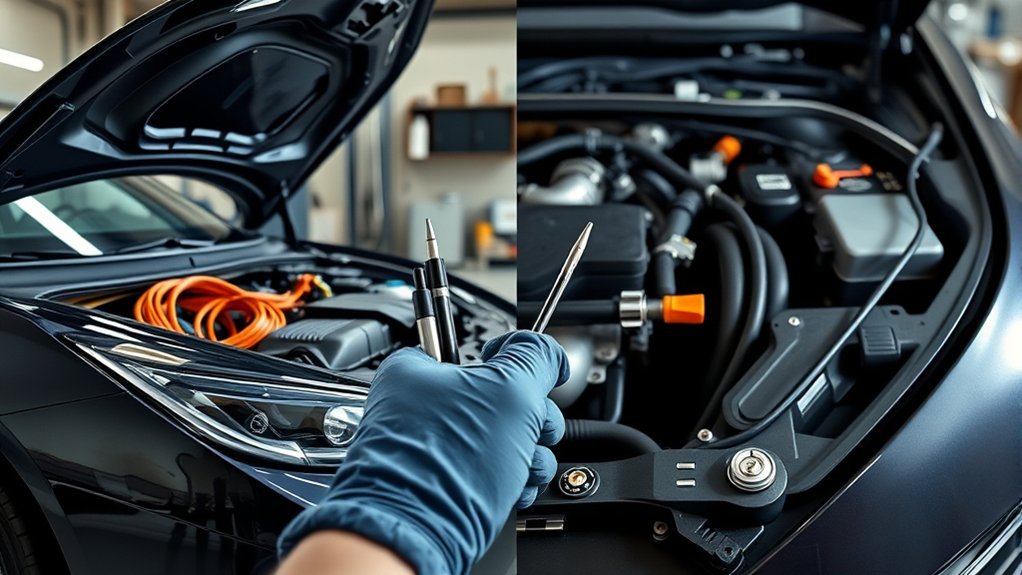
A gasoline car uses an internal combustion engine as its main source of power. A hybrid combines a combustion engine with one or more electric motors and a traction battery. The electric system can help the engine, recover energy during braking, reduce idling, and sometimes move the vehicle at low speeds.
According to the U.S. Department of Energy, conventional hybrid electric vehicles charge their batteries through regenerative braking and the combustion engine. They cannot be connected to an outside electrical source.
Note: The word “hybrid” can describe several different systems. Confirm whether a vehicle is a mild hybrid, full hybrid, or plug-in hybrid before comparing fuel economy, charging needs, and ownership costs.
Mild Hybrid
A mild hybrid uses a small motor and battery to assist the engine. It may support automatic stop-start operation and provide extra power during acceleration. However, it normally cannot drive the vehicle using electric power alone.
Mild hybrids may improve efficiency, but the gain is usually smaller than with a full hybrid. Their driving experience often feels similar to that of a regular gasoline vehicle.
Full Hybrid
A full hybrid has a larger battery and a more powerful electric motor. It may move for short distances or at low speeds using electric power, depending on the design and conditions. You do not plug it in.
Full hybrids often gain the most efficiency in city traffic because they can recover braking energy, shut off the engine while stopped, and use the electric motor when a gasoline engine would be less efficient.
Plug-In Hybrid
A plug-in hybrid electric vehicle, or PHEV, has a larger battery and a charging port. It can be charged from an electrical outlet or charging station and then switch to gasoline operation when needed.
The Department of Energy reports that current light-duty PHEVs commonly provide about 15 to 60-plus miles of electric range, although the exact figure varies by model. A PHEV provides its greatest electric-driving benefit when you charge it regularly.
Hybrid vs. Gasoline Car Comparison
| Factor | Full Hybrid | Plug-In Hybrid | Gasoline Car |
|---|---|---|---|
| External charging | No | Yes, for maximum electric-driving benefit | No |
| Fuel use | Usually lower than a comparable gas model | Can use very little gasoline when charged often and driven within its electric range | Depends on engine, vehicle, drivetrain, and driving conditions |
| Routine engine service | Required | Required | Required |
| Brake wear | Often reduced by regenerative braking | Often reduced by regenerative braking | Relies mainly on friction brakes |
| Purchase price | Often higher than a matched gas trim | Often higher because of the larger battery and charging hardware | Often lower, but model-dependent |
| Often best suited to | Frequent city or mixed driving without charging | Reliable charging and daily trips that use much of the electric range | Low annual mileage, a large hybrid price premium, or needs better met by the gas configuration |
A hybrid’s strongest advantage is usually reduced fuel use in the right driving conditions, not a guarantee of lower costs in every ownership category.
What Maintenance Should You Expect?
Hybrids and gasoline cars share many maintenance needs because both contain combustion engines. The exact schedule depends on the manufacturer, engine, oil specification, climate, mileage, and driving conditions.
The Department of Energy’s maintenance guidance says HEVs and PHEVs generally require the same types of routine maintenance as conventional vehicles. Their electric motors, batteries, and power electronics usually need little scheduled maintenance, while regenerative braking can reduce friction-brake use.
[Amazon Products Picked for You]

All You Need Is One: This advanced hybrid formula acts as both a cutting compound and finishing polish, removing swirls, scratches, and oxidation in just one step. Ideal for bringing faded or tired paint back to life with minimal time and effort

FORMULATED WITH ADVANCED SCIENCE! – Are you tired of using products that look great, but don’t last? You won’t experience that here! This magic in a bottle produces a deep shine, slick surface, and gives lasting protection!

Nylon Material: Made of impacted resistant nylon fiber material with high level craftsmanship, it’s non-toxic, durable and not like brittle material which is prone to bent or crack
Routine Maintenance Requirements
Both powertrains may require:
- Engine-oil and oil-filter changes
- Tire rotations, balancing, and alignment checks
- Engine and cabin air-filter replacement
- Brake-fluid inspections or replacement
- Engine-coolant service
- Spark-plug replacement
- Transmission-fluid service when specified
- Belt, hose, suspension, and steering inspections
- 12-volt battery testing or replacement
A hybrid may also have a separate cooling circuit for the traction battery, inverter, motor, or other electrical components. Some models use air-cooled batteries with intake vents that must remain clean and unobstructed.
Do not assume that a hybrid automatically receives a longer oil-change interval. Follow the maintenance schedule for the exact vehicle. Severe service, frequent short trips, towing, dust, heat, and cold can change the required interval.
Brake and Tire Maintenance
Regenerative braking slows a hybrid by using the electric motor as a generator. This can reduce use of the friction brakes and may extend pad and rotor life.
Longer pad life does not eliminate brake service. Rotors can rust, calipers can stick, and brake fluid can absorb moisture. Have the complete system inspected at the interval listed by the manufacturer.
Tire wear depends on vehicle weight, alignment, tire design, inflation, road surface, and driving style. A hybrid does not automatically use tires faster or slower than a gas car. Check pressure regularly and compare replacement-tire load and speed ratings with the original specifications.
Battery and Electrical System
The traction battery is separate from the small 12-volt battery used for accessories and control systems. Traction batteries are designed for long service, but capacity and performance can change with age, heat exposure, mileage, cooling-system condition, and operating history.
There is no single hybrid-battery warranty for every manufacturer. For example, Honda’s 2025 U.S. High Voltage Battery Capacity Limited Warranty lasts 8 years or 100,000 miles, whichever comes first. Toyota states that the hybrid battery on applicable 2020-and-newer U.S. models is covered for 10 years or 150,000 miles, while specified Toyota hybrid-system components use separate coverage. Check the exact model-year warranty booklet because battery, capacity, hybrid-component, emissions, transferability, and state-specific terms can differ.
A warranty period is not a prediction that the battery will fail when coverage ends. When evaluating a used hybrid, battery diagnostic data, fault codes, cooling performance, temperature behavior, and state-of-charge behavior are more useful than age or odometer mileage alone.
Warning: Do not open a hybrid battery casing or touch orange high-voltage cables. Traction-battery, inverter, and high-voltage repairs should be handled by technicians with the correct training, protective equipment, and service information.
Repair Complexity Differences
A hybrid contains an engine, fuel system, exhaust system, electric motor, battery, power electronics, and control software. This gives technicians more systems to diagnose.
Routine work such as tires, filters, suspension, and many brake services can often be performed by an independent repair shop. High-voltage faults, battery cooling problems, inverter failures, and some software issues may require a hybrid-trained technician or dealership equipment.
A gasoline car may be easier to service in areas with few hybrid specialists. However, gasoline vehicles can also have expensive turbochargers, transmissions, emissions systems, direct-injection components, and electronic modules. Repair risk should be judged by the specific model and its service history.
How Do Hybrid and Gasoline Cars Feel to Drive?
The difference in driving feel depends on the hybrid design, engine, transmission, vehicle weight, and software tuning. A test drive is more useful than assuming every hybrid behaves the same way.
For a fair back-to-back comparison, drive the hybrid and gasoline versions over the same route when possible. Use similar climate-control settings and compare low-speed response, merging power, brake-pedal feel, highway noise, visibility, cargo access, seating, and any difference in ride quality caused by wheel or tire size.
Acceleration and Power Delivery
Electric motors can produce torque immediately, which may give a hybrid smooth and responsive low-speed acceleration. The motor can also assist the gasoline engine when merging, climbing, or passing.
Some hybrids use continuously variable or electronically controlled transmissions. Under hard acceleration, engine speed may rise and remain steady while road speed increases. Some drivers like the smoothness, while others prefer the shifting feel and engine sound of a conventional automatic transmission.
A gasoline version may be lighter or offer a different power rating, but this is not universal. Compare published acceleration, horsepower, torque, towing, payload, and curb-weight specifications for the exact trims.
Braking Feel
Hybrid brakes blend regenerative and friction braking. In well-tuned systems, the transition is difficult to notice. In other vehicles, the pedal may feel less linear than in a traditional gas car, especially at low speeds.
Test the vehicle in normal traffic, during gentle stops, and during firmer braking. Make sure the pedal response feels predictable to you.
Noise and Low-Speed Operation
A full hybrid may move quietly at low speed or while the engine is off. The engine can restart automatically when more power, cabin heat, battery charging, or emissions-system operation is needed.
A gasoline car generally produces a more consistent engine sound because the engine remains the main source of propulsion. Whether that feels better is a matter of preference.
Driving Range, Charging, and Refueling
A conventional hybrid refuels at a normal gas station and does not need a charging station. Its total range depends on fuel-tank size and real-world fuel economy.
A plug-in hybrid has both a fuel tank and a charging port. You can continue driving on gasoline after the usable electric charge is depleted. However, the Department of Energy notes that if a PHEV is never plugged in, its gasoline use can be similar to that of a similarly sized conventional hybrid. Regular charging is therefore important if electric operation is a main reason for paying extra for the PHEV.
A gasoline car also refuels quickly and benefits from broad fuel availability. Do not assume a fixed 300-, 400-, 600-, or 700-mile range for any category. Check the EPA label and tank capacity for the exact vehicle.
Which Gets Better Fuel Economy: Hybrid or Gas?
Hybrids often use less gasoline than comparable gas-only vehicles, but there is no single MPG figure that represents every hybrid. Vehicle size, drivetrain, tires, aerodynamics, temperature, speed, cargo, terrain, and driving style all affect fuel use.
City Driving
Full hybrids often perform well in stop-and-go traffic. Regenerative braking recovers part of the energy that would otherwise become heat, and automatic stop-start operation reduces fuel used while idling.
Short trips in cold weather may reduce the advantage because the engine may run to warm itself, heat the cabin, or bring the emissions system to operating temperature.
Highway Driving
The hybrid advantage may become smaller during steady high-speed travel because there are fewer braking events and less opportunity to recover energy. Aerodynamic drag also rises as speed increases.
Some hybrids remain highly efficient on the highway, while others show a larger city advantage. Compare the separate city, highway, and combined EPA ratings for the exact hybrid and gas trims rather than assuming the highway advantage disappears completely.
How to Calculate Your Fuel Savings
For a conventional hybrid and gas car, use these formulas:
- Annual gallons used: annual miles divided by MPG
- Annual fuel cost: annual gallons multiplied by fuel price
- Annual hybrid savings: gas-car fuel cost minus hybrid fuel cost
- Simple payback period: hybrid price premium divided by annual fuel savings
For example, suppose you drive 12,000 miles per year, gasoline costs $3.50 per gallon, the gas car returns 30 MPG, and the hybrid returns 45 MPG:
- Gas car: 12,000 ÷ 30 = 400 gallons, or $1,400 per year
- Hybrid: 12,000 ÷ 45 = about 267 gallons, or about $933 per year
- Estimated annual fuel savings: about $467
If the hybrid costs $3,000 more, the simple fuel-only payback would be about 6.4 years. The same assumptions show how strongly annual mileage changes the result:
| Annual Miles | Estimated Annual Fuel Savings | Simple Payback on $3,000 Premium |
|---|---|---|
| 8,000 | About $311 | About 9.6 years |
| 12,000 | About $467 | About 6.4 years |
| 15,000 | About $583 | About 5.1 years |
| 20,000 | About $778 | About 3.9 years |
These are fuel-only calculations using the same hypothetical 30-MPG gas car, 45-MPG hybrid, $3.50-per-gallon fuel price, and $3,000 hybrid premium. They do not include financing, insurance, maintenance, registration fees, resale value, or changes in fuel price.
For a plug-in hybrid, also calculate electricity. A simple estimate is: electric miles × (EPA kWh per 100 miles ÷ 100) × your electricity rate per kWh. Then add the gasoline cost for miles driven in gasoline/hybrid operation. Use the exact vehicle’s EPA electricity-consumption and gas-mode figures rather than comparing MPGe directly with gasoline MPG as a dollar-cost figure.
Pro Tip: Use the official FuelEconomy.gov hybrid comparison tool to compare a hybrid with a closely matched non-hybrid from the same manufacturer. Enter your actual annual mileage, city-driving percentage, and local fuel price.
What Are the Maintenance and Repair Costs?
It is not accurate to say that every hybrid costs less to maintain than every gasoline car. Routine maintenance is often similar because both have engines, fluids, filters, tires, suspension parts, air-conditioning systems, and 12-volt batteries.
A hybrid may save money on brake pads and rotors because regenerative braking handles part of the stopping load. Its electric motor and power electronics also normally require little scheduled maintenance.
However, a high-voltage battery, inverter, electric air-conditioning compressor, battery cooling system, or hybrid-specific control module can be expensive outside warranty. These failures are not routine maintenance, and their probability and cost vary by model.
[Amazon Products Picked for You]

*Select your vehicle above*

Lithium Coin Battery: Duracell's 2450 3V coin batteries provide reliable, long lasting power for your medical devices, security devices, electronics and more.

Ownership Costs to Compare
Before buying, estimate all of the following:
- Purchase price and dealer fees
- Interest paid on the price difference
- Annual gasoline use
- Electricity use for a plug-in hybrid
- Insurance quotes for both vehicles
- Registration or property-tax differences
- Scheduled maintenance
- Tire replacement cost
- Expected repair risk after warranty
- Resale or trade-in value
Request insurance quotes for the exact trim or VIN before buying. A hybrid can cost more or less to insure depending on the vehicle’s value, repair costs, claims experience, safety equipment, your location and driver profile, coverage limits, and deductibles. Do not use a generic “hybrids cost X% more” assumption in the payback calculation.
A small monthly fuel saving may not recover a large purchase-price premium during a short ownership period. In contrast, a driver with high annual mileage and frequent urban driving may recover the premium sooner.
Battery Replacement Risk
Do not assume that every hybrid will need a complete battery replacement. If a battery problem occurs, the repair may involve the full pack, a module, a cooling component, wiring, a sensor, or a control unit.
Replacement prices change by vehicle, battery chemistry, pack size, labor rate, and whether the part is new, remanufactured, used, or repaired. Confirm warranty coverage and obtain a vehicle-specific quote before using any battery-cost estimate in your buying decision.
How Do Hybrid Vehicles Affect the Environment?
A hybrid normally burns less gasoline than a comparable gas-only vehicle when it achieves better fuel economy. Burning less fuel generally reduces carbon-dioxide emissions from the tailpipe.
The U.S. Environmental Protection Agency estimates that a typical gasoline passenger vehicle emits about 4.6 metric tons of carbon dioxide per year under assumptions of roughly 22.2 MPG and 11,500 miles driven annually. EPA also reports that burning one gallon of gasoline produces about 8,887 grams of tailpipe CO₂.
Every gallon of gasoline avoided reduces direct tailpipe carbon-dioxide emissions, but the total environmental comparison must also include fuel production, vehicle manufacturing, battery production, recycling, and disposal.
Tailpipe emissions are only one part of the picture. A lifecycle comparison includes raw-material extraction, manufacturing, fuel production, fuel transport, vehicle use, battery production, recycling, and end-of-life processing.
The Department of Energy notes that HEVs and PHEVs typically produce lower tailpipe emissions than comparable conventional vehicles. For PHEVs, total emissions also depend on the electricity source and how often the vehicle operates electrically.
Are Hybrids Eligible for Incentives?
Do not assume that a conventional hybrid qualifies for a federal clean-vehicle tax credit. For current U.S. purchases, the Internal Revenue Service states that the New Clean Vehicle Credit and Previously-Owned Clean Vehicle Credit are not available for vehicles acquired after September 30, 2025. A vehicle acquired on or before that date may still qualify when it is later placed in service if all applicable requirements are met.
State, local, utility, toll, parking, charging, or registration programs can use different eligibility rules and can change. The Department of Energy maintains a searchable Federal and State Laws and Incentives database, but eligibility should still be confirmed with the agency or program responsible for the incentive before a purchase or lease.
Note: Incentive eligibility can depend on the vehicle, acquisition date, location, income rules, lease structure, program funding, and other requirements. Confirm eligibility through the responsible government agency or utility before including an incentive in your budget.
What Should You Consider Before Choosing?
Use the same process for every vehicle pair instead of deciding from the powertrain label alone:
- Match the trims: compare out-the-door prices for vehicles with similar drivetrain, equipment, wheels, safety features, and options.
- Use your driving pattern: enter your actual annual mileage, city/highway split, local gasoline price, and, for a PHEV, your electricity rate and realistic charging frequency.
- Run more than one ownership period: calculate fuel or energy cost over about 5, 7, and 10 years rather than assuming you will keep the car indefinitely.
- Add non-fuel costs: compare financing, insurance quotes, registration or property taxes, tires, scheduled maintenance, and likely resale value.
- Check practical constraints: verify cargo room, towing and payload, spare-tire arrangements, warranty coverage, and access to qualified service before choosing the lower calculated cost.
A Hybrid May Suit You If
- You drive many miles each year.
- A large share of your driving is in city or suburban traffic.
- The hybrid price premium is small.
- You plan to keep the vehicle long enough to recover the premium.
- You value quieter low-speed operation.
- A qualified hybrid repair shop is available nearby.
- The battery warranty covers most of your expected ownership period.
A Gasoline Car May Suit You If
- You drive relatively few miles each year.
- The gas model costs much less to buy or finance.
- Your driving is mainly steady highway travel and the matched hybrid provides only a small MPG advantage.
- The gas version offers better towing, payload, cargo capacity, or configuration choices for your needs.
- You live where hybrid service or parts access is limited.
- You plan to sell the vehicle before fuel savings recover the price premium.
A Plug-In Hybrid May Suit You If
- You can charge reliably at home or work.
- Your daily trips fit within much of the vehicle’s electric range.
- You still need gasoline backup for longer trips.
- Your electricity cost per mile is favorable relative to gasoline for the specific vehicle.
- The higher purchase price makes sense after electricity, fuel, financing, insurance, and other ownership costs are included.
Check Practical Differences Between Trims
The hybrid and gas versions of the same vehicle may not have identical equipment. Check:
- Cargo volume and spare-tire availability
- Rear-seat and battery placement
- Towing and payload limits
- All-wheel-drive design
- Wheel and tire sizes
- Fuel-tank capacity
- Ground clearance
- Warranty terms
- Standard safety and convenience features
A higher hybrid price may partly reflect extra standard equipment rather than the powertrain alone. Compare closely matched trims and obtain itemized prices.
For model-specific examples, see our Toyota RAV4 gas vs. hybrid comparison, Toyota Tacoma gas vs. hybrid drivetrain guide, and hybrid vs. gas pickup-truck comparison. Those pages cover model-specific MPG, capability, trim, and drivetrain differences that should not be generalized to every hybrid.
What Should You Check When Buying a Used Hybrid?
A used hybrid can be a strong value, but age, service history, battery condition, and warranty status matter. Before buying:
- Confirm the exact model year, trim, powertrain, and original sales state.
- Read the traction-battery and emissions-warranty terms.
- Check whether any battery warranty transfers to the next owner.
- Review maintenance records and recall completion.
- Scan every control module for current, pending, and history codes.
- Inspect the battery cooling intake and confirm that it is unobstructed.
- Test the vehicle from a cold start and after it is fully warm.
- Watch for warning lights, rapid battery-level swings, unusual fan noise, or a lasting unexplained drop in fuel economy.
- Test the brakes for smooth blending and predictable pedal response.
- Have the vehicle inspected by a technician familiar with that hybrid system.
A dashboard battery gauge is not a complete battery-health test. Ask whether the technician can check battery data, temperature differences, state-of-charge behavior, fault history, and model-specific diagnostic information.
[Amazon Products Picked for You]

OBD2 SCANNER & BATTERY TESTER IN ONE – The INNOVA 5210 OBD2 scanner not only reads and clears check engine light and ABS codes (coverage may vary) but also functions as a car battery tester to check alternator health and prevent unexpected breakdowns.

NOTE: This device requires a compatible third-party app to operate and is primarily designed for standard OBD-II diagnostics. Please check the product description or user instructions before purchase for compatible apps and supported data & functions.

NOTE: This device requires a compatible third-party app to operate and is primarily designed for standard OBD-II diagnostics (excluding ABS/SRS, oil light or service reset, etc.). Please check the product description for compatible apps and supported functions.
Frequently Asked Questions
Are hybrids cheaper to maintain than gas cars?
Not automatically. Hybrids and gas cars share engine, tire, fluid, filter, suspension, and brake-inspection needs. Regenerative braking may reduce pad and rotor wear, and hybrid electrical components generally need little scheduled maintenance. However, hybrid-specific repairs outside warranty can be costly, so compare the exact models rather than assuming one powertrain always costs less.
Can a normal repair shop service a hybrid?
Many shops can perform tires, filters, suspension, alignment, brakes, and routine engine service. Work involving the traction battery, inverter, high-voltage wiring, or hybrid control system should be handled by a technician with suitable hybrid training, tools, service information, and safety equipment.
What are the main disadvantages of a hybrid car?
Possible disadvantages include a higher purchase price, added diagnostic complexity, limited hybrid-specialist access in some areas, and potentially expensive high-voltage repairs after warranty. Some models also have different cargo, towing, payload, wheel, or spare-tire arrangements. The trade-offs depend on the exact vehicle.
Does a regular hybrid need to be plugged in?
No. A conventional hybrid charges its traction battery through regenerative braking and the gasoline engine. A plug-in hybrid has a charging port and is designed to receive electricity from an external source.
How long is a hybrid battery covered by warranty?
There is no universal warranty term. For example, Honda’s 2025 U.S. high-voltage battery capacity warranty is 8 years or 100,000 miles, while Toyota states that applicable 2020-and-newer U.S. hybrid batteries are covered for 10 years or 150,000 miles. Coverage can differ by manufacturer, model year, component, state, emissions certification, and warranty type, so read the exact vehicle’s warranty booklet.
How long does a hybrid battery last?
There is no guaranteed lifespan that applies to every hybrid battery, and the warranty period is not a failure prediction. Battery condition depends on design, age, mileage, temperature exposure, cooling, use, and individual battery history. For a used hybrid, diagnostic battery data and fault history are more useful than assuming the pack is good or bad from age or mileage alone.
Is a hybrid worth it if I mostly drive on the highway?
It can be, but the fuel-economy advantage may be smaller than in stop-and-go traffic because steady highway driving provides fewer regenerative-braking opportunities. Compare the exact gas and hybrid highway MPG ratings, annual mileage, purchase-price difference, and expected ownership period before deciding.
Do hybrids cost more to insure than gas cars?
Not in every case. Insurance depends on the exact model, vehicle value, repair and claims costs, safety equipment, location, driver profile, coverage limits, and deductibles. Get comparable quotes for both vehicles before using insurance in your ownership-cost calculation.
What happens if you never charge a plug-in hybrid?
A PHEV can continue operating after its usable plug-in charge is depleted because it also has a combustion engine. However, the Department of Energy notes that if it is never plugged in, gasoline use can be similar to that of a similarly sized conventional hybrid. Regular charging is important if electric driving and reduced gasoline use are major reasons for choosing the PHEV.
Conclusion
A hybrid often fits drivers who cover substantial annual mileage, spend meaningful time in city or mixed traffic, and can recover any purchase-price premium through lower fuel use and other ownership differences. A plug-in hybrid is most useful when you can charge regularly and use much of its electric range during normal trips.
A gasoline car can still have the lower practical ownership cost when annual mileage is low, the hybrid price premium is large, highway driving dominates, the gas configuration better meets towing or cargo needs, or local hybrid service access is limited.
Compare closely matched trims, calculate fuel or energy costs with your own mileage and local prices, obtain insurance quotes, review the exact battery and powertrain warranties, and check the practical differences before signing a purchase agreement. The useful comparison is the full cost and capability of the two exact vehicles you would actually buy—not the drivetrain label by itself.
Sources
- U.S. Department of Energy: Hybrid Electric Vehicles — explains mild and full hybrids, regenerative braking, and why conventional hybrids do not plug in.
- U.S. Department of Energy: Plug-In Hybrid Electric Vehicles — explains charging, electric range, gasoline operation, and why regular charging affects PHEV fuel use.
- U.S. Department of Energy: Maintenance and Safety of Electric Vehicles — supports maintenance, regenerative-braking, battery, and high-voltage safety guidance.
- FuelEconomy.gov: Can a Hybrid Save Me Money? — provides model-specific fuel-cost and payback comparisons.
- U.S. Environmental Protection Agency: Passenger-Vehicle Greenhouse Gas Emissions — supports gasoline CO₂ and annual-emissions figures and their assumptions.
- Toyota USA Newsroom: Hybrid Battery Warranty Extension — supports Toyota’s 10-year/150,000-mile hybrid-battery coverage and separate hybrid-component coverage for applicable vehicles.
- Honda: 2025 Warranty Basebook — supports Honda’s 8-year/100,000-mile High Voltage Battery Capacity Limited Warranty.
- Internal Revenue Service: Clean Vehicle Tax Credits — confirms that federal clean-vehicle credits are unavailable for vehicles acquired after September 30, 2025 and explains the acquisition/placed-in-service distinction.
- U.S. Department of Energy: Federal and State Laws and Incentives — provides a searchable resource for current federal, state, local, and utility vehicle-related programs.
