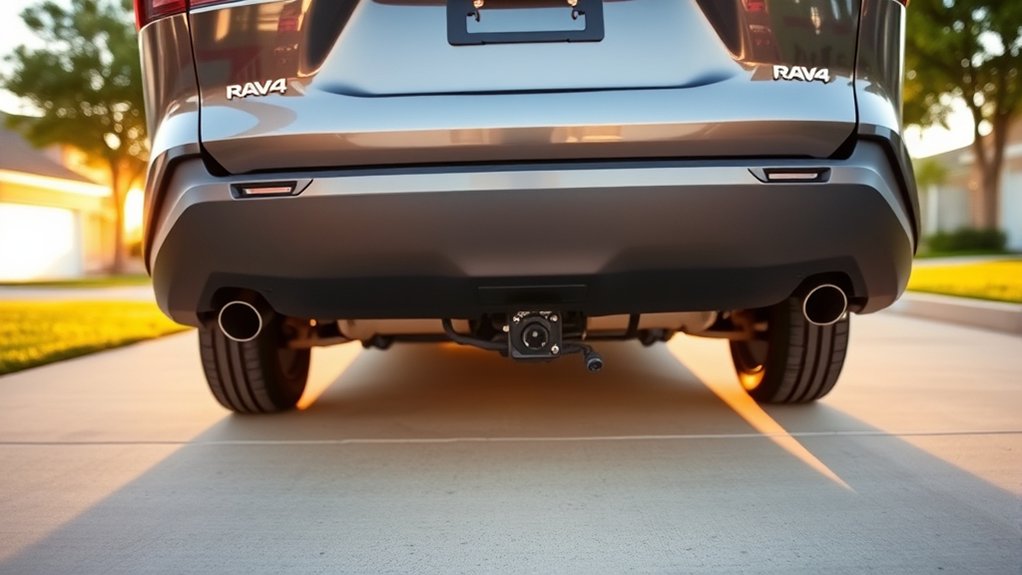
No. The 2026 Toyota RAV4 XLE does not include a towing hitch or trailer wiring as standard equipment. A factory hitch is optional, and dealers or service providers can install OEM or aftermarket bolt-on hitches without drilling. Trailer wiring also requires an added harness, typically a 4-pin module. The vehicle is rated for up to 5,000 pounds towing and 750 pounds tongue weight, subject to the owner’s manual. Further details cover fitment, cost, and towing setup.
Does the 2026 RAV4 XLE Have a Hitch?
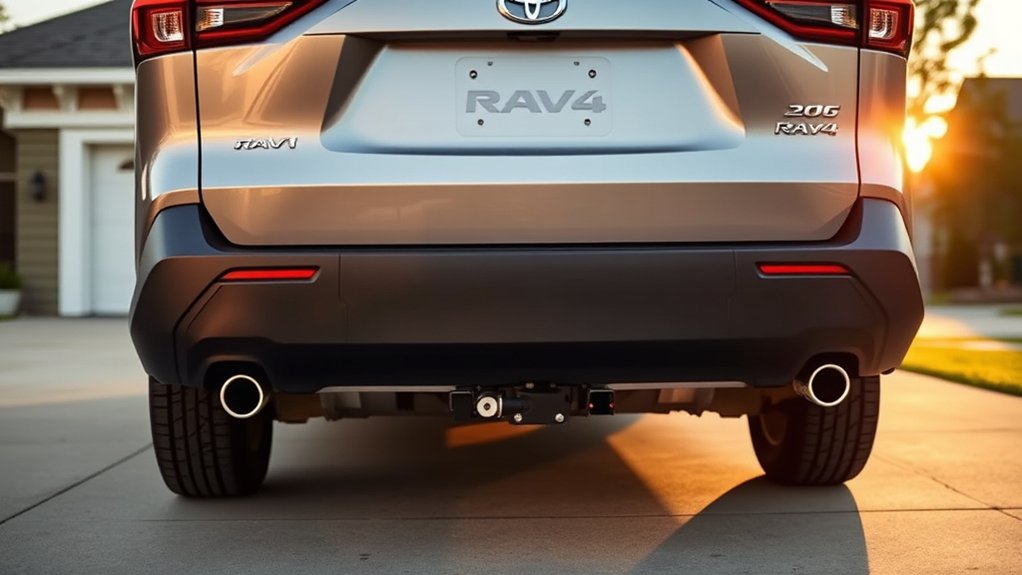
Does the 2026 RAV4 XLE have a hitch? The 2026 Toyota RAV4 XLE does not include a towing hitch as standard equipment. Buyers seeking greater utility are not locked into that baseline.
The 2026 Toyota RAV4 XLE does not come standard with a towing hitch, though utility-focused buyers still have options.
A factory-installed towing hitch is available as an option, and dealer or service-provider installation of an aftermarket hitch is also supported.
For owners prioritizing flexibility, the aftermarket hitch route is straightforward. Available units are engineered as 100 percent bolt-on assemblies, so installation requires no drilling and no permanent vehicle modification.
That preserves the vehicle’s structure while expanding capability. The OEM-style towing hitch setup retains full operation of the hands-free kick sensor, leaving only the receiver exposed when the hitch is not in use.
Factory-equipped configurations are rated to support towing capacity up to 5,000 pounds. User feedback on the OEM hitch is generally positive, although some owners prefer a more concealed hitch profile for cleaner rear-end aesthetics and visual freedom.
Does the 2026 RAV4 XLE Include Wiring?
Notably, the 2026 Toyota RAV4 XLE does not include factory-installed trailer wiring, just as it does not include a towing hitch as standard equipment. Buyers seeking towing function must add wiring installation separately, typically with a 4-pin harness and a required light module. This preserves electrical compatibility while enabling trailer lighting operation without permanent alteration.
| Item | Standard on XLE | Notes |
|---|---|---|
| Trailer wiring | No | Optional accessory |
| Light module | No | Needed for 4-pin setup |
| Installation method | Bolt-on | No drilling required |
This specification gives owners freedom to configure towing capability on their own terms. Available aftermarket options commonly bundle the harness, module, and towing hitch into a coordinated package. Proper aftermarket wiring solution design maintains full vehicle electrical functionality for towing purposes. In practical terms, the RAV4 XLE arrives wiring-ready only through added components, not through factory inclusion. That distinction matters for planning cost, timing, and installation scope.
Should You Choose OEM or Aftermarket?
For the 2026 RAV4 XLE, the OEM-versus-aftermarket decision centers on compatibility, warranty retention, and towing system integration, since no factory hitch or wiring is included.
OEM hitches provide vehicle-specific fitment and a cleaner concealed appearance, while aftermarket alternatives can reduce cost by roughly $500 but may introduce visible hardware or require installation modifications.
The selection thus depends on whether priority is placed on factory-supported fit and finish or on lower acquisition cost and broader configuration flexibility.
OEM Vs Aftermarket
While the 2026 Toyota RAV4 XLE does not include a factory towing hitch or wiring as standard equipment, the OEM-versus-aftermarket decision centers on compatibility, cost, appearance, and long-term reliability.
For buyers seeking liberated ownership, OEM hitches provide validated fitment, integrated wiring provisions, and stronger warranty alignment. They are commonly favored for predictable installation and consistent towing capabilities under manufacturer specifications.
Aftermarket options expand choice and can support the same basic towing capabilities, but fit, corrosion resistance, hardware quality, and electrical integration vary by supplier.
Many setups require a separate light module, adding complexity to installation. OEM hitches generally deliver higher confidence in long-term function, whereas aftermarket options demand closer scrutiny of load ratings, connector design, and installer competence.
The better choice depends on priorities: certainty, flexibility, or both.
Cost And Appearance
Cost and appearance usually determine whether a 2026 Toyota RAV4 XLE owner selects an OEM hitch or an aftermarket unit. Because the model excludes hitch and wiring as standard equipment, the buyer must compare factory integration against lower acquisition cost and visual discretion.
OEM hardware generally preserves factory lines and a consistent rear-profile appearance, which appeals to owners seeking seamless Toyota RAV styling. It also carries a compatibility advantage that reduces uncertainty at purchase.
Aftermarket alternatives, however, often create the strongest value proposition. Reported savings of roughly $500 show how non-OEM sourcing can liberate budget without necessarily undermining function. Among these options, hidden cross-member designs receive favorable attention because they minimize visible structure below the bumper.
The decision thus centers on aesthetic priority, price tolerance, and preferred sourcing path.
Installation And Capability
Beyond price and rear-profile aesthetics, hitch selection for the 2026 Toyota RAV4 XLE is defined by installation method and verified towing performance.
Because the XLE does not include a factory hitch or wiring, buyers must add either OEM accessories or aftermarket hardware. OEM installation guarantees direct compatibility and preserves the hands-free kick sensor, a functional advantage for users who want capability without compromise.
Capability metrics favor the OEM unit when maximum rated performance matters. It carries a 5,000-pound towing capacity and 750-pound tongue weight rating, certified to SAE J684 standards. That specification is enough to keep hauling choices open for trailers and camping gear.
Aftermarket systems can work great and often use a concealed receiver design. Both types are available with professional, 100% bolt-on installation, requiring no drilling.
What Hitch Fits a 2026 RAV4 XLE?
For the 2026 RAV4 XLE, the correct fitment is a separately purchased Class 3 hitch rated for 750 pounds of tongue weight and 5,000 pounds of towing capacity. That specification aligns with common hitch compatibility considerations for owners seeking capability without factory installation.
The 2026 RAV4 XLE does not include a hitch as standard equipment, so selection must focus on confirmed vehicle-specific mounting geometry and receiver integration.
The compatible unit installs with a 100 percent bolt-on procedure and requires no drilling, supporting efficient DIY fitment. Typical installation tools required are basic hand tools suited to factory mounting points.
For towing function, a light module is required to support a 4-pin electrical connection. The OEM-style concealed design preserves exterior aesthetics by leaving only the receiver visible when the hitch is not in use.
Practical towing safety tips include verifying torque specifications, confirming wiring operation, and staying within rated limits for stable, self-directed utility.
How Much Does a 2026 RAV4 Hitch Cost?
With fitment established, pricing for a 2026 RAV4 XLE hitch generally centers around $500 for the hitch assembly, with comparable setups reported near $547 depending on supplier and included hardware. That range covers the primary receiver components and reflects normal market variability rather than major specification differences.
For buyers seeking control over total outlay, a cost comparison should separate the hitch itself from wiring-related extras. A complete towing-ready package can rise above the base figure when a light module is required for a 4-pin connection.
Professional labor also changes final pricing, although the OEM system’s 100% bolt-on design, with no drilling, strengthens value and simplifies service planning. In specification terms, purchase decisions should align with intended towing capacity, connector requirements, and hardware completeness.
Practical installation tips at this stage focus on confirming whether quoted prices include brackets, fasteners, trim pieces, and electrical interfaces before scheduling any work.
Can You Install a RAV4 Hitch Yourself?
Although the 2026 Toyota RAV4 does not include a factory-installed hitch or wiring as standard, a DIY installation is generally feasible because the receiver system is engineered as a 100% bolt-on assembly with no drilling or permanent vehicle modification. Most aftermarket kits include the complete bolt hardware package and clear instructions, allowing independent owners to add towing capability without bumper removal in many cases.
| Factor | DIY Assessment | Notes |
|---|---|---|
| Fitment | Straightforward | Bolt-on mounting points |
| Equipment | Basic | DIY tools needed |
| Risk | Moderate | Avoid common mistakes |
Useful hitch installation tips include confirming torque specifications, supporting the receiver during alignment, and verifying hardware count before starting. Reported user feedback regularly describes the process as manageable for mechanically inclined owners seeking control over cost and scheduling. Typical common mistakes involve cross-threading fasteners, skipping torque checks, or misreading orientation diagrams. For owners wanting a hands-off option, professional installation remains available.
Does a RAV4 Hitch Reduce Clearance?
How much clearance is actually lost depends on hitch geometry, but a properly fitted 2026 Toyota RAV4 hitch is engineered to keep the effect minimal. With the vehicle still maintaining 14.5 inches of ground clearance and approximately 16 inches at the receiver, the hitch design impact is limited in practical use. This preserves the RAV4’s capability for confident movement over uneven surfaces.
A correctly installed OEM-style hitch is designed to avoid bumper modification, which supports factory dimensional integrity and protects ground clearance benefits. Its lightweight construction also reduces unnecessary rear-end mass, helping preserve agility rather than burdening it.
From a specification standpoint, a well-designed hitch should not materially compromise exit angle clearance, so maneuverability remains intact during normal driving and light towing scenarios. For buyers focused on freedom of movement, that matters.
Within towing safety considerations, clearance reduction is consequently modest, predictable, and generally not a meaningful drawback when the hitch is properly selected and installed.
What Should You Check Before Towing?
Before towing, the 2026 RAV4 XLE should be verified against the owner’s manual limits: 5,000 pounds maximum towing capacity and 750 pounds maximum tongue weight.
The hitch assembly and wiring connections should be inspected for wear, damage, and load compatibility to confirm proper function under the intended trailer setup.
Ground clearance should also be checked, with 14.5 inches considered in relation to hitch fitment, trailer angle, and overall towing stability.
Hitch And Wiring Capacity
Because the 2026 Toyota RAV4 XLE is not factory-equipped with a towing hitch or trailer wiring, towing readiness depends on confirming a compatible hitch installation, verifying the owner’s manual ratings of 5,000 pounds maximum trailer weight and 750 pounds tongue weight, and ensuring a properly installed light module for any 4-pin trailer-light connection.
- Confirm hitch fitment to the 2026 RAV4 platform; OEM-style solutions preserve clearance and function, reflecting practical hitch installation tips and aftermarket benefits.
- Verify electrical readiness: a functioning light module is required for 4-pin trailer lamps, with secure routing and protected connectors.
- Inspect hitch structure and wiring condition before each trip for corrosion, abrasion, looseness, or insulation damage, following SAE J684 towing safety guidelines.
These checks support independent, standards-aligned towing without unnecessary compromise or modification.
Tongue Weight Limits
With hitch fitment and trailer-light wiring verified, the next check is tongue weight compliance. The 2026 Toyota RAV4 carries a 750-pound tongue weight rating, and that limit governs towing safety as much as overall tow capacity. The owner’s manual remains the controlling source because ratings can vary by configuration and equipment.
Aftermarket hitches do not authorize higher factory limits; they only provide compatible mounting hardware. Hauling accessories, including cargo carriers or bike racks, consume available tongue weight and must be deducted before loading a trailer.
A Maximum Hitch Weight (Tongue Weight) Estimator can help quantify the real load at the receiver and support proper weight distribution. Staying within published specifications preserves braking stability, axle loading, and steering authority, giving the operator more freedom to tow confidently without compromising mechanical limits.
Ground Clearance Check
Although tow rating and tongue load receive most of the attention, ground clearance should be checked next to confirm the 2026 Toyota RAV4 can clear ramps, driveway changes, and uneven terrain without receiver or underbody contact.
- Confirm 14.5 inches of ground clearance. This specification supports ground clearance benefits, protects lower components, and improves terrain handling on rutted approaches.
- Verify 16 inches of receiver clearance. Adequate receiver height preserves alignment with draw bars and accessory mounts, reducing scrape risk during loading shifts.
- Inspect the hitch installation and related limits. A bolt-on, no-drill mount preserves structural integrity, while the 750-pound tongue weight rating and 5,000-pound towing capacity must remain uncompromised for stable towing performance.
These checks help the RAV4 operate with fewer constraints, giving drivers more route freedom with loaded trailers.
Frequently Asked Questions
Does the 2026 Toyota RAV4 Come With a Tow Hitch?
No, the 2026 Toyota RAV4 typically does not include a factory-installed tow hitch. Buyers seeking autonomy can select towing accessories options, supporting RAV4 towing capabilities through OEM hardware aligned with published RAV4 performance metrics.
How to Tell if RAV4 Has a Towing Package?
Roughly 80% of equipped SUVs show a visible rear receiver; one verifies a RAV4 towing package by confirming hitch specifications, rear wiring harness presence, owner-manual towing capacity data, and dealer VIN validation for vehicle compatibility.
How Much Does It Cost to Install a Tow Hitch on a RAV4?
Installation typically costs about $500 for a RAV4, with reported totals reaching $547 depending on wiring and aftermarket accessories. Available installation options include professional bolt-on service, while towing capacity depends on correct hitch specification and configuration.
Where Can I Find a Trailer Wiring Harness for My Toyota RAV4?
Like a key releasing movement, a Toyota RAV4 trailer wiring harness is found through Toyota parts departments, eTrailer, Curt, or Tekonsha retailers. Selection should match towing capacity, trailer weight, and preferred wiring options for compatibility.
Conclusion
For the 2026 RAV4 XLE, a hitch may be optional, wiring may be separate, fitment may vary by trim. OEM parts prioritize factory integration; aftermarket parts prioritize price and availability. Receiver size, tow rating, harness type, and ground-clearance impact should be verified before purchase. Installation may be practical for experienced owners, but torque specs, fascia clearance, and electrical compatibility remain critical. Before towing, vehicle rating, trailer weight, tongue load, and brake-light function should be confirmed.
