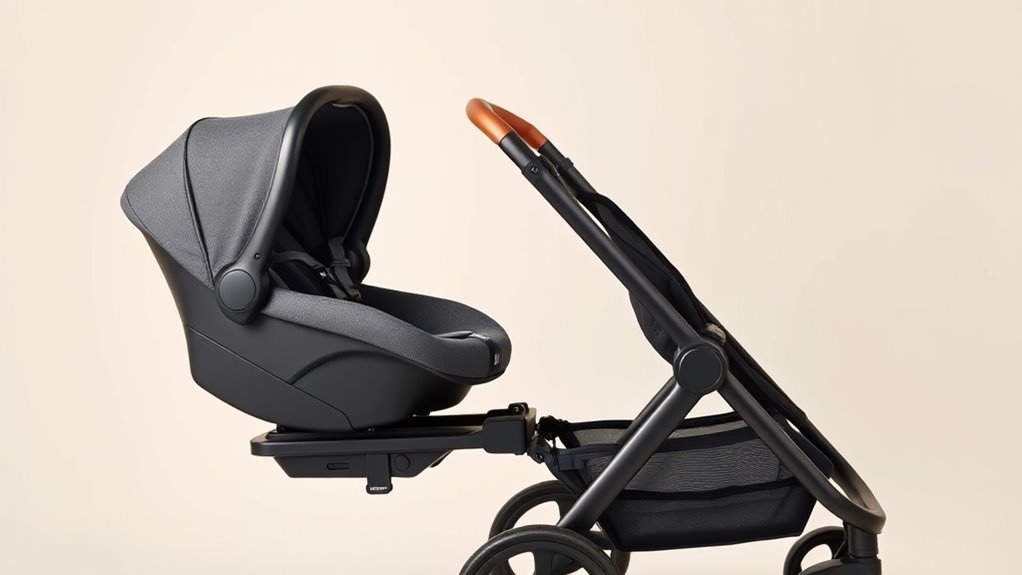
American Airlines does not treat a car seat and stroller together as one single checked item. Each is handled separately, and families can usually check one stroller and one car seat free of charge. Gate-check tags should be requested before boarding, and one item may be gate-checked while the other is processed at the counter. TSA screening is separate for each piece. Proper tagging and early boarding improve compliance and retrieval, with more details below.
Key Takeaways
- American Airlines generally checks one stroller and one car seat free, but each counts as a separate item.
- A car seat and stroller cannot usually be combined and checked together as one single counter item.
- Obtain gate-check tags for both items at the gate before boarding to avoid delays.
- One item may be gate-checked while the other is checked at the counter or with luggage.
- TSA screens strollers and car seats separately, so remove loose parts before reaching security.
Can You Check a Car Seat and Stroller on American Airlines?
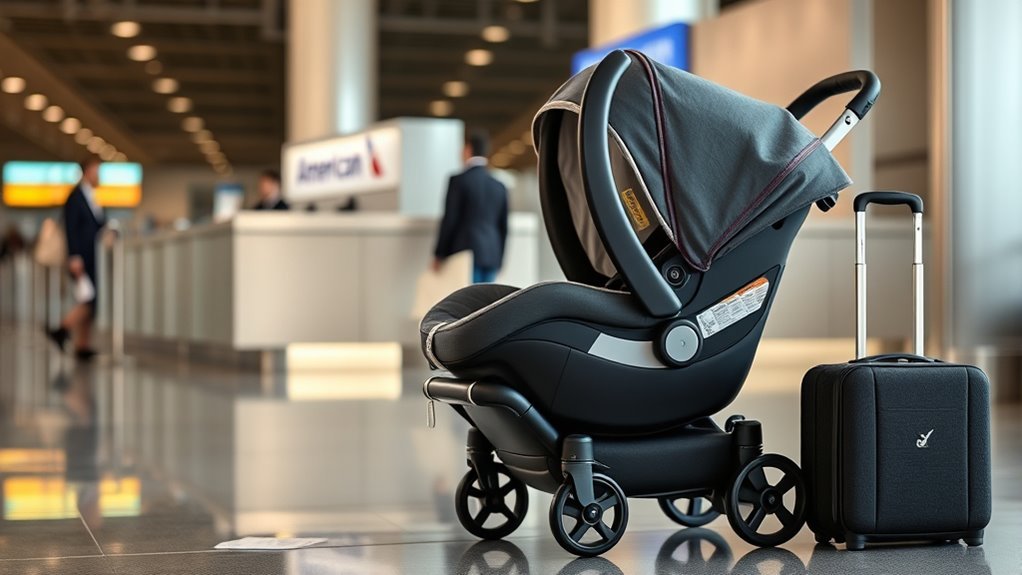
Yes—on American Airlines, one stroller and one car seat may be checked free of charge as separate items. Each is treated as an individual checked item, not as a combined allowance.
For compliance, one item must undergo gate check, while the other may be processed at the ticket counter. The traveler should obtain tags for both items at the gate before boarding to guarantee correct handling.
Families traveling with infants are often offered early boarding, which can reduce processing delays and preserve order. If the car seat is intended for onboard use, its FAA-approved car designation should be confirmed in advance.
This arrangement supports practical movement through the airport while maintaining regulatory alignment. The stroller and car seat consequently remain distinct operational units, allowing families to travel with greater autonomy and fewer barriers.
Proper documentation and timely tagging are essential to avoid misrouting or denial of carriage.
American Airlines Gate-Check Rules
American Airlines permits families to gate-check both a car seat and a stroller at no charge, provided the items are processed under the airline’s handling rules. Compliance is straightforward: one item may be gate-checked, while the other is checked with luggage, allowing a travel system to move with minimal friction.
Early boarding typically reduces delays and gives the family room to organize at the aircraft door before departure.
Early boarding often eases delays and gives families time to organize at the aircraft door before departure.
- Present the car seat at the gate.
- Present the stroller for the alternate check point.
- Confirm tags are attached to both items.
- Release both items into the airline’s custody.
This procedure usually keeps bulky equipment out of the main cabin and separates it from standard baggage claim handling.
Reported traveler experience indicates the process is generally trouble-free when executed as directed. The result is controlled mobility: the family retains access to essential child equipment while maintaining orderly transit through the airport and toward baggage claim.
How to Get Gate-Check Tags
At the gate, the traveler should request gate-check tags from the gate agent before boarding.
Each item, including the car seat and stroller, should receive its own clearly visible tag for compliance and identification.
Early boarding with family groups helps secure tags promptly and reduces processing delays.
Ask At The Gate
Upon arrival at the gate, the gate agent should be asked immediately for gate-check tags for both the car seat and stroller; prompt request guarantees the tags are available before boarding begins.
For travelers seeking autonomy, the car seat carrier and stroller and car seat arrangement should be treated as two controlled items during traveling with a car. The gate-check tags should be obtained without delay, because families are typically allowed to board early.
Compliance steps are straightforward:
- Present both items together.
- Request gate-check tags.
- Verify name and contact details.
- Retain tags until handoff.
This process supports orderly movement, reduces interference, and preserves the traveler’s freedom to manage infant equipment efficiently.
On American Airlines, proper procedure permits gate-checking without additional charge.
Tag Both Items
With both the stroller and car seat presented at the gate, airline staff should be asked for gate-check tags before boarding begins.
The car seat and stroller should be treated as separate units for identification, even when checked together. Gate check tags must be attached securely to each item, including infant car seats, so they can be routed and returned correctly after flight arrival.
For stroller travel, confirmation of airline-specific rules is recommended before surrendering the items. A personal mark or unique identifier may be added to reduce mix-ups at the aircraft door.
Passengers should check your car seat status on the tag and verify that both labels remain visible. Proper tagging preserves access, order, and mobility while supporting compliant transfer of custody.
Board Early Together
Families flying American Airlines may board early to streamline gate-check processing for the stroller and car seat. At the gate, the parent should request gate-check tags from the agent before the infant car seat enters the jet bridge.
Early boarding gives time to verify that the stroller and a car seat remain paired, labeled, and ready for transfer. A car seat travel bag can reduce abrasion during handling and support compliance.
The process is straightforward:
- Keep both items together until boarding.
- Present them to the gate agent.
- Confirm gate-check tags are attached.
- Board during early boarding and release them at the aircraft door.
This method supports orderly transport, lowers damage risk, and preserves freedom of movement. After landing, tagged items are usually returned promptly.
Should You Gate Check the Stroller or Car Seat First?
When traveling with both a stroller and a car seat, the stroller is typically gate checked first because it is bulkier, easier to maneuver through the airport until boarding, and more likely to create space constraints at the gate.
For families, this gate check order supports a cleaner boarding process and preserves mobility until the final moment. American Airlines permits both items to be gate checked, yet tagging the stroller first can reduce handling delays and clarify custody at the aircraft door.
The car seat may remain available longer if needed, but if it will not be used onboard, it can be stowed separately with luggage. This sequence is operationally efficient and aligns with common family practice.
Community feedback also indicates that checking the stroller first often produces smoother gate operations and less congestion. The result is a more controlled shift, allowing families to move through boarding with greater flexibility and fewer constraints.
How to Get Through Security With Both Items
At TSA security, the car seat and stroller must be screened separately, so they should be prepared for quick disassembly before reaching the checkpoint. For a car seat and stroller combo, airport security works best when the family treats each component as an independent item in the travel systems workflow.
Remove straps, toys, and loose attachments before the lane, then place essentials in an accessible bag for inspection.
- Fold the stroller and clear the basket.
- Detach the car seat from the frame.
- Keep diapers and snacks within reach.
- Present documents and move forward with TSA PreCheck when available.
This procedure improves ease of use and reduces handling time. Families seeking liberation from congestion should arrive early, maintain orderly packing, and follow screening instructions without delay.
If staff direct them to check your stroller later, the screening phase remains separate and compliant. The result is a cleaner, faster passage through airport security with minimal interruption.
Why Families Gate Check Both Items
Gate checking both the car seat and stroller is often preferred because it reduces the chance of damage compared with placing them in standard checked baggage, while also keeping the child in the stroller until boarding.
For many families, this car seat and stroller combo supports efficient travel by preserving mobility and limiting handling. A gate check also helps the infant remain contained and comfortable during airport waits, which can reduce operational stress at the terminal.
Airlines frequently allow both items to be gate checked at no additional cost, improving compliance with budget constraints. Correct tagging at the gate is essential for immediate retrieval after landing and for a smoother transfer to ground transport.
Community reports indicate that families view this process as reliable, practical, and low-risk. In practice, gate check procedures align with a streamlined, freedom-oriented travel strategy that prioritizes control, accessibility, and minimal disruption for the infant and caregiver alike.
FAA-Approved Car Seats for Air Travel
FAA-approved car seats provide a compliant in-flight restraint option for families who want the child secured during air travel rather than only during airport movement.
FAA-approved car seats offer compliant in-flight restraint, keeping children secured throughout air travel, not just in the airport.
For a car seat and stroller combo traveler, the FAA-approved label should be verified before departure, especially on a first time itinerary. The label confirms the restraint meets aircraft use standards, and airline policy may still require a purchased seat for installation.
- Locate the FAA-approved marking on the shell.
- Reserve a window seat, not aisle or middle.
- Match the car seat to vehicle and aircraft dimensions.
- Pack travel bags so the restraint remains accessible.
This process gives families technical certainty and greater freedom to move without relying on uncertainty at boarding.
Airlines may impose additional limits, so direct confirmation prevents refusal at the gate. Proper preflight validation supports safe, controlled seating and preserves the flexibility sought by families carrying a stroller combo alongside the car seat.
What to Expect When You Land
Upon landing, families using a car seat and stroller combo should expect either immediate gate retrieval or baggage claim pickup, depending on how the items were handled before departure.
If the items were gate checked, airline staff typically position them at the aircraft door, allowing travelers to retrieve them with minimal delay. Proper tag placement at the gate remains essential, because it supports accurate identification and release.
When early boarding was permitted, there is usually more time to verify that the stroller and seat were secured before departure, reducing post-landing uncertainty.
If the stroller was checked with luggage instead of by gate check, it may arrive at baggage claim, where timing can vary.
The process is procedural, not discretionary: collect each item in the assigned location, confirm the tags, and continue without dependence on unnecessary assistance.
This preserves mobility, restores control, and supports an orderly exit from the terminal.
Tips for a Smoother Flight With an Infant
Airport preparation should include confirmation that the car seat is FAA-approved, review of airline-specific stroller and seat policies, and placement of diapers, wipes, and bottles in immediately accessible storage.
At the gate, the stroller and car seat should be checked through the gate process when required, reducing handling risk and preserving equipment integrity.
Early boarding is recommended to secure installation space, complete proper stowage, and support infant comfort throughout the flight.
Airport Prep Essentials
Before departure, the caregiver should verify the airline’s policy for car seat and stroller combinations, since many carriers allow the pair to be treated as one item for gate check or baggage handling.
Effective airport prep essentials also include confirming TSA rules, so stroller combos and check seats clear screening efficiently and with minimal interruption.
- Attach a luggage tag to each unit.
- Place car seat travel bags over exposed padding.
- Arrive early to preserve family boarding access.
- Keep documents ready for inspection and transfer.
This procedure reduces friction, protects equipment, and supports a liberated, low-stress movement through the terminal.
Compliance with carrier and security requirements preserves time, prevents avoidable handling errors, and helps the infant travel system remain intact from curb to gate.
Gate Check Strategy
For gate check strategy, the caregiver should keep the car seat in use until boarding and present both the stroller and car seat to gate staff for tagged gate check, reducing handling damage and improving airport mobility with an infant. New parents using a car seat combo and stroller in one should request labels for each item, confirm the destination code, and retain claim stubs. Early boarding permits orderly placement and preserves freedom from rushed decisions. Airline staff can verify local procedures and clarify any aircraft-specific limits. Easy to install equipment should be checked for secure identification, not reassembled at the gate.
| Step | Action | Benefit |
|---|---|---|
| 1 | Ask staff | Clarity |
| 2 | Tag both | Retrieval |
| 3 | Keep seat | Protection |
| 4 | Board early | Time |
| 5 | Reclaim | Relief |
In-Flight Comfort Tips
During the flight, the caregiver should keep diapers, wipes, snacks, and other essentials within immediate reach to reduce disruptions and maintain infant comfort.
A car seat, stroller combo does not replace active monitoring, but a highly rated infant seat may improve settling when permitted by airline policy.
For in-flight comfort, layering is advisable to match cabin temperature changes, and a light blanket or swaddle can preserve a familiar, calm enclosure.
Consider ear-pressure relief during takeoff and landing through a pacifier or bottle, if the infant accepts one.
Frequent cabin walks and gentle rocking may further reduce distress.
- Layer clothing for thermal control.
- Offer sucking support during ascent and descent.
- Use a portable blanket for sensory continuity.
- Move periodically to maintain calm and freedom.
Frequently Asked Questions
Are Car Seat and Stroller Combos Safe?
Yes, car seat and stroller combos can be safe when they meet safety standards, follow installation guidelines, respect weight limits, and match usage duration. They also provide travel convenience while preserving child autonomy through compliant design.
What Is a Stroller Car Seat Combo Called?
A stroller car seat combo is called a travel system. This baby gear offers travel convenience, safety features, compatibility options, and user reviews that support compliance-focused selection, enabling liberated, lightweight, linked mobility for caregivers.
What’s a Good Stroller and Car Seat Combo?
The Doona, Chicco Corso Primo ClearTex, Baby Trend Expedition, and Nuna Pipa Urbn Flex represent strong options; evaluation should prioritize travel convenience, safety features, compatibility issues, budget considerations, and brand comparisons for compliant selection.
Is It Worth Getting a Stroller Carseat Combo?
Yes; a stroller carseat combo is often worth it for convenience factor, travel ease, storage options, price comparison, and longevity benefits, provided it satisfies safety compliance, installation requirements, and practical mobility needs.
Conclusion
To sum up, American Airlines permits families to gate-check a stroller and FAA-approved car seat, often treating the combination as one single item when properly tagged. Compliance with gate-check procedures, security screening requirements, and boarding staff instructions reduces the risk of delays or misrouting. The safest approach is to confirm tagging at the gate, inspect the items upon retrieval, and allow extra time. Following the rules helps keep the journey on the straight and narrow.
