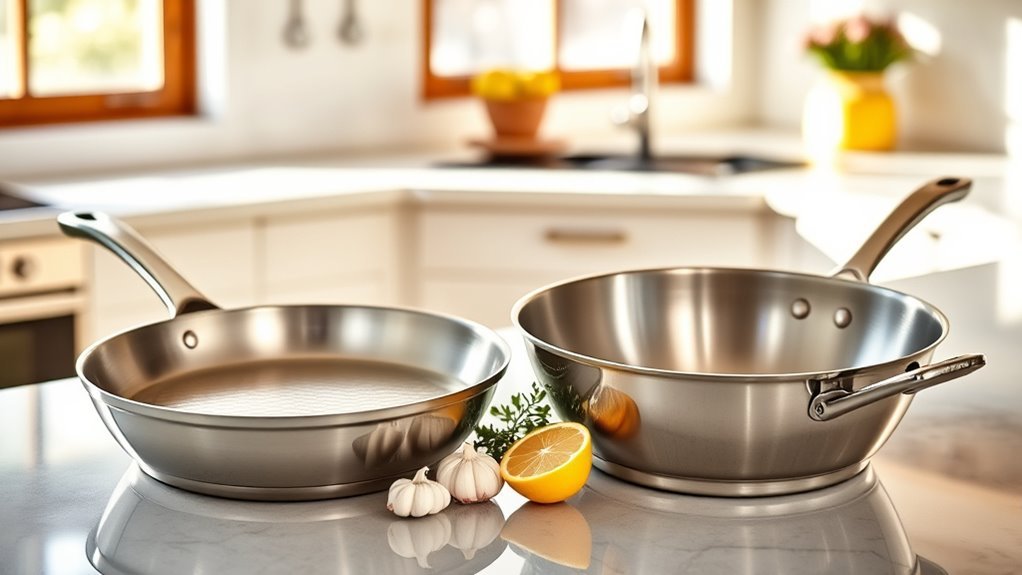
HexClad and Henckels take different paths to nonstick cookware. HexClad costs more, holds heat better, and performs especially well on induction, while Henckels heats faster and usually costs less. Henckels offers both PTFE-based and ceramic options, but HexClad’s textured TerraBond surface is more resilient and easier to clean after searing. Both still benefit from some oil. The better pick depends on whether speed, value, heat retention, or cooking style matters most, as the details matter.
Key Takeaways
- Henckels heats faster, while HexClad holds heat better for steadier cooking and induction performance.
- HexClad uses a textured stainless-steel and ceramic surface; Henckels offers smoother PTFE or ceramic nonstick options.
- Both pans need some oil for reliable release, but HexClad is generally easier to clean after searing.
- Henckels is usually cheaper and lighter, making it a strong value for quick tasks like eggs and pancakes.
- HexClad costs much more, but suits cooks who want better heat retention, browning, and more versatile all-purpose use.
HexClad vs. Henckels at a Glance
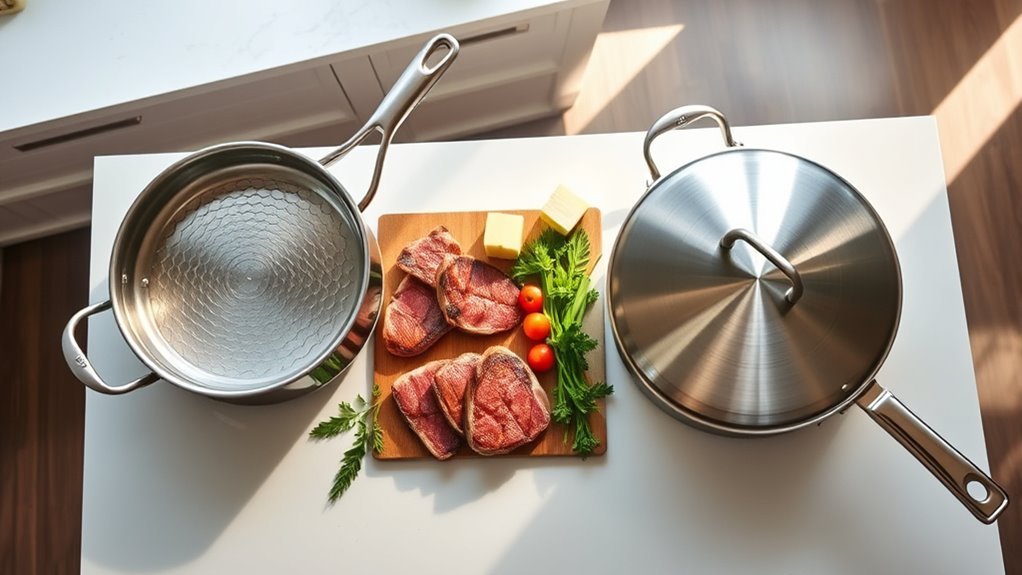
At a glance, HexClad and Henckels take different approaches to nonstick cookware: HexClad uses a proprietary ceramic TerraBond coating, while Henckels offers a PTFE-based surface, plus a PTFE-free ceramic option.
HexClad emphasizes heat retention; in testing, it held water at 102°F after 10 minutes, versus 96°F for Henckels.
HexClad held heat longer in testing, keeping water at 102°F after 10 minutes, versus 96°F for Henckels.
Henckels, by contrast, is lighter and heats faster, boiling water in 2:19 compared with HexClad’s 2:30. That makes Henckels the more agile choice for quick, efficient tasks, while HexClad is positioned for steadier thermal performance.
Build details also diverge: Henckels uses longer, angled handles with engraved logos, while HexClad’s handles are shorter, smoother, and groove-free.
Price separates them further. HexClad costs more than twice as much as Henckels Paradigm cookware, which may appeal to buyers seeking lower barriers to access and less expensive non-stick cookware overall.
How HexClad vs. Henckels Perform in Daily Cooking
Daily cooking tests show a split between speed and retention: Henckels reached a boil in 2:19, while HexClad took 2:30, giving Henckels the edge for fast tasks like eggs and pancakes.
Food release also depends on technique, as both pans need greasing, though Henckels delivered better initial browning on chicken thighs.
Over longer cooking periods, HexClad’s stronger heat retention can support steadier results.
Heat-Up Speed
When comparing heat-up speed, Henckels pans edge out HexClad in everyday stovetop use, boiling two cups of water in 2 minutes and 19 seconds versus HexClad’s 2 minutes and 30 seconds. The difference reflects lighter weight and more direct heat conduction in Henckels pans, which translates into faster heat response for cooks seeking freedom from delay.
| Pan | Time to boil 2 cups |
|---|---|
| Henckels | 2:19 |
| HexClad | 2:30 |
| Cooktop | Faster result |
| Standard stovetop | Henckels |
| Induction | HexClad |
HexClad can reach a boil faster on induction, but its thicker build also retains heat better. For quick browning of eggs or pancakes, Henckels often moves first.
Food Release Performance
Heat-up speed also shapes how each pan releases food in everyday cooking. In testing, both HexClad and Henckels required grease for reliable food release, yet Henckels HXagon heated faster and browned eggs and pancakes more effectively. That quicker response improved early release, especially on delicate batters and thin proteins.
HexClad, however, held heat longer after cooking, which can help maintain sear integrity during longer tasks. For meat, both performed well, but Henckels initially browned chicken thighs more aggressively before results evened out.
HexClad’s ceramic layer also simplified cleanup, giving it a more forgiving feel than many non-stick pans, while Henckels’ polished steel base was more likely to stain. For cooks seeking freedom from fuss, each offers a different path to control.
Which Pan Heats Faster on Induction?
On induction cooktops, HexClad heats faster and more steadily than Henckels. Tested and reviewed, HexClad uses its design to leverage induction cooktops efficiently, producing stronger heat distribution and a quicker climb to cooking temperature. For cooks seeking freedom from guesswork, that consistency matters.
| Pan | Time to Bubble | Time to Boil |
|---|---|---|
| HexClad | 2:10 | 5:30 |
| Henckels | Still simmering | Slower overall |
HexClad was the first to show bubbling water at 2:10, while Henckels was still simmering at that mark. By 5:30, HexClad reached a full boil, confirming the faster heat-up. Henckels can heat quickly at first, but it demands closer monitoring because it responds more sharply to changes. Both pans can handle delicate foods when greased, yet HexClad delivers the more controlled, efficient path on induction.
How Heat Retention Differs Between the Two
HexClad holds temperature longer than Henckels, showing stronger heat retention in side-by-side testing. In a 10-minute water test, HexClad stayed at 102°F, while Henckels fell to 96°F. That gap matters when cooking should not be rushed by falling temperatures.
HexClad pans use thicker construction, helping them conduct heat more steadily and hold it longer during prolonged use. Henckels, by contrast, heats faster at first but gives up temperature sooner, which can shift results in slow simmers, reductions, and delicate sauces.
- Faster initial heat-up: Henckels, 2:19
- Longer hold: HexClad, 2:30
- Even heating: both brands
- Better for long cooks: HexClad
For cooks seeking freedom from temperature swings, the difference is practical, not theoretical. Consistent heat retention can support more controlled outcomes when recipes demand patience and stable heat.
HexClad vs. Henckels Handle Design
Henckels handles measure 8.5 inches and sit 3.5 inches above the counter, compared with HexClad’s 8-inch length and 2.5-inch height.
That added length and angle can improve grip comfort and control for some users, while the lower HexClad profile may feel more compact in hand.
Henckels also adds a thumb indentation and engraved logo, whereas HexClad keeps a smoother, simpler handle design.
Handle Length And Angle
Handle geometry is one of the clearest differences between the two pans. HexClad offers an 8-inch handle set 2.5 inches above the counter, while Henckels extends to 8.5 inches and sits 3.5 inches high. That added height changes the handle length, grip style, comfort, and leverage in practical use.
- HexClad’s lower angle supports a relaxed hold.
- Henckels’ higher rise can aid lifting.
- Henckels adds an engraved logo and thumb indentation.
- HexClad stays smooth, with no grooves.
For lighter daily cooking, HexClad may feel more direct and freeing. For heavier dishes or more forceful maneuvering, Henckels can supply extra leverage.
Neither design is universally better; the better fit depends on the cook’s preferred angle and movement.
Grip Comfort And Control
Grip comfort and control differ in ways that matter during actual stovetop use.
Henckels handles, at 8.5 inches, give more leverage, while the higher angle supports steadier control when pans are lifted or shifted. Their engraved logo and thumb indentation add tactile guidance, improving grip comfort and reducing slip risk.
HexClad handles are shorter at 8 inches and sit 2.5 inches above the counter, creating a compact profile that may suit lighter handling. However, the smooth surface lacks grooves, so grip stability can weaken with heavier loads.
For users seeking freedom of movement and confident control, Henckels handles offer a more secure interface.
HexClad handles remain practical, but their cleaner design trades some grip comfort for minimalism and space efficiency.
Nonstick and Cooking Surface Differences
When comparing nonstick performance, HexClad uses a proprietary ceramic TerraBond coating that blends nonstick properties with stainless-steel durability, while Henckels relies on a PTFE-based coating and also offers a PTFE-free ceramic alternative.
On the surface, both use a hybrid layout, but HexClad cookware carries more stainless steel, which supports a tougher nonstick coating and easier cleanup. Its hexagonal texture also promotes even heat and helps release food with less sticking.
Henckels surfaces are smoother, so they may ask for more oil and gentler care to preserve release performance.
- HexClad: diamond-dust reinforcement for added durability
- Henckels: PTFE or ceramic choice for different preferences
- HexClad: textured cooking zone favors low-friction searing
- Henckels: smoother finish can need closer monitoring
For buyers seeking more independence at the stove, HexClad offers a more resilient cooking surface, while Henckels provides a simpler, conventional nonstick path with less abrasion tolerance.
HexClad vs. Henckels Bottom Design
HexClad’s bottom design extends its hexagon-patterned, non-stick stainless-steel surface beyond the interior, which helps improve durability, cleaning ease, and heat distribution.
Compared with Henckels, HexClad carries the hybrid pattern across the base, not just the cooking zone, giving the pan a more uniform exterior and a cleaner profile under use.
The non-stick coating on the HexClad bottom design reduces staining and makes wipe-downs easier, while Henckels’ polished steel bottoms can show marks over time.
On induction cooktops, HexClad’s construction is designed to engage more efficiently, supporting faster heating and more even heat distribution.
Henckels uses more exposed steel overall, which may shift the cooking feel and thermal retention.
For users seeking practical control and less maintenance, the bottom design difference is measurable: HexClad emphasizes performance and ease, while Henckels prioritizes a more traditional steel-heavy build.
Price, Value, and What You Get
On price, the gap is substantial: HexClad cookware generally costs more than double Henckels Paradigm, and in some cases a 12-inch HexClad frying pan costs more than a complete Henckels Paradigm 3-piece set.
HexClad’s price premium is stark: a single 12-inch pan can exceed a full Henckels Paradigm set.
That difference changes the value equation immediately. For buyers seeking liberation from overspending, Henckels presents a lower-risk path: comparable cooking features, less financial strain, and stronger everyday value.
HexClad justifies its premium through features such as better heat retention, which may matter in specific cooking situations, yet the price remains high relative to what is included.
- HexClad: premium price, premium feature set
- Henckels: lower price, practical value
- 12-inch HexClad pan can outcost a full Henckels set
- Budget and cooking needs should guide the choice
Which Pan Is Better for Your Cooking Style?
Which pan fits a given cooking style depends mainly on speed, heat retention, and handling.
Henckels heats faster and is lighter, so it suits quick-turn tasks such as eggs, pancakes, and other agile stovetop work. Its PTFE-based non-stick surface also appeals to buyers seeking a familiar, low-friction release.
HexClad, by contrast, combines stainless steel with a ceramic non-stick coating and holds heat more effectively, which supports searing, browning, simmering, and other patient methods.
On induction, HexClad typically shows stronger heat distribution and finer control, making it better for precision.
For cooks who value freedom of movement and rapid response, Henckels is the more flexible choice. For those who want steadier temperatures, more mass, and broader technique range, HexClad has the edge.
The better pan is consequently the one aligned with the user’s cooking style, not a universal winner.
Frequently Asked Questions
Are Henckel Pans as Good as Hexclad Pans?
Henckel pans are nearly as good as HexClad; they offer strong non stick performance, faster heat distribution, and lower cost. The durability comparison favors HexClad slightly, while cookware materials differ mainly in coating and retention.
What Is the Hexclad Controversy?
HexClad controversy centers on marketing claims challenged in a class-action suit. Hexclad reviews cited overstated nonstick performance, durability issues, and mixed customer satisfaction; the settlement offered refunds while HexClad denied wrongdoing, raising transparency concerns.
Are Henckels Pans Good Quality?
Yes, Henckels pans are generally good quality. Their cookware materials support responsive heat distribution, solid durability comparison, and easy maintenance tips, while lighter construction and ergonomic handles improve everyday control and value for cooks seeking autonomy.
Is There Better Pans Than Hexclad?
Absolutely, some pans are leagues better than HexClad. All-Clad and Cuisinart often win on heat distribution and durability comparison; Scanpan and T-fal can beat it on non stick performance and price evaluation, offering practical liberation.
Conclusion
When Henckels and HexClad go head-to-head, the differences can feel enormous: one leans toward classic stainless-steel durability and lower cost, while the other flashes hybrid nonstick convenience and a premium price tag. HexClad may heat faster and offer easier cleanup, but Henckels often wins on simplicity, value, and traditional cooking control. For buyers, the “better” pan is less about hype and more about matching performance, maintenance, and budget to the way they actually cook.
