
The best full synthetic motor oil is the one that matches your engine’s required viscosity and performance specifications. Choosing the wrong grade can matter more than choosing between two respected brands.
For vehicles that require 5W-30, Castrol EDGE 5W-30 is our best overall pick because it combines current API/ILSAC standards with broad OEM-spec coverage. Valvoline Advanced Protection 5W-30 is the value-focused alternative.
We checked each linked product against current manufacturer specifications, the linked ASIN, package size, viscosity, protection positioning, and current safety information.
Full Synthetic Motor Oil Compared
| Product | Best for | Viscosity | Package | Current standards |
|---|---|---|---|---|
|
Mid-range
|
Best overall | 5W-30 | 5-quart jug | API SQ, ILSAC GF-7, dexos1 Gen 3 |
|
Budget
|
Best value | 5W-30 | 5-quart jug | API SQ, ILSAC GF-7A, dexos1 Gen 3 |
|
Premium
|
Best for 5W-20 | 5W-20 | 6 × 1 quart | Current line: API SQ, ILSAC GF-7A |
|
Premium
|
Premium 0W-20 pick | 0W-20 | 5-quart bottle | API SQ, ILSAC GF-7 |
|
Mid-range
|
Best for high mileage | 5W-30 | 5-quart jug | API SQ, ILSAC GF-7A |
Best Full Synthetic Motor Oil: Our Top Picks
Bottom line: Castrol EDGE 5W-30 is the strongest all-around choice here when your engine requires 5W-30 and its listed approvals. It combines modern gasoline-engine specifications with Castrol’s extended-protection positioning.
- Viscosity: 5W-30, only for engines allowing this grade
- Package: 5-quart jug, convenient for many oil changes
- Standards: API SQ, ILSAC GF-7, dexos1 Gen 3, broad current coverage
- Positioning: Up to 20,000 miles or one year, manufacturer claim
Castrol positions current EDGE 5W-30 for wear protection, viscosity control, cleanliness, and high-temperature performance. Its current U.S. specifications include API SQ, ILSAC GF-7, GM dexos1 Gen 3, and relevant Ford and Chrysler requirements.
The extended-protection claim does not override your owner’s manual. If your vehicle calls for a shorter interval, severe-service schedule, or different approval, follow the vehicle requirement instead.
- Current API SQ and ILSAC GF-7 performance standards
- GM dexos1 Gen 3 specification listed for 5W-30
- Convenient 5-quart package
- Extended-protection positioning for compatible applications
- Not suitable when your engine requires another viscosity
- Maximum protection claim does not replace the OEM interval
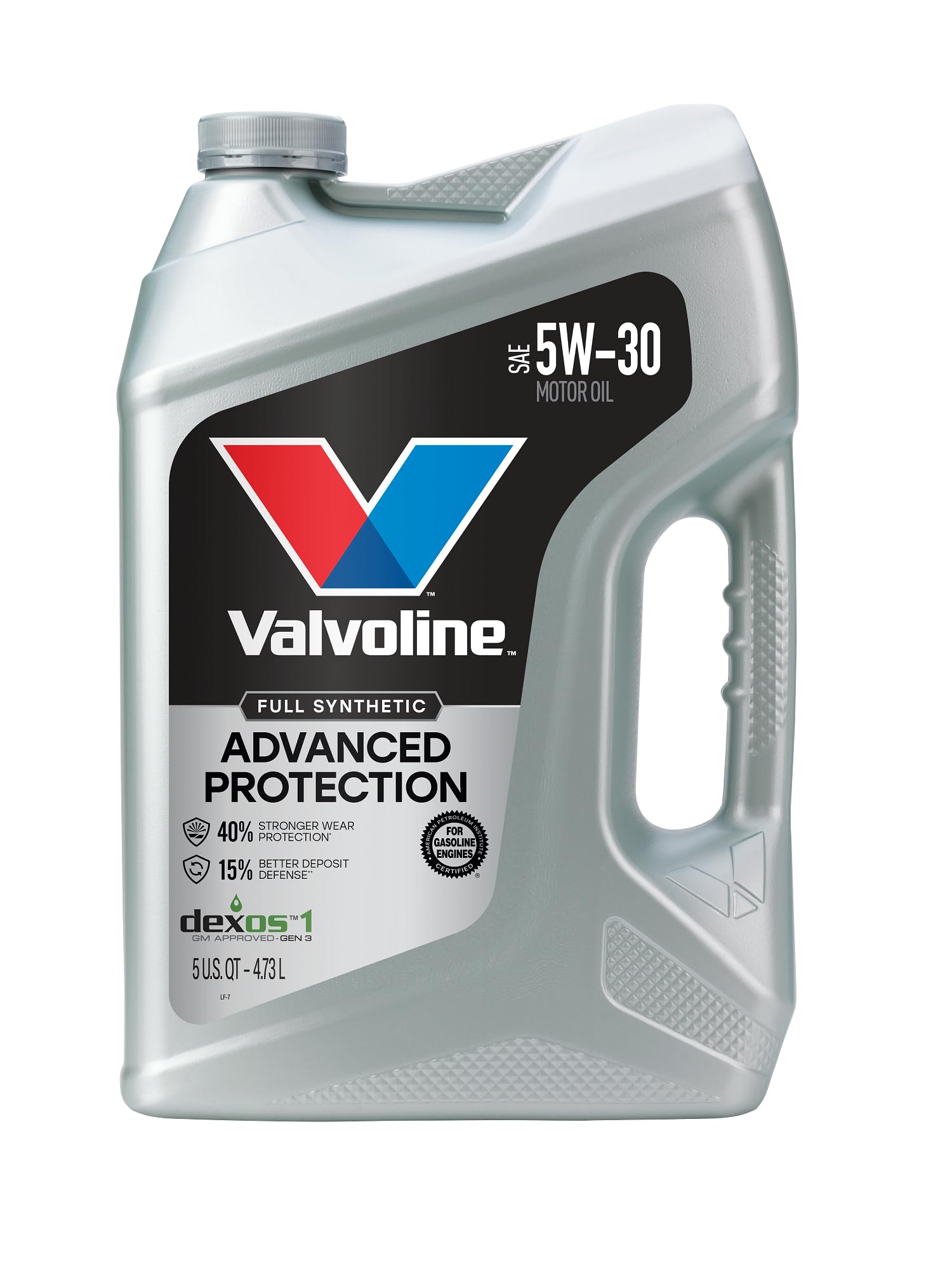
Bottom line: Valvoline Advanced Protection 5W-30 is the value pick for routine maintenance when your vehicle specifies 5W-30 and its current approvals match.
- Viscosity: 5W-30, common but not universal
- Package: 5-quart jug, practical for routine service
- Standards: API SQ, ILSAC GF-7A, dexos1 Gen 3, current gasoline specs
- Positioning: Everyday full synthetic, focused on core engine protection
Valvoline’s current Advanced Protection formula targets the four common stresses the brand highlights: wear, friction, heat, and deposits. The 5W-30 version also lists API SQ, ILSAC GF-7A, Ford WSS-M2C961-A1, Chrysler MS-13340, and GM dexos1 Gen 3 requirements.
It is a straightforward choice if you do not need a dedicated high-mileage formula. Valvoline also advises owners to use the oil-change interval specified by the vehicle manufacturer rather than assuming a fixed extended interval.
- Current API SQ and ILSAC GF-7A standards
- GM dexos1 Gen 3 listed for this viscosity
- Full-synthetic formula for everyday driving
- Convenient 5-quart jug
- Not a dedicated high-mileage formula
- No universal extended oil-change interval should be assumed
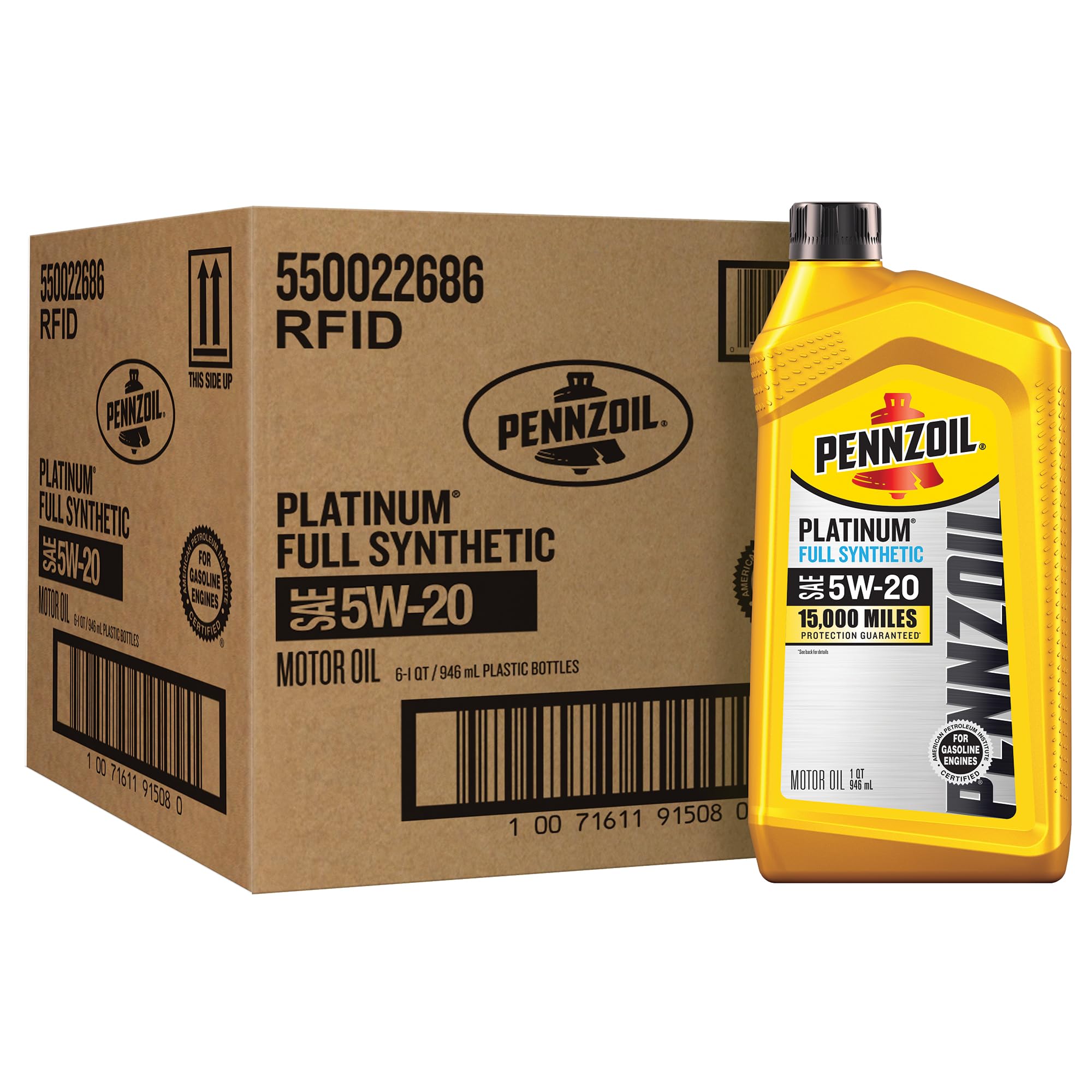
Bottom line: Pennzoil Platinum 5W-20 is the most practical pick here for compatible 5W-20 engines, especially if you prefer six separate quart bottles for measuring and top-offs.
- Viscosity: 5W-20, use only where approved
- Package: Six 1-quart bottles, flexible for measuring and storage
- Standards: Current line API SQ and ILSAC GF-7A, verify bottle
- Positioning: 15,000-mile or one-year protection guarantee, conditions apply
The linked ASIN is a case of six 1-quart bottles, giving you six quarts total. That can be more convenient than a single jug when your engine capacity is not exactly five quarts or when you want oil left for future top-offs.
Pennzoil now describes Platinum as made with natural gas. Its current warranty offers protection for up to 15,000 miles or one year under stated conditions, including eligibility requirements, a suitable filter, and following the vehicle manufacturer’s guidance.
- Six individual quart bottles simplify measuring
- Current Pennzoil line meets modern API/ILSAC requirements
- Manufacturer protection guarantee is available under stated terms
- Useful choice for engines specifying 5W-20
- Six bottles take more storage space than one jug
- Warranty protection has eligibility and service conditions
- Older inventory may show an earlier specification label
Bottom line: Royal Purple High Performance 0W-20 is the premium option in this group for vehicles specifically calling for 0W-20.
- Viscosity: 0W-20, intended for engines specifying this grade
- Package: 5-quart bottle, convenient for routine service
- Standards: API SQ and current ILSAC GF-7 formulation, modern coverage
- Positioning: High-performance synthetic, premium rather than extended-drain focused
Royal Purple’s current High Performance Motor Oil line has been updated for the API SQ and ILSAC GF-7 generation of standards. The 0W-20 version remains available in a 5-quart size matching the linked product.
The main reason to choose it is not that 0W-20 is inherently better than 5W-20 or 5W-30. It makes sense only when 0W-20 and the listed performance specifications are correct for your engine.
- Current API SQ performance positioning
- 0W-20 option for compatible modern engines
- Five-quart package suits many oil-change capacities
- Distinct performance-focused formulation
- Premium positioning may cost more than mainstream alternatives
- Wrong choice for engines requiring another viscosity
Bottom line: Mobil 1 Extended Performance High Mileage 5W-30 is the most targeted choice for compatible engines with more than 75,000 miles.
- Viscosity: 5W-30, confirm your engine allows this grade
- Package: 5-quart jug, convenient for routine service
- Standards: API SQ and ILSAC GF-7A, current gasoline standards
- Positioning: 25,000 miles or one year guaranteed, conditions apply
Mobil markets this formula specifically for engines over 75,000 miles. The current formulation is designed to address deposits and leaks while providing the brand’s extended-protection benefits.
The current manufacturer guarantee is up to 25,000 miles or one year, whichever comes first, subject to its terms. Mobil also tells owners of vehicles under warranty to follow the vehicle’s oil-life system or manufacturer-recommended interval.
High-mileage engines also deserve regular oil-level checks. Age, wear, leaks, or consumption can reduce the oil level before an extended interval is reached.
- Designed specifically for engines over 75,000 miles
- Current API SQ and ILSAC GF-7A standards
- Formulated to help prevent leaks and deposits
- Manufacturer-backed extended-protection guarantee
- Specialty formula may be unnecessary for lower-mileage engines
- Maximum interval does not automatically apply to every vehicle
- Oil level still needs regular checking on aging engines
Castrol EDGE 5W-30 vs Valvoline Advanced Protection 5W-30: Is the Upgrade Worth It?
Both oils cover mainstream 5W-30 applications with current API and ILSAC performance standards. The choice comes down more to protection positioning, specific OEM requirements, and current cost than to viscosity.
- Extended-protection positioning: Castrol markets EDGE 5W-30 for up to 20,000 miles or one year, while Valvoline directs owners to the vehicle manufacturer’s oil-change interval.
- Current standards: Both carry modern API/ILSAC credentials, and both list GM dexos1 Gen 3 for 5W-30.
- Buying focus: Castrol fits buyers who value its premium extended-protection positioning; Valvoline is the simpler value choice for routine service.
- Compatibility: Compare every required OEM specification, because matching SAE viscosity alone is not enough.
Which Motor Oil Should You Buy?
- Balanced 5W-30 protection: get the Castrol EDGE 5W-30.
- Value-focused 5W-30: get the Valvoline Advanced Protection 5W-30.
- 5W-20 with individual quart bottles: get the Pennzoil Platinum 5W-20.
- Premium 0W-20: get the Royal Purple High Performance 0W-20.
- High-mileage 5W-30: get the Mobil 1 Extended Performance High Mileage 5W-30.
How We Chose
- Exact product match: We checked each linked ASIN against the product name, viscosity, and package size.
- Current specifications: Manufacturer information took priority for API, ILSAC, dexos, Ford, Chrysler, and other performance requirements.
- Use case: We separated everyday, premium, 5W-20, 0W-20, and high-mileage needs instead of treating different viscosities as direct substitutes.
- Real-world information: We looked for repeated non-Amazon owner trends and did not treat isolated anecdotes as evidence.
- Safety and freshness: We checked current product information and recall sources before keeping each oil as a recommended pick.
Oil Change Safety and Service Notes
- Follow the service schedule: An extended-protection claim does not automatically replace your oil-life monitor, warranty terms, or severe-service interval.
- Check the oil level: Inspect it regularly, especially on older engines that may consume or leak oil.
- Use a suitable filter: Longer protection claims may require a filter designed for the intended service interval.
- Use the correct capacity: Do not assume a five-quart jug equals your engine’s required fill volume.
- Dispose of used oil correctly: Take used motor oil and filters to an appropriate recycling or collection location.
How to Choose Full Synthetic Motor Oil
Start With the Required Viscosity
SAE grades such as 0W-20, 5W-20, and 5W-30 describe how an oil behaves across temperature conditions. They are not interchangeable simply because they are all full synthetic. Check the owner’s manual, oil-filler cap, or official manufacturer service information before ordering.
Match API, ILSAC, and OEM Specifications
Viscosity is only part of compatibility. Your vehicle may also require an API category, ILSAC specification, dexos approval, or a Ford, Chrysler, European, or other manufacturer standard. Read the current bottle label rather than assuming every viscosity in a product family carries identical approvals.
Understand API SQ and ILSAC GF-7
API SQ and the ILSAC GF-7 generation are current gasoline-engine oil standards. GF-7A covers common grades such as 0W-20, 5W-20, and 5W-30, while some lower-viscosity applications use GF-7B. Older vehicles may require an earlier standard, so vehicle documentation remains the deciding source.
Do Not Choose Oil by the Longest Mileage Claim
Some oils carry extended-protection guarantees, but those claims have conditions. Severe driving, warranty requirements, oil consumption, filter capability, and the vehicle manufacturer’s schedule can all require a shorter interval. The longest advertised interval is not automatically the right interval for your engine.
Decide Whether You Need High-Mileage Oil
High-mileage formulas are commonly marketed for engines above 75,000 miles. They may include formulation choices aimed at aging-engine concerns such as leaks and deposits. If you have a compatible higher-mileage 5W-30 engine, Mobil 1 Extended Performance High Mileage 5W-30 is the targeted option here.
Choose the Package Size That Fits Your Oil Capacity
Most picks here use 5-quart containers, while Pennzoil Platinum 5W-20 comes as six 1-quart bottles. Check your engine’s oil capacity before buying so you have enough for the change without accidentally overfilling it.
Mistakes to Avoid When Buying Motor Oil
- Buying by brand alone: Verify viscosity and specifications before comparing brands.
- Assuming thicker is safer: Use the viscosity your engine was designed to run.
- Ignoring OEM approvals: API or ILSAC compliance may not cover every manufacturer-specific requirement.
- Stretching the interval automatically: Follow the shorter applicable vehicle or product requirement.
- Forgetting package volume: Confirm both engine capacity and how much oil the listing actually includes.
FAQs
Which Motor Oil Should I Use?
Use the SAE viscosity and performance specifications listed by your vehicle manufacturer. Check the owner’s manual, oil-filler cap, or official service information, then confirm that the current oil bottle carries the required API, ILSAC, and OEM specifications. Brand and marketing claims should come after compatibility.
Is 0W-20 Better Than 5W-20 or 5W-30?
No viscosity grade is universally better. The numbers describe the oil’s viscosity behavior at cold start and operating temperature. Engines are designed around specific grades and performance requirements, so use an approved viscosity rather than choosing the thinnest, thickest, or most expensive oil.
Can I Mix Different Motor Oils?
Compatible engine oils can generally be mixed for an emergency top-off, but matching the required viscosity and specification is preferable. Mixing different formulations can dilute the additive package or specialty benefits. For a planned oil change, use one compatible product in the correct quantity whenever practical.
Does Synthetic Oil Void My Vehicle Warranty?
Using synthetic oil by itself generally does not void a U.S. vehicle warranty. What matters is using oil that meets the manufacturer’s required viscosity and specifications and following the required maintenance schedule. Keep service records and check your warranty documentation because requirements can vary by vehicle and manufacturer.
Do Extended-Protection Claims Replace My Service Schedule?
No. A motor-oil mileage guarantee can include operating, filter, eligibility, and warranty conditions. Follow your vehicle’s oil-life monitor, owner’s manual, severe-service schedule, and warranty requirements when they call for a shorter interval. Frequent towing, idling, short trips, dust, or extreme temperatures can also affect service needs.
Should I Use High-Mileage Oil After 75,000 Miles?
High-mileage oil can be a useful option after about 75,000 miles, especially when the formulation targets aging-engine concerns such as deposits or leaks. It is not mandatory solely because the odometer crossed that number. The oil still needs the correct viscosity and specifications for your particular engine.
How Do I Know When to Change My Oil?
Follow the vehicle’s oil-life monitor or scheduled maintenance interval and check the oil level regularly. Do not wait for the next scheduled change if you find a low level, visible leak, oil-pressure warning, unusual engine noise, or persistent burning-oil smell. Diagnose the underlying problem promptly.
Final Verdict
The best full synthetic motor oil depends first on your engine’s viscosity and specification requirements. For compatible 5W-30 vehicles, Castrol EDGE combines current standards, broad OEM coverage, and clear extended-protection positioning.
For a value-focused 5W-30 option, compare Valvoline Advanced Protection 5W-30; for a premium 0W-20 application, consider Royal Purple High Performance 0W-20.
| Product Name | Image | Viscosity | Package Size | Best For |
|---|---|---|---|---|
| Castrol EDGE 5W-30 Advanced Full Synthetic Motor Oil, 5 Quarts |
 |
5W-30 | 5 Quarts | Best overall for compatible 5W-30 vehicles |
| Valvoline Advanced Full Synthetic SAE 5W-30 Motor Oil 5 QT |
 |
5W-30 | 5 Quarts | Value-focused everyday maintenance |
| Pennzoil Platinum Full Synthetic 5W-20 Motor Oil (1-Quart, Case of 6) |
 |
5W-20 | 6 × 1 Quart | Flexible packaging and extended-protection positioning |
| Royal Purple ROY51020 API-Licensed SAE 0W-20 High Performance Synthetic Motor Oil – 5 qt. |
 |
0W-20 | 5 Quarts | Premium 0W-20 applications |
| Mobil 1 Extended Performance High Mileage Full Synthetic Motor Oil 5W-30, 5 Quart |
 |
5W-30 | 5 Quarts | Engines over 75,000 miles |