
Yes, a Toyota RAV4 can run on synthetic oil. In fact, full synthetic oil is a practical and widely available choice for many RAV4 engines. What matters most, however, is not the word “synthetic” on the bottle. The oil must match the SAE viscosity and performance standard listed for your exact model year, engine, powertrain, and market.
Quick Answer
A Toyota RAV4 can use full synthetic oil, provided it has the viscosity and API or ILSAC certification required by the exact owner’s manual. Do not switch to thicker oil solely because the engine has passed 75,000 miles, and do not extend oil-change intervals beyond Toyota’s schedule simply because the oil is synthetic.
Key Takeaways
- Check the oil cap and the owner’s manual for your exact RAV4 before buying oil.
- Viscosity, such as 0W-16, is different from the oil’s synthetic or conventional formulation.
- A fallback grade such as 0W-20 may be permitted temporarily, but it is not automatically a permanent substitute.
- High mileage alone is not a reason to change from the factory-specified viscosity to 5W-30.
- For many recent RAV4s, normal-service oil changes occur at 10,000 miles or 12 months, while qualifying special-service use requires 5,000-mile or six-month changes.
How to Choose the Right Oil for Your Toyota RAV4

The safest way to choose Toyota RAV4 engine oil is to verify the specification for the exact vehicle rather than relying on a broad online chart. Oil requirements can change between engines, generations, hybrid systems, countries, and even consecutive model years.
- Read the oil-filler cap. The cap normally displays the primary SAE viscosity, such as 0W-20 or 0W-16.
- Check the owner’s manual. The manual identifies the required viscosity, oil-performance standard, allowable substitute grades, and oil capacity.
- Confirm the engine and powertrain. A gasoline RAV4, RAV4 Hybrid, and RAV4 Plug-in Hybrid may not always share the same specification.
- Use the correct market manual. A U.S.-specification vehicle may have different instructions from one sold in Canada, Europe, Australia, or another market.
- Match the certification mark. Use an oil that carries the API or ILSAC certification required by the manual, not merely one with the correct viscosity printed on the front.
Note: Toyota’s maintenance guides direct owners to the vehicle’s owner’s manual for the specific viscosity. The manual and oil cap take priority over generic model-year charts.
Viscosity, Certification, and Synthetic Oil Are Different
An oil label contains several kinds of information:
- SAE viscosity describes how the oil flows when cold and at operating temperature. Examples include 0W-16, 0W-20, and 5W-30.
- API or ILSAC certification confirms that the oil has passed a defined set of performance tests. Look for the certification mark required by your manual.
- Synthetic, synthetic blend, or conventional describes the base-oil formulation. This does not replace the viscosity or certification requirement.
The American Petroleum Institute’s current Motor Oil Guide explains the certification marks used on passenger-car engine oil. Its shield-shaped mark is used for certified 0W-16 oils, while other eligible passenger-car grades use the standard certification mark.
The correct viscosity and performance certification matter more than the marketing term printed most prominently on the bottle.
Recommended Oil Types by RAV4 Model Year and Engine
The following table gives common examples for U.S.-market vehicles. It is not a substitute for the manual supplied with your RAV4.
| Model and Engine | Common U.S. Specification | Important Qualification |
|---|---|---|
| 2012 RAV4, 2.5L four-cylinder | SAE 0W-20 preferred | The manual permits 5W-20 when 0W-20 is unavailable and directs the owner to return to 0W-20 at the next change. |
| 2012 RAV4, 3.5L V6 | SAE 5W-30 | This engine has a different requirement from the four-cylinder. Do not select oil by model year alone. |
| 2013–2018 RAV4, 2.5L four-cylinder | Commonly SAE 0W-20 | Some manuals permit 5W-20 temporarily if 0W-20 is unavailable. Verify the exact year and market. |
| 2019–2025 RAV4, 2.5L gasoline and electrified variants | Commonly SAE 0W-16 | Where the manual permits 0W-20 because 0W-16 is unavailable, return to 0W-16 at the next oil change. |
| 2026 RAV4 generation | Check the exact 2026 owner’s manual | The 2026 RAV4 is a new generation with separate documentation. Do not assume the 2025 grade or capacity carries forward. |
The official 2012 Toyota RAV4 Owner’s Manual documents the different requirements for the four-cylinder and V6 engines. Toyota also provides manuals for later vehicles through its Manuals and Warranties portal.
Pro Tip: Save a photo of the oil-filler cap and the manual’s oil-specification page on your phone. You can compare them with the bottle before buying oil or handing the vehicle to a service shop.
Benefits of Using Synthetic Oil in Your RAV4
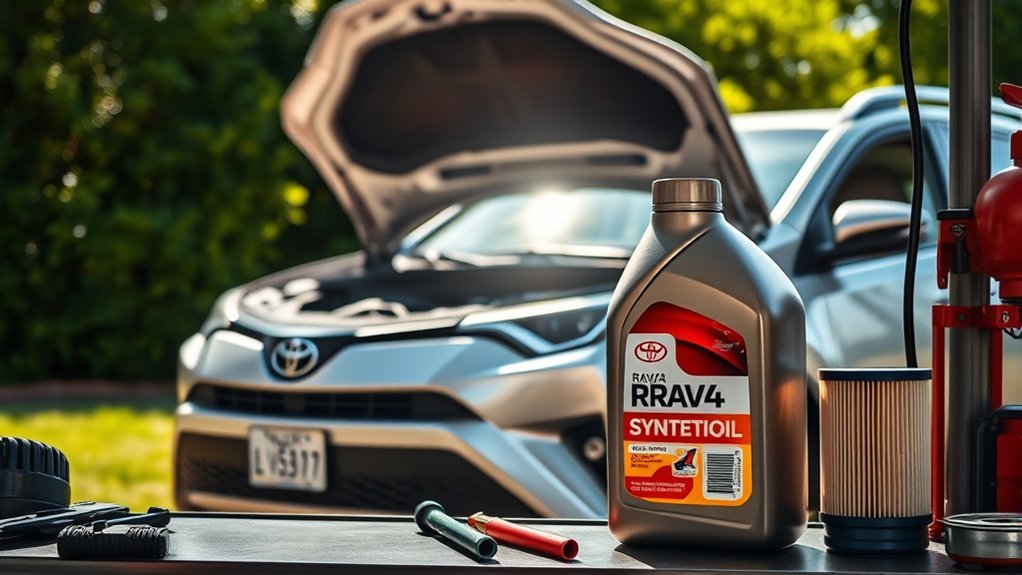
A properly specified synthetic oil can provide several practical advantages. Synthetic formulations generally maintain their performance well across a broad temperature range, resist oxidation, and flow readily during cold starts. They are also readily available in the low-viscosity grades used by many recent RAV4 engines.
Those advantages do not mean that any synthetic oil is suitable. A synthetic 5W-30 is not an automatic replacement for specified 0W-16, and a synthetic label does not authorize a longer interval than Toyota publishes.
Choose a product that satisfies all three requirements:
- The correct SAE viscosity
- The required API or ILSAC performance category
- The oil-change interval listed for your vehicle and driving conditions
Claims that synthetic oil will dramatically improve fuel economy, repair worn seals, or reverse existing engine damage should be treated cautiously. Correct oil can support normal lubrication and cleanliness, but it cannot repair failed gaskets, worn piston rings, damaged bearings, or a mechanical oil leak.
Oil Change Frequency for Your RAV4
Oil-change frequency depends on the model year and operating conditions, not simply on whether the bottle says synthetic. For the 2025 RAV4, Toyota’s official maintenance chart schedules general maintenance every 5,000 miles or six months and engine-oil replacement at the 10,000-mile normal-service points.
| Operating Pattern | Typical 2025 RAV4 Oil Interval |
|---|---|
| Normal operation with the recommended oil | 10,000 miles or 12 months, whichever comes first |
| Vehicle driven primarily on dirt or dusty roads | 5,000 miles or six months |
| Frequent towing, car-top-carrier use, or heavy loading | 5,000 miles or six months when the Toyota schedule identifies the condition for your model |
| Repeated trips under five miles in temperatures below 32°F/0°C | 5,000 miles or six months |
| Extensive idling or prolonged low-speed commercial-style driving | 5,000 miles or six months |
These intervals come from the 2025 Toyota RAV4 Warranty & Maintenance Guide. Earlier and later vehicles may have different schedules, so use the guide for your exact model year.
Note: A maintenance reminder at 5,000 miles does not always mean the engine oil is due. That visit may include tire rotation, inspections, and fluid checks. Check the maintenance chart rather than assuming every reminder is an oil-change reminder.
Should a High-Mileage RAV4 Use High-Mileage Oil?
A high-mileage oil can be used in a RAV4 when it has the exact viscosity and certification required for the engine. Some high-mileage formulations contain additives intended to condition aging seals or manage deposits, but mileage alone does not authorize a thicker grade.
For example, a RAV4 specified for 0W-16 should not automatically be switched to 5W-30 when the odometer reaches 75,000 miles. If the engine is leaking, consuming oil, making unusual noise, or showing a low-oil-pressure warning, have the cause diagnosed rather than trying to hide the symptom with thicker oil.
Check the oil level more frequently as the vehicle ages. Oil consumption can vary with driving style, temperature, maintenance history, mechanical condition, and total mileage.
How to Check and Top Up RAV4 Engine Oil
- Park on level ground and turn off the engine.
- Wait several minutes so the oil can drain back into the oil pan. Follow any timing instruction in your owner’s manual.
- Remove the dipstick, wipe it clean, fully reinsert it, and remove it again.
- Confirm that the oil level is between the low and full marks.
- If the level is low, add the manual-specified oil in small amounts through the filler opening.
- Recheck the dipstick after each addition and stop before the level exceeds the full mark.
Warning: Hot engine oil can cause serious burns. Never work under a vehicle supported only by a jack, avoid prolonged skin contact with used oil, and do not drive with an oil-pressure warning illuminated. Overfilling can also damage the engine or emissions system.
Oil Capacity and Filter Selection
RAV4 oil capacity varies by engine, powertrain, model year, and whether the filter is replaced. Do not pour in a generic quantity taken from an unrelated RAV4 chart. Check the capacity in the owner’s manual, add slightly less than the reference amount, run the engine as directed, inspect for leaks, and make the final adjustment with the dipstick.
Choose an oil filter using the VIN, engine, and model year. A Toyota Genuine filter is one option, but an aftermarket filter may also be suitable when its manufacturer lists the exact RAV4 application and it meets the necessary fit, bypass-valve, sealing, and filtration requirements. A brand name by itself does not confirm fitment.
Common Mistakes to Avoid When Changing Your Toyota RAV4’s Oil
Avoid these common errors when selecting, topping up, or changing RAV4 engine oil:
- Choosing oil by mileage alone: Passing 75,000 miles does not automatically change the factory viscosity requirement.
- Treating a fallback grade as permanent: If the manual permits a substitute because the preferred oil is unavailable, follow its instruction about returning to the preferred grade.
- Extending the interval because the oil is synthetic: Follow Toyota’s schedule and the applicable normal- or special-service conditions.
- Using the wrong capacity: Underfilling can reduce lubrication, while overfilling may cause foaming, excess crankcase pressure, leaks, or emissions-system damage.
- Ignoring the certification mark: Matching the viscosity alone does not prove that the oil meets the required performance category.
- Installing the wrong filter: Verify the exact application instead of assuming all RAV4 filters are interchangeable.
- Using supplemental additives without approval: Modern licensed oil already contains a balanced additive package. Add another product only when Toyota specifically authorizes it.
- Failing to check for leaks: Inspect the drain plug and filter area after service and recheck the oil level.
- Improperly discarding used oil: Store it in a clean, leak-proof container and take it to an authorized collection location.
Related Guides
Frequently Asked Questions
Can I mix synthetic and conventional oil in my RAV4?
Routine mixing is not ideal because it can reduce the benefits of the chosen formulation. During an emergency, however, topping up with a compatible oil that meets the correct viscosity and performance specification is generally safer than driving with a dangerously low oil level. Return to the preferred oil at the next service.
What oil filter should I use for my Toyota RAV4?
Use a Toyota Genuine filter or a verified equivalent listed for the exact model year, engine, and powertrain. Confirm fitment with the VIN or an authoritative parts catalog rather than selecting a filter by brand alone.
Is high-mileage oil safe for my RAV4?
Yes, provided the high-mileage product has the viscosity and certification required by the owner’s manual. Do not change to a thicker viscosity solely because the vehicle has exceeded 75,000 miles.
How do I know when to change my RAV4’s oil?
Follow the maintenance guide for the exact model year and compare your driving with Toyota’s normal and special operating conditions. Do not rely only on a dashboard reminder, because some reminders indicate a general 5,000-mile maintenance visit rather than an oil change.
Can I use oil additives in my RAV4 engine?
Supplemental additives are normally unnecessary when you use properly certified engine oil. They can alter the oil’s balanced formulation, so use one only when Toyota specifically recommends or authorizes it for your vehicle.
Can I use 0W-20 instead of 0W-16 in a RAV4?
Only when the exact owner’s manual permits it. In many fifth-generation U.S. RAV4 manuals, 0W-20 is allowed when 0W-16 is unavailable, with instructions to return to 0W-16 at the next oil change. Do not assume the same rule applies to every model year.
Do I have to use Toyota-branded synthetic oil?
No particular brand is required solely because it carries Toyota’s name. The oil must meet the viscosity and performance requirements in the manual, and maintenance must be performed correctly. Keep receipts showing the oil grade, specification, filter, mileage, and service date.
Conclusion
A Toyota RAV4 can run well on synthetic oil, but the correct choice depends on more than the base-oil type. Verify the SAE viscosity, API or ILSAC certification, capacity, substitute-oil rules, and maintenance interval for the exact engine and model year. High mileage does not automatically justify thicker oil, and synthetic oil does not override Toyota’s service schedule.
Check the oil level regularly, use a correctly fitted filter, investigate leaks or unusual consumption, and retain maintenance records. With the correct specification and timely service, the engine receives the protection Toyota intended without relying on unsupported shortcuts or one-size-fits-all advice.
Sources
- Toyota 2025 RAV4 Warranty & Maintenance Guide — normal maintenance intervals, special operating conditions, and oil-selection instructions.
- Toyota 2012 RAV4 Owner’s Manual — engine-specific viscosity and capacity information.
- Toyota 2019 RAV4 Owner’s Manual — fifth-generation engine-oil specifications and substitute-oil guidance.
- Toyota 2026 RAV4 Hybrid Warranty & Maintenance Guide — current-generation maintenance documentation.
- American Petroleum Institute Motor Oil Guide — API and ILSAC certification marks and current oil categories.
- U.S. Environmental Protection Agency: Managing, Reusing, and Recycling Used Oil — safe handling and recycling of used motor oil.
