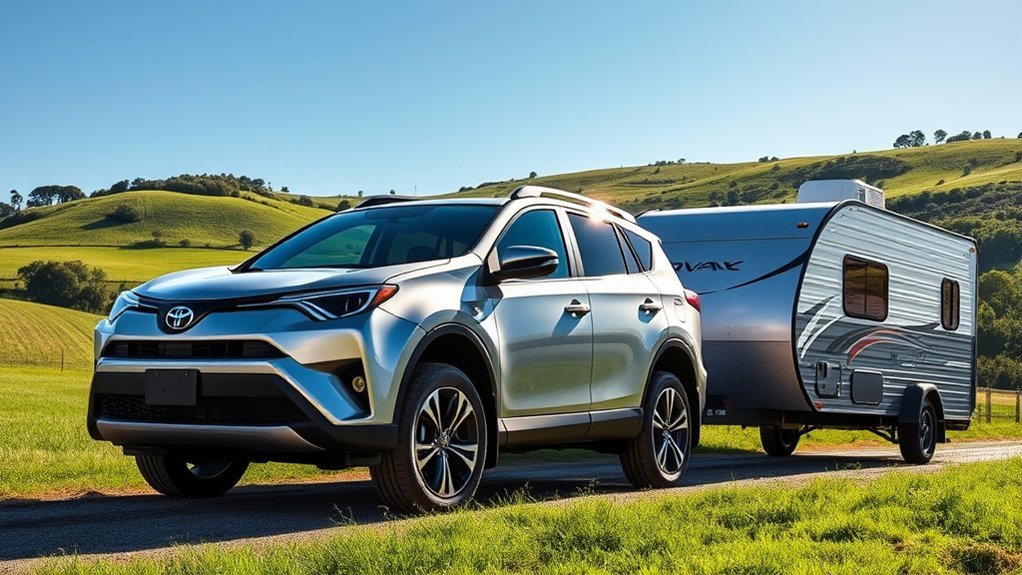
Yes, a Toyota RAV4 can pull certain lightweight campers, but the correct answer depends on the vehicle’s model year, powertrain, drive system, and grade. You also need to check the camper’s loaded weight, tongue weight, and effect on the RAV4’s payload. A camper’s advertised dry weight alone does not prove that the combination is safe.
Quick Answer
A Toyota RAV4 can tow a small teardrop, compact pop-up, or other lightweight camper when its actual loaded weight stays below the exact vehicle’s tow rating. U.S. RAV4 ratings vary from about 1,500 to 3,500 pounds by model year and grade, but payload and tongue-weight limits can reduce what is practical.
Key Takeaways
- Check the owner’s manual for your exact model year, powertrain, drivetrain, and grade. A generic RAV4 rating is not enough.
- Compare the limit with the camper’s loaded weight, not only its dry or unloaded weight.
- Tongue weight, passengers, cargo, and hitch equipment all use part of the RAV4’s payload capacity.
- Current nuCamp TAB 320 and Forest River r•pod models are heavier than the figures in many older online lists.
- AWD and Trailer-Sway Control can aid traction or stability, but they do not increase the manufacturer’s towing or payload ratings.
Toyota RAV4 Towing Capacities by Model Year
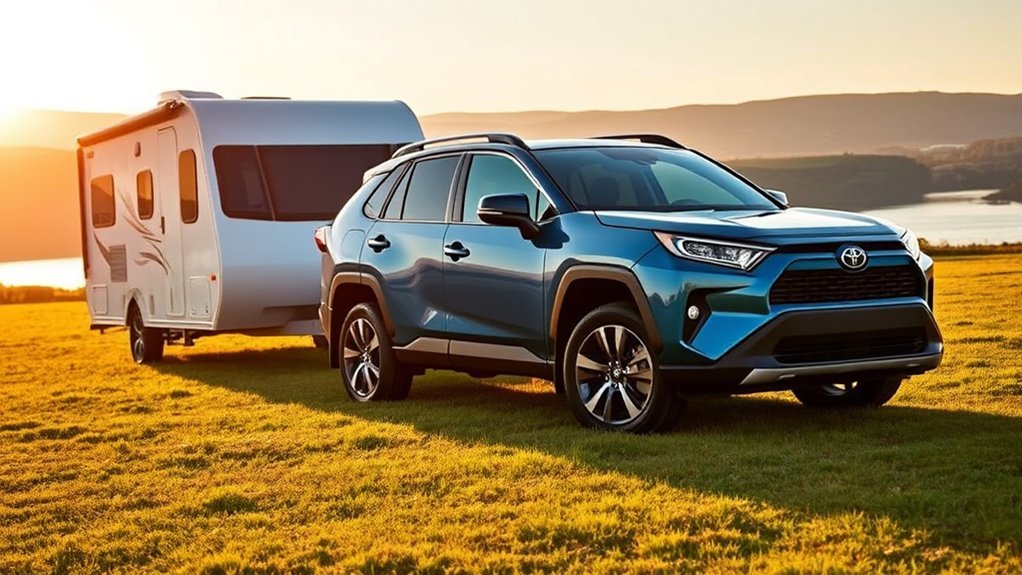
RAV4 towing capacity is not a single number. Toyota has changed the available powertrains, grades, and tow ratings between model years. The figures below summarize commonly published U.S. ratings, but your exact Toyota owner’s manual and vehicle labels remain the final authority.
| Model year and configuration | Published maximum | Important context |
|---|---|---|
| 2024 gas LE, XLE, XLE Premium, and Limited | Up to 1,500 lb | Confirm FWD or AWD equipment and the exact manual. |
| 2024 RAV4 Hybrid | Up to 1,750 lb | A small camper must remain within both trailer-weight and payload limits. |
| 2024 RAV4 Prime plug-in hybrid | Up to 2,500 lb | The trailer’s travel-ready weight can be much higher than its brochure dry weight. |
| 2024 Adventure and TRD Off-Road | Up to 3,500 lb | These gas grades were not continued for the 2025 model year. |
| 2025 gas RAV4 | Up to 1,500 lb | Toyota offered LE, XLE, XLE Premium, and Limited gas grades for 2025. |
| 2025 RAV4 Hybrid | Up to 1,750 lb | Do not pair it with a trailer weighing more than this before cargo is added. |
| 2025 RAV4 Plug-in Hybrid | Up to 2,500 lb | Available in SE and XSE grades in the U.S. |
| 2026 RAV4 FWD and LE AWD | Up to 1,750 lb | The redesigned U.S. RAV4 uses hybrid and plug-in-hybrid powertrains. |
| Specified 2026 AWD HEV and PHEV grades | Up to 3,500 lb | Toyota lists selected AWD grades only. Confirm the finalized rating for your exact grade and equipment. |
Warning: Never apply the highest RAV4 rating to every model. Use the lowest applicable limit among the vehicle, hitch receiver, ball mount, hitch ball, trailer, tires, axles, and local legal requirements. Exceeding any one of these limits can reduce steering control, braking performance, and vehicle stability.
How to Check Whether a Camper Fits Your RAV4
A camper is compatible only when every relevant weight remains within its limit. Use this process before buying or renting a trailer.
1. Find Your Exact RAV4 Rating
Identify the model year, powertrain, drivetrain, and grade. Then check the towing section of the owner’s manual. Do not rely on a search result that simply says “RAV4 towing capacity.”
2. Use Loaded Trailer Weight
Start with the trailer’s unloaded weight, then add batteries, propane, water, dealer-installed options, food, clothing, camping equipment, and everything stored inside. A public vehicle scale gives you a more reliable figure than a brochure estimate.
3. Calculate the RAV4’s Payload Use
The payload label is normally located near the driver’s door. Subtract the weight of passengers, vehicle cargo, hitch equipment, and the trailer’s tongue weight from the available payload.
Example: If a RAV4 has 1,050 pounds of available payload, and its occupants and cargo total 650 pounds, only 400 pounds remain for the hitch hardware and tongue weight. The tow rating does not override this payload calculation.
4. Check Tongue and Hitch Limits
Travel trailers commonly require enough forward load on the hitch to remain stable, but the correct target and maximum must come from the RAV4 manual, trailer instructions, and hitch labels. A common 10 to 15 percent planning range is not permission to exceed the vehicle’s payload or receiver rating.
5. Check Combined and Axle Ratings
Confirm that the loaded RAV4 remains within its gross vehicle weight rating and axle ratings. Where Toyota provides a gross combined weight rating, the loaded vehicle and loaded trailer must remain below that figure as well.
A camper does not fit simply because its dry weight matches the RAV4’s tow rating. The loaded trailer, tongue weight, vehicle payload, axle loads, hitch ratings, and combined weight must all pass.
Campers That May Fit RAV4 Towing Limits
Small teardrops and compact folding campers are often the most realistic options, but model names alone do not determine compatibility. Compare the exact floorplan and its travel-ready weight with your specific RAV4.
| Camper | Published weight information | RAV4 suitability |
|---|---|---|
| Basic teardrop trailer | Varies widely by manufacturer, equipment, and construction | Often the best category to investigate for a 1,500- or 1,750-pound rating. Verify loaded weight, frontal area, tongue weight, and brakes. |
| Compact pop-up camper | Varies by box size, options, battery, propane, water, and cargo | May fit lower-rated RAV4s when the actual loaded weight and tongue load remain within every vehicle and hitch limit. |
| 2026 nuCamp TAB 320 | Dry weight starts at 2,069 lb before fluids, cargo, and some equipment | Too heavy for a 1,500- or 1,750-pound rating. A 2,500-pound-rated RAV4 leaves limited capacity for options and cargo, so actual loaded and tongue weights require careful verification. |
| 2026 Forest River r•pod RP-171 | 2,529 lb UVW, 360 lb listed hitch weight, and 1,500 lb cargo capacity | Exceeds 1,500-, 1,750-, and 2,500-pound ratings before cargo. Even with a 3,500-pound RAV4, loaded weight, tongue weight, payload, hitch limits, and the trailer’s higher potential operating weight must be checked. |
Note: “Teardrop” and “pop-up” describe camper styles, not weight classes. Two campers that look similar can differ by hundreds of pounds because of bathrooms, air conditioners, batteries, frames, water tanks, and optional equipment.
Helpful Tips for Towing Safely With Your RAV4
Use Compatible Towing Equipment
- Receiver and hitch: Use a receiver, ball mount, and hitch ball that are approved for the RAV4 and rated above the trailer’s loaded weight and tongue load.
- Wiring: Confirm that the trailer lights, turn signals, and brake lights work before every trip.
- Safety chains: Connect correctly and leave enough clearance for turns without allowing the chains to drag.
- Trailer brakes: Use brakes and a compatible controller when required by the trailer manufacturer, Toyota, or local law.
- Breakaway system: Test the battery and switch where the trailer has electric brakes and a breakaway device.
- Mirrors: Your mirrors must provide a clear view along both sides of the trailer.
Inspect the RAV4 and Camper
- Set the vehicle and trailer tire pressures according to their labels while the tires are cold.
- Inspect tire condition, wheel fasteners, coupler engagement, hitch pin security, chains, wiring, and the breakaway cable.
- Secure loose cargo and distribute it according to the camper manufacturer’s instructions.
- Check the RAV4’s brakes, cooling system, fluids, and scheduled maintenance before a demanding trip.
- Verify that doors, roof vents, windows, stabilizers, steps, and awnings are secured.
Adjust Your Driving
Accelerate gradually, leave more stopping distance, and slow down before curves or steep descents. Strong crosswinds, passing trucks, high speeds, and abrupt steering can make a small trailer feel unstable.
For hills, follow the grade-driving and transmission instructions in your exact owner’s manual. Do not assume that D3, D2, or another gear command applies to every gas, hybrid, and plug-in-hybrid RAV4.
Pro Tip: Weigh the fully packed combination before a long trip. Obtain separate vehicle and trailer axle readings when possible, then compare them with the ratings on the RAV4, hitch, and trailer labels.
Reasons to Choose the RAV4 for Lightweight Towing
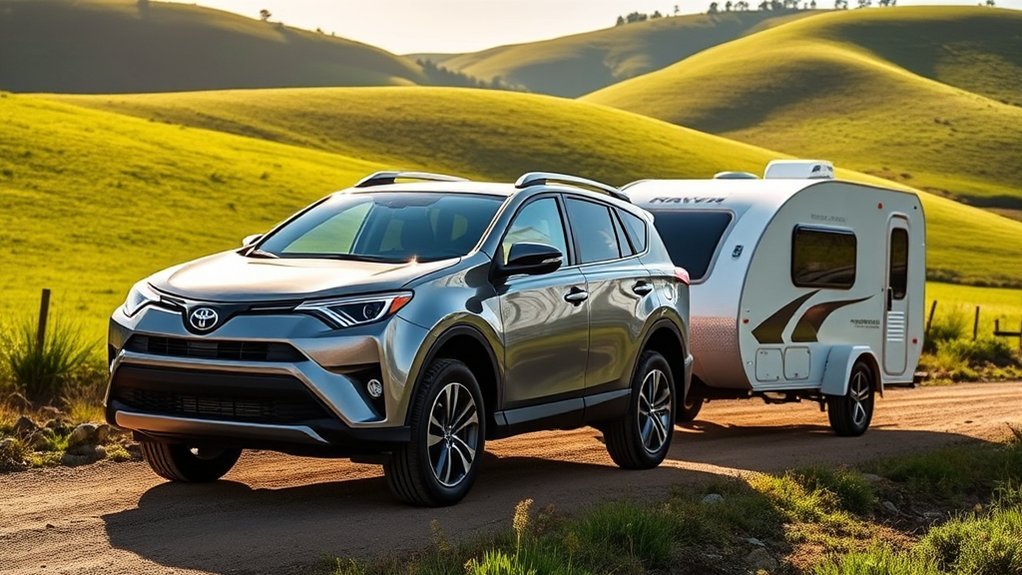
A properly matched RAV4 can work well for a small camper because the vehicle remains practical for commuting, parking, and everyday errands after the trailer is disconnected. Its compact dimensions also make it easier to maneuver than a full-size truck or large SUV.
Some RAV4 grades include AWD and electronic stability features that can support traction and help the driver maintain control. These systems are useful aids, but they cannot correct an overloaded trailer or increase the limits printed in Toyota’s documentation.
The RAV4 is a better fit for campers with modest loaded weights, manageable tongue loads, and relatively small frontal areas. It becomes less suitable when a trailer needs a heavy tongue load, carries large water tanks, has substantial cargo capacity, or will regularly travel through steep mountains and strong winds near the vehicle’s maximum ratings.
Understanding RAV4 Towing Terms and Safety Limits
| Term | What it means |
|---|---|
| Dry weight or UVW | The trailer’s unloaded weight under the manufacturer’s stated conditions. It may exclude cargo, water, propane, batteries, or dealer-installed equipment. |
| Loaded trailer weight | What the camper actually weighs when packed for travel. This is the figure to compare with the RAV4’s trailer-weight rating. |
| Trailer GVWR | The maximum permitted operating weight of the trailer. Using GVWR as an initial screening figure can prevent you from selecting a camper whose full carrying potential exceeds the RAV4’s limit. |
| Tongue weight | The downward load the trailer places on the hitch. It counts against the RAV4’s payload and may also be limited by the receiver and ball mount. |
| Vehicle payload | The total allowable weight of occupants, cargo, accessories, hitch hardware, and trailer tongue load carried by the RAV4. |
| GVWR and GAWR | The maximum loaded vehicle weight and maximum load permitted on each axle. |
| GCWR | The maximum permitted combined weight of the loaded RAV4 and loaded trailer when Toyota provides this rating. |
No electronic feature replaces correct loading. Trailer-Sway Control may help detect and reduce certain sway conditions, but it cannot make an overweight or poorly balanced trailer safe.
How Towing Affects Fuel Efficiency and Performance
Towing normally reduces fuel economy or electric range, but no single percentage applies to every trip. A tall, box-shaped camper can create more aerodynamic drag than a lower trailer of similar weight.
Speed, headwinds, hills, temperature, tire pressure, cargo, and stop-and-go driving also affect consumption. Plan more frequent fuel or charging stops, especially when driving into strong wind or through mountainous areas.
You may also notice slower acceleration, longer braking distances, more frequent engine operation in a hybrid, and higher drivetrain or brake temperatures. These changes become more pronounced as the combination approaches its limits.
When a RAV4 Is Not the Right Tow Vehicle
Choose a more capable tow vehicle when any of the following applies:
- The camper’s dry weight already approaches or exceeds the RAV4’s maximum trailer rating.
- The trailer’s normal loaded weight exceeds the rating.
- Tongue weight, passengers, and cargo would exceed the RAV4’s payload.
- The trailer requires hitch equipment that Toyota or the receiver manufacturer does not approve.
- The trailer’s frontal area or operating conditions exceed the manual’s guidance.
- You expect frequent mountain travel, high winds, or long trips close to the vehicle’s maximum limits.
- You cannot confirm the weights with reliable manufacturer data or a scale.
A larger tow vehicle can provide more payload, braking capacity, cooling capability, and operating margin. It may be the safer and more comfortable choice even when a trailer appears to fit on paper.
Frequently Asked Questions
What is the maximum tongue weight for a RAV4?
No single maximum applies to every RAV4. Check the towing section of your exact owner’s manual, the vehicle payload label, and the ratings on the receiver and ball mount. A common 10 to 15 percent trailer-balancing range is only a planning guide and does not override those limits.
Can I tow a pop-up camper with my RAV4?
Possibly. Many compact pop-ups are lighter than hard-sided travel trailers, but you must check the exact camper’s loaded weight, tongue weight, GVWR, brakes, and frontal area. You must also confirm the RAV4’s payload after adding passengers, cargo, and hitch hardware.
Do I need a weight-distribution hitch?
Do not install one based only on generic towing advice. Use a weight-distribution hitch only when Toyota, the receiver manufacturer, and the trailer manufacturer approve it for the exact setup. Some vehicle and hitch designs restrict or prohibit this equipment.
What towing accessories does a RAV4 need?
The setup may require an approved receiver, correctly sized ball mount and hitch ball, wiring connector, safety chains, trailer brakes, a compatible brake controller, a breakaway system, and extended mirrors. The exact equipment depends on the vehicle, trailer, and local law.
How much does towing reduce RAV4 fuel economy?
No reliable universal percentage applies. Trailer height and shape, speed, wind, terrain, temperature, weight, and driving style all matter. Expect lower fuel economy or electric range and plan stops accordingly.
Can every 2026 RAV4 tow 3,500 pounds?
No. Toyota announced a 1,750-pound rating for FWD versions and the LE AWD. The 3,500-pound rating applies only to specified AWD HEV and PHEV grades. Check the finalized manual and specification label for the exact vehicle.
Should I compare the RAV4 rating with dry weight or GVWR?
Use the trailer’s actual loaded weight for the final calculation. GVWR is useful for initial screening because it shows how heavy the trailer is permitted to become. Dry weight alone is not enough because it may exclude essential equipment, fluids, and camping cargo.
Does my camper need trailer brakes?
That depends on the camper, its weight, the RAV4 manual, and the laws where you drive. Follow the strictest applicable requirement. When electric brakes are installed, use a controller and breakaway system that are compatible with the vehicle and trailer.
Conclusion
A Toyota RAV4 can pull a camper when the trailer is genuinely matched to the exact vehicle. Lower-rated RAV4s are best paired with very light teardrops or compact pop-ups, while selected older and 2026 AWD grades provide higher limits.
Before towing, verify the manual, weigh the loaded camper, calculate remaining payload, confirm tongue and hitch limits, and inspect the full connection. If the numbers are close or uncertain, choose a lighter camper or a more capable tow vehicle.
Sources
- Toyota USA Newsroom: 2026 RAV4 debut — 2026 powertrains, grade distinctions, and announced 1,750- and 3,500-pound towing ratings.
- Toyota USA Newsroom: 2025 RAV4 overview — 2025 gas and hybrid lineup information and discontinuation of the gas Adventure and TRD Off-Road grades.
- Toyota USA Newsroom: 2025 RAV4 Plug-in Hybrid — official 2025 PHEV model and product-information resources.
- Toyota Manuals and Warranties — model-specific owner’s manuals and towing instructions.
- nuCamp: 2026 TAB 320 specifications — current starting dry weight and camper details.
- Forest River: r•pod floorplans — current UVW, hitch-weight, and cargo-capacity figures.
