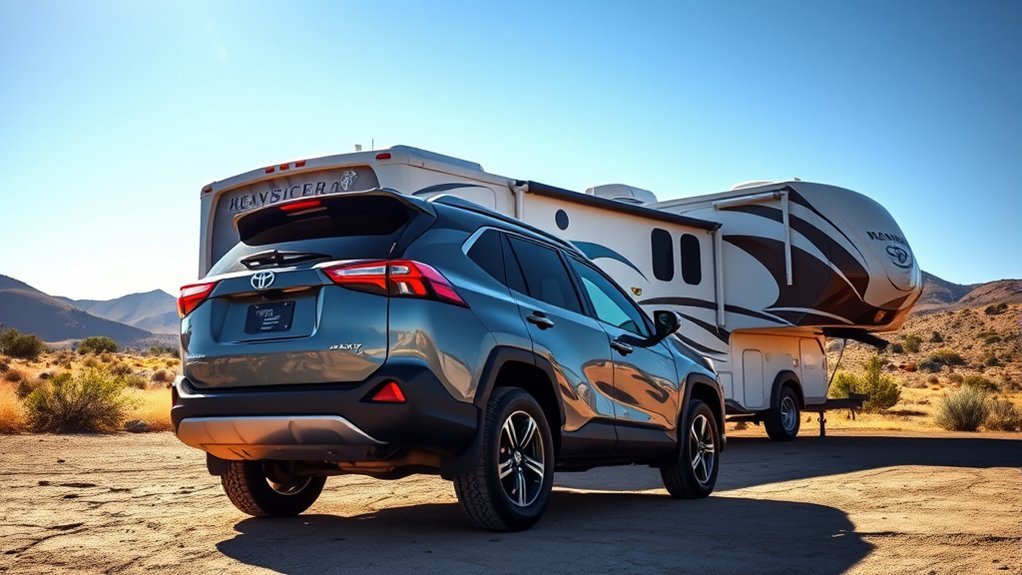
You can transport a Toyota RAV4 behind an RV, but the correct method depends on its exact model year, transmission, drivetrain, and powertrain. Four-wheels-down flat towing is not a safe default for a RAV4. Before connecting anything, verify the procedure in Toyota’s manual for your vehicle and compare it with the instructions for your RV and towing equipment.
Quick Answer
Yes, you can transport a Toyota RAV4 behind an RV, but four-wheels-down flat towing is not a safe default. Use the exact owner’s manual for your model year and drivetrain. A flatbed trailer is the broadest safe option; a tow dolly may work only when both Toyota and the dolly maker permit it.
Key Takeaways
- Do not assume a RAV4 can be flat towed because another owner tows a similar-looking model.
- Use Toyota’s instructions for the exact model year, drivetrain, transmission, and market.
- A full flatbed trailer keeps all four RAV4 wheels off the road and avoids rolling the vehicle’s drivetrain.
- A tow dolly may suit certain front-wheel-drive configurations, but only when the vehicle and dolly instructions allow it.
- Check the RV’s hitch, axle, payload, and combined-weight ratings before choosing any towing method.
Last updated: July 15, 2026.
Warning: Never flat tow a RAV4 unless the owner’s manual for that exact vehicle expressly permits four-wheels-down recreational towing. Selecting neutral, leaving the ignition in ACC, or adding an aftermarket lubrication device does not by itself establish compatibility.
Essential Safety Tips for Flat Towing Your RAV4

Start with the Toyota owner’s manual for your exact RAV4. Search its index for terms such as “recreational towing,” “dinghy towing,” “towing behind a motorhome,” “emergency towing,” and “tow dolly.” Emergency-towing instructions are not automatically suitable for long-distance recreational towing.
Match the manual to the vehicle identification details, including:
- Model year
- Gas, hybrid, plug-in-hybrid, or electric powertrain
- Front-wheel drive or all-wheel drive
- Automatic transmission, continuously variable transmission, hybrid transaxle, or manual transmission
- Country or market in which the RAV4 was sold
If the manual does not clearly authorize four-down towing, use an approved dolly or a full vehicle trailer instead. Do not treat the absence of an obvious warning as permission.
Manufacturer instructions for the exact vehicle take priority over forum posts, dealer comments, generic towing guides, and procedures written for another RAV4 generation.
You must also confirm that the motorhome can handle the complete towing load. Include the RAV4, trailer or dolly, tow bar, baseplate, braking equipment, cargo, fuel, passengers, and any accessories when checking the RV’s hitch rating, gross combined weight rating, rear-axle rating, and available payload.
Before traveling, inspect the towing connection, safety cables or chains, lights, supplemental braking equipment, breakaway system, tires, wheel straps, tie-downs, and hitch pins. Follow the torque and inspection intervals specified by each equipment manufacturer.
Is Flat Towing Your RAV4 Safe and Compatible?
Flat towing means pulling a vehicle with all four of its tires on the road. The wheels, axles, differentials, driveshafts, transmission, or hybrid transaxle may continue moving even though the engine or hybrid system is not operating normally.
That movement can create heat or lubrication problems in a drivetrain that was not designed for recreational towing. Electronic steering locks, parking systems, all-wheel-drive couplings, hybrid components, and push-button ignition systems can create additional restrictions.
Use this method comparison before choosing a setup:
| Method | RAV4 Wheels on Road | When It May Work | Main Concern |
| Four-down flat towing | All four | Only when the exact Toyota manual expressly permits it | Drivetrain lubrication, steering, battery, braking, and warranty risk |
| Tow dolly | Usually two | Potentially certain front-wheel-drive models when both manuals approve the setup | Loading direction, rear-wheel rotation, clearance, straps, and dolly weight |
| Flatbed vehicle trailer | None | When the trailer and RV have adequate ratings and the RAV4 is secured correctly | Higher total weight, storage space, loading angle, and trailer maintenance |
Do not use a general model-year list as your only compatibility check. Two RAV4s from the same year may have different drivetrains or powertrains. Instructions may also differ between U.S., Canadian, European, Australian, and other-market versions.
Note: “Towing capacity” usually describes how much a RAV4 can pull. It does not tell you whether the RAV4 itself may be pulled behind a motorhome.
Tow Dolly vs. Flatbed Trailer: Which Is Better?
A tow dolly carries one axle while the other axle remains on the road. It is generally lighter and easier to store than a full vehicle trailer, but it is not automatically compatible with every front-wheel-drive vehicle.
Before using a dolly, confirm all of the following:
- The exact RAV4 manual permits dolly towing.
- The correct axle will be placed on the dolly.
- The dolly can carry the RAV4’s actual loaded weight.
- The tire width, wheelbase, ground clearance, and body clearance are suitable.
- The straps, chains, steering position, parking brake, and transmission setting follow both manuals.
- The dolly’s brakes, lights, tires, wheel bearings, and breakaway equipment meet the applicable requirements.
A flatbed trailer supports all four wheels. This prevents the RAV4’s wheels from driving its transmission, transaxle, differentials, or all-wheel-drive components during transport.
When Toyota does not approve four-down or dolly towing for your exact RAV4, a properly rated flatbed trailer is usually the clearest way to keep the vehicle’s drivetrain from rotating on the road.
The tradeoff is weight. The RV must carry the combined load of the RAV4 and the trailer without exceeding its hitch, axle, tire, payload, or gross combined weight limits. Confirm the loaded combination at a certified scale instead of relying only on brochure estimates.
Pro Tip: Before renting or buying equipment, give the supplier your RAV4’s year, drivetrain, powertrain, tire size, curb weight, and VIN details. Ask for written confirmation that the proposed equipment fits the vehicle and its loaded weight.
How to Set Up Your RAV4 for an Approved Towing Method
At a Glance
| Time Required | About 15–30 minutes for a practiced pre-trip connection and inspection; initial loading or installation takes longer |
| Difficulty | Moderate; structural, electrical, and braking installations should be handled by a qualified installer |
| Tools Needed | Vehicle and equipment manuals, tire-pressure gauge, inspection light, gloves, checklist, and any manufacturer-specified torque tools |
| Cost | Varies widely by towing method, equipment ratings, professional installation, rental terms, and storage needs |
1. Confirm the Permitted Method
Read the RAV4 manual first. If it prohibits four-down towing, do not proceed with a tow-bar setup. Check whether it permits dolly towing or directs you to carry the vehicle with all four wheels off the ground.
2. Verify the RV’s Ratings
Check the motorhome’s hitch rating, gross combined weight rating, rear gross axle weight rating, tire ratings, and available payload. Account for passengers, water, fuel, cargo, the RAV4, and every piece of towing equipment.
3. Match Every Component
The weakest-rated component controls the setup. Confirm the ratings and compatibility of the hitch, receiver, tow bar, baseplate, dolly, trailer, coupler, safety cables, chains, wheel straps, tie-downs, braking system, breakaway system, and electrical connector.
4. Use Professional Installation Where Needed
A baseplate, supplemental braking system, charge line, lighting circuit, lube pump, or driveline modification can affect structural, electrical, braking, and drivetrain systems. Use an installer experienced with the exact RAV4 and the selected towing equipment.
An aftermarket conversion should come with written operating instructions, maintenance requirements, compatibility details, and warranty terms. Do not describe the conversion as Toyota-approved unless Toyota expressly provides that approval.
5. Follow the Exact Vehicle Shutdown Procedure
Use the manual’s instructions for the transmission, ignition, steering, parking brake, key, smart-key system, electronic parking system, and battery. Do not copy an ACC procedure from another model year.
If the manual specifies a speed limit, distance limit, engine-start interval, fuse procedure, battery-maintenance method, or steering setting, follow it exactly. When several limits apply, use the lowest one.
6. Connect and Test the Equipment
Connect the primary coupling and independent safety cables or chains. Attach the electrical connector, braking system, and breakaway cable according to their manuals. Confirm that the RAV4’s running lights, brake lights, and turn signals respond correctly from the motorhome.
Perform a low-speed test in a safe area. Check tracking, braking response, steering movement, clearances, strap tension, and warning indicators before entering traffic.
7. Recheck After the First Stop
Stop after a short initial distance in a safe location. Reinspect hitch pins, couplers, cables, chains, straps, tire temperatures, wheel bearings, electrical connections, and brake components. Repeat inspections at the intervals required by the equipment manufacturers.
Avoiding Common Mistakes When Towing a RAV4
The most damaging mistake is assuming that placing the transmission in neutral makes a RAV4 safe to tow. Neutral may disconnect engine power, but it does not guarantee that every rotating drivetrain component receives lubrication.
Other common errors include:
- Using instructions for a different model year or drivetrain
- Confusing emergency towing with long-distance recreational towing
- Exceeding the motorhome’s hitch or rear-axle rating
- Ignoring the weight of the trailer, dolly, baseplate, and accessories
- Attaching a breakaway cable to the same removable point as the main coupling
- Using crossed, twisted, loose, or dragging safety cables
- Failing to test lights and supplemental brakes
- Using worn straps or failing to retighten them
- Backing up with equipment that is not designed for reversing
- Following a universal speed recommendation instead of the lowest applicable limit
Ignition Position Importance
Do not assume the ignition should always remain in ACC. On some vehicles, ACC may unlock steering or support a specific towing procedure. On others, it may operate accessories, discharge the 12-volt battery, trigger electronic systems, or conflict with the required shutdown sequence.
Push-button-start vehicles can also behave differently from vehicles with a mechanical key. Follow the exact manual and equipment instructions for steering, key location, smart-key functions, parking systems, and battery support.
If a charge line or battery-maintenance device is used, it must be correctly fused, wired, rated, and installed. A charge line does not correct an otherwise prohibited drivetrain setup.
Regular Maintenance Checks
Inspect the RAV4 and towing equipment before every travel day. Check:
- RAV4, RV, dolly, and trailer tire pressures
- Tire age, cracking, cuts, bulges, and tread condition
- Wheel-lug torque according to the equipment manual
- Hitch, receiver, tow bar, coupler, and baseplate fasteners
- Safety cables, chains, hooks, and attachment points
- Wheel straps and vehicle tie-downs
- Lighting, connectors, and wiring
- Supplemental brakes and breakaway operation
- Dolly or trailer wheel bearings and brakes
- Fluid leaks, warning lights, and unusual noises
Keep records of inspections, installation work, repairs, and equipment maintenance. Stop immediately if the RAV4 tracks poorly, a strap loosens, a tire overheats, a warning light appears, or the braking system behaves unexpectedly.
Flat Towing Experiences From Other RV Owners
RV-owner forums can help you learn how particular tow bars, braking systems, trailers, and dollies behave in daily use. Owners may also identify practical issues such as low bumper clearance, difficult connector access, battery discharge, or limited campsite storage.
However, another owner’s successful trip does not prove that your RAV4 is approved for the same setup. The other vehicle may have a different transmission, drivetrain, market specification, aftermarket conversion, or maintenance history.
Use community advice for practical questions such as:
- How easy a component is to connect
- Where owners store a dolly or trailer
- How often straps need rechecking
- Which installers have experience with the equipment
- What clearance problems appeared during loading
Do not use forum reports as the final authority for drivetrain compatibility, ignition position, speed limits, braking requirements, warranty coverage, or legal compliance.
Frequently Asked Questions
What models of Toyota RAV4 can be flat towed?
Treat a RAV4 as four-down towable only when the owner’s manual for that exact model year, drivetrain, transmission, powertrain, and market expressly authorizes recreational towing with all four wheels on the road. Do not rely on a blanket year range.
Can I flat tow a Toyota RAV4 Hybrid or plug-in hybrid?
Do not flat tow a RAV4 Hybrid or plug-in hybrid unless its exact owner’s manual expressly permits the method. Electrified models use specialized transaxles, motors, electronic controls, and high-voltage components. A neutral indicator alone does not prove four-down compatibility.
Can a front-wheel-drive RAV4 be carried on a tow dolly?
Possibly, but only when Toyota’s manual and the dolly manufacturer both permit the configuration. Confirm which axle goes on the dolly, the required transmission and parking-brake settings, rear-wheel rotation limits, ground clearance, loaded weight, and strap procedure.
Is a flatbed trailer the safest way to transport a RAV4?
A properly rated flatbed keeps all four RAV4 wheels off the road, which avoids rolling the vehicle’s drivetrain during transport. The trailer must still fit the RAV4, stay within the RV’s ratings, use suitable tie-down points, and comply with applicable brake, lighting, and breakaway requirements.
Does installing a lube pump make any RAV4 safe to flat tow?
No. A lube pump addresses only a specific lubrication problem and does not automatically resolve steering, differential, all-wheel-drive, transaxle, electronic-control, braking, warranty, or legal concerns. Use one only as part of a documented conversion approved by its manufacturer and installed for the exact vehicle.
How does towing affect the RAV4 warranty?
Using an aftermarket component does not automatically erase every warranty right. However, damage linked to an unapproved towing method, incorrect installation, improper use, or inadequate maintenance may not be covered. Review Toyota’s applicable warranty guide and obtain written advice before modifying the drivetrain or electrical system.
What is the maximum speed when towing a RAV4 behind an RV?
No single speed applies to every setup. Follow the lowest limit stated by Toyota, the RV manufacturer, the tow-bar, dolly or trailer maker, the tire manufacturer, local law, and posted road signs. Also observe any required stopping intervals or distance limits.
What accessories are needed for approved four-down towing?
A compatible setup commonly includes a rated RV hitch, vehicle-specific baseplate, tow bar, independent safety cables, lighting connection, supplemental braking system, breakaway device, and any manufacturer-required battery support. Every component must be rated, installed, connected, and maintained for the exact vehicle and RV.
Conclusion
You can carry a Toyota RAV4 behind an RV, but you should not begin with the assumption that four-down flat towing is permitted. Start with the exact Toyota manual, identify the approved transport method, and then verify the motorhome and equipment ratings.
When four-down towing is not expressly authorized, use a permitted tow-dolly configuration or a properly rated flatbed trailer. Whichever method you choose, follow the manufacturer’s setup procedure, use suitable braking and safety equipment, inspect every connection, and comply with the laws that apply along your route.
Sources
- Toyota Manuals and Warranties — vehicle-specific owner’s manuals, operating instructions, and warranty materials
- Federal Trade Commission: Nixing the Fix — federal warranty principles concerning third-party parts and repairs
- Electronic Code of Federal Regulations, 49 CFR Part 571 — federal motor-vehicle equipment standards, including applicable lighting and safety requirements
