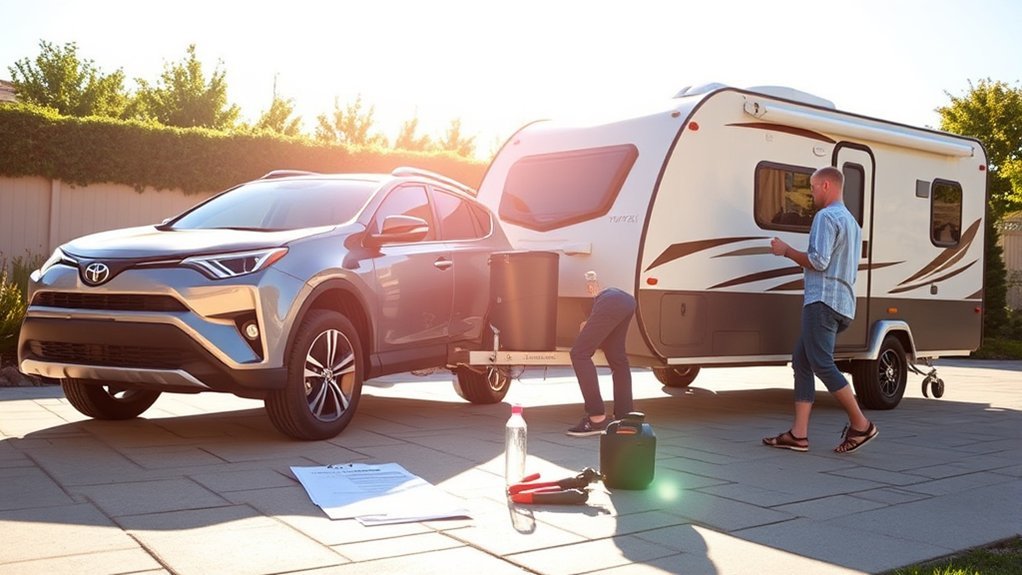
Yes, a Toyota RAV4 can tow a trailer, but the safe limit depends on its model year, grade, drivetrain, powertrain, payload, and installed towing equipment. For U.S.-market 2026 RAV4s, Toyota rates all FWD configurations and the LE AWD at 1,750 pounds, while selected AWD configurations can tow up to 3,500 pounds. Before towing, confirm the exact rating in your vehicle documentation and use the trailer’s actual loaded weight rather than its advertised empty weight.
Last updated: September 19, 2026. Rechecked against Toyota’s current U.S. 2026 RAV4 lineup and towing guidance.
Methodology: This guide compares Toyota’s U.S. owner-manual guidance, current model and grade information, vehicle-loading limits, and official towing-accessory instructions. It does not replace the labels or owner’s manual for your exact RAV4.
Quick Answer
A Toyota RAV4 may tow from 1,500 to 3,500 pounds depending on its model year and configuration. For the 2026 U.S. RAV4, all FWD configurations and the LE AWD are rated at 1,750 pounds, while selected AWD configurations reach 3,500 pounds. AWD alone does not establish the higher rating, so check the documentation for your exact vehicle before choosing or loading a trailer.
Key Takeaways
- Check the rating for your exact model year, grade, drivetrain, and powertrain. RAV4 capacities are not universal.
- Use the trailer’s actual loaded weight, including water, batteries, propane, food, equipment, and accessories.
- Toyota RAV4 owner-manual guidance commonly calls for tongue weight equal to 9% to 11% of gross trailer weight; follow the manual for your exact vehicle.
- Passengers, cargo, hitch equipment, and tongue weight consume the RAV4’s available occupant-and-cargo allowance.
- The lowest applicable rating among the vehicle, hitch, ball mount, ball, coupler, tires, trailer, and brake equipment controls the setup.
At a Glance
| Time Required | Varies by setup; allow enough time for a complete pre-trip inspection, plus a separate scale visit when loaded weights need verification |
| Difficulty | Moderate; professional hitch, wiring, or brake-controller installation may be appropriate |
| Tools Needed | Owner’s manual, tire-pressure gauge, torque wrench when specified, wheel chocks, tongue scale or public vehicle scale, and hitch-pin safety clip |
| Cost | Varies by the vehicle-specific hitch, wiring, trailer brakes, brake controller, ball mount, and professional installation required |
Can a Toyota RAV4 Tow a Trailer? Understanding the Basics

Your RAV4 may be suitable for a micro camper, teardrop, small utility trailer, personal-watercraft trailer, or another lightweight single-axle trailer. The correct choice depends on the trailer’s loaded weight, not simply its size or product category.
A trailer advertised at 1,200 pounds may weigh considerably more after you add a battery, propane cylinder, water, camping equipment, food, tools, and dealer-installed options. Use a public scale or trailer scale to verify the finished setup.
Warning: Never use the brochure’s maximum towing figure as your only limit. You must also remain within the RAV4’s payload or occupant-and-cargo allowance, GVWR, front and rear GAWR, GCWR, tire limits, hitch rating, tongue-weight limit, and all trailer-component ratings.
Start with the Toyota owner’s-manual library. Match the manual to your exact year and model before buying or loading a trailer.
Use a Four-Number RAV4 Trailer Fit Test
A trailer is not a safe match merely because its weight is below the advertised towing capacity. Check these four areas together:
- Loaded trailer weight: The trailer in normal travel condition must stay within the RAV4’s Trailer Weight Rating and the trailer’s own limits.
- Tongue weight: The measured hitch load must follow Toyota’s guidance for the exact RAV4 and remain within every vehicle, hitch, ball-mount, ball, and coupler limit.
- Loaded RAV4: Occupants, cargo, added towing equipment, and tongue weight must fit the vehicle’s occupant-and-cargo allowance, GVWR, and front and rear GAWR.
- Combined weight: The loaded RAV4 and loaded trailer together must remain within GCWR, while the tires, hitch system, trailer brakes, and other components remain within their own ratings.
If any one of these checks fails, the combination is not within its ratings even when the trailer is below a headline towing-capacity number.
What Is the Towing Capacity of the Toyota RAV4?
Toyota RAV4 towing capacity has changed across generations. A figure that applies to a 2024 Adventure may not apply to a 2026 LE AWD, even though both vehicles carry the RAV4 name. For a year-by-year lookup, see the Toyota RAV4 towing capacity by year and trim guide.
Current 2026 RAV4 Towing Capacities
The redesigned 2026 U.S. RAV4 uses hybrid-electric or plug-in-hybrid powertrains. Toyota states that all FWD versions and the LE AWD have a 1,750-pound towing capacity, while selected AWD configurations can tow up to 3,500 pounds.
| Configuration | Maximum Published Capacity | What to Check |
|---|---|---|
| All FWD models | 1,750 lb | Exact grade, payload, hitch, and owner’s manual |
| LE AWD | 1,750 lb | Vehicle and hitch labels plus the owner’s manual |
| Selected AWD HEV and PHEV configurations | Up to 3,500 lb | Only configurations Toyota specifically rates at 3,500 lb; AWD alone does not establish the rating |
Toyota’s final U.S. production information for the 2026 RAV4 uses the XLE Premium grade name and identifies certain AWD configurations for the 3,500-pound rating. Toyota’s current RAV4 Plug-in Hybrid information specifically lists Woodland, SE, and XSE at 3,500 pounds. Toyota’s public PHEV page does not state a towing figure for GR SPORT, so verify that grade’s rating in the exact vehicle documentation rather than inferring it from AWD or power output.
Note: The 2026 RAV4 represents a new generation. Do not copy the towing figure from a 2019–2025 article or brochure and assume that it applies to a 2026 vehicle.
Previous-Generation Gas, Hybrid, and Prime Ratings
For comparison, the official 2024 U.S. brochure lists four main capacity groups. These figures are useful for owners of that model year, but they should not replace the manual for a different year.
| 2024 Trim Group | Maximum Capacity |
|---|---|
| Gas LE, XLE, XLE Premium, and Limited | 1,500 lb |
| Gas Adventure and TRD Off-Road | 3,500 lb |
| RAV4 Hybrid trims | 1,750 lb |
| RAV4 Prime SE and XSE | 2,500 lb |
You can review these ratings in Toyota’s official 2024 RAV4 brochure. For a 2019–2025 RAV4, use the manual for the exact model year rather than carrying a 2024 figure backward or forward.
Understand the Ratings Before You Load
- TWR, or Trailer Weight Rating: The maximum permitted gross trailer weight under the conditions Toyota specifies.
- Gross trailer weight: The trailer plus every item carried in or on it.
- GVWR: The maximum permitted weight of the loaded RAV4, including occupants, cargo, equipment, and trailer tongue weight.
- GAWR: The maximum permitted load on the front or rear axle.
- GCWR: The maximum combined weight of the loaded RAV4 and loaded trailer.
- Payload or occupant-and-cargo allowance: The vehicle-specific capacity available for people, cargo, added equipment, hitch components, and tongue load.
The Tire and Loading Information label on the driver’s door area gives the vehicle-specific combined occupant and cargo limit. Do not assume a brochure’s highest published payload applies to your individual RAV4.
What Trailers Can a Toyota RAV4 Tow?
A suitable trailer is one whose actual loaded weight, tongue weight, and braking equipment fit every rating for your RAV4. Small utility trailers, micro campers, lightweight teardrops, and some pop-up campers may qualify, but their names alone do not prove that they are safe matches.
Trailer Options by Loaded Weight
- Small open utility trailers: Often suitable for garden materials, camping equipment, or small recreational gear when the finished load remains within all limits.
- Micro campers and lightweight teardrops: Possible choices for many RAV4 configurations when their fully loaded weight remains within the vehicle’s exact rating.
- Pop-up campers: Suitable only when the loaded trailer, tongue load, payload, brake system, and hitch requirements fit the exact RAV4.
- Personal-watercraft or small boat trailers: The trailer, watercraft, fuel, battery, equipment, and added supplies must all be included in gross trailer weight.
- Larger compact campers: More likely to require a 2,500- or 3,500-pound-rated RAV4, trailer brakes, greater payload availability, and careful scale verification.
Dry Weight Is Not the Number You Tow
Manufacturers may list a dry, curb, or unloaded trailer weight that excludes cargo and may exclude dealer-installed equipment. A camper’s loaded weight can rise quickly after adding water, propane, batteries, bedding, food, cookware, tools, an awning, and outdoor equipment.
Pro Tip: Use trailer GVWR as a conservative screening figure when shopping, then weigh the trailer in its normal travel condition. A low advertised dry weight does not guarantee that the finished setup will fit your RAV4.
Key Tips for Safe Towing With Your RAV4
- Confirm the exact ratings. Check TWR, GCWR, GVWR, GAWR, occupant-and-cargo allowance, tongue weight, hitch limits, tire limits, and the trailer’s GVWR.
- Weigh the finished setup. Include passengers, vehicle cargo, trailer cargo, water, batteries, propane, accessories, and hitch equipment.
- Balance the trailer correctly. Keep heavy cargo low, centered, and secured so it cannot shift while driving.
- Use the correct tongue weight. Follow the exact manual. Toyota RAV4 guidance commonly specifies 9% to 11% of gross trailer weight.
- Connect safety chains correctly. Cross them beneath the coupler when the trailer and local requirements call for that arrangement, leaving enough slack for turns without dragging.
- Test lights and brakes. Confirm taillights, brake lights, turn signals, hazard lights, trailer brakes, and the breakaway system when fitted.
- Increase following distance. Added weight increases stopping distance and reduces acceleration.
- Slow down before curves and hills. Avoid sudden steering, hard braking, and rapid lane changes.
What to Do If the Trailer Starts Swaying
If sway starts, keep the steering wheel firm and point the vehicle straight ahead. Gradually release the accelerator; do not accelerate or make abrupt steering corrections. Toyota manuals commonly instruct drivers not to apply the vehicle brakes while active sway is occurring. Follow the exact RAV4 manual and the instructions supplied with any trailer-brake controller in your setup.
Once the combination is stable, pull over safely. Check for cargo movement, incorrect tongue weight, tire problems, coupler engagement, loose hitch hardware, excessive speed, and vehicle or trailer overloading before continuing.
What You Need to Know About Weight Distribution and Tongue Weight
Tongue weight is the downward load the trailer places on the hitch ball. Too little can encourage sway, while too much can overload the RAV4’s rear axle, suspension, tires, hitch, or available occupant-and-cargo capacity.
Toyota RAV4 owner-manual guidance commonly calls for tongue weight equal to 9% to 11% of gross trailer weight. Follow the manual for your exact model year because the calculations below are examples, not universal maximums.
| Loaded Trailer Weight | 9% Tongue Weight | 11% Tongue Weight |
|---|---|---|
| 1,500 lb | 135 lb | 165 lb |
| 1,750 lb | About 158 lb | About 193 lb |
| 2,500 lb | 225 lb | 275 lb |
| 3,500 lb | 315 lb | 385 lb |
A 1,750-pound loaded trailer produces about 158–193 pounds of tongue weight at a 9%–11% target, and that entire load must be included when checking the RAV4’s vehicle-loading limits.
Do not use the calculated range if it exceeds the vehicle, rear-axle, hitch, ball mount, ball, coupler, or trailer limit. The lowest applicable rating always controls.
How Payload Affects Towing
A useful screening calculation is: remaining occupant-and-cargo allowance = door-label combined limit − occupants − in-vehicle cargo − added towing equipment carried by the RAV4 − trailer tongue weight.
Suppose the vehicle’s loading label permits 1,100 pounds of occupants and cargo. Four occupants, luggage, a cargo organizer, hitch equipment, and 190 pounds of tongue weight must all fit within that allowance.
A full cargo area can therefore reduce the amount of trailer tongue weight the vehicle can accept. Towing capacity and vehicle-loading limits are separate, and you must satisfy both.
How to Weigh Your RAV4 and Trailer
- Load the RAV4 with the occupants, fuel, cargo, and accessories you normally carry.
- Load the trailer with water, batteries, propane, equipment, food, and other travel items.
- Weigh the complete RAV4-and-trailer combination at a suitable public platform scale.
- Weigh the RAV4 separately while the trailer remains connected, when the scale procedure permits.
- Weigh the RAV4 without the trailer to help determine the actual tongue load and vehicle load.
- Compare the measured values with TWR, GCWR, GVWR, GAWR, occupant-and-cargo capacity, tire, hitch, and trailer limits.
A dedicated tongue scale may help with adjustment, but it does not replace axle and combination-weight measurements when those ratings are close.
How to Choose the Right Hitch for Your RAV4
Choose a receiver designed for your exact RAV4 model year, powertrain, drivetrain, grade, and bumper configuration. A hitch’s advertised class or maximum rating does not increase the towing capacity assigned by Toyota.
Toyota’s genuine RAV4 tow-hitch guidance states that owners must follow all vehicle weight ratings and account for occupants, cargo, and added equipment.
Hitch Components to Check
- Receiver hitch: It must fit the vehicle and meet or exceed the required load without exceeding Toyota’s limits.
- Ball mount: Select the correct rise or drop so the loaded trailer sits approximately level.
- Hitch ball: Match the trailer coupler’s ball diameter and required shank dimensions.
- Coupler: Confirm full engagement and lock it before travel.
- Hitch pin and clip: Use the correct size and verify secure installation.
- Wiring harness: Use a compatible harness for taillights, brake lights, and turn signals.
- Brake wiring: A trailer with electric service brakes may require a compatible connector and brake controller.
- Safety chains: Confirm their ratings, attachment points, routing, and ground clearance.
Note: Do not install or use a weight-distribution or load-equalizing hitch unless the owner’s manual for your exact RAV4 and the hitch manufacturer both permit it. Toyota’s recommendations have varied by model year.
What Towing Equipment Does a RAV4 Need?
Your required equipment depends on the trailer, vehicle, applicable law, and Toyota’s instructions. A basic setup may need a receiver, ball mount, hitch ball, locking pin, wiring harness, safety chains, wheel chocks, tire-pressure gauge, and suitable mirrors.
Heavier trailers may also require service brakes, an electric brake controller, a breakaway switch, a compatible electrical connector, and additional equipment specified by the trailer manufacturer.
Trailer Brakes and Wiring
Check the RAV4 manual for its unbraked trailer rating. If the loaded trailer exceeds that figure, trailer service brakes are required. State or provincial law may require brakes at a lower weight, so comply with whichever requirement is stricter. Do not substitute a generic legal threshold for Toyota’s vehicle-specific unbraked limit.
Toyota’s RAV4 towing-wire-harness information describes a four-pin connection for trailer lighting on compatible applications. Electric trailer brakes commonly need additional wiring and a compatible brake-control system.
Can You Use a Hitch-Mounted Cargo Carrier?
A hitch-mounted cargo carrier is not a trailer, so do not automatically apply the RAV4’s 9%–11% trailer tongue-weight calculation to a carrier. Count the carrier, rack, bikes or other cargo, adapters, and attachment hardware against the applicable vehicle and receiver limits.
Loads positioned behind the receiver can also create leverage on the hitch and rear of the vehicle. Follow Toyota’s instructions and the hitch or carrier manufacturer’s limits for receiver-mounted cargo rather than assuming that a trailer-towing rating makes the same load acceptable on a cargo carrier.
How to Get Your RAV4 Ready for Towing
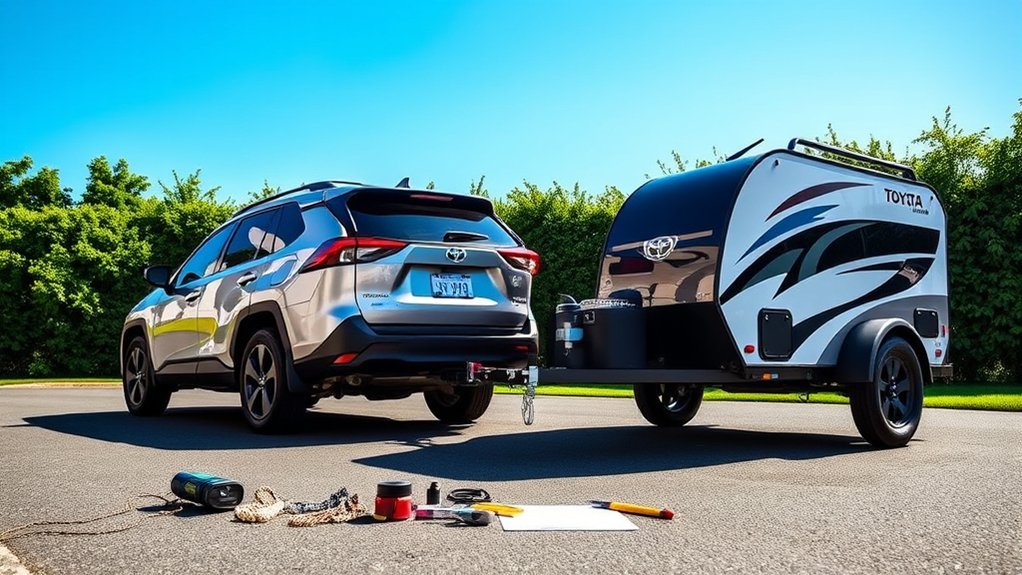
Prepare the vehicle and trailer before every trip. Do not wait until highway speed to discover a loose coupler, underinflated tire, overloaded rear axle, or failed brake light.
RAV4 Pre-Trip Towing Checklist
- Confirm the trailer’s actual loaded weight and tongue weight.
- Check the RAV4’s occupant-and-cargo allowance, GVWR, GAWR, GCWR, and towing rating.
- Inspect the receiver, ball mount, hitch ball, coupler, pin, clip, and mounting hardware.
- Verify that the coupler is fully seated and locked.
- Attach and inspect the safety chains and breakaway cable when fitted.
- Test the trailer’s taillights, brake lights, turn signals, hazard lights, and brakes.
- Set tire pressures according to the vehicle and trailer manufacturers’ cold-pressure specifications.
- Inspect tires for cracking, bulges, damage, uneven wear, and adequate tread.
- Secure all cargo so it cannot move and change the trailer’s balance.
- Confirm that doors, hatches, windows, awnings, steps, and stabilizers are secured.
- Check mirror visibility and adjust mirrors before moving.
- Remove wheel chocks only after the trailer is connected and ready to move.
Drive a short distance at low speed, stop safely, and recheck the coupler, chains, wiring, tires, cargo, and hitch connections. Follow the specified torque procedure for any fastener that requires periodic checking.
Practice Before the Trip
Practice starting, stopping, turning, and reversing in an open area away from traffic. A trailer cuts inside the RAV4’s path during turns, so leave extra space around curbs, posts, signs, and parked vehicles.
When reversing, use small steering inputs and move slowly. A spotter can help, but agree on hand signals before you begin and stop whenever the spotter leaves your view.
Towing on Hills and in Hot Weather
Reduce speed before a descent and use the transmission or drive mode as directed by the owner’s manual. Repeated heavy braking can overheat the vehicle or trailer brakes.
Watch for temperature warnings, reduced power, unusual odors, smoke, brake fade, or unstable handling. Pull over safely and allow the equipment to cool if the vehicle or trailer shows signs of overheating.
How Does the RAV4 Compare to Other SUVs for Towing?
The RAV4 competes with other compact SUVs, but towing comparisons must use the same model year and specific configurations. A base configuration and a towing-oriented grade can have very different limits.
Current RAV4 Towing Position
For the U.S.-market 2026 RAV4, Toyota publishes a 1,750-pound rating for all FWD configurations and the LE AWD, while selected AWD configurations reach 3,500 pounds. The maximum should never be applied to a vehicle merely because it has AWD.
Some RAV4 model years also include vehicle-stability functions intended to help reduce trailer sway. Driver-assistance systems cannot compensate for excess speed, poor loading, incorrect tongue weight, worn tires, or an overloaded combination.
Comparison With Competitor SUVs
| Vehicle | Maximum Published Rating | Context |
|---|---|---|
| Toyota RAV4 | 1,750–3,500 lb | Depends on drivetrain and exact configuration |
| Honda CR-V | 1,500 lb gas; 1,000 lb hybrid | 2026 gas and hybrid configurations carry different ratings |
| Subaru Forester Wilderness | 3,500 lb | Wilderness-specific rating |
A higher-rated 2026 RAV4 configuration has a greater published towing limit than the cited 2026 CR-V configurations and matches the published maximum of the 2026 Forester Wilderness. That does not determine which vehicle is the right choice for a particular trailer because payload, hitch design, braking equipment, cargo needs, fuel or energy use, and operating conditions also matter.
Mistakes to Avoid When Towing With Your RAV4
- Using the wrong model-year rating: Confirm the exact vehicle instead of relying on a general RAV4 figure.
- Assuming every AWD RAV4 gets the maximum: Drivetrain alone does not establish a 3,500-pound rating.
- Using dry weight as loaded weight: Include all cargo, fluids, batteries, propane, accessories, and equipment.
- Ignoring vehicle-loading limits: Occupants, vehicle cargo, hitch equipment, and tongue weight consume capacity.
- Following an unsupported 80% rule: Stay within every official rating and leave a sensible margin for the actual conditions rather than treating an arbitrary percentage as a manufacturer specification.
- Using 10% to 15% tongue weight without checking Toyota’s guidance: RAV4 manuals commonly specify 9% to 11%; follow the exact manual.
- Assuming the hitch rating raises the vehicle rating: It does not.
- Skipping trailer brakes: Compare the loaded trailer with the vehicle-specific unbraked rating and applicable law.
- Poor cargo placement: Rear-heavy or unsecured loads can promote sway.
- Driving as though no trailer is attached: Allow more time for acceleration, stopping, turning, merging, and passing.
- Ignoring tire condition: Underinflation, age, damage, or overloading can cause heat buildup and failure.
- Using cruise control without checking the manual: Some towing conditions or manuals may restrict its use.
- Failing to recheck connections: Stop after a short distance and inspect the setup again.
Signs You Should Stop and Inspect the Setup
Pull over safely if you notice repeated sway, steering lightness, excessive rear sag, unusual tire heat, burning smells, reduced braking, warning lights, unstable handling, rattling hardware, or rising vehicle temperature.
Do not continue until you identify the cause. Reweigh or redistribute the load when needed, and have the vehicle, hitch, brakes, or trailer inspected by a qualified professional if the problem remains.
Related Guides
Frequently Asked Questions
Can I tow a trailer with a full RAV4 cargo space?
Possibly, but not automatically. Passengers, cargo, hitch hardware, accessories, and trailer tongue weight all count toward the RAV4’s loading limits. Check the door-label capacity and confirm GVWR, rear GAWR, GCWR, and towing capacity with the fully loaded vehicle and trailer.
What type of trailer is best for a RAV4?
A small utility trailer, micro camper, lightweight teardrop, or qualifying pop-up may work. Choose by actual loaded weight, tongue weight, trailer GVWR, brake requirements, and the rating of your exact RAV4 rather than by trailer type alone.
Can a RAV4 tow a 2,000-pound trailer?
Only a RAV4 configuration with a trailer rating above 2,000 pounds can potentially tow a 2,000-pound loaded trailer. A RAV4 rated at 1,500 or 1,750 pounds cannot tow a 2,000-pound loaded trailer within that rating. A higher-rated configuration may qualify only after payload, tongue weight, GVWR, GAWR, GCWR, hitch, tire, and brake limits are also checked.
Can a Toyota RAV4 tow a camper?
Yes, some RAV4 configurations can tow a lightweight camper, but camper type alone does not establish compatibility. Compare the camper’s actual loaded weight and tongue weight with the exact RAV4’s towing, payload, axle, combined-weight, hitch, tire, and brake limits.
Does towing affect my RAV4’s warranty?
Towing does not create one universal warranty result. Coverage depends on the warranty terms and the cause of the problem. Overloading, improper equipment, or towing against Toyota’s instructions may lead to damage that is not covered, so follow the owner’s manual and warranty booklet.
How does towing affect RAV4 fuel economy?
Towing normally increases energy or fuel consumption because the vehicle must move more weight and overcome additional aerodynamic drag. Trailer shape, speed, hills, wind, temperature, tire pressure, and cargo weight can affect the result substantially.
Are there special driving tips for towing with a RAV4?
Use gradual steering, braking, and acceleration. Increase following distance, slow before turns and descents, allow more room when merging, and practice reversing away from traffic. Stop after a short distance to recheck the hitch, chains, wiring, tires, and cargo.
Do I need trailer brakes when towing with a RAV4?
You need trailer service brakes when the loaded trailer exceeds the unbraked rating in the exact RAV4 manual or when applicable law requires them at a lower weight. Electric brakes may also require a compatible brake controller, connector, wiring, and breakaway system.
Can I use a weight-distribution hitch on a Toyota RAV4?
Do not use one based only on a hitch seller’s recommendation. Toyota’s guidance can differ by model year, and some RAV4 manuals advise against load-equalizing equipment. Use a weight-distribution hitch only when the exact vehicle manual and hitch manufacturer both expressly permit it.
Conclusion
A Toyota RAV4 can tow a useful range of utility trailers, teardrops, micro campers, and other lightweight trailers when the vehicle and trailer are matched correctly. Depending on the model year and configuration, the published maximum may range from 1,500 to 3,500 pounds.
Start with the manual and loading label for your exact RAV4, determine the trailer’s fully loaded weight, and run the setup through the four-number check: trailer weight, tongue weight, loaded-vehicle limits, and combined weight. Then verify the hitch, tires, brake equipment, and other component ratings before towing.
Sources
- Toyota: The Next Adventure Begins — 2026 RAV4 Arrives This Winter — supports the final U.S. production lineup and current-generation towing information.
- Toyota: Three…Two…One, Toyota Debuts Amazing All-New RAV4 — supports the 2026 generation change, electrified powertrains, and initial towing-capacity announcement.
- Toyota RAV4 Plug-in Hybrid — supports Toyota’s current public towing statement for 2026 PHEV Woodland, SE, and XSE configurations.
- Toyota 2024 RAV4 Brochure — supports the 2024 gas, Hybrid, Adventure, TRD Off-Road, and Prime ratings.
- Toyota RAV4 Hybrid Owner’s Manual — supports towing definitions, scale measurement, and 9% to 11% tongue-weight guidance.
- Toyota Genuine RAV4 Tow Hitch Receiver Guidance — supports hitch, equipment, cargo, occupant, and weight-rating cautions.
- Toyota RAV4 Towing Wire Harness Kit — supports the four-pin trailer-lighting connection on compatible applications.
- Honda 2026 CR-V Specifications — supports the 2026 CR-V towing comparison.
- Subaru 2026 Forester Wilderness Features — supports the Forester Wilderness towing comparison.
