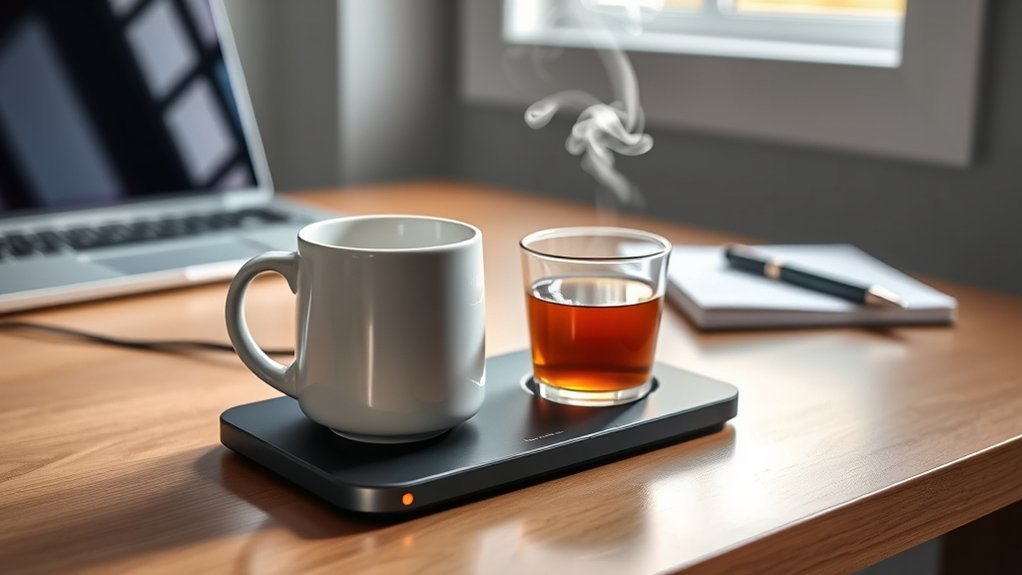
A coffee and tea mug warmer keeps a freshly made drink warm while you work, read, or take your time between sips. You can choose a battery-powered heated mug, a plug-in warming plate, or a matched mug-and-pad system. The main differences are portability, temperature control, mug compatibility, and how long each setup can maintain warmth.
Quick Answer
Choose a self-warming mug if you want temperature control away from your desk. Choose a plug-in plate warmer if you want to keep using your own flat-bottom mug at a lower cost. Both work best with a drink that starts hot; neither should be treated as a fast way to reheat cold coffee.
Last checked: September 26, 2026. Dates and figures were verified against official sources.
Key Takeaways
- A plate’s advertised temperature is not necessarily the temperature of the liquid in your cup.
- Flat-bottom, single-wall mugs usually transfer heat better than thick or insulated mugs.
- Automatic shut-off times and cup sensors vary by model; do not assume every warmer has them.
- A warmer is not a substitute for safe food storage when a drink contains perishable ingredients.
What Is a Coffee and Tea Mug Warmer?
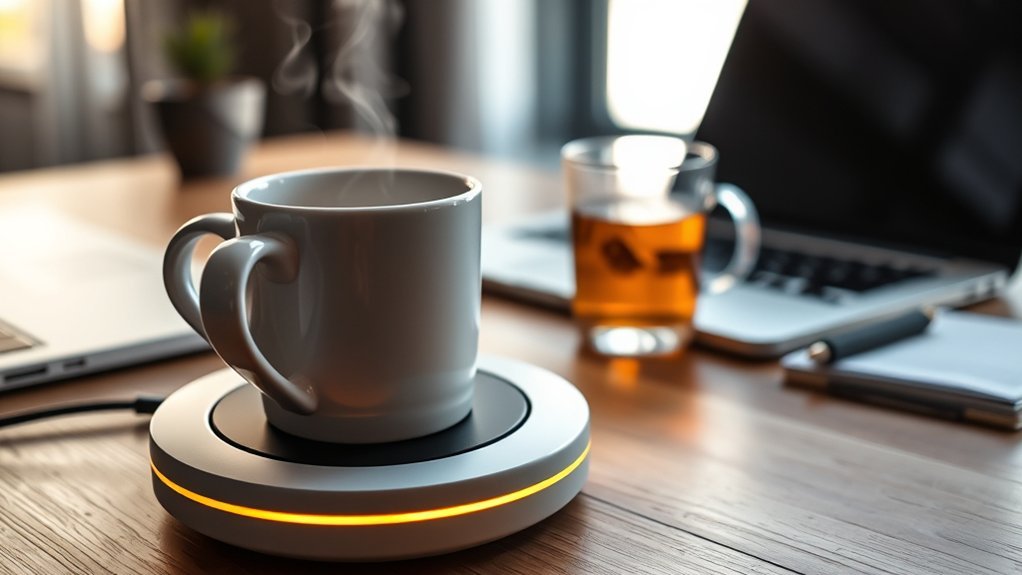
A coffee and tea mug warmer is an electric device that slows the cooling of a hot drink. Many models advertise settings around 130°F to 150°F, although the temperature in the cup depends on the warmer, mug, drink volume, and room conditions.
A typical desk warmer heats a plate beneath your cup. Other designs put the heater inside the mug or use a compatible mug with a powered pad. Controls may include a touch switch, indicator light, adjustable settings, a timer, or automatic cup detection.
For example, the Oracer ET-01 specifications list two settings, 130°F and 150°F. Those are the manufacturer’s stated settings; they do not guarantee that every drink will reach or remain at the same measured temperature.
Self-Warming vs. Plate Warmers: Which One to Choose?
The key difference is where the heat comes from. A battery-powered mug carries its heater with it, while a plate warmer heats a compatible cup from below and needs a power connection.
A third option, such as the OHOM Ui system, uses a specially designed mug and powered pad. It is a matched heating system rather than a battery-powered mug you can carry around while it continues heating.
Self-Warming Mug Benefits
A self-warming mug suits people who move between rooms or want more precise control over their drinking temperature. Built-in heating and sensors help maintain the selected setting until the battery runs down or the mug returns to its charging coaster.
The Ember Mug 3, for example, comes in 10- and 14-ounce sizes. Its five on-mug presets are 125°F, 130°F, 135°F, 140°F, and 145°F, and its app allows finer adjustments. At 135°F, Ember rates the unplugged battery for about 90 minutes on the 10-ounce mug or 80 minutes on the 14-ounce mug without the lid.
| Feature | Self-Warming Mug | Plate Warmer |
|---|---|---|
| Portability | Battery-powered models maintain heat away from a coaster | Usually stays near an outlet |
| Temperature Control | Often adjustable with built-in sensors | Single or multiple settings, depending on the model |
| Capacity | Limited to the mug’s stated size | Depends on the mug and heating-plate fit |
The trade-offs are a higher purchase price, a fixed mug size, and the need to charge and care for the electronics.
Plate Warmer Advantages
Plate warmers are generally more affordable and let you keep using a favorite mug, provided its base makes suitable contact with the plate. A corded warmer can keep supplying heat while it is switched on, subject to its timer and safety controls.
They are not all limited to one setting. Some have adjustable temperatures, while simpler models use a single heat level. A flat-bottom ceramic or glass mug usually works better than an insulated travel tumbler because insulation slows heat transfer.
The OHOM Ui Self-heating Mug Set offers another desk-based approach: a 12-ounce ceramic mug and induction pad with three heating modes. Its pad can also serve as a compatible wireless phone charger, but the mug depends on the powered pad for heating.
Key Features of Mug Warmers
Look first at temperature control, the type of mug a warmer accepts, and its shut-off behavior. These details affect daily use more than appearance alone.
Temperature Control Options
Adjustable settings let you choose a gentler or hotter drink, but the number on a warming plate may describe the plate rather than the beverage. The cup’s thickness, contact area, and starting temperature can all change the result.
- Precise control: A heated mug with a liquid-temperature sensor can maintain a chosen drink setting more directly.
- Preset control: A plate warmer may offer one or several heat levels. Oracer ET-01 has two, while other models provide more.
- Digital controls: Models such as the COSORI Original Coffee Warmer offer temperature adjustment. Read the manual to determine whether the displayed value refers to the heating surface or the drink.
If you care about an exact drinking temperature, measure the liquid with a suitable thermometer rather than relying only on the plate display.
Design and Portability
A compact warmer fits more easily on a crowded desk, but check the plate diameter and available cord reach before choosing one. The mug must sit flat and stable without hanging over the heating area.
The Oracer design uses a plastic frame and conductive glass surface. The original specifications describe a 5-foot cord and a 20-watt power rating; confirm both against the version you buy. A power rating is not the product’s weight.
Thin-wall, flat-bottom mugs usually make better contact with a plate than thick, recessed, or double-wall bases. A powered mug avoids that compatibility problem, but you are limited to its own vessel.
Safety Features Included
An automatic timer and cup sensor are useful safeguards, not reasons to leave a hot plate unattended indefinitely. Check the exact model’s instructions because shut-off behavior varies.
- Timed shut-off: Oracer specifies an eight-hour automatic shut-off for its ET-01.
- Cup sensing: Oracer also says its plate switches off within five minutes after the mug is removed.
- Stable base: Non-slip feet help reduce movement and spills on a level desk.
Look for a credible electrical safety certification appropriate to your market. You can check a claimed UL listing through the UL Solutions product certification database using the manufacturer and model details.
Warning: The plate and mug base can remain hot after heating stops. Keep the warmer on a dry, level surface, away from paper and other heat-sensitive items. Unplug it and allow it to cool before cleaning.
How Do Mug Warmers Work?
A plate warmer converts electricity into heat and transfers it through the bottom of a suitable mug. A self-heating mug has its own heater and sensors, while a compatible induction system heats its specially designed vessel through the powered pad.
The purpose is temperature maintenance. A warmer may slowly raise the temperature of a cooler drink, but it is not designed to boil water or rapidly heat a drink from refrigerator temperature. Begin with freshly prepared coffee or tea for a more consistent result.
Use only the mug type specified by the manufacturer. In particular, the OHOM care instructions explain that its induction-compatible products contain metallic material in the base and must not go in a microwave. OHOM also specifies its supplied power adapter rather than an ordinary computer USB port.
Warning: Do not use a mug warmer to hold milk-heavy coffee or another perishable drink for an entire workday. The FDA’s food-safety guidance identifies 40°F–140°F as the danger zone and advises against leaving perishable food in that range for more than two hours. A plate setting does not prove the drink itself is safely hot-held.
Essential Tips for Maximizing Your Mug Warmer’s Performance
The best results come from good contact between the mug and heater, a drink that starts hot, and regular cleaning. Match your routine to the device’s instructions rather than assuming every warmer operates the same way.
- Choose the right mug. For a standard plate, use a heat-safe, flat-bottom, single-wall mug that sits securely on the heating surface. Avoid a travel mug with an insulated or deeply recessed base unless the maker approves it.
- Start with a hot drink. If your manual permits operation without a cup, you can preheat a manually switched plate for the originally suggested two to three minutes. Skip empty-plate preheating on cup-sensing models.
- Keep the contact surface clean. After the unit cools and is unplugged, wipe it with a damp cloth. Do not immerse the warmer, charging coaster, or power connection in water.
For a rechargeable mug, use its lid when appropriate and return it to the coaster during long desk sessions. Follow the exact model’s washing instructions: Ember Mug 3 is top-rack dishwasher safe on a low-temperature cycle, but that rule does not apply automatically to older Ember mugs or their charging coasters.
Troubleshooting Your Mug Warmer: Common Problems and Fixes
Most warming problems come from a power issue, poor mug contact, or an automatic shut-off feature. Start with the simplest checks before assuming the heater has failed.
- Check power and controls. Confirm the outlet works, the adapter is compatible, and the unit is switched on if it has a power button.
- Center the mug. A flat base should rest fully on the plate, without crumbs or a raised rim creating a gap.
- Check the cup sensor. A gravity-activated model may need a minimum combined mug-and-drink weight. The original 10.4-ounce figure is model-specific, not a rule for every warmer.
- Review timer behavior. If heating stops at a repeatable interval, check the model’s automatic shut-off and cup-removal settings.
- Inspect for damage. Stop using a warmer with a damaged cord, cracked heating surface, liquid inside the housing, or an unusual burning smell.
| Problem | Likely Cause | Solution |
|---|---|---|
| Uneven heating | Off-center mug or poor base contact | Center a suitable flat-bottom mug |
| Not heating | Power, control, or adapter issue | Check the outlet, switch, and specified adapter |
| Shuts off too quickly | Timer or cup sensor is activating | Check the model’s timer and minimum-weight requirements |
If a device repeatedly overheats or fails after these checks, unplug it and contact the manufacturer rather than opening or repairing its electrical parts yourself.
Top Mug Warmer Recommendations for Every Budget
The right purchase depends on whether you need an inexpensive desk plate, precise battery-powered heating, or a matched mug-and-pad setup. These are useful options to compare, not products tested for this article. Prices below are manufacturer-listed US figures where available and may change.
- Ember Mug 3 — precise, portable heating. The manufacturer lists the 10-ounce size at $129.95 and the 14-ounce size at $149.95. The mug has five on-mug presets, optional app adjustment, and an included charging coaster. Ember advertises over three hours of battery life with the included sliding lid under its stated conditions.
- Bestinnkits Gravity-Induction Mug Warmer — basic desk option. The original article places this around $24 and cites a 131°F setting. Treat that as a listing-specific figure: confirm the exact version, included mug, sensor requirements, and selling price before ordering.
- OHOM Ui Self-heating Mug Set — coordinated mug and pad. The reviewed 12-ounce set was listed at $109. It offers three heating modes and a pad that can also charge compatible phones. Unlike a battery-powered Ember, its mug needs the powered pad to maintain heat.
For a conventional plate, Oracer ET-01 was listed at $23.99 but marked out of stock on the checked manufacturer page. COSORI’s Original Coffee Warmer was listed at $29.99 and offers adjustable control. InstaCuppa also sells models with multiple settings; compare the exact version rather than assuming that all its warmers have the same controls.
Frequently Asked Questions
Do Coffee Mug Warmers Really Work?
Yes. A mug warmer slows the cooling of a drink that starts hot. Results depend on mug construction, room temperature, drink volume, and the device’s heat output. A flat-bottom mug usually works better on a plate than a double-wall insulated tumbler.
What Is the Best Coffee Cup Warmer?
The best type depends on how you drink coffee. A battery-powered heated mug suits movement and precise control, while a corded plate suits a fixed desk and compatible mugs. Compare the actual model’s settings, shut-off behavior, capacity, and cleaning instructions.
What Temperature Is a Coffee Mug Warmer At?
Many warmers advertise settings around 130°F to 150°F, but the range varies by model. A plate’s setting may describe its surface rather than the drink. A heated mug with a liquid sensor can control beverage temperature more directly.
What Is the Best Coffee Mug Warmer for a Desk?
A compact plug-in plate with a stable base, suitable cord length, temperature options, and automatic shut-off is practical for a desk. Oracer ET-01 is one example with two stated settings and cup sensing, although the checked manufacturer listing showed it out of stock.
Can a Mug Warmer Reheat Cold Coffee?
A mug warmer may slowly raise the temperature of cool coffee, but it is mainly designed to maintain warmth. It is not a fast reheating appliance. Start with a hot drink for more reliable results, and do not use a warmer to make long-held perishable drinks safe again.
Can You Use an Insulated Mug on a Warming Plate?
An insulated mug is usually a poor match for a standard warming plate. Its construction limits heat transfer, and a recessed bottom may prevent full contact. Use a heat-safe mug with a flat base unless the warmer’s manufacturer specifies another compatible design.
Conclusion
A coffee and tea mug warmer is most useful when you want to enjoy a freshly made drink slowly. For a fixed desk, prioritize mug contact, simple controls, and shut-off features. For movement and precise temperature control, consider a rechargeable heated mug. Match the device to your routine, follow its care instructions, and treat milk-based drinks with appropriate food-safety caution.
Sources
- Oracer ET-01 product information: stated settings, cup sensing, shut-off, construction, listed price, and availability.
- Ember Mug 3 FAQ: sizes, prices, presets, battery ratings, and cleaning instructions.
- OHOM Ui product information: capacity, heating modes, pad functions, and price.
- COSORI Original Coffee Warmer: product identification, adjustable warmer, and listed price.
- UL Solutions certification database: checking product certification claims.
- OHOM FAQ: power-supply compatibility and microwave restrictions.
- US Food and Drug Administration: temperature danger zone and perishable-food holding guidance.
- Ember Mug 3 product information: manufacturer-listed price and lid-supported battery-life claims.
