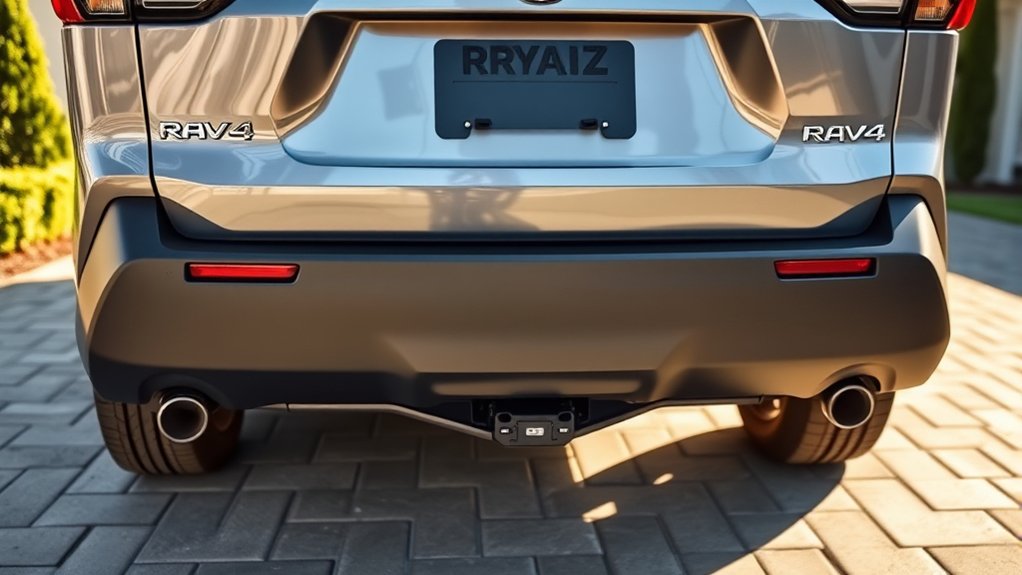
The Toyota RAV4 can accept a receiver hitch, but whether it can tow—and how much—depends on the exact model year, trim, drivetrain, powertrain, and equipment. A hitch can also support a compatible bike rack or cargo carrier without towing a trailer. Before buying equipment, identify your RAV4 precisely and treat its owner’s manual and the hitch manufacturer’s instructions as the controlling sources.
Quick Answer
Yes. Many Toyota RAV4 model years can accept an OEM or aftermarket receiver hitch, and the 2026 Woodland includes a standard 2-inch receiver with wiring. Towing capacity is not universal, however. Verify the exact vehicle rating, hitch rating, tongue-weight limit, wiring, and trailer-brake requirements before towing.
Key Takeaways
- A tow hitch may be factory-installed, dealer-installed, or added with a vehicle-specific aftermarket kit.
- Many compatible RAV4 hitches have a 2-inch receiver, but that size is not factory-standard on every model.
- Installing a higher-rated hitch never raises the RAV4’s manufacturer-rated towing limit.
- Trailer towing normally requires a compatible ball mount, hitch ball, safety chains, and functioning trailer lights in addition to the receiver.
- Always verify the exact year, trim, drivetrain, loaded trailer weight, tongue weight, payload, and local brake requirements.
What Is a Tow Hitch and Why Add One to Your Toyota RAV4?
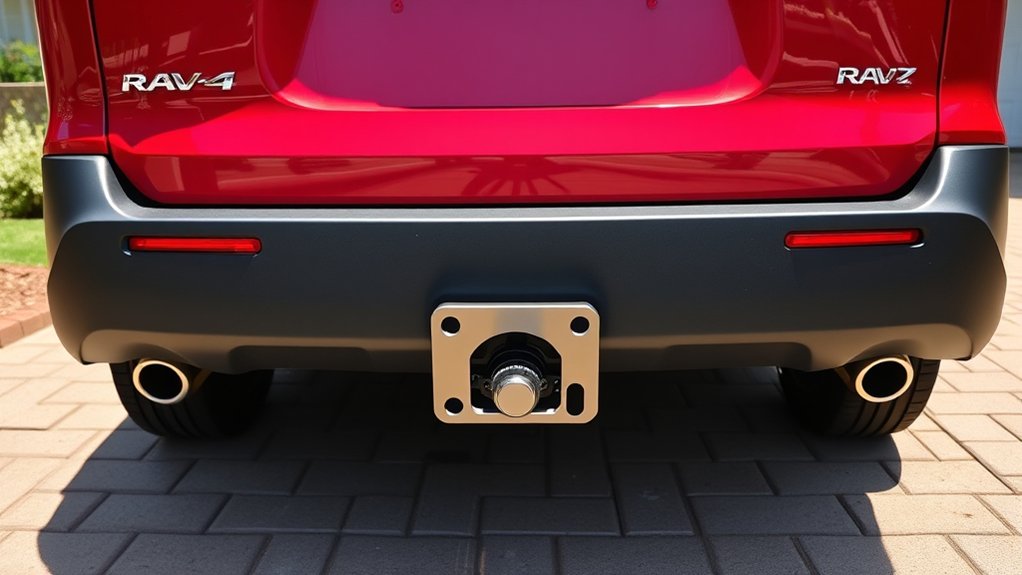
A receiver hitch is a steel structure that bolts to designated points on the vehicle’s frame or unibody structure. Its square receiver opening can hold a compatible ball mount, bike rack, cargo carrier, or other hitch-mounted accessory.
Adding a hitch can make a RAV4 more versatile, but the intended use matters:
- Trailer towing: Requires a complete, correctly rated towing system, including a ball mount, hitch ball, pin and clip, safety chains, electrical connection, and any required trailer brakes.
- Bike rack: Does not normally require trailer wiring, but the rack shank must fit the receiver and the combined rack-and-bike load must remain within every applicable limit.
- Cargo carrier: Places weight behind the rear axle, so the carrier, cargo, receiver, and vehicle limits must all be checked.
Warning: A receiver hitch does not increase the RAV4’s towing capacity, payload, axle ratings, or structural limits. The usable limit is always the lowest applicable rating in the complete vehicle-and-trailer combination.
Start by locating the towing section in the Toyota owner’s manual for your exact vehicle. Do not rely on the rating for a similar-looking RAV4, a different drivetrain, or a different model year.
Essential Guide to Installing a Tow Hitch on Your RAV4
Many RAV4 receiver hitches are designed as bolt-on products, but their hardware and procedures are not interchangeable. The correct installation instructions are the instructions supplied for the exact hitch part number and exact RAV4 configuration.
At a Glance
| Time Required | Often 1–2 hours for a straightforward bolt-on receiver; allow more time for wiring, rusted threads, fascia work, or difficult access. |
| Difficulty | Easy to moderate for an experienced DIY installer; professional installation is safer when lifting, trimming, wiring, or sensor work is required. |
| Tools Needed | Safety glasses, wheel chocks, torque wrench, correct sockets and extensions, thread-cleaning supplies, and any model-specific tools listed by the hitch manufacturer. |
| Cost | Varies by hitch, wiring kit, ball mount, hitch ball, accessories, and labor. Price the complete setup rather than the receiver alone. |
Required Tools and Supplies
Gather everything listed in the product instructions before lifting the hitch. A typical bolt-on installation may require:
- Safety glasses and work gloves
- Wheel chocks
- A torque wrench with the required range
- Correct metric sockets, extensions, and adapters
- A nylon or suitable wire brush for dirty weldnuts
- Penetrating lubricant or compressed air, when permitted by the instructions
- Trim-removal or exhaust-hanger tools if the specific installation requires them
- A helper or suitable lifting support for positioning the receiver
- The exact bolts, washers, spacers, and other hardware supplied with the hitch
- A vehicle-specific wiring kit if a trailer will be towed
Hardware is not universal. As one documented example, the CURT 13416 installation manual uses four M12 bolts with conical-toothed washers in existing weldnuts and requires no drilling. Its specified torque applies only to that part and application; it must not be copied to another hitch.
Note: Some installations require lowering an exhaust section, removing an underbody panel, trimming a fascia panel, relocating a tie-down bracket, or accounting for a hands-free liftgate sensor. Perform those steps only when the exact instructions require them.
Installation Step-by-Step Guide
- Confirm exact fitment. Match the hitch part number to the RAV4’s model year, trim, drivetrain, hybrid or plug-in-hybrid configuration, and any exclusions in the manufacturer’s fit guide.
- Read the complete instructions. Identify the attachment points, hardware, torque specifications, trimming requirements, wiring route, and any parts that must be temporarily removed.
- Prepare the vehicle safely. Park on a firm, level surface, set the parking brake, chock the wheels, allow the exhaust to cool, and follow Toyota’s approved lifting procedures if additional clearance is necessary. Never work under a vehicle supported only by a jack.
- Inspect the mounting points. Remove stickers or plugs only as directed. Clean corrosion and debris from existing weldnuts without damaging the threads. Each bolt should turn correctly before the heavy receiver is raised into place.
- Remove only the specified components. This may include a tie-down bracket, underbody panel, exhaust hanger, or fascia section. Keep unrelated factory parts intact.
- Position the receiver. Use a helper or stable lifting support. Start every fastener by hand and leave the hardware loose enough for alignment. Do not force a cross-threaded bolt.
- Torque the hardware. Tighten the fasteners in the sequence and to the values stated in the hitch instructions. Do not substitute a generic RAV4 torque value.
- Restore and inspect the vehicle. Reinstall panels, exhaust supports, and other components. Check receiver alignment, exhaust clearance, bumper clearance, spare-tire access, liftgate operation, and nearby sensors.
- Install and test the wiring when towing. Use a vehicle-specific powered converter or harness when required. Test the running lights, brake lights, turn signals, and any trailer-brake circuit before driving.
- Complete a final check. Confirm the hitch pin and clip fit, verify all hardware visually, and follow the manufacturer’s inspection or recheck interval after initial use.
Pro Tip: Clean and test the weldnut threads before lifting the receiver. Discovering a damaged or heavily rusted thread while supporting a heavy hitch makes the job slower and less safe.
Determining the Right Receiver Size for Your RAV4
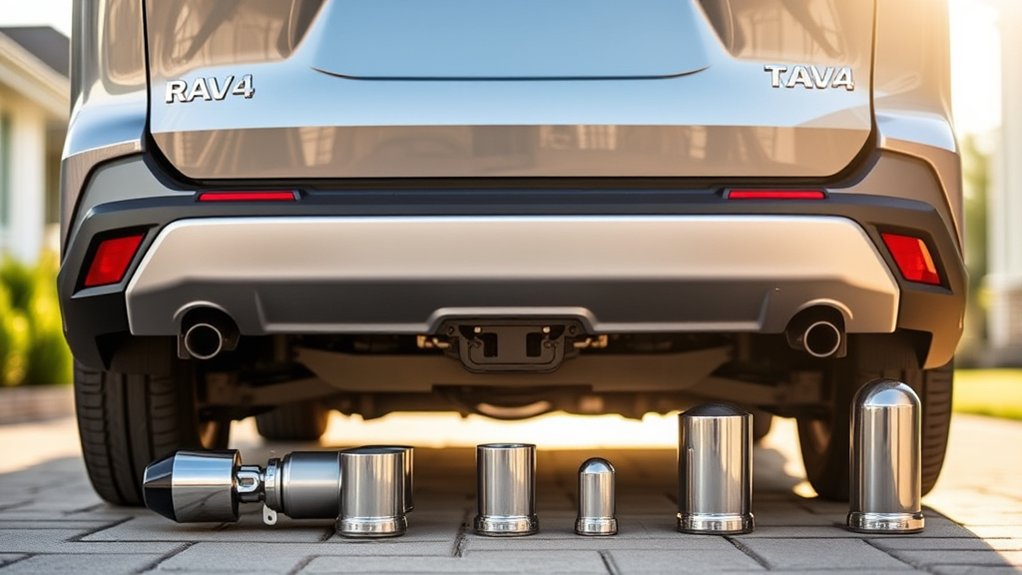
A 2-inch receiver opening is common among RAV4 hitches and works with many ball mounts, bike racks, and cargo carriers. It is not correct, however, to assume that every RAV4 has a factory receiver or that every compatible hitch uses the same design.
Toyota lists a standard 2-inch receiver and wiring harness on the 2026 Woodland. Owners of other configurations should confirm whether an OEM accessory or an exact-fit aftermarket receiver is available for their vehicle.
Check these details before ordering:
- Vehicle fitment: Confirm the exact model year, trim, drivetrain, and powertrain.
- Receiver opening: Match the rack, carrier, or ball-mount shank to the receiver size.
- Vehicle rating: Find the towing and tongue-weight information for the exact RAV4.
- Hitch rating: Read the receiver label and product documentation.
- Accessory rating: Confirm the separate rating for the ball mount, hitch ball, rack, carrier, or adapter.
- Clearance: Check ground clearance, bumper clearance, exhaust clearance, and liftgate operation.
Receiver size and towing capacity are not the same thing. Two vehicles may both use a 2-inch receiver while having very different towing limits.
How to Select the Correct Ball-Mount Rise or Drop
A trailer should sit approximately level when connected and loaded correctly. Do not use a fixed RAV4 measurement copied from another vehicle.
- Park the RAV4 and trailer separately on level ground.
- Level the trailer and measure from the ground to the relevant coupler reference point.
- Measure from the ground to the receiver opening using the ball-mount manufacturer’s stated measurement method.
- Use the difference to select the required ball-mount rise or drop.
- Confirm that the ball diameter matches the coupler and that the ball mount, ball, and fasteners have adequate ratings.
Note: A receiver adapter can reduce capacity, add movement, and increase leverage. Use one only when every component manufacturer permits it and all resulting limits are understood.
OEM and Aftermarket Hitch Options for the RAV4
RAV4 owners generally choose between a Toyota accessory hitch, factory-installed equipment on a qualifying trim, or a vehicle-specific aftermarket receiver. There is no single universal “Adventure Series hitch” for all RAV4 models.
OEM or Factory Hitch
An OEM or factory setup may offer:
- Fitment designed around the specific bumper and underbody
- Coordinated wiring components
- A receiver position intended to preserve useful departure clearance
- Installation through a Toyota dealer familiar with the vehicle
For the current lineup, Toyota documents the 2026 Woodland with a standard 2-inch rear receiver and wiring harness. Equipment on other years and trims must be checked separately.
Aftermarket Hitch
An aftermarket receiver may provide more choices in price, receiver position, visible cross-tube design, load rating, and installation method. Select one through the manufacturer’s vehicle-specific fit guide rather than by receiver width alone.
Fitment questions to review include:
- Gas, hybrid, or plug-in-hybrid compatibility
- Front-wheel-drive or all-wheel-drive compatibility
- Exhaust and underbody clearance
- Bumper or fascia trimming
- Spare-tire and recovery-point access
- Hands-free liftgate sensor operation
- Required wiring converter and connector type
A high receiver rating can provide a useful structural margin, but it does not authorize the RAV4 to exceed Toyota’s limit.
A hitch labeled for 4,000 pounds does not turn a RAV4 rated for 1,750 pounds into a 4,000-pound tow vehicle.
What You Need to Know About Your RAV4’s Towing Capacity
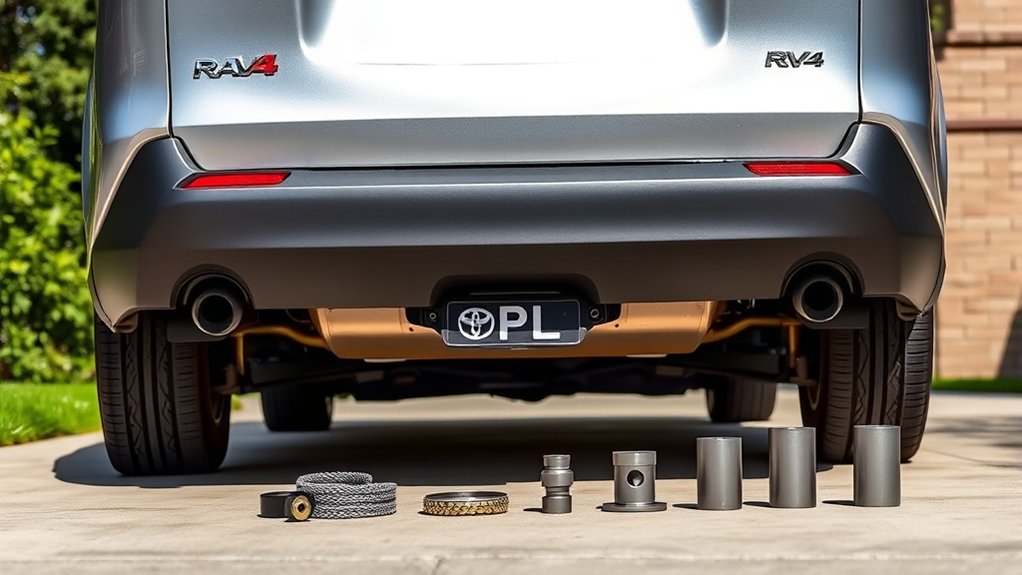
There is no single towing-capacity figure that applies to every Toyota RAV4. Ratings change with the generation, trim, drivetrain, powertrain, cooling equipment, and market.
For example, Toyota’s U.S. specifications for the 2026 lineup include:
- RAV4 LE AWD: 1,750-pound towing capacity
- RAV4 XLE Premium AWD: 3,500-pound towing capacity
- RAV4 Woodland: 3,500-pound towing capacity, with a standard 2-inch receiver and wiring harness
- RAV4 SE AWD: 3,500-pound towing capacity
Older models have their own ratings. As one historical example, Toyota rated the 2020 RAV4 TRD Off-Road to tow up to 3,500 pounds. That figure does not apply automatically to another 2020 trim or another model year.
Use these examples only to understand how widely ratings can vary. Verify your own vehicle through its owner’s manual, certification labels, dealer documentation, and any vehicle-specific towing instructions.
Weight Limits You Must Check
- Maximum trailer weight: The permitted weight of the trailer and everything loaded in or on it.
- Actual loaded trailer weight: Includes cargo, batteries, propane, water, equipment, and other items—not merely the trailer’s advertised empty weight.
- Tongue weight: The downward load the coupled trailer applies to the hitch.
- Vehicle payload: Passengers, luggage, accessories, and trailer tongue weight all use available payload.
- Axle and vehicle ratings: Do not exceed the ratings shown in the vehicle documentation and certification labels.
- Receiver rating: The hitch has separate gross-trailer-weight and tongue-weight limits.
- Ball mount and hitch ball: Both must fit correctly and meet or exceed the required rating.
- Trailer rating: The trailer, coupler, tires, axle, and safety equipment also have individual limits.
Warning: Never choose the largest published RAV4 towing figure simply because your vehicle has AWD or a 2-inch receiver. Verify the rating for the exact configuration, then remain within the lowest vehicle, hitch, accessory, and trailer limit.
Wiring and Trailer Brakes
A trailer used on public roads needs the required working lights. A vehicle-specific wiring harness allows the RAV4 to operate the trailer’s running lights, brake lights, and turn signals without unsafe splicing into sensitive vehicle circuits.
Some trailers also require electric or surge brakes because of their weight, the owner’s manual, or applicable law. A basic light connector does not necessarily provide a trailer-brake-control circuit. Verify:
- The electrical connector required by the trailer
- Whether a brake controller or additional wiring is needed
- The trailer manufacturer’s brake requirements
- Toyota’s instructions for the exact vehicle
- The laws that apply where the combination will be operated
Maintaining Your Tow Hitch and Setup
Inspect the hitch and towing equipment regularly, especially before a long trip or after driving on salted roads, rough surfaces, or muddy trails.
- Check the receiver, welds, and mounting areas for cracks, deformation, rust, or collision damage.
- Confirm that visible mounting hardware remains secure and follow the hitch manufacturer’s inspection instructions.
- Keep the receiver opening free of packed dirt and severe corrosion.
- Inspect the hitch pin, clip, coupler latch, safety-chain attachments, and electrical connector.
- Look for damaged wiring, loose grounds, bent terminals, or corroded connector contacts.
- Test every required trailer light before departure.
- Inspect the ball mount and hitch ball for looseness, damage, and abnormal wear.
- Follow the component manufacturer’s lubrication directions rather than applying lubricant indiscriminately.
- Remove a rack, carrier, or ball mount when it is not needed if doing so is recommended and practical.
An anti-rattle device may reduce movement or noise from a compatible rack or carrier, but it is not a substitute for the correct hitch pin, properly secured coupler, safety chains, or sound mounting hardware.
Common Towing Questions for the Toyota RAV4
What Is My RAV4’s Towing Capacity?
It depends on the exact model year and configuration. Check the towing section of the owner’s manual and confirm that the information matches the trim, drivetrain, and powertrain shown on your vehicle.
What Hitch Size Do I Need?
Many RAV4-compatible receivers use a 2-inch opening, but exact vehicle fitment comes first. Match the receiver to the vehicle and then match the ball mount, rack, or carrier to that receiver.
Can a RAV4 Tow a Rental Trailer?
Possibly, but not every RAV4 can tow every rental trailer. Before making a reservation, confirm:
- The rental provider accepts the exact vehicle and hitch setup
- The trailer’s estimated loaded weight stays within the RAV4’s limit
- The expected tongue weight fits within all applicable limits
- Passengers, cargo, and tongue weight remain within payload and axle limits
- The ball size, ball-mount height, chains, lights, and brakes are compatible
Pre-Tow Safety Checklist
- Confirm the loaded trailer and tongue weights.
- Verify payload and all vehicle, hitch, ball mount, ball, and trailer limits.
- Seat the coupler fully on the correct hitch ball and lock the latch.
- Install the correct hitch pin and retaining clip.
- Attach the safety chains to approved points without dragging them on the road.
- Connect the breakaway cable separately when the trailer has one.
- Plug in the electrical connector and test all required lights.
- Confirm trailer-brake operation when equipped.
- Inspect vehicle and trailer tires, pressures, lug nuts, and visible damage.
- Secure all cargo and balance the load properly.
- Check mirrors and rear visibility.
- Perform a low-speed brake and handling check in a safe area before entering traffic.
Pro Tip: Weigh the loaded combination when practical. Advertised dry or empty trailer weight does not include the cargo and supplies that may push the real trip weight beyond the RAV4’s limit.
Related Guides
Frequently Asked Questions
Can I use a bike rack with my RAV4 tow hitch?
Yes, provided the rack shank matches the receiver and the loaded rack remains within the rack, hitch, vehicle, and any accessory-load limits. Include the weight of the rack, bicycles, adapters, and locks. Also confirm liftgate and bumper clearance.
What trailers can the RAV4 tow safely?
The RAV4 may be able to tow a lightweight utility trailer, small watercraft trailer, compact camping trailer, or another trailer whose actual loaded weight and tongue weight remain within every applicable limit. Trailer type alone does not determine compatibility; the complete loaded specifications do.
Is a wiring harness necessary for towing?
A trailer needs the legally required functioning lights, so a compatible wiring connection is normally necessary for trailer towing. A passive bike rack or cargo carrier does not ordinarily require trailer wiring unless it blocks the vehicle’s lights or requires auxiliary lighting.
How do I know whether a hitch is compatible?
Use the hitch manufacturer’s fit guide and confirm the exact RAV4 model year, trim, drivetrain, and powertrain. Review exclusions involving the bumper, exhaust, underbody, spare tire, hybrid or plug-in-hybrid equipment, and hands-free liftgate sensor.
Can I install the tow hitch myself?
Many exact-fit receivers are suitable for an experienced DIY installer with the specified tools, a torque wrench, safe lifting equipment, and the ability to follow the complete instructions. Use a qualified installer when the job requires procedures beyond your tools or experience.
Does adding a hitch increase the RAV4’s towing capacity?
No. The receiver provides an attachment point, but it does not change the vehicle’s manufacturer-rated towing capacity, payload, axle ratings, cooling capability, or braking limits.
Does my RAV4 trailer need its own brakes?
That depends on the trailer, its loaded weight, Toyota’s instructions, the trailer manufacturer’s requirements, and applicable law. Verify the requirement before towing and confirm that the RAV4 has the correct connector and brake-control equipment when needed.
Conclusion
A properly selected Toyota RAV4 tow hitch can support trailer towing, a bike rack, or a cargo carrier, but safe use begins with exact vehicle identification. Confirm the RAV4’s rating, choose a vehicle-specific receiver, follow the supplied installation instructions, and check every component in the complete setup. Before towing, verify loaded weight, tongue weight, payload, wiring, brakes, coupling, chains, tires, and lights rather than relying on a generic RAV4 capacity or receiver size.
Sources
- Toyota USA Newsroom: 2026 RAV4 — current trim, towing-capacity, receiver, and wiring examples.
- Toyota Owners: Manuals and Warranties — access to vehicle-specific owner documentation.
- CURT 13416 Installation Manual — documented example of hitch hardware, existing-weldnut installation, torque control, and inspection warnings.
- Toyota USA Newsroom: 2020 RAV4 TRD Off-Road — historical 3,500-pound towing-capacity example.
