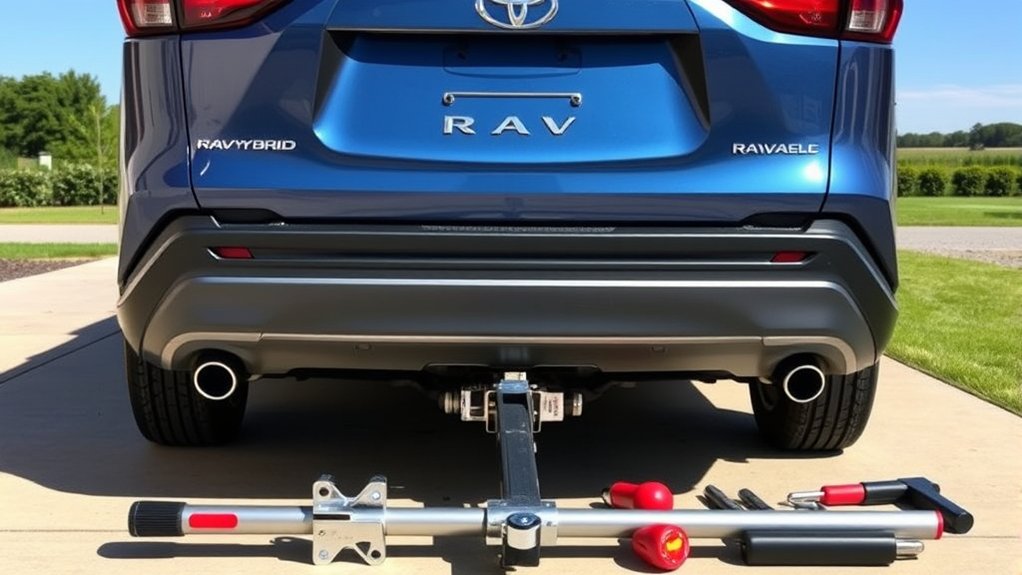
A 2025 Toyota RAV4 Hybrid does not include a trailer hitch receiver as standard equipment. However, you can add a Toyota Genuine receiver or a compatible aftermarket hitch for towing, bike racks, and cargo carriers. The important part is matching every component to your exact model while staying within Toyota’s published weight limits.
Quick Answer
No. A 2025 Toyota RAV4 Hybrid does not include a hitch receiver as standard equipment. You can add a Toyota Genuine or vehicle-specific aftermarket receiver. For trailer towing, the 2025 model is rated up to 1,750 pounds, with a 1,000-pound unbraked limit, subject to vehicle-load and equipment limits.
Key Takeaways
- The 2025 RAV4 Hybrid does not have a standard factory-installed hitch receiver, but Toyota Genuine and aftermarket options are available.
- Toyota rates the 2025 RAV4 Hybrid for up to 1,750 pounds of gross trailer weight and 1,000 pounds without trailer brakes.
- Toyota specifies tongue weight equal to 9% to 11% of the loaded trailer weight.
- A receiver rated above 1,750 pounds does not increase the vehicle’s towing capacity.
- Fitment, bumper trimming, wiring, kick-sensor operation, and installation time depend on the exact hitch design.
At a Glance
| Time Required | About 45 minutes to more than two hours, depending on the hitch, corrosion, wiring, exhaust clearance, and whether fascia trimming is required. |
| Difficulty | Moderate. Professional installation is sensible when trimming, electrical work, or lifting a heavy receiver is outside your experience. |
| Tools Needed | Socket set, calibrated torque wrench, safety glasses, exhaust-hanger tool or suitable pliers, support strap, trim tools, and any hitch-specific tools listed by the manufacturer. |
| Cost | Varies by receiver, ball mount, wiring, brake-controller equipment, and professional labor. Verify current pricing and included parts before ordering. |
Last updated: July 15, 2026. Specifications below apply primarily to the U.S.-market 2025 RAV4 Hybrid. Always confirm your model year, trim, market, and VIN before purchasing towing equipment.
Understanding the Towing Capacity of the Toyota RAV4 Hybrid
According to the 2025 Toyota RAV4 Hybrid Owner’s Manual, the maximum gross trailer weight is 1,750 pounds. This number includes the trailer itself and everything loaded into or onto it.
- Maximum trailer weight rating: 1,750 pounds
- Maximum unbraked trailer weight: 1,000 pounds
- Gross combination weight rating: 6,670 pounds
- Recommended tongue weight: 9% to 11% of gross trailer weight
At the full 1,750-pound trailer rating, the recommended tongue-weight range is approximately 158 to 193 pounds. You must also remain within the vehicle’s gross vehicle weight rating and front and rear axle ratings shown on its certification label.
A 1,750-pound hitch rating is not the same as permission to load any 1,750-pound trailer. Passengers, vehicle cargo, accessories, tongue weight, and the rating of every towing component still matter.
A trailer’s advertised dry weight rarely includes every battery, propane cylinder, tank of water, accessory, or piece of camping equipment. Use the trailer’s actual loaded weight when checking the limit. A public vehicle scale or another suitable scale gives you a more reliable figure than a brochure estimate.
Warning: Never use the hitch manufacturer’s higher rating as the RAV4 Hybrid’s towing capacity. The lowest rating among the vehicle, receiver, ball mount, trailer ball, coupler, and other components controls the setup.
Aftermarket Hitch Options for Your RAV4 Hybrid
The 2025 RAV4 Hybrid does not include a standard receiver, but you have both Toyota Genuine and aftermarket choices. Toyota sells a Genuine Tow Hitch Receiver with a ball mount, while manufacturers such as Torklift Central and CURT offer vehicle-specific aftermarket designs.
A receiver’s own rating may be much higher than 1,750 pounds. That extra structural rating can be useful for compatibility with certain hitch accessories, but it does not raise Toyota’s vehicle limit.
Check the following before choosing a hitch:
- Exact fitment: Confirm the model year, Hybrid powertrain, trim, production market, and part number.
- Receiver opening: Match the receiver size to your ball mount, bike rack, or cargo-carrier shank.
- Ground clearance: A lower receiver may scrape on steep driveways, while a hidden design may sit closer to the bumper.
- Installation method: Some designs bolt below the bumper without trimming. Others require a carefully measured fascia opening.
- Kick-sensor compatibility: A receiver may interfere with the hands-free liftgate sensor or require the sensor to be moved, disabled, or reconfigured.
- Exhaust clearance: Check that the installed receiver does not contact the exhaust or create vibration.
- Included components: A receiver may not include the wiring harness, trailer ball, pin, clip, or brake-controller equipment.
Note: “Toyota Genuine” does not necessarily mean the receiver was installed at the factory. A Toyota dealer may install the accessory before or after vehicle delivery.
Installing a Hitch on Your RAV4 Hybrid
Hitch installation can be manageable for an experienced home mechanic, but the procedure is not identical for every receiver. Use the instructions supplied with your exact part instead of relying on a generic video or another brand’s torque values.
Required Tools and Materials
The required tools depend on the receiver, but a typical installation may call for:
- A metric socket and ratchet set
- A calibrated torque wrench covering the specified torque range
- Safety glasses and work gloves
- An exhaust-hanger removal tool or suitable pliers
- A strap or stand to support the exhaust when hangers are disconnected
- Trim-removal tools
- Painter’s tape and measuring tools if fascia trimming is specified
- A suitable cutting tool only when the hitch instructions require trimming
- A second person or safe lifting support for positioning the receiver
- The correct wiring kit when the vehicle will tow a trailer
Do not assume a drill or cutting tool is required. Many custom receivers use existing mounting locations, while some hidden designs require limited fascia trimming for the receiver opening.
Step-by-Step Installation Process
- Verify the part: Confirm that the receiver and wiring kit list your exact RAV4 Hybrid year and trim.
- Read the complete instructions: Identify the required torque values, trimming dimensions, exhaust steps, kick-sensor changes, and wiring route before beginning.
- Prepare the vehicle: Park on a firm, level surface, engage the parking brake, chock the wheels, and let the exhaust cool completely.
- Support nearby components: If the instructions require lowering the exhaust, support it before releasing any rubber hangers.
- Expose the mounting points: Remove only the panels, fasteners, tow hooks, or shields identified in the hitch instructions.
- Trim only when required: Measure twice, protect the surrounding finish with tape, and cut only the dimensions provided for that receiver and vehicle configuration.
- Lift the receiver into position: Use a helper or suitable support. Start all mounting hardware by hand to avoid cross-threading.
- Torque the hardware: Tighten every fastener in the specified sequence and to the exact value published by the hitch manufacturer.
- Restore the vehicle: Reattach the exhaust, shields, panels, and kick-sensor wiring as instructed. Confirm adequate clearance around the receiver and exhaust.
- Install and test the wiring: Use vehicle-specific connectors rather than splicing directly into the lighting circuits. Test the running lights, turn signals, and brake lights before towing.
Tips for Proper Fitment
- Enter your VIN when a Toyota parts catalog or installer offers VIN-based fitment checking.
- Do not enlarge frame holes, substitute lower-grade hardware, or add washers unless the instructions specifically permit it.
- Confirm that the liftgate opens normally and that the receiver does not obstruct sensors, lights, or the exhaust.
- Check the receiver opening height before buying a ball mount. The trailer should sit level when coupled and loaded.
- Keep the hitch instructions and torque specifications with your maintenance records.
- Inspect the installation after the first trips and after any impact, unusual noise, or evidence of movement.
Pro Tip: Buy the hitch, wiring, ball mount, trailer ball, and locking or retaining hardware as one planned system. This prevents a last-minute discovery that the receiver opening, ball diameter, rise, drop, or electrical connector does not match the trailer.
Trailers You Can Tow With the Toyota RAV4 Hybrid
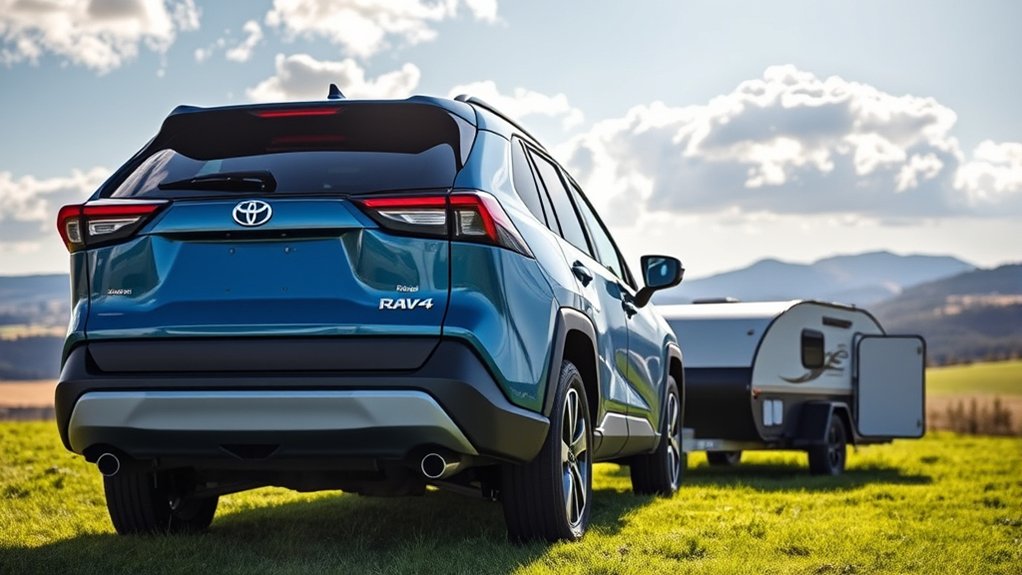
The 2025 RAV4 Hybrid is best matched with genuinely lightweight trailers. Suitability depends on the trailer’s loaded weight, tongue weight, brakes, frontal area, load distribution, and the vehicle’s passenger and cargo load.
Lightweight Trailer Options
Possible matches may include:
- Small open utility trailers: Useful for landscaping supplies, camping equipment, or household items when the trailer and cargo remain within every limit.
- Compact teardrop or micro campers: Suitable only when the fully loaded weight, tongue weight, and braking equipment meet Toyota’s requirements.
- Light watercraft trailers: Small personal-watercraft, kayak, or boat packages may fit, but include the motor, fuel, battery, safety equipment, and trailer in the calculation.
- Light motorcycle or powersports trailers: Weigh the complete loaded combination rather than relying on the empty trailer specification.
A camper advertised at 1,300 pounds dry can exceed the RAV4 Hybrid’s limit after adding a battery, propane, water, food, awning, spare parts, and personal gear. Confirm the loaded weight before traveling.
Recommended Weight Limits
Toyota’s 1,750-pound figure is a maximum rating, not a requirement to tow at that weight. You may choose additional personal margin for weather, terrain, or comfort, but the commonly repeated “80% rule” is not an official Toyota specification.
Use these checks instead:
- Gross trailer weight must not exceed 1,750 pounds.
- A trailer without its own service brakes must not exceed 1,000 pounds.
- Tongue weight should equal 9% to 11% of loaded trailer weight.
- The combined vehicle and trailer weight must remain within the 6,670-pound GCWR.
- The vehicle must remain within its GVWR and front and rear GAWR.
- Passengers, vehicle cargo, accessories, and tongue weight count against the vehicle’s available load capacity.
- Every hitch component must be rated for the actual load.
Note: A hitch-mounted bike rack or cargo carrier does not use the trailer-weight rating in the same way as a trailer. Check the receiver, vehicle, and accessory limits, include the weight of the rack or carrier itself, and account for the leverage created by loads extending behind the receiver.
Top Tips for Safe and Efficient Towing With Your RAV4 Hybrid
- Practice before a trip: Learn how the combination accelerates, turns, stops, and reverses in an open area away from traffic.
- Use a conservative speed: Toyota recommends no more than 65 mph on a flat, straight, dry road, or a lower posted or trailer-manufacturer limit when applicable.
- Increase following distance: A loaded trailer increases stopping distance and changes emergency handling.
- Slow before turns: Avoid sudden steering, rapid lane changes, abrupt acceleration, and hard braking.
- Manage long descents: Reduce speed before the grade and use the lower transmission range recommended by Toyota instead of riding the brakes.
- Watch temperatures: Heavy loads, high ambient temperatures, and long climbs increase heat. Stop safely if the vehicle displays an overheating warning.
- Follow the driver-assistance instructions: Toyota directs owners to disable certain assistance and parking systems while towing because their operation may be affected. Follow the list for your exact trim and manual.
- Inspect the load at stops: Check the coupler, safety chains, electrical connector, tires, cargo restraints, and hitch hardware after the first few miles and during longer trips.
Warning: If trailer sway begins, hold the steering wheel firmly and steer straight. Release the accelerator gradually. Do not accelerate, make abrupt steering corrections, or immediately apply hard vehicle braking. After the sway stops, pull over safely and inspect the tires, load position, coupling, and tongue weight.
How to Ensure Safe Towing With Your RAV4 Hybrid
Complete a full inspection before every trip instead of relying on the previous journey’s setup.
- Confirm the loaded trailer weight and tongue weight.
- Check the vehicle certification label for GVWR and axle limits.
- Set the trailer-ball height so the coupled trailer sits level.
- Confirm the coupler is fully latched and secured.
- Attach safety chains securely to the vehicle and trailer.
- Test the trailer’s running lights, turn signals, brake lights, and brakes.
- Inflate the vehicle and trailer tires to their specified pressures.
- Secure all trailer cargo so it cannot shift.
- Confirm mirrors provide the view required by applicable laws.
- Remove excessive vehicle cargo if the combined load approaches a rating.
- Carry suitable wheel chocks for parking.
Toyota recommends that a new vehicle, or a vehicle with a newly installed powertrain component, be driven more than 500 miles before towing. During the next 500 miles of trailer towing, Toyota advises staying below 45 mph and avoiding full-throttle acceleration.
Towing also creates additional maintenance demands. Toyota instructs owners to retighten the towing-ball and bracket fasteners after approximately 600 miles of trailer towing and to follow the severe-use or towing maintenance guidance in the maintenance schedule.
Common Questions About Towing With the RAV4 Hybrid
- Does the 2025 RAV4 Hybrid include a receiver? No. A receiver may be added as a Toyota Genuine or aftermarket accessory.
- Does installing a hitch increase the towing capacity? No. The 2025 vehicle limit remains 1,750 pounds even when the receiver has a higher structural rating.
- Does the 2025 Hybrid have a tow-preparation package? It does not use the higher-capacity towing-package arrangement found on certain gas-only Adventure and TRD configurations from the previous generation.
- When are trailer brakes needed? Toyota’s unbraked trailer limit is 1,000 pounds. A trailer exceeding that weight requires service brakes under Toyota’s guidance, plus any equipment required by local law.
- Can the same guidance be used for a 2026 RAV4? No. The redesigned 2026 RAV4 has trim- and drivetrain-dependent ratings, including 1,750- and 3,500-pound configurations.
Note: Toyota substantially changed the RAV4 for 2026. Check the official 2026 grade information rather than applying the 2025 Hybrid’s 1,750-pound rating to every newer model.
Where to Find Towing Accessories for Your RAV4 Hybrid
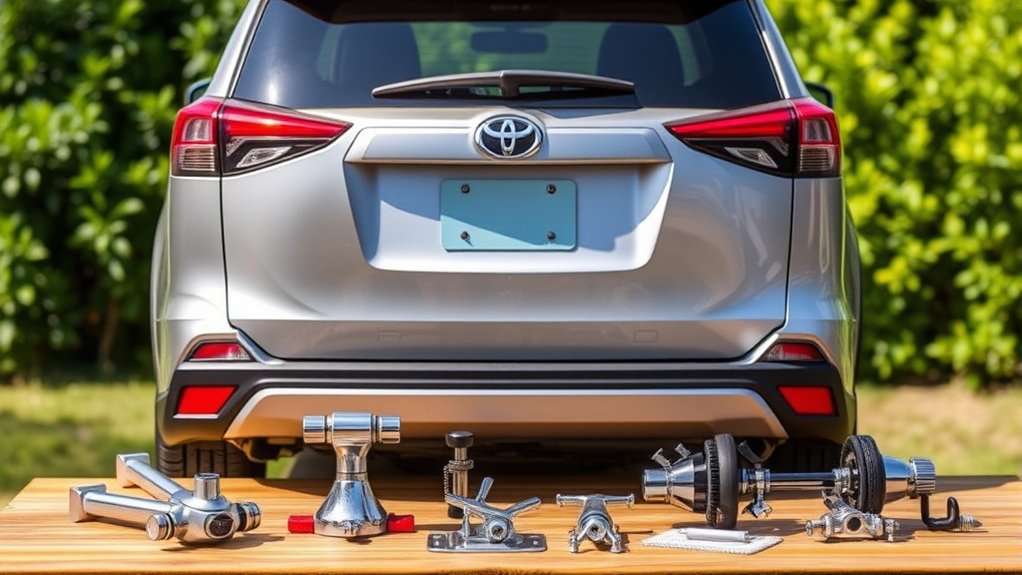
Toyota dealers, hitch installers, towing-equipment shops, and established hitch manufacturers can supply compatible equipment. Verify fitment before ordering, especially when your RAV4 has a hands-free liftgate sensor or an appearance package that changes the rear bumper.
A complete trailer-towing setup may require:
- A vehicle-specific hitch receiver
- A correctly rated ball mount with the necessary rise or drop
- A trailer ball matching the coupler diameter
- A hitch pin and retaining clip or approved locking pin
- Safety-chain attachment points
- A vehicle-specific lighting converter and harness
- Trailer brakes when the loaded trailer exceeds the unbraked limit
- A seven-way connection and brake controller when required for electric trailer brakes
- Extended mirrors when required for adequate visibility
Toyota’s Genuine RAV4 towing wire harness provides a four-pin connector for the trailer’s running lights, turn signals, and brake lights. A four-pin connector does not provide the full brake-controller and auxiliary-power circuits commonly associated with a seven-way connector.
A trailer with surge brakes may not need an in-cabin electric brake controller, while a trailer with electric brakes normally needs a compatible controller and electrical connection. Follow the trailer-brake manufacturer’s instructions and applicable state or provincial laws.
Related Guides
Frequently Asked Questions
Can I install a hitch myself, or should I hire a professional?
You can install a compatible hitch yourself when you have the required tools, can safely support the receiver and exhaust, and can follow the exact torque and trimming instructions. Hire a professional when the job requires wiring changes, fascia cutting, sensor relocation, or work beyond your experience.
What tools are required for installing a hitch on my RAV4 Hybrid?
Most installations require a metric socket set, calibrated torque wrench, safety glasses, an exhaust-hanger tool or suitable pliers, and a safe way to support the receiver. Trim tools, measuring equipment, or a cutting tool are needed only when the specific instructions call for them.
Will installing an aftermarket hitch void my vehicle’s warranty?
An aftermarket hitch does not automatically cancel the entire vehicle warranty. However, damage caused by improper installation, an unsuitable component, overloading, or misuse may not be covered. Keep the receipt and installation records, follow every rating, and review the FTC’s auto-warranty guidance.
Can I use a weight-distribution hitch with the RAV4 Hybrid?
Do not assume that every weight-distribution system is approved. Use one only when Toyota’s guidance for your exact model and the documentation for the exact receiver both permit it. A receiver’s weight-distribution rating does not increase the RAV4 Hybrid’s 1,750-pound vehicle rating.
Are specific trailer brakes needed for my RAV4 Hybrid?
Toyota requires trailer service brakes when gross trailer weight exceeds the 1,000-pound unbraked limit. Electric and surge brakes are both used on light trailers. Electric brakes normally require a compatible brake controller and suitable electrical connection. The trailer must also comply with local brake laws.
Does the 2025 Toyota RAV4 Hybrid come with a standard hitch receiver?
No. The receiver is an accessory rather than standard equipment. It may be installed by a Toyota dealer, an independent hitch installer, or an experienced owner using a compatible product and its instructions.
Can I use a hitch receiver only for a bike rack or cargo carrier?
Yes, provided the receiver and accessory fit correctly and every load limit is respected. Include the weight of the rack or carrier itself, all bikes or cargo, and any adapter. Check rear-light visibility, license-plate visibility, ground clearance, liftgate clearance, and the accessory manufacturer’s restrictions.
Sources
- 2025 Toyota RAV4 Hybrid Owner’s Manual — towing ratings, tongue weight, trailer brakes, break-in guidance, driving precautions, and maintenance.
- Toyota Genuine Tow Hitch Receiver — accessory availability, separate wiring requirement, loading disclaimer, and kick-sensor considerations.
- Toyota Genuine Towing Wire Harness Kit — four-pin trailer-light connection and vehicle-specific wiring information.
- Toyota 2026 RAV4 Grade Information — current trim-dependent towing capacities for the redesigned model.
- Federal Trade Commission Auto Warranty Guidance — aftermarket parts and vehicle-warranty coverage.
- Torklift Central EcoHitch for 2019–2025 RAV4 — aftermarket fitment, receiver specifications, and confirmation that a hitch does not increase vehicle towing capacity.
Conclusion
The 2025 Toyota RAV4 Hybrid can accept a hitch receiver, but the receiver is not standard factory equipment. Toyota Genuine and compatible aftermarket designs can support trailer towing, bike racks, or cargo carriers when the equipment is correctly fitted and used within every published limit.
For trailer towing, treat 1,750 pounds as the maximum gross trailer rating, 1,000 pounds as the unbraked limit, and 9% to 11% as the correct tongue-weight range. Verify the loaded weights, use the proper wiring and trailer brakes, follow the exact installation instructions, and check the owner’s manual for your model year before each towing setup.

