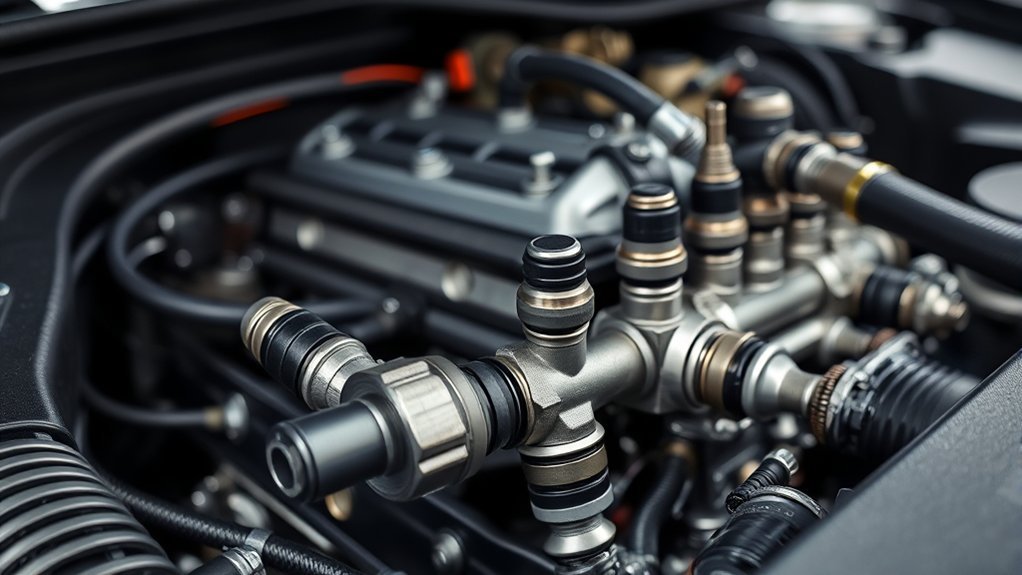
Port fuel injection and direct injection deliver gasoline to different parts of an engine. That difference affects fuel pressure, combustion control, power potential, particle emissions, intake-valve deposits, repair complexity, and cost. However, the comparison is often mislabeled as “EFI versus direct injection” because EFI is not a separate injector location. It is a broader term for electronically controlled fuel injection.
Quick Answer
Port fuel injection sprays gasoline into the intake port before the intake valve. Direct injection sprays it inside the combustion chamber at much higher pressure. Direct injection can support stronger torque and efficiency, while port injection usually offers lower complexity, fewer particle emissions, and a useful intake-valve cleaning effect.
Key Takeaways
- EFI is an umbrella term: Both port injection and gasoline direct injection normally use electronic controls.
- Direct injection uses much higher pressure: It places fuel directly inside the combustion chamber for precise control and charge cooling.
- Port injection is simpler: It avoids the extra high-pressure pump, rail, sensors, and injectors required by GDI.
- Emissions are not a one-sided contest: GDI can support lower fuel consumption and CO2, while PFI often produces fewer particles.
- Dual-injection engines use both: The engine controller can select port or direct injection according to load, temperature, and operating conditions.
EFI, Port Injection, and Direct Injection: A Comparative Overview
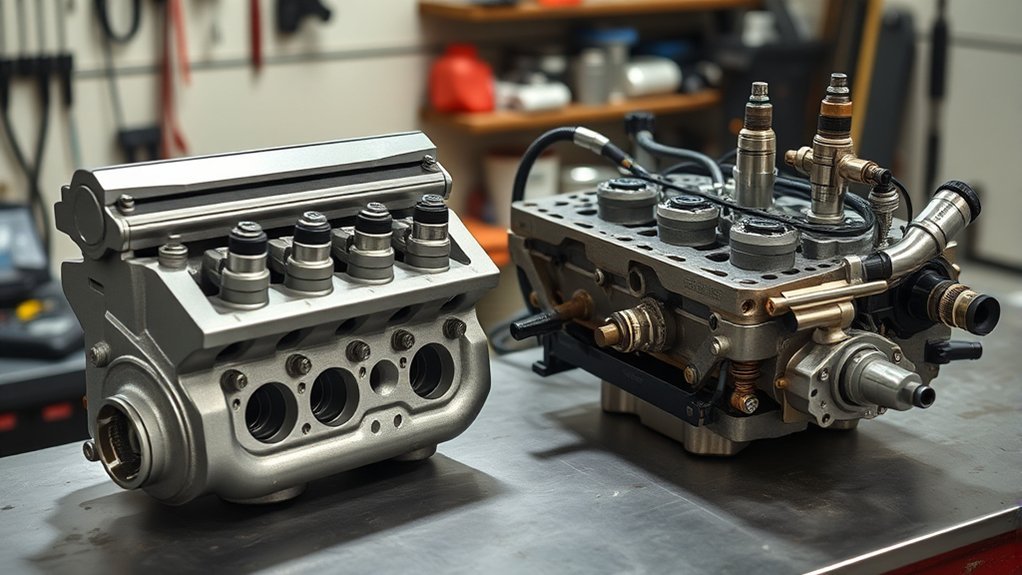
Before comparing the systems, it helps to separate three commonly confused terms:
- Electronic Fuel Injection (EFI): A broad description of fuel injection controlled by an electronic control unit. Modern PFI and GDI systems are both forms of EFI.
- Port Fuel Injection (PFI or MPI): Fuel is sprayed into an intake port before the intake valve. MPI means multipoint injection, usually with one port injector for each cylinder.
- Gasoline Direct Injection (GDI or DI): Fuel is injected directly into the combustion chamber.
The technically useful comparison is therefore port fuel injection versus gasoline direct injection, not EFI versus DI.
Both systems may be electronically controlled. The major difference is where the injector delivers the gasoline.
PFI generally uses lower fuel pressure and fewer specialized components. GDI requires a high-pressure pump, fuel rail, pressure control equipment, and injectors designed to operate inside the cylinder. Those parts give engineers more control over fuel delivery but also increase system complexity.
How Direct Injection Works and Its Benefits
A gasoline direct-injection system first moves fuel from the tank through a low-pressure supply circuit. An engine-driven high-pressure pump then sends it to a high-pressure rail. The injectors spray a carefully metered amount of fuel directly into each combustion chamber.
Fuel pressure varies by engine and operating condition. Current Bosch gasoline direct-injection systems, for example, can supply the rail at pressures of up to 350 bar. This is much higher than the pressure used by a typical port-injection system.
The engine control unit coordinates injection timing, fuel quantity, ignition timing, throttle position, airflow, boost pressure, and emissions equipment. Some engines perform more than one injection during a combustion cycle to improve mixture preparation or manage cold-start emissions.
Direct-Injection Benefits
- Charge cooling: Fuel evaporating inside the cylinder can cool the incoming charge and help reduce knock.
- Higher power potential: Better knock resistance can support higher compression ratios, turbocharging, or greater torque under load.
- Precise fuel placement: Engineers can adjust injection timing and quantity for different speeds, loads, and temperatures.
- Efficiency opportunities: GDI can support downsized turbocharged engines and other strategies intended to reduce fuel consumption and CO2 output.
- Strong low-speed torque: The system can help an engine produce responsive torque at lower engine speeds when paired with suitable combustion and boost controls.
These are engineering opportunities, not guaranteed results for every vehicle. You cannot assume that one GDI vehicle will use a fixed percentage less fuel than a similar PFI vehicle. Transmission gearing, aerodynamics, vehicle weight, engine calibration, driving conditions, and hybrid assistance can have a greater effect on real-world mileage.
Direct-Injection Drawbacks
- More components: The high-pressure pump, rail, sensor, control valve, and specialized injectors add complexity.
- Potentially higher repair costs: Diagnosis and replacement may require specialized equipment and procedures.
- Intake-valve deposits: Fuel does not pass over the back of the intake valve in a DI-only engine.
- Particle formation: Direct injection can produce more fine particles under some operating conditions because fuel has less time to mix and evaporate.
- Greater operating noise: High-pressure injectors and pumps may produce a noticeable ticking sound that is normal for some engines.
Warning: Never loosen a GDI fuel line, rail fitting, pump connection, or injector while the system may be pressurized. Residual fuel pressure can cause serious injury or fire. Follow the manufacturer’s depressurization procedure or leave high-pressure work to a qualified technician.
How Port Fuel Injection Works and Its Key Benefits
Port fuel injection creates the air-fuel mixture outside the combustion chamber. An injector sprays fuel into the intake port, usually near the back of the intake valve. During the intake stroke, the valve opens and the prepared mixture enters the cylinder.
PFI operates at substantially lower pressure than GDI. Bosch describes its current gasoline port-injection system as using approximately 6 bar, although the exact pressure depends on the engine and fuel-system design.
Port-Injection Benefits
- Lower complexity: PFI does not need the GDI system’s separate high-pressure pump and rail hardware.
- Lower component cost: Port injectors and their supporting equipment are often less costly to service.
- Good mixture preparation: Fuel has more time to evaporate and mix with incoming air before ignition.
- Lower particle output: Better mixture homogenization can reduce particle formation, particularly under lighter loads.
- Intake-valve washing: Fuel passing over the intake ports and valves can help limit some deposits.
- Quieter operation: Lower-pressure injectors usually produce less audible ticking than high-pressure GDI injectors.
The washing effect does not make a PFI engine immune to contamination. Oil vapor, exhaust-gas recirculation, poor maintenance, worn components, and low-quality fuel can still contribute to deposits in the intake or combustion chamber.
Port-Injection Limitations
PFI does not provide the same in-cylinder charge-cooling effect as direct injection. That may limit compression, boost, or ignition strategies in a high-output engine. Fuel can also form a film on intake surfaces during cold operation, although modern injector targeting and electronic controls reduce this problem.
PFI should not automatically be described as inefficient or outdated. Current port-injection systems use electronic controls, advanced spray patterns, improved pressure management, and precise injection timing. In some operating ranges, PFI can use less energy to drive the fuel system because it does not need to generate extreme pressure.
Fuel Efficiency and Emissions: A Comparison
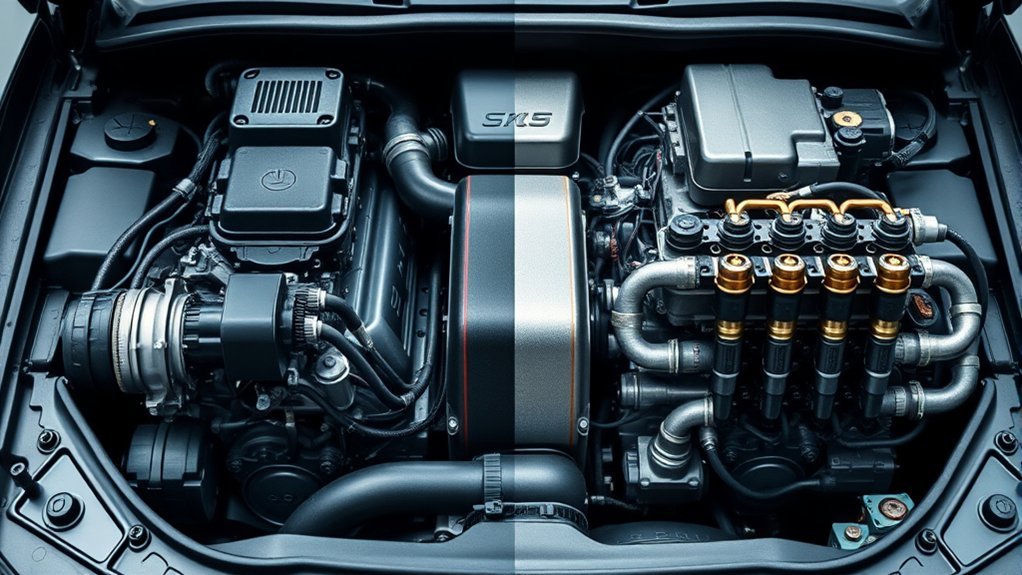
Neither system wins every fuel-economy or emissions category. The result depends on the engine, operating load, catalyst temperature, injection strategy, turbocharging, exhaust treatment, and vehicle design.
GDI Fuel-Efficiency Advantages
Direct injection gives engineers precise control over when and where fuel enters the cylinder. The cooling effect of evaporation can increase resistance to knock, helping an engine use a higher compression ratio or additional turbocharger boost.
GDI also works well with engine downsizing. A smaller turbocharged engine can provide the required power while operating in more efficient areas of its load range. However, GDI alone does not guarantee a specific MPG improvement. Vehicle-level test results are more useful than a broad percentage assigned to the injection system.
PFI Emissions Advantages and Trade-Offs
Port injection gives fuel more time to mix with air before combustion. This generally supports a uniform mixture and can reduce particle-number emissions. It can also reduce the need for high-pressure fuel-system energy under lighter loads.
Direct injection may support lower fuel consumption and therefore lower CO2 output in a suitably designed engine. However, wall wetting, incomplete vaporization, and locally rich areas can increase particle formation. Manufacturers control these particles through injector design, pressure, multiple injections, combustion calibration, dual injection, and, on some vehicles, gasoline particulate filters.
Statements such as “GDI has lower emissions” or “PFI has higher emissions” are therefore too broad. One system may perform better for CO2 or torque while the other performs better for particle output, noise, or low-load fuel-system losses.
Comparative Performance Metrics
| Feature | Gasoline Direct Injection | Port Fuel Injection |
|---|---|---|
| Injector location | Inside the combustion chamber | In the intake port before the valve |
| Fuel pressure | High pressure, often tens to hundreds of bar | Much lower pressure; exact value varies |
| Power potential | Strong knock resistance and charge cooling can support higher output | Suitable for everyday and many high-output applications, with less charge cooling |
| Fuel economy | Can support efficient downsizing and combustion strategies | Can perform efficiently, especially at lower loads, with lower pumping demands |
| Particle emissions | Can be higher without careful mixture and emissions control | Often lower because fuel and air have more time to mix |
| Intake-valve washing | No fuel washing in a DI-only system | Fuel passes over the intake port and valve |
| System complexity | Higher because of high-pressure components | Generally lower |
| Typical operating noise | More injector and pump ticking may be noticeable | Usually quieter |
Which Injection System Is Easier to Maintain?
Port fuel injection generally has the maintenance advantage because its lower-pressure layout uses fewer specialized parts. Direct injection adds equipment that must meter fuel accurately under far greater pressure.
That difference does not mean every GDI engine is unreliable or that every PFI engine is inexpensive to own. Reliability depends on the engine family, component design, maintenance history, oil control, software calibration, fuel quality, operating temperature, and driving pattern.
Maintenance Complexity Comparison
A DI system normally includes a high-pressure pump, high-pressure rail, pressure sensor, control equipment, and cylinder-mounted injectors. Diagnosing a fault may require a scan tool that can display commanded and actual rail pressure, injector correction data, misfire counts, and manufacturer-specific trouble codes.
PFI injectors are usually easier to access and operate at lower pressure. The system can still develop clogged injectors, wiring faults, pressure-regulator problems, pump failures, or leaks, but it avoids several GDI-specific high-pressure components.
Component Accessibility Issues
Injector location can influence labor time. Port injectors are positioned in the intake system, while direct injectors enter the cylinder head and may sit beneath additional engine components. Some direct injectors also require new seals, sizing procedures, calibration codes, or installation tools when replaced.
Accessibility varies by vehicle. A well-packaged GDI engine may be easier to service than a tightly packaged PFI engine, so you should review model-specific repair information before estimating labor.
Long-Term Reliability Factors
Direct injection does not automatically shorten engine life. Its additional high-pressure parts create more possible repair points, but their service life varies. A properly maintained GDI vehicle can deliver long service, while neglected oil changes, incorrect fuel, unresolved misfires, and poor crankcase ventilation can increase problems in either system.
Use the fuel grade required on the fuel-door label or in the owner’s manual. Do not assume that every direct-injection engine needs premium gasoline or that using a higher octane than required will clean the injection system.
Carbon Buildup on Direct-Injection Intake Valves
Oil vapor and combustion gases can enter the intake through the crankcase ventilation and emissions systems. In a port-injected engine, gasoline passes over the intake valves and may help wash away some contamination. In a DI-only engine, the gasoline enters downstream of those valves, so it cannot provide the same cleaning action.
The amount of buildup varies. Engine design, oil consumption, driving pattern, temperature, maintenance, valve timing, and crankcase-ventilation performance all matter. Possible symptoms of heavy deposits include:
- Rough cold starts or an uneven idle
- Misfire codes, especially when the engine is cold
- Reduced performance or hesitation
- Higher fuel consumption
- Airflow imbalance between cylinders
These symptoms can also result from ignition, injector, compression, sensor, or vacuum problems. A technician should confirm the cause before recommending intake cleaning.
Note: A cleaner poured into the fuel tank travels through a DI injector and enters the combustion chamber. It does not flow over the back of the intake valves in a DI-only engine, so it cannot directly wash away deposits located there.
If inspection confirms significant valve deposits, the correct service method depends on the engine. Options may include an approved chemical procedure or mechanical media cleaning with the intake manifold removed. Follow the manufacturer’s service information because an incorrect method can damage valves, sensors, the turbocharger, or the catalytic converter.
What Is Dual Injection?
A dual-injection engine has both port injectors and direct injectors. The engine controller can use either set or both sets according to speed, load, temperature, and emissions requirements.
For example, port injection may provide good mixture preparation, low particle output, quieter operation, and intake-valve washing during lighter-load driving. Direct injection may take over near higher loads where its charge cooling and knock resistance are more useful.
Bosch explains that combined port and direct injection can use PFI under partial load and DI closer to full load. The approach can reduce particles and improve fuel use across a wider operating range.
The trade-off is cost and complexity. A dual-injection engine has two sets of injectors and the supporting equipment for both fuel-delivery methods.
Choosing Between Direct and Port Fuel Injection
You rarely choose an injection system by itself. You choose a complete vehicle, engine, transmission, emissions system, warranty, and maintenance history. Injection type should be one part of that decision.
Port injection may suit you better when:
- You value lower mechanical complexity.
- You plan to keep the vehicle for many years and want simpler fuel-system service.
- You prefer lower injector noise.
- You are comparing basic, naturally aspirated engines with similar performance.
- You drive in a market where fuel quality or specialist repair access varies.
Direct injection may suit you better when:
- You want stronger torque from a smaller turbocharged engine.
- The vehicle delivers better tested fuel economy or performance than the alternatives.
- You are comfortable following model-specific maintenance requirements.
- The engine has a strong reliability record and good parts support.
- You value the complete vehicle more than the simplicity of one subsystem.
Dual injection may offer the broadest technical balance, but it also adds parts. Do not assume it is automatically more reliable or more economical. Review the record of the specific engine and model year.
Pro Tip: When comparing used vehicles, prioritize service records, cold-start behavior, scan results, oil consumption, recalls, technical service bulletins, and the reputation of the exact engine family. Those details are more useful than choosing solely by injection type.
How to Tell Which Fuel-Injection System Your Vehicle Has
The quickest method is to check the owner’s manual, manufacturer specifications, emissions label, service information, or engine code. Terms such as GDI, T-GDI, FSI, TFSI, EcoBoost, DIG, D-4, or direct injection may indicate an in-cylinder system, but brand names are not always consistent across every engine.
A visual inspection may also help:
- A GDI engine usually has a mechanical high-pressure pump mounted on the engine and rigid metal lines leading to the fuel rail.
- A PFI engine usually has injectors positioned along the intake manifold or intake ports.
- A dual-injection engine has both port injectors and direct injectors, although one set may be difficult to see.
Do not disconnect lines or remove covers solely to identify the system. Use the vehicle identification number or engine code when the layout is unclear.
Frequently Asked Questions
What is the difference between EFI and direct fuel injection?
EFI means electronic fuel injection, so it can include electronically controlled port injection and direct injection. The meaningful mechanical difference is injector location. PFI sprays fuel before the intake valve, while GDI sprays fuel directly into the combustion chamber.
What are the disadvantages of port fuel injection?
Port injection provides less in-cylinder charge cooling than direct injection. That can restrict some high-compression or high-boost strategies. Fuel may also wet intake surfaces during cold operation. However, PFI normally has lower pressure, fewer specialized components, good mixture preparation, and a useful intake-valve washing effect.
What are three types of fuel injection systems?
Three gasoline fuel-injection layouts are throttle-body injection, port or multipoint fuel injection, and gasoline direct injection. A carburetor is not a fuel-injection system because it meters fuel through a different mechanical process.
What is the major difference between direct injection and port injection?
Direct injection places fuel inside the combustion chamber at high pressure. Port injection places fuel in the intake port before the valve at much lower pressure. That difference affects charge cooling, mixture formation, component complexity, particle emissions, and intake-valve cleaning.
Is direct injection less reliable than port injection?
Not automatically. Direct injection has more high-pressure components and can be more expensive to diagnose or repair, but reliability varies by engine design. A proven, well-maintained GDI engine may be a better ownership choice than a neglected or poorly designed PFI engine.
Does direct injection always require premium fuel?
No. Required octane depends on the complete engine design and manufacturer calibration, not injection location alone. Use the fuel grade listed on the fuel-door label and in the owner’s manual. Premium fuel provides little benefit when the manufacturer specifies regular gasoline.
Can a fuel additive clean direct-injection intake valves?
A tank additive cannot directly wash the intake valves of a DI-only engine because the injector sprays downstream of them. An additive may help clean the injector or combustion chamber when approved for the vehicle, but confirmed intake-valve deposits may require a manufacturer-approved intake-cleaning procedure.
Conclusion
Port fuel injection and gasoline direct injection each have practical strengths. GDI provides precise in-cylinder delivery, charge cooling, and strong performance potential. PFI uses lower pressure, has fewer specialized components, prepares a uniform mixture, and helps wash the intake valves.
Neither system guarantees better reliability, fuel economy, or emissions in every vehicle. Compare the complete engine and vehicle, not one component in isolation. A strong maintenance history and a proven engine design normally matter more than whether the injectors sit in the intake ports or combustion chambers.
Sources
- Bosch Mobility: Gasoline Direct Injection — GDI operation, pressure, system components, torque, downsizing, and combined injection.
- Bosch Mobility: Gasoline Port Fuel Injection — PFI operation, approximate pressure, complexity, mixture preparation, particles, and valve-cleaning effect.
- Bosch Gasoline Direct Injection System Summary — Current high-pressure GDI system overview.
- Bosch Gasoline Port Fuel Injection System Summary — Current low-pressure PFI system overview.
- U.S. EPA Automotive Trends Report — Current vehicle-level fuel-economy, emissions, and technology context.
