Last updated: July 17, 2026
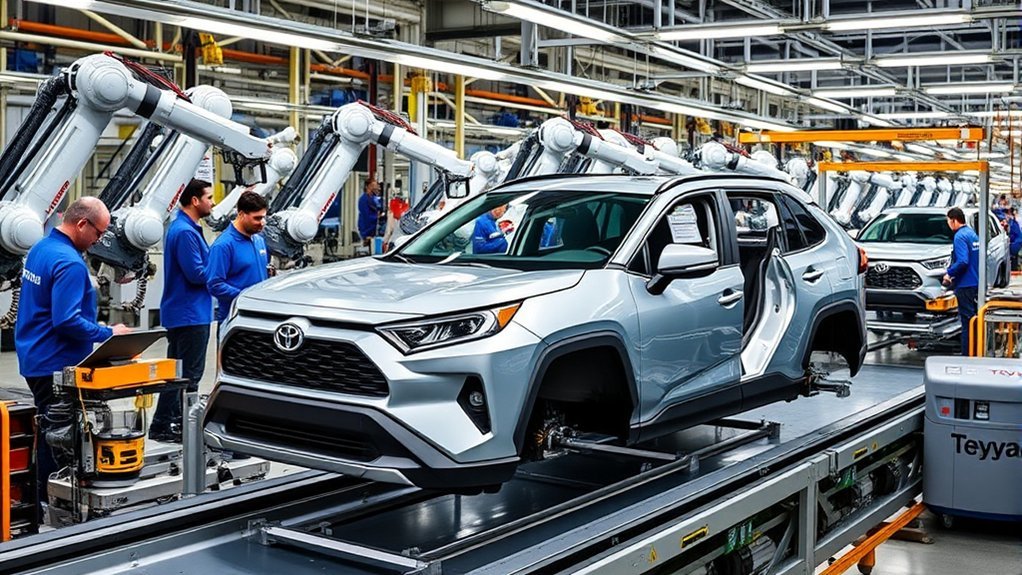
Toyota does not publish one official RAV4 build-time figure, and that’s why searches on this question return wildly different answers — some pages claim about a day, others say 8 to 12 days, others 4 to 12 weeks, and some even claim 9 to 14 months. Those numbers usually aren’t fabricated so much as they’re each describing a different stage: pure assembly time on one line, total time across every production department, or the entire order-to-driveway wait that includes shipping and dealer prep. A RAV4 typically moves through body welding, paint, final assembly, and inspection within roughly one production day at a given plant, but the total elapsed time — and especially the time until a customer takes delivery — depends on the factory, model year, powertrain, and parts availability.
Quick Answer
Toyota does not publish one official RAV4 assembly-time figure. A vehicle may pass through body welding, paint, final assembly, and inspection within roughly a production day, but plant schedules, model year, powertrain, quality holds, and parts availability can change the elapsed time. Customer delivery usually takes much longer.
Key Takeaways
- Toyota does not provide a single public build-time number that applies to every RAV4.
- Manufacturing includes stamping, body assembly, painting, final assembly, testing, and inspection.
- The redesigned, hybrid-only 2026 RAV4 shifted production across plants, so an answer that was true for older model years may not hold today.
- A rare trim or color may increase your buying wait because a matching allocation is harder to find.
- Shipping, port processing, rail transport, accessories, and dealer preparation can take longer than assembly itself.
- You can use the vehicle identification number to confirm the assembly plant and country for a specific RAV4.
How Long Does Building a RAV4 Take?
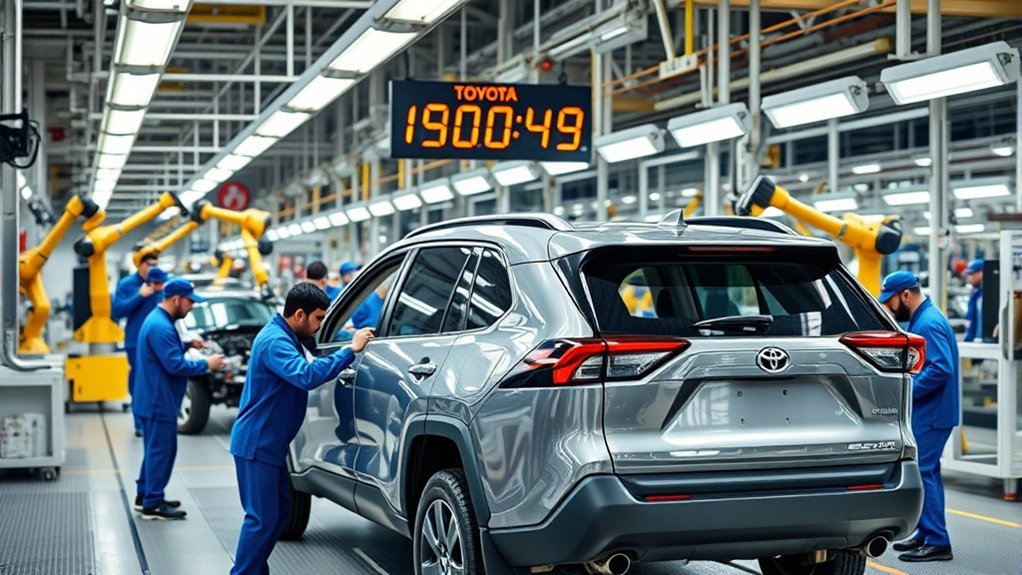
Toyota does not publish a fixed number of hours for building every RAV4. Published estimates found online may refer to active labor time, time on one assembly line, or total elapsed time across several production areas. Those measurements are not interchangeable.
A RAV4 must move through body construction, corrosion protection, paint, component installation, software checks, testing, and final inspection. Some processes flow continuously, while others include curing time, staging, shift changes, or a temporary hold.
For a sense of line pace rather than one vehicle’s total build time: Toyota’s Georgetown, Kentucky plant — its largest North American facility, which builds RAV4 Hybrids alongside the Camry — has been described as running on a takt time near one vehicle every minute per assembly line. That figure describes overall line throughput across multiple models on shared lines, not a dedicated RAV4 build-time total, and can change with production schedule.
Toyota states that a car contains more than 30,000 parts. That is a general vehicle figure, not an official RAV4-specific parts count. Toyota coordinates those parts through its Just-in-Time production system.
Note: Factory assembly time is different from the time you wait after placing a deposit. Allocation, transportation, port processing, accessories, and dealer preparation can add days or weeks after assembly.
Has the 2026 Redesign Changed Where the RAV4 Is Built?
Yes, in a way that affects the plant answer directly. The 2026 RAV4 is a redesigned, hybrid-only generation, and Toyota has said the conventional hybrid (HEV) is assembled at its Georgetown, Kentucky plant and its Woodstock and Cambridge, Ontario plants, while the plug-in hybrid (PHEV) is assembled in Japan. Trade press has also reported Toyota ramping up Kentucky output specifically to help meet demand for this redesign, alongside retooling at the Canadian and Japanese lines to support the new hybrid-only lineup.
Practically, this means a plant answer that was accurate for a 2022 or 2023 RAV4 isn’t necessarily accurate for a 2026 one — powertrain choice (HEV vs. PHEV) is now a more reliable predictor of assembly country than it used to be.
The Toyota RAV4 Production Process: An Overview
A RAV4 moves through a sequence of specialized production areas. Robots handle many repetitive or precision tasks, while trained workers install components, inspect work, respond to problems, and complete jobs that require human judgment.
Production Timeline Breakdown
The exact sequence differs by factory, but modern vehicle manufacturing normally includes the following stages:
- Stamping: Large presses shape sheet metal into body panels such as doors, roof sections, and side panels.
- Body assembly: Robots and workers join the stamped panels to create the body shell.
- Surface treatment and paint: The body receives cleaning, corrosion protection, primer, color coats, and protective finishing.
- Final assembly: Workers and automated systems install the powertrain, suspension, wiring, glass, interior, seats, dashboard, wheels, and other equipment.
- Software and system checks: Electronic modules, warning systems, controls, and installed features are checked.
- Inspection and release: The completed vehicle undergoes plant-specific quality checks before it is released for transportation.
Vehicles do not always move through every stage without interruption. A unit may wait between departments, stop for a correction, or remain in a holding area before shipment.
Factors Influencing Build Time
Several conditions can change how long one RAV4 remains in the production system:
- The factory and assembly line producing the vehicle
- The model year and powertrain
- The mix of vehicles scheduled on the line
- Parts availability from Toyota and its suppliers
- Paint color and production sequencing
- Equipment maintenance or line changeovers
- Quality checks, corrections, or temporary holds
- Shift schedules, holidays, and planned shutdowns
These factors make a universal hour estimate unreliable. A factory can also maintain the same line speed while the total elapsed time for one vehicle changes because of staging or inspection.
Key Stages in the RAV4 Assembly Line
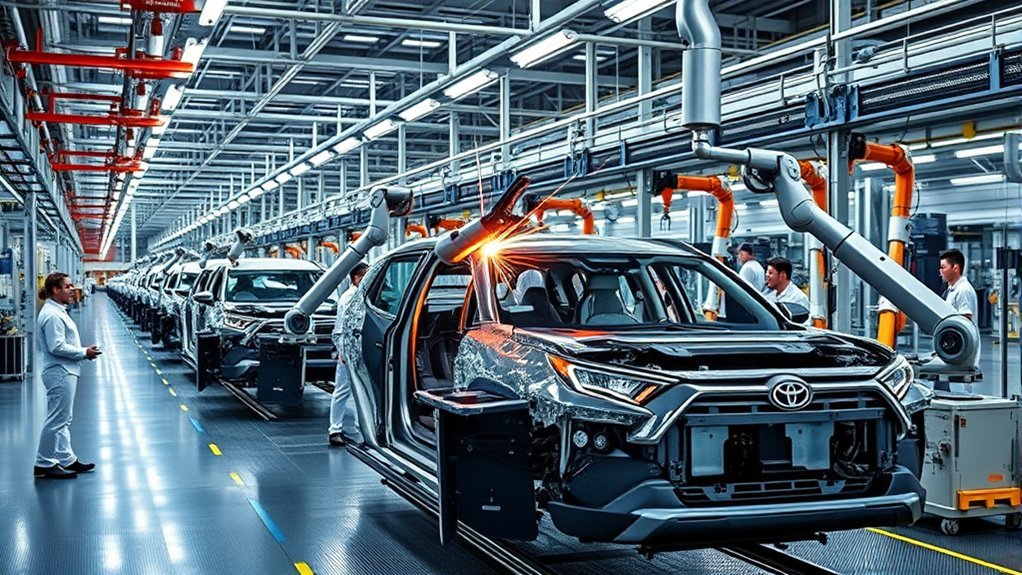
The major stages work together as one production system. Each stage must deliver the right component or completed task at the correct time so the next station can continue working.
- Shaping and stamping: Presses form structural and exterior panels from sheets or coils of metal.
- Body assembly: Welding and joining processes create the main vehicle structure.
- Corrosion protection and painting: The body is cleaned, treated, coated, painted, and cured.
- Powertrain and chassis installation: Major mechanical and electrical systems are fitted to the vehicle.
- Interior installation: Seats, trim, controls, displays, carpeting, and safety equipment are added.
- Fluids and programming: Required fluids are added, and electronic systems are configured.
- Quality confirmation: Workers and automated equipment check fit, function, warning systems, and other plant-specific requirements.
Toyota’s production system combines Just-in-Time parts flow with jidoka, which Toyota describes as automation with a human touch. A machine or worker can identify an abnormal condition and stop the process so the problem can be addressed.
The fastest production line is not useful if it allows defects to continue. Toyota’s jidoka principle focuses on detecting abnormalities and correcting them during production.
How Customization Affects RAV4 Build Time
A higher trim level does not automatically add a known number of hours to a RAV4’s assembly time. Modern assembly lines are planned to produce different trims, colors, and powertrains in a controlled sequence. (If you’re still comparing trims, see our guide to RAV4 trim levels and pricing —.)
However, your configuration can affect how long you wait to receive a vehicle. A popular color and common trim may already be included in a dealer’s incoming allocation. A rare combination may require the dealer to wait for a matching unit, trade with another dealer, or request a future allocation. This has been especially true for the plug-in hybrid, where demand has outpaced supply since the 2026 redesign.
Some accessories may also be installed after factory assembly. Depending on the vehicle and market, installation may occur at a processing center or dealership. That work can affect the delivery date without changing the time spent on the main assembly line.
Pro Tip: When asking about a RAV4’s arrival, request the production status, VIN status, estimated port or rail date, and dealer arrival estimate separately. A general “on order” status does not confirm that assembly has started.
How Quality Control Keeps Your RAV4 Reliable

Quality control takes place throughout manufacturing, not only after the vehicle reaches the end of the line. Parts, welds, coatings, fasteners, electrical connections, and completed functions may be checked at different stages.
These checks are intended to identify production abnormalities and confirm that the vehicle meets the factory’s release requirements. They do not guarantee that every RAV4 will last a specific number of miles. Service life also depends on maintenance, driving conditions, climate, corrosion exposure, repairs, and vehicle use.
Rigorous Testing Procedures
Plant-specific testing may include automated checks, worker inspections, electronic diagnostics, leak detection, alignment confirmation, and functional tests. The exact procedures and equipment are not identical at every plant or for every model year.
If a problem appears, the vehicle may be corrected on the line, routed to a repair area, or held for further review. A quality hold can increase elapsed production or delivery time even when assembly is otherwise complete.
Standardized Inspection Processes
Standardized work helps employees perform tasks in a consistent sequence. Toyota’s jidoka approach also allows equipment or workers to stop production when an abnormal condition is detected.
This system focuses on correcting the immediate issue and preventing the same problem from continuing through later vehicles. It supports consistency, but it should not be described as a guarantee of a particular lifespan or freedom from future repairs.
Factors That Can Delay RAV4 Production
A RAV4 can be delayed before, during, or after assembly. Some delays affect the entire production line, while others affect only one vehicle or one configuration.
- Supplier constraints: A missing electronic, battery, interior, or powertrain component can disrupt the planned sequence.
- Quality holds: Toyota may pause or inspect vehicles when a potential production issue requires review.
- Equipment maintenance: Planned service or an unexpected machinery problem can slow a department.
- Model changeovers: Factories need time to prepare tooling, software, workstations, and training for a new model year or generation — the 2026 redesign’s hybrid-only transition is a current example of this kind of changeover.
- Weather and transportation interruptions: Severe weather can affect suppliers, rail lines, ports, highways, or factory operations.
- Configuration demand: Demand for a specific trim, color, or powertrain may exceed the number scheduled for a region — currently most visible with the plug-in hybrid.
- Accessory installation: Port-installed or dealer-installed equipment may add another processing step.
A delay does not always mean the vehicle is still being assembled. It may already be complete but waiting for inspection, transportation, processing, or dealer delivery.
RAV4 Shipping Timeline After Production
After production release, the shipping route depends on the assembly plant and dealership location. A North American-built RAV4 may travel by rail, truck, or both. An imported vehicle may also require ocean transport, port unloading, customs processing, inspection, and inland transportation.
No single shipping estimate applies to every RAV4. Vessel schedules, railcar availability, weather, port congestion, accessory installation, and dealer distance can all change the timeline.
How Long Are Buyers Waiting for a 2026 RAV4, From Order to Delivery?
There is no single confirmed figure, and Toyota does not publish one. Recent factory-order reporting has cited roughly 8 to 14 weeks for a custom-ordered 2026 RAV4, and owners describe a similarly wide range depending on powertrain, with plug-in hybrid orders generally taking longer than gasoline-hybrid orders due to stronger demand. Some buyers matched to an existing dealer allocation report receiving a vehicle within one to two weeks of it being built; others waiting on a specific configuration have described multi-month waits.
Your dealer’s estimated arrival date is usually more useful than a general online shipping average. Even that date can change because it is based on the latest logistics information available to the dealer.
Once a VIN has been assigned, you can use the NHTSA VIN Decoder to identify the vehicle’s reported plant and country of manufacture — look for the “Plant Country,” “Plant City,” and “Plant Company Name” fields in the decoded results. The plant information appears in the decoded vehicle results.
What Happens After the RAV4 Is Built? Delivery Insights
A completed RAV4 usually passes through several steps before you can take delivery:
- Production release: The factory confirms that the vehicle has completed required checks.
- Transportation assignment: The vehicle is assigned to rail, truck, vessel, or a combination of methods.
- Port or distribution processing: Imported vehicles and some domestic shipments may pass through a processing center.
- Accessory installation: Approved accessories may be added before the vehicle reaches the dealer.
- Dealer arrival: The dealership receives and checks the vehicle.
- Pre-delivery inspection: The dealer removes transport protection, checks fluids and systems, and prepares the vehicle for handover.
- Customer delivery: Paperwork, payment, registration, and the vehicle handover are completed.
Status labels can differ among Toyota regions and dealership systems. Ask the dealer what a status means instead of assuming that “built,” “shipped,” or “in transit” identifies an exact location. (For a deeper look at hybrid vs. plug-in hybrid trade-offs while you wait, see our RAV4 Hybrid vs. RAV4 Prime comparison —.)
Warning: Treat delivery dates as estimates until the vehicle reaches the dealership. Production holds, damaged-in-transit inspections, port delays, rail changes, or severe weather can move the date.
Related Guides
Frequently Asked Questions
What materials are used in the construction of a RAV4?
A RAV4 uses a combination of steel, aluminum, glass, rubber, plastics, copper wiring, electronic components, textiles, coatings, adhesives, and other materials. The exact material mix varies by model year, powertrain, trim, and component. Toyota does not publish a simple complete material list for every RAV4 configuration.
How many RAV4s are produced daily at a factory?
Toyota does not publish one daily number that applies to every RAV4 factory. Output changes with the plant, number of shifts, operating days, model mix, maintenance schedule, supplier conditions, and production year. Plant-wide output may also include vehicles other than the RAV4, such as the Camry at the Kentucky plant.
Where are Toyota RAV4s manufactured?
Production locations vary by model year, powertrain, and sales market. For the redesigned, hybrid-only 2026 RAV4, Toyota has said the conventional hybrid is assembled at its Georgetown, Kentucky plant and its Woodstock and Cambridge, Ontario plants, while the plug-in hybrid is assembled in Japan. Earlier generations used a different mix of plants. Check the driver-door certification label or decode the VIN through NHTSA to confirm the exact plant for a specific vehicle.
Are wait times different for the 2026 RAV4?
Many buyers report longer waits than in prior model years, driven by the hybrid-only redesign and especially by demand for the plug-in hybrid. Factory-order reporting has cited ranges around 8 to 14 weeks, though individual experiences vary widely by region, dealer allocation, and configuration.
What is the warranty period for a new RAV4?
In the United States, Toyota lists 36-month/36,000-mile basic coverage and 60-month/60,000-mile powertrain coverage for new vehicles. Eligible Toyota hybrid batteries from model year 2020 onward receive 10-year/150,000-mile coverage, whichever comes first. Terms vary by country and model year, so check the applicable Toyota Warranty and Maintenance Guide.
Can customers visit a RAV4 production facility?
Some Toyota manufacturing facilities offer public tours, but availability, age limits, schedules, and reservation requirements vary and have changed over time at specific plants. A plant that builds or previously built a RAV4 may not currently offer tours. Check Toyota’s official factory-tour portal before planning a visit.
Sources
- Toyota Motor Corporation: Toyota Production System — supports the explanations of Just-in-Time, jidoka, parts flow, and Toyota’s statement that a car contains more than 30,000 parts.
- National Highway Traffic Safety Administration VIN Decoder — provides manufacturer-reported plant and country information for a specific VIN.
- Toyota Manuals and Warranties — supports U.S. basic, powertrain, rust-through, and hybrid warranty information.
- Toyota Factory Tours — provides current tour locations, schedules, and reservation information.
- Toyota: The Next Adventure Begins — 2026 RAV4 Arrives This Winter — supports the 2026 hybrid-only redesign and plant assignment by powertrain.
- Auto123: Toyota Now Making 2026 RAV4s in Kentucky — supports the Kentucky production ramp-up tied to the redesign.
- CarSaver: Factory Order Wait Times 2026 — supports current factory-order wait-time ranges.
- RAV4 World Forum: 2026 PHEV Wait Times — owner-reported, anecdotal; supports the qualitative pattern of longer PHEV waits, not a specific figure.
Conclusion
Toyota does not publish one confirmed number of hours that applies to every RAV4. The vehicle must pass through stamping, body assembly, paint, final assembly, system checks, and inspection, but elapsed time varies by factory and production conditions — and for the redesigned, hybrid-only 2026 model, the plant answer itself has changed.
Your total wait is usually affected more by allocation, configuration availability, transportation, port or distribution processing, and dealer preparation than by the assembly line alone. For the most accurate update, ask your dealer for the vehicle’s current production and logistics status, then use the VIN to confirm its assembly plant.