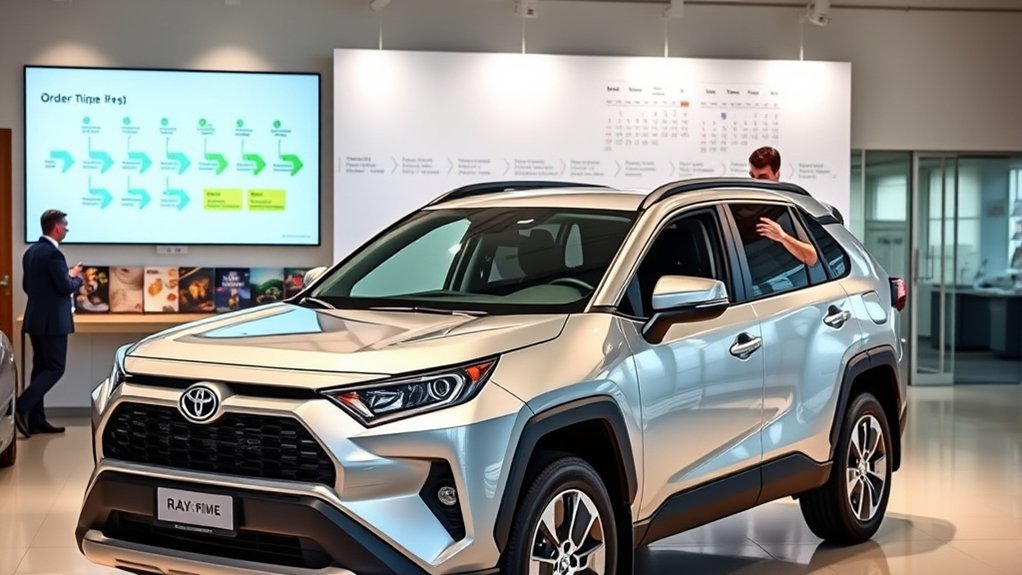
There is no single official U.S. Toyota RAV4 Prime wait time. For the model now sold as the RAV4 Plug-in Hybrid, the fastest path is a vehicle already in stock; an allocated or in-transit vehicle with a VIN has a more useful dealer ETA, while a preference request without a matched vehicle can remain open for months. The key is to verify the exact vehicle status rather than rely on a generic national estimate.
Last updated: September 22, 2026. This guide focuses on U.S. retail purchases. Availability, warranties, deposits, and consumer rules can differ in Canada and other markets.
Quick Answer
Toyota does not publish one nationwide RAV4 Prime wait time. An in-stock vehicle can move to delivery after dealership preparation and paperwork. An allocated or in-transit vehicle with a VIN gives the dealer a specific unit to track, but its ETA can still change. A preference request without a matched vehicle has the least predictable timeline and no guaranteed delivery date.
Key Takeaways
- Toyota renamed the RAV4 Prime to the RAV4 Plug-in Hybrid beginning with model year 2025.
- A VIN tied to a confirmed dealer allocation or transit status provides a more useful delivery estimate than a place on a dealer waiting list, but a VIN alone does not guarantee the arrival date.
- Toyota allows dealers to submit preference requests, but the requested configuration and delivery date are not guaranteed.
- Flexibility about trim, color, packages, and dealer location increases your chance of matching available inventory.
- Get the deposit policy, selling price, add-ons, fees, and cancellation terms in writing before paying.
Understanding the Toyota RAV4 Prime Ordering Process

The first point to understand is that “RAV4 Prime” is now an older model name. Toyota changed the U.S. name to RAV4 Plug-in Hybrid for model year 2025. Dealers and used-vehicle listings may still use “Prime” when referring to 2021–2024 models or when using the familiar search term.
Buying one also differs from placing a guaranteed factory order with a manufacturer that builds a vehicle directly from your submitted specifications. Toyota says a dealership may submit a preference request for the vehicle you want, but that request does not guarantee the exact options or a delivery date.
A practical purchase process looks like this:
- Search current inventory. Check nearby dealers and Toyota’s online inventory tools for vehicles already available or in transit.
- Separate must-haves from preferences. Tell the dealer which features are essential and which colors, packages, or accessories you can change.
- Ask whether a VIN is assigned to a dealer allocation. A VIN lets you identify a specific vehicle record instead of relying on an open-ended request, but confirm that the unit is actually assigned to the dealership and available to you.
- Review the actual equipment. Confirm factory options, port-installed accessories, dealer-installed products, and any mandatory add-ons.
- Get the agreement in writing. Document the price, deposit terms, estimated arrival, refund conditions, and what happens if the vehicle changes.
- Confirm updates with the dealer. Production, port, rail, and truck schedules can move, so treat an ETA as an estimate rather than a promise.
Note: Toyota’s online tools help you identify a configuration and browse dealer inventory. They do not turn a preference request into a guaranteed custom factory order for that exact vehicle.
The most useful delivery evidence is a specific vehicle that the dealer can identify, show as allocated or in transit, and support with a recently updated ETA. A waiting-list position by itself is much less informative.
What Wait Time Should You Expect?
No single number accurately describes every RAV4 Prime or RAV4 Plug-in Hybrid purchase. Two buyers requesting the same trim can have very different experiences because their dealerships may receive different vehicles and their regions may have different inventory.
Use the vehicle’s current status to judge how certain the timeline is:
| Vehicle Status | What It Means | Timeline Certainty |
|---|---|---|
| In stock at the dealer | The vehicle is physically present, although inspection, preparation, financing, or paperwork may remain. | Highest. Confirm that the vehicle is actually available for sale and not reserved. |
| In transit with a VIN | A specific vehicle has been identified and is moving through production, port, rail, or truck delivery stages. | Moderate. The dealer can provide an ETA, but shipping and processing delays can change it. |
| Dealer expects a future allocation | The dealer expects inventory but may not yet have a confirmed vehicle matching your request. | Low until a VIN and equipment list are available. |
| Preference request without a VIN | The dealer has recorded or submitted your desired configuration but has not matched it to a specific vehicle. | Lowest. Toyota does not guarantee the exact configuration or delivery date. |
An in-stock vehicle represents the shortest path. An in-transit vehicle with a VIN is normally the next most predictable option. A request for a specific combination without a VIN has the most uncertain timeline and may require flexibility or a wider dealer search.
What Does 2026 Availability Tell You?
Toyota said the all-new 2026 RAV4 Plug-in Hybrid would begin arriving at U.S. dealerships in spring 2026 and confirmed that 2026 plug-in-hybrid models are assembled in Japan. That makes port and inland transportation part of the delivery chain for U.S. buyers.
Recent market reporting also shows why a single national wait-time number can mislead. Car and Driver reported in July 2026 that shoppers were describing waits of roughly six to nine months for some redesigned RAV4 trims during the production ramp-up. That is useful market context, not an official Toyota PHEV average. Your dealer’s VIN-linked status and latest ETA remain more relevant to your purchase.
Key Factors Affecting RAV4 Prime Wait Times
Your wait is shaped by several factors that can change independently:
- Local dealer inventory: One dealer may have a matching vehicle while another has no assigned plug-in hybrids.
- VIN assignment: An assigned VIN connects your request to a specific vehicle and makes status updates more meaningful.
- Grade and equipment flexibility: For 2026, Toyota offers the RAV4 Plug-in Hybrid in SE, Woodland, XSE, and GR SPORT grades. Requiring one exact grade, color, interior, package, or accessory combination reduces the number of vehicles you can accept.
- Geographic search radius: Checking additional authorized dealerships may uncover available inventory, but travel costs and local pricing differences matter.
- Model-year transitions: Dealers may stop receiving one model year while waiting for the next, which can change equipment, pricing, and delivery expectations.
- Port and transportation timing: Toyota says 2026 RAV4 Plug-in Hybrid models are assembled in Japan, so ocean shipping, port processing, and inland transportation can affect dealer ETAs.
- Reservation and cancellation activity: A previously reserved vehicle may become available when another buyer cancels.
- Dealer-installed products: Accessories, protection packages, or other dealer work may delay final delivery after the vehicle arrives.
Toyota announced that the all-new 2026 RAV4 Plug-in Hybrid was expected to begin reaching U.S. dealerships in spring 2026 and that PHEV models would be assembled in Japan. That launch timing describes the national rollout; it does not guarantee that every dealer or region received each grade or configuration at the same time.
Understanding Dealer Preference Requests and Allocations

Dealerships sell from the vehicles available or assigned to them. When a dealer lacks your preferred RAV4 Plug-in Hybrid, it may record or submit a preference request. However, Toyota states that this does not guarantee the exact requested options and may result in an extended wait.
How the Preference Process Works
A dealer can document your preferred trim, color, packages, and accessories. The useful question is whether that request has been matched to a specific incoming vehicle.
Ask the salesperson to distinguish among these statements:
- “We have the vehicle on our lot.”
- “We have an incoming vehicle with a VIN.”
- “We expect to receive this model.”
- “We submitted or recorded your preference.”
These statements do not provide the same level of certainty. Only the first two describe a specific vehicle that can be independently identified.
Dealer Communication Matters
Good communication does not make Toyota manufacture or allocate a vehicle faster. It can help the dealership understand your acceptable alternatives, tell you when a VIN-linked match appears, and contact you quickly when a cancellation becomes available.
| Action | What It Can Do | What It Cannot Do |
|---|---|---|
| Provide clear must-haves | Helps the dealer identify acceptable vehicles. | Guarantee that Toyota will build that configuration. |
| Respond quickly | May help you reserve a cancellation or newly available unit. | Change production or transportation schedules. |
| Request regular updates | Keeps you informed about VIN, status, and ETA changes. | Turn an estimated arrival date into a guaranteed date. |
| Place a deposit | May reserve a specific vehicle under the dealer’s written terms. | Guarantee refundability, price protection, or an allocation unless the agreement says so. |
How Demand Affects Availability
Strong demand can reduce the number of unreserved vehicles, but demand is not uniform across the country. Availability may differ by state, metropolitan area, dealership, trim, and week.
For that reason, a dealer’s current inventory and assigned incoming vehicles provide better evidence than an undated national wait-time estimate. Ask when the status was last updated and whether another buyer has already reserved the vehicle.
How to Get a RAV4 Prime Faster
You cannot control Toyota’s production or transportation schedules, but you can improve your chance of matching an available vehicle.
- Search before joining a list. Use Toyota’s SmartPath and dealer inventory tools to look for actual available vehicles.
- Prioritize vehicles with a VIN. Ask for the VIN, equipment sheet, current status, and latest ETA.
- Expand your acceptable choices. Consider more than one color, package, or trim when those differences are not essential.
- Contact several dealers within a practical radius. Compare actual inventory, written prices, add-ons, and deposit rules.
- Avoid stacking unclear deposits. Multiple nonrefundable deposits can create financial and cancellation problems.
- Ask to be contacted about cancellations. Buyers sometimes withdraw from reserved vehicles before delivery.
- Be ready to review an offer promptly. Have financing or payment plans prepared, but inspect all written terms before committing.
- Compare the complete price. A faster vehicle may not be worthwhile if it carries unwanted products or a significantly higher total cost.
Pro Tip: Ask the dealer, “Can you send me the VIN, equipment list, current transit status, estimated arrival date, and complete out-the-door price?” This quickly separates a specific incoming vehicle from a general waiting-list promise.
Questions to Ask the Dealer
Clear questions are more useful than repeatedly asking, “When will my car arrive?” Use the following checklist before paying a deposit:
- Is this vehicle physically in stock, in transit, assigned to the dealership, or only a preference request?
- Has a VIN been assigned, and is that VIN tied to a vehicle allocated to this dealership?
- What is the vehicle’s current production or transit status?
- When was the ETA last updated?
- Is another customer already ahead of me for this specific vehicle?
- Which factory, port-installed, and dealer-installed options are included?
- What is the complete out-the-door price, including fees and add-ons?
- Is the deposit refundable, and under exactly which conditions?
- Does the agreement protect the quoted price if the model year or equipment changes?
- What happens if the vehicle arrives later than the written estimate?
- How often will the dealership provide updates?
Warning: Do not rely only on verbal statements about refundability, arrival dates, markups, add-ons, or price protection. Get the deposit agreement and complete out-the-door price in writing before paying or traveling to the dealership.
The Federal Trade Commission recommends confirming that an advertised vehicle is actually available and obtaining the out-the-door price in writing. When financing, compare the dealer’s proposal with a bank or credit-union preapproval rather than focusing only on the monthly payment.
What to Do If Your RAV4 Prime Is Delayed

A delayed ETA does not always mean the vehicle has been canceled. Production changes, port processing, transportation, weather, inspections, and dealer preparation can all move an estimated date.
Confirm the Exact Status
Ask the dealer for the latest status connected to the VIN and confirm that the vehicle is still allocated to that dealership. If no matched vehicle exists, ask whether the dealership has received any matching allocation or whether you remain on an open-ended preference list.
When an ETA changes, request answers to these questions:
- Has the vehicle been built?
- Has it reached a port or transportation hub?
- Is it waiting for rail or truck transport?
- Is the delay connected to an accessory or inspection?
- Has the VIN, trim, equipment, or model year changed?
- Can the dealer offer another incoming vehicle that meets your essential requirements?
Explore Current Alternatives
When timing matters more than one exact configuration, compare these options:
- A different RAV4 Plug-in Hybrid color, trim, or package
- An available vehicle at another authorized Toyota dealership
- A regular 2026 RAV4 Hybrid
- A used or Toyota Certified Used RAV4 Prime
- A remaining new 2025 RAV4 Plug-in Hybrid
- Another in-stock plug-in hybrid or electric vehicle that meets your range and space needs
Note: Toyota moved the U.S. 2026 RAV4 lineup to hybrid and plug-in-hybrid powertrains. A new gas-only 2026 RAV4 is not part of the current U.S. lineup.
Before switching vehicles, compare the complete purchase price, fuel or charging needs, cargo space, expected ownership period, insurance, financing, and available warranty coverage. A shorter wait does not automatically make another vehicle the better long-term choice.
Related Guides
Frequently Asked Questions
How long does it take to get a Toyota RAV4 Prime?
Toyota does not publish one nationwide wait time. An in-stock vehicle offers the shortest path. An allocated or in-transit vehicle with a VIN follows its individual dealer ETA, which can still change. A preference request without a matched vehicle may take months and does not have a guaranteed delivery date.
Is the Toyota RAV4 Prime discontinued?
The plug-in-hybrid model continues, but Toyota changed its U.S. name. Beginning with model year 2025, the RAV4 Prime became the Toyota RAV4 Plug-in Hybrid. Earlier vehicles still carry the Prime name.
Can I order a RAV4 Prime directly from Toyota?
Toyota directs U.S. shoppers through dealerships and dealer inventory. If a dealer cannot locate the exact vehicle you want, it may submit a preference request, but Toyota does not guarantee the exact requested configuration or a delivery date. Ask whether your request has been matched to a specific dealer allocation and VIN.
Can I track my RAV4 Prime order online?
Toyota’s public U.S. shopping tools display dealer inventory, but Toyota does not present them as a universal factory-order tracker for customer preference requests. Ask the dealer for the VIN, current status, last update, and estimated arrival. Some dealerships may also provide their own status portal.
What happens if I change my mind after paying a deposit?
The answer depends on the written deposit agreement, dealership policy, and applicable state law. Before paying, confirm whether the deposit is refundable, the cancellation deadline, any deductions, and whether it applies to one identified VIN or only a waiting-list request.
Are financing and leasing options available?
Financing and leasing availability depends on the vehicle, region, participating dealer, credit approval, and current programs. Compare the dealer’s proposal with outside lender offers, and review the APR, loan length, total amount financed, fees, and total cost rather than only the monthly payment.
Can I customize a RAV4 Plug-in Hybrid before delivery?
You can identify preferred colors, trims, packages, and accessories, and the dealer may submit a preference request. However, Toyota says the exact requested vehicle is not guaranteed. Confirm the actual equipment list after a VIN has been assigned.
What warranty coverage does a new RAV4 Plug-in Hybrid include?
Toyota’s 2026 RAV4 launch information lists 3-year/36,000-mile basic coverage, 5-year/60,000-mile powertrain coverage, 8-year/100,000-mile coverage for specified hybrid-related components, and 10-year/150,000-mile hybrid-battery coverage, whichever applicable limit comes first. Terms, exclusions, emissions coverage, and other conditions apply, so review the warranty guide for your exact vehicle.
Conclusion
A realistic RAV4 Prime wait time depends less on a national average and more on the status of the specific RAV4 Plug-in Hybrid you are pursuing. An in-stock unit gives you the clearest path. An allocated or in-transit vehicle with a VIN gives you a specific unit to verify, but its ETA can still move. A preference request without a matched vehicle remains the least certain because Toyota does not guarantee the exact configuration or delivery date.
Search actual inventory, define your essential features, ask direct status questions, and get every price and deposit term in writing. Flexibility can improve your chances, but a verbal delivery estimate should never replace a VIN, current transit information, and a clear written agreement.
Sources
- Toyota USA Newsroom: 2025 RAV4 Plug-in Hybrid name change — confirms that the RAV4 Prime name changed for model year 2025.
- Toyota USA Newsroom: 2026 RAV4 launch information — supports current powertrain choices, launch timing, and production details.
- Toyota Support: Vehicle preference requests — explains that a preference request does not guarantee the exact requested vehicle.
- Toyota SmartPath — explains Toyota’s real-time dealer inventory and online shopping process.
- Toyota Manuals and Warranties — supports U.S. basic, powertrain, hybrid-system, and hybrid-battery warranty information.
- Federal Trade Commission: Car dealer ads and promotions — supports obtaining vehicle availability, offer details, fees, and out-the-door pricing in writing.
- Car and Driver: 2026 RAV4 production ramp-up — provides July 2026 market context about constrained supply and reported waits for some redesigned RAV4 trims.
