Last updated: September 11, 2026
Winter tire rubber compounds improve traction by staying flexible in cold weather, allowing the tread blocks and sipes to deform and work against pavement texture, packed snow, and irregular icy surfaces. Below about 7°C (45°F), Transport Canada says typical all-season and summer tires begin losing elasticity, while winter tires are designed to retain useful flexibility. Compound chemistry works together with tread blocks, grooves, sipes, tread depth, inflation pressure, and tire construction, so softer rubber alone does not guarantee shorter stopping distances on every winter surface.
Quick Answer
Winter tire rubber compounds improve traction by retaining useful flexibility as temperatures fall. This helps the tread deform around small road irregularities and allows sipes and tread blocks to create effective biting edges, while grooves manage snow, water, and slush. Compound chemistry matters, but the complete tire design matters more than softness alone, especially on polished ice.
Key Takeaways
- Winter compounds are formulated to retain useful flexibility in cold weather rather than becoming excessively stiff.
- Rubber chemistry, tread depth, grooves, tread blocks, and sipes must work as a complete system.
- The Three-Peak Mountain Snowflake symbol confirms a severe-snow performance requirement, but it does not guarantee equal ice grip among all tires.
- Install winter tires in a set of four and use the size and cold inflation pressure approved for your vehicle.
- Tread wear, age, pressure, speed, and road conditions can reduce the traction available from even a high-quality winter tire.
How Tire Rubber Compounds Improve Winter Traction
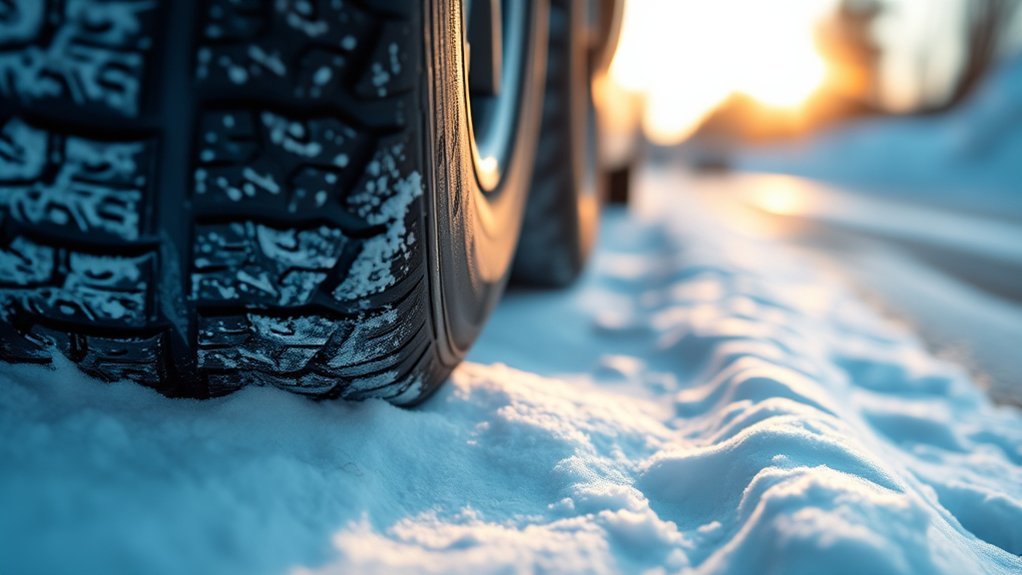
Rubber changes as its temperature changes. A tread compound designed mainly for warm weather can become stiffer in the cold, making it harder for the tread surface to follow tiny bumps and rough areas in the pavement. A winter compound is formulated to remain more pliable across lower temperatures.
That flexibility can improve traction in several ways. The tread blocks can deform as they enter the contact area, sipes can open and create extra edges, and the rubber can interact more effectively with a rough road surface. The tire still needs correct inflation, adequate tread depth, and a suitable tread pattern. A soft compound by itself does not guarantee good braking or cornering.
A 2022 experimental study in the Journal of Terramechanics tested 16 winter tires with identical dimensions, construction, and tread pattern but different tread compounds. The researchers found that compound choice significantly changed measured traction on ice, with a particularly strong effect in the low-slip region. The study also cautioned that lower stiffness cannot automatically be treated as better performance in every situation, reinforcing the need to judge the complete tire rather than rubber softness alone.
Transport Canada uses 7°C (45°F) as a practical seasonal reference. Below this point, typical summer and all-season tires begin losing elasticity, while winter tires are designed to retain useful flexibility at lower temperatures. This is a planning guideline rather than a promise that every winter tire will outperform every all-season tire in every test.
Winter grip comes from the interaction of compound chemistry, tread design, inflation pressure, tread depth, and the road surface. “Softer rubber” is only one part of the system.
What Is in a Winter Tire Rubber Compound?
Tire manufacturers use proprietary formulas, so two winter tires may behave differently even when their tread patterns look similar. A tread compound can include natural and synthetic rubbers, reinforcing fillers, silica, resins, processing oils, curing agents, and protective additives.
- Rubber polymers provide the elastic base of the tread and help determine how the material responds to temperature and repeated flexing.
- Silica and reinforcing fillers can influence wet grip, rolling resistance, strength, and wear. Their effect depends on the complete formula rather than the amount of one ingredient.
- Resins and oils can help engineers tune low-temperature flexibility and surface friction.
- Curing and protective additives help the tread maintain strength and resist damage from heat, oxygen, ozone, and repeated deformation.
Manufacturers must balance competing goals. A compound that produces strong cold grip may wear faster or feel less precise on warm, dry pavement. A harder, long-wearing compound may provide less winter flexibility. The best balance depends on your climate, vehicle, mileage, and typical road conditions.
The Importance of Tread Design for Winter Performance
The compound creates the tread’s material properties, but the tread pattern controls how that material meets snow, slush, water, and pavement. Winter tires commonly use many small tread blocks, open grooves, and a high density of sipes.
Sipes are narrow cuts molded into the tread blocks. As a block enters the contact area, the sipes can open slightly and create additional edges. These edges help the tire interact with packed snow, wet pavement, and uneven icy surfaces. The surrounding tread block must remain stable enough to support braking and steering forces.
Wide grooves and channels provide space for slush and water to move away from the contact area. Deeper voids can accept loose snow, while the tread pattern helps release it as the tire rotates. Snow retained within parts of the tread can also press against snow on the road, which may contribute to traction.
More grooves and sipes are not automatically better. Excessive tread movement can make steering feel vague, increase heat, and accelerate wear. Tire designers adjust block shape, siping, groove direction, and compound stiffness as one system.
The Role of Flexibility in Winter Tire Performance
Useful flexibility allows a winter tire’s tread surface to follow small road irregularities instead of skimming across them as a rigid block. This can improve the way the tire generates friction during acceleration, braking, and cornering.
However, flexibility does not dramatically increase the total contact patch by itself. Vehicle load, tire construction, size, and inflation pressure strongly influence the shape of the contact area. The compound’s main benefit is that the tread can work within that area without becoming too stiff for the temperature.
Flexibility also affects the sipes. A properly designed tread block can deform enough for its sipes to create edges, then recover as it leaves the road. If the rubber becomes too stiff, those features may not work as intended. If it becomes too soft in warm weather, the blocks can move excessively and wear faster.
Why Does Cold Change Rubber Grip?
Rubber is viscoelastic, meaning it can deform under load while also resisting and recovering from that deformation. As temperature falls, a warm-weather tread compound can become less compliant. That makes it harder for the rubber to deform around small pavement features or interact effectively with snow and ice. Winter formulations are engineered so useful viscoelastic behavior continues at lower temperatures.
A Tribology International study of tire tread blocks on compacted snow found that rubber friction increased as the compound’s glass-transition temperature decreased. The researchers also found that siped tread blocks produced higher friction at higher test velocities than blocks without sipes. For shoppers, the practical lesson is not to choose a tire by “softness” or one ingredient alone; the compound and tread features have to work together.
Pro Tip: Arrange seasonal tire installation before average temperatures settle near 7°C. Waiting for the first major snowfall can leave you driving on cold, stiff tires while tire shops are busiest.
How Winter Conditions Affect Tire Performance
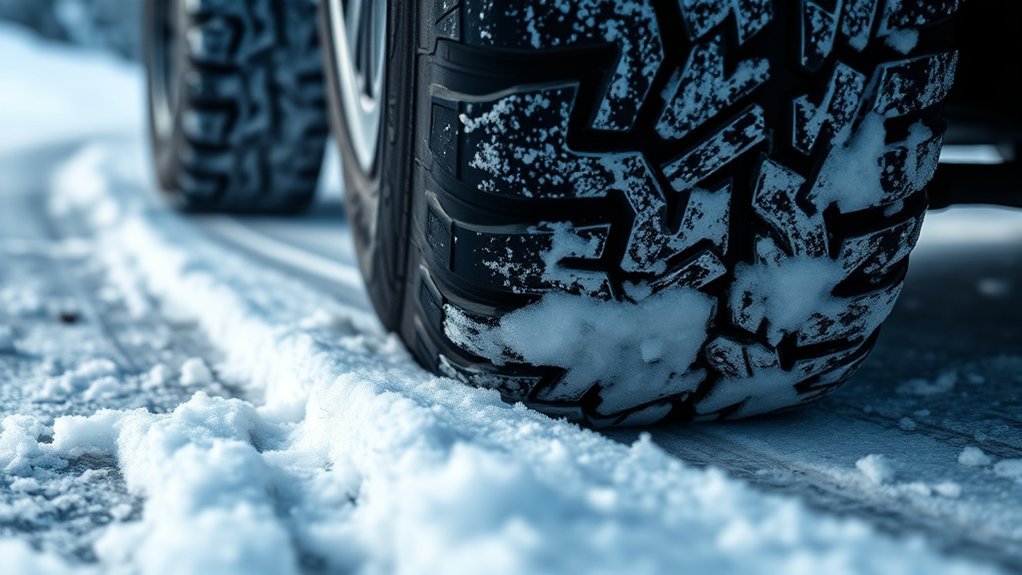
Winter is not one road condition. A tire may encounter cold dry pavement, wet pavement, slush, loose snow, compacted snow, black ice, and refrozen ruts during one trip. Compound and tread features contribute differently on each surface.
| Condition | Helpful Features | Important Limitation |
|---|---|---|
| Cold, dry pavement | Low-temperature flexibility helps the tread follow pavement texture. | Very soft blocks may feel less responsive than performance-oriented warm-weather tires. |
| Loose or packed snow | Open grooves, tread edges, sipes, and spaces that accept and release snow. | Traction falls as tread depth decreases or snow packs into a worn pattern. |
| Slush and standing water | Channels that move fluid away and a compound tuned for cold, wet surfaces. | Speed can overwhelm the tread’s ability to clear slush or water. |
| Polished or wet ice | Flexible rubber, dense edges, and tire-specific ice technologies. | Available friction remains extremely low, and stopping distances can still be long. |
| Warm, dry pavement | The tire remains usable during short seasonal temperature swings. | Prolonged warm-weather use may increase wear and reduce steering precision. |
Warning: Winter tires increase the traction available to your vehicle, but they cannot eliminate skidding. Reduce speed, leave a longer following distance, and avoid abrupt steering, braking, or acceleration when roads may be icy.
Winter Tire Symbols: 3PMSF and M+S
When shopping, look beyond words such as “snow capable” or “winter ready.” The most useful North American winter marking is the Three-Peak Mountain Snowflake, often shortened to 3PMSF. According to Transport Canada, tires carrying this mark meet a defined snow-traction performance requirement and are designed for severe snow conditions.
The M+S, M/S, or Mud and Snow marking is less informative by itself. It is widely found on all-season and all-terrain tires and does not provide the same severe-snow performance assurance as the mountain-and-snowflake mark.
Note: The 3PMSF mark confirms qualifying snow performance. It does not mean that every marked tire has the same braking distance on ice, the same wet grip, or the same warm-weather durability. Compare independent tests for the conditions you face most often.
Winter, All-Weather, and All-Season Tires
Dedicated winter tires place the greatest emphasis on cold, snow, and ice performance. They are usually the strongest choice for areas with frequent freezing temperatures, repeated snowfall, steep winter roads, or persistent ice.
All-weather tires are designed for year-round use and commonly carry the 3PMSF symbol. They can be practical where winters are moderate or seasonal storage is difficult. However, their summer and winter requirements create compromises, so they may not match a dedicated winter tire in severe ice or deep snow.
All-season tires cover a broad range of mild conditions. Many carry an M+S mark, but that alone does not make them equivalent to a dedicated winter tire. NHTSA notes that winter tires are more effective than all-season tires in deep snow. NHTSA also advises selecting a tire type based on local weather and driving conditions.
Studded winter tires can provide additional grip on some hard-packed or icy surfaces, but their use is restricted by season or location in many jurisdictions. Check local laws before buying or installing them.
Choosing Winter Tires: Key Rubber Tips
The compound formula is rarely published in enough detail for useful side-by-side shopping. Instead of choosing by one ingredient or marketing term, evaluate the tire as a complete product.
- Start with the correct size. Use the size, load capacity, and specifications shown on the vehicle placard or approved by the vehicle manufacturer.
- Look for the 3PMSF symbol. This is more meaningful for severe-snow use than an M+S mark alone.
- Match the tire to your main hazard. A driver facing frequent ice may prioritize ice-braking tests, while a rural driver may need stronger deep-snow traction.
- Install four compatible winter tires. Mixing winter and non-winter tires can create an imbalance in front-to-rear grip.
- Compare worn-tire performance when available. A design that performs well when new may lose capability as its grooves and sipes become shallower.
- Consider warm-weather use. Dedicated winter compounds can wear faster if left on through sustained warm conditions.
- Check local requirements. Winter-tire dates, approved markings, chains, and stud rules vary by jurisdiction.
How to Compare Winter Tire Compounds in Real Tests
Because manufacturers rarely publish enough compound data for direct comparison, independent whole-tire testing is usually more useful than comparing ingredient lists. Focus on tests performed under conditions similar to your own driving rather than assuming the tire with the softest-feeling tread or most silica will perform best.
- Frequent ice: Prioritize instrumented ice braking and acceleration results. Check the test temperature when it is reported.
- Deep or packed snow: Compare snow acceleration, braking, hill-start, and handling results.
- Slush and wet winter roads: Look at wet braking, water evacuation, slush handling, and hydroplaning-related tests.
- Long dry-road stretches: Compare steering stability, braking, noise, and warm-pavement behavior as well as winter grip.
- Long-term ownership: Look for worn-tire testing where available, because groove depth and usable siping decrease as the tread wears.
This approach evaluates what the compound actually accomplishes inside the complete tire. A marketing claim about silica, natural rubber, oils, pores, or another ingredient is less useful without measured performance under the winter condition that matters to you.
Transport Canada recommends installing winter tires in sets of four and using matching tire characteristics to support stable handling. It also advises placing the tires with the deepest tread on the rear axle when tread depths differ.
Maintaining Winter Tire Traction
Check Tread Depth Before Snow Season
Tread depth affects the space available for snow and slush and determines how much of the original siping remains. Although legal minimums vary, Transport Canada advises against using tires worn close to 4 mm or 5/32 inch on snow-covered roads. This winter-use guidance is more conservative than the general 2/32-inch replacement threshold described by NHTSA for ordinary tire safety.
Measure Pressure When Tires Are Cold
Cold weather can reduce inflation pressure. Check all four tires and the spare with a gauge before long trips and at least monthly. Use the cold inflation pressure printed on the vehicle’s tire-information label or listed in the owner’s manual. Do not use the maximum pressure molded onto the tire sidewall as your normal target.
NHTSA recommends measuring pressure when the vehicle has been parked for at least three hours. A tire-pressure monitoring system can warn about significant underinflation, but it does not replace regular gauge checks.
Inspect Age, Wear, and Damage
Replace or professionally inspect tires that show cracking, bulges, exposed material, repeated pressure loss, vibration, or irregular wear. Age alone does not reveal the complete condition of a tire, so follow the vehicle and tire manufacturers’ inspection and replacement guidance.
Store Seasonal Tires Correctly
Clean and dry removed tires before storage. Keep them in a cool, dry area away from sunlight, ozone-producing equipment, petroleum products, and strong heat. Mark each tire’s vehicle position so you can follow the recommended rotation pattern during the next installation.
Related Guides
Frequently Asked Questions
Why do winter tires work better below 7°C?
As temperatures fall, typical summer and all-season tread compounds become less elastic. Winter compounds are formulated to retain useful flexibility at lower temperatures, allowing the tread and sipes to keep working against pavement, snow, and ice. Transport Canada uses 7°C (45°F) as a practical seasonal reference rather than an absolute performance boundary for every tire.
Does softer rubber always mean better winter traction?
No. Useful low-temperature flexibility is important, but excessive tread movement can reduce steering precision and increase wear. Compound chemistry, tread-block support, sipes, grooves, tire construction, pressure, and the road surface all affect the final result. Controlled ice research has also shown that lower stiffness cannot automatically be treated as better whole-tire performance.
What do silica and other fillers do in a winter tire compound?
Silica and other reinforcing fillers help tire engineers tune properties such as wet grip, rolling resistance, strength, wear, and cold-weather behavior. Resins, oils, rubber polymers, and curing systems also contribute. The final formulation matters more than the presence or amount of one advertised ingredient.
Does the 3PMSF symbol guarantee good ice traction?
No. The symbol confirms that the tire meets a defined severe-snow traction requirement. It does not mean every marked tire provides the same braking or cornering on polished ice. Review independent ice tests when ice is your main winter hazard.
Do winter tires wear faster in warm weather?
They can. Dedicated winter compounds and heavily siped tread patterns are optimized for cold conditions. Sustained warm-road use can increase tread movement, accelerate wear, and reduce steering precision compared with tires designed for warmer conditions. Short seasonal temperature swings are different from leaving winter tires on throughout consistently warm weather.
Do you need winter tires if your vehicle has all-wheel drive?
All-wheel drive can distribute engine power across more wheels, which may help the vehicle accelerate. It does not create additional friction between the tires and road during braking. The tires still determine how much grip is available for stopping and steering.
Sources
- Transport Canada: Using Winter Tires — supports the 7°C guidance, severe-snow symbol, four-tire installation, winter tread depth, rear-tire placement, and cold-pressure advice.
- Transport Canada: Winter Driving — supports seasonal preparation and the safety benefits of winter tires in Canadian conditions.
- National Highway Traffic Safety Administration: TireWise — supports tire sizing, placard pressure, cold-pressure checks, tread inspection, tire aging, deep-snow guidance, and UTQG definitions.
- Journal of Terramechanics: Tread rubber compound effect in winter tires — controlled testing of winter tires with identical design and construction but different tread compounds on ice.
- Tribology International: Investigation of rubber friction on snow for tyres — supports the relationship between rubber viscoelastic properties, glass-transition behavior, siping, and snow friction.
- Michelin Tire Glossary — provides supporting definitions for silica tread compounds and sipes.
Conclusion
Tire rubber compounds improve winter traction by retaining useful flexibility as temperatures fall, but the compound cannot work alone. Controlled testing shows that changing the tread compound can materially change ice-traction behavior even when tire dimensions, construction, and tread pattern stay the same. Tread blocks, sipes, grooves, pressure, tread depth, and overall construction still determine how effectively that compound works on the road.
Choose four correctly sized tires suited to your main winter conditions, look for the Three-Peak Mountain Snowflake symbol, and compare independent snow, ice, wet, and worn-tire tests where available. Check tread depth and cold inflation pressure throughout the season, and remember that even a strong winter tire cannot replace lower speeds and extra stopping distance on slippery roads.