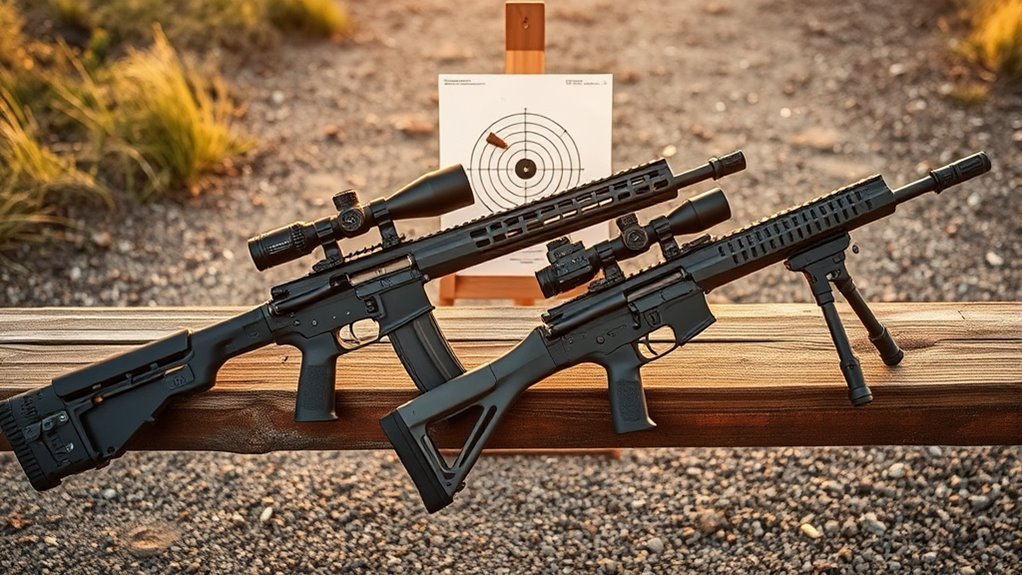
A 3 mil minimum accuracy claim means a rifle should keep shots inside about a 30-inch circle at 1,000 yards, or roughly 3.6 inches at 100 yards. That is serviceable for casual target work, hunting at moderate range, and some defensive use, but it is not precision-grade. Buyers should verify barrel quality, trigger consistency, optics, and ammunition fit. Mil reticles aid ranging and corrections, and practical testing reveals whether the rifle truly meets the standard.
Key Takeaways
- 3 mil accuracy means about a 30-inch group at 1,000 yards, or roughly 3.6 inches at 100 yards.
- It is adequate for casual shooting, moderate hunting, and some defensive uses, but not ideal for precision competition.
- Expect tighter groups only with a quality barrel, consistent ammo, and reliable optics.
- Verify real-world performance with controlled range testing, ideally with 30 rounds and stable support.
- Match the rifle to your purpose and budget, since cheaper rifles often meet basic accuracy but not elite precision.
What Does 3 Mil Minimum Accuracy Mean?
A 3 Mil minimum accuracy standard means a rifle should consistently place shots within a 30-inch circle at 1,000 yards, or roughly 3.6 inches at 100 yards.
In practical terms, 3 Mil accuracy defines a baseline of repeatable mechanical performance, not a mark of elite precision. Military and tactical users apply this threshold because it helps guarantee predictable shot placement across changing conditions.
Meeting the standard usually depends on a precision barrel, ammunition of consistent quality, and an optics system capable of precise zeroing and adjustment.
A precision barrel, consistent ammunition, and a reliable optic are essential for meeting the standard.
Mil-based corrections further clarify the concept: a 3 Mil miss at 300 yards requires a 1 Mil hold or turret change. For shooters seeking control over their equipment and environment, this specification provides measurable autonomy.
Competitors and long-range marksmen often demand tighter groups, but 3 Mil accuracy remains a clear technical reference for evaluating whether a rifle performs to minimum expectations.
Is 3 Mil Accuracy Good Enough?
A 3 Mil accuracy standard can be adequate in real-world use cases such as casual target shooting, hunting at moderate ranges, and some defensive applications, where extreme precision is not the primary requirement.
Its suitability depends on the firearm’s role and engagement distance, since long-range shooting and competition typically demand substantially tighter dispersion, often near sub-MOA levels.
Budget and performance must be weighed together, because ammunition quality, rifle consistency, and shooter training can determine whether 3 Mil accuracy is practical or merely acceptable.
Real-World Use Cases
In practical use, a 3 Mil accuracy standard is often sufficient for general hunting, tactical, and self-defense roles where fast target acquisition matters more than extreme precision.
These real-world use cases show that 3 Mil accuracy can place shots within roughly 10.8 inches at 300 yards, a tolerance many shooters accept for larger targets and urgent engagements. It remains workable for recreational shooting and field applications, especially when consistent ammunition and disciplined technique reduce dispersion.
However, smaller targets and distant shots expose its limits, and precision work quickly demands tighter performance. Competitive shooters generally require 1 to 2 Mil groupings for liberation from wasted effort and uncertainty.
Consequently, the standard is practical, but not universal, and its value depends on mission, training, and target size.
Range and Role Fit
For many shooters, 3 Mil accuracy is adequate at moderate distances, but its suitability depends heavily on the role and required precision.
In range and role fit analysis, 3 Mil equals about 10.8 inches at 300 yards, which can support general shooting yet constrain exacting tasks. Compared with a 1 MOA standard, it is serviceable, not exceptional, for disciplined users seeking practical freedom in the field.
- Casual target shooting: acceptable
- Self-defense and tactical use: often workable
- Long-range hunting: marginal precision
- Competition or tight shot placement: usually insufficient
Understanding Mil adjustments against distance is essential, because small angular errors expand quickly.
For liberated decision-making, the key is matching capability to mission, not accepting loose tolerance where precision governs outcomes.
Budget Vs Performance
Budget and performance often diverge sharply at the 3 mil threshold: while that level of accuracy is roughly 10 inches at 1,000 yards and can suit hunting or self-defense, it is usually below the consistency expected for precision or competitive work. Budget rifles often live here.
| Tier | Typical Use | Tradeoff |
|---|---|---|
| 3 mil | Field use | Lower cost |
| <1 mil | Competition | Higher cost |
| Upgraded | Precision | Better control |
For liberation-minded shooters, the equation is straightforward: accept modest dispersion for access, or invest in match-grade barrels and triggers for tighter groups. A rifle that meets a minimum standard may free a buyer from high entry cost, yet serious performance demands tighter tolerances, stronger reliability, and repeatable cold-bore impacts. The prudent choice depends on mission, not marketing.
How Mil Reticles Measure Miss Distance?
Mil reticles use fixed angular spacing, with each hash mark typically subtending 0.5 or 1.0 mil and 1 mil equaling 1/1000 of the target distance.
By comparing the observed impact point to these references, the shooter can read miss distance in inches or centimeters based on range, such as about 7.2 inches at 200 yards per mil.
That measurement then informs corrective holds or dialing adjustments for elevation and windage, enabling rapid follow-up shots with minimal calculation.
Mil Spacing Basics
At the core of a mil reticle is angular measurement: 1 mil represents 1/1000 of the distance to the target, giving shooters a precise way to estimate and correct miss distance.
In mil spacing basics, each hash mark usually equals 0.1 mil, enabling controlled windage and elevation changes without guesswork. At 100 yards, 1 mil is about 3.6 inches, a useful conversion for practical correction.
- Fine increments support disciplined shot correction.
- Distance-based math remains direct and repeatable.
- A 20 cm miss at 200 yards can call for 1 mil up.
- Mils streamline fast follow-up shots under pressure.
Reading Miss Distance
Once the spacing of the reticle is understood, the next step is using it to read how far a shot missed and what correction is needed. A mil reticle measures angular error, and mil equals 1/1000th of the distance to the target. This makes miss distance legible without guesswork.
At 300 yards, a 2 mil error translates to about 6.6 inches, showing the scale of correction required. Markings are usually spaced in 0.5 or 1.0 mil increments, giving clear reference points for estimating offset.
A practical formula converts mils to inches by multiplying the mil value by distance in yards; 1 mil at 300 yards equals 3.6 inches. Such readings support fast windage and elevation decisions, preserving autonomy under pressure.
Dialing Corrective Holds
Corrective holds can be dialed with precision because a mil reticle converts a shot’s offset into a usable angular value. In military (mils) practice, 1 mil equals 1 meter of miss at 1,000 meters, letting the shooter translate impact error into direct correction.
The rule is simple: target distance in meters multiplied by miss in mils yields the adjustment in centimeters.
- This removes guesswork from wind and elevation changes.
- A 20 cm miss at 200 yards is about 1 mil.
- Follow-up shots become faster and more controlled.
- Accuracy improves through repeatable, liberated adjustment.
Mil vs. MOA: Which Scope Is Better?
When comparing Mil and MOA optics, the better choice usually depends on how the shooter thinks and works under pressure. Mil uses a decimal system built on 1/1000th of target distance, which supports fast mental math and practical hold corrections. MOA remains familiar to many American shooters, yet mil often feels more direct in precision work.
| System | 100-yard value | Common use |
|---|---|---|
| mil | 3.6 in | Rapid calculation |
| moa | 1 in | Familiar adjustment |
| mil hash | .2 increments | Turret matching |
Modern mil reticles with .2 hashmarks align cleanly with matching turrets, reducing friction and preserving clarity. That advantage matters when conditions shift and the shooter needs disciplined, emancipated decision-making. MOA can still serve well, but mil systems are commonly favored in military contexts for their straightforward application. Preference, training, and consistency ultimately decide which optic is better.
What Do You Need to Shoot in Mils?
To shoot effectively in mils, the shooter must understand that 1 mil equals 1/1000th of the target distance, a scale that simplifies ranging, holdovers, and corrections. This decimal system is favored by military units because it supports fast, disciplined adjustments under pressure and removes much of the arithmetic burden imposed by older angular systems.
A mil-based reticle usually presents 0.5 or 1.0 mil hash marks, giving clear reference points for elevation and windage. At 100 yards, 1 mil equals about 3.6 inches, a useful conversion for estimating impact change.
Practical use demands:
- a mil reticle or matching turret system
- familiarity with 0.5 and 1.0 mil increments
- awareness of 3.6 inches per mil at 100 yards
- ballistic calculator practice for refined corrections
With these tools, follow-up shots become faster, cleaner, and more autonomous.
How Do You Check a Rifle’s Real Accuracy?
A rifle’s real accuracy is best verified through controlled live-fire testing, not by catalog claims or isolated anecdotal results. The evaluation should begin with a stable rest or sandbag, reducing shooter-induced error and exposing the rifle’s true behavior.
A serious test uses at least 30 rounds, fired in measured shot group strings at several distances, so consistency can be observed rather than guessed. Each shot group should be recorded in inches, then compared with the maker’s stated standard; a 1 MOA rifle should print roughly 1 inch at 100 yards.
Conditions must be noted carefully, because wind and temperature can distort results. Ammunition should also remain consistent, ideally from the same lot number, so group size reflects the rifle, not cartridge variation.
This method replaces marketing with evidence and gives the buyer a clear, disciplined basis for judgment.
What Are the Best Uses for 3 Mil Accuracy?
Three-mil accuracy is most valuable where small angular deviations matter at distance, especially beyond 300 yards. In practical terms, 3 Mil accuracy supports disciplined marksmanship by reducing uncertainty and improving shot placement when targets shrink against range, wind, and elevation changes. It is a strong fit for precision rifle competition, where incremental corrections can separate a clean score from a miss.
- Long-range shooting with tight hold adjustments
- Precision rifle matches demanding repeatable correction
- Tactical use in dynamic, low-collateral environments
- Ethical hunting of large game in open terrain
For shooters seeking liberation from guesswork, 3 Mil accuracy also simplifies ballistic calculations. Wind calls, drop compensation, and range estimation become more manageable, enabling fast, informed decisions.
That clarity is especially valuable when conditions shift quickly and decisive engagement is required. In these roles, 3 Mil accuracy is less about excess and more about controlled effectiveness, making it a practical standard for extended-range performance.
What Should You Look For Before Buying?
Before purchasing a rifle built to support minimum 3 Mil accuracy, the buyer should first define the primary use case—self-defense, competition, or hunting—because that decision determines the acceptable accuracy standard and feature set. Factory claims should be checked against a 1 MOA benchmark, since that level signals disciplined manufacturing and supports a long-range shooter’s demand for repeatable precision. Barrel choice matters: a 16″ tube offers versatility, while a longer barrel can tighten performance at distance. Trigger quality should not be ignored; a smooth, lighter break reduces disturbance at release and improves control. Optics compatibility is equally decisive, because reticle design and mounting integrity govern practical hit probability.
| Factor | Priority | Effect |
|---|---|---|
| Barrel | Medium | Range and stability |
| Trigger | High | Shot control |
| Optics | High | Precision targeting |
A buyer seeking freedom through capability should verify each component before purchase.
Frequently Asked Questions
What Is the Most Accurate Rifle for the Money?
Tikka T3x is often the most accurate rifle for the money; its factory Rifle Calibration, sub-MOA consistency, and smooth action suit precision seekers. In 6.5 Creedmoor or .308, it delivers disciplined performance.
Is 3 Moa Good for a Rifle?
3 MOA is serviceable, but hardly heroic; it suits hunting, not precision domination. Precision Factors, including ammunition, barrel quality, and shooter skill, determine whether it feels acceptable or frustratingly loose for demanding marksmen.
Are Accuracy International Rifles Worth the Money?
Accuracy International rifles are often worth the money for a serious Rifle Investment: sub-MOA precision, modular chassis, and harsh-condition reliability justify the cost, especially for shooters pursuing capability, autonomy, and long-range performance without compromise.
What’s Better, Moa or MIL?
MIL is generally better for most precision shooters because its decimal system and matching turret/reticle layout simplify calculations. MOA remains familiar for hunters. Precision Metrics favor mils for speed, consistency, and practical freedom at distance.
Conclusion
To sum up, 3 mil minimum accuracy marks a practical, precision-minded baseline, not a benchmark for bragging. Buyers should weigh real-world rifle reliability, reticle resolution, and range requirements before relying on it. Mil systems deliver measured, methodical miss correction, while MOA may suit some marksmen better. Ultimately, the best choice depends on intended use, verified performance, and careful comparison. Smart shooters seek solid specifications, not simply seductive sales language.
