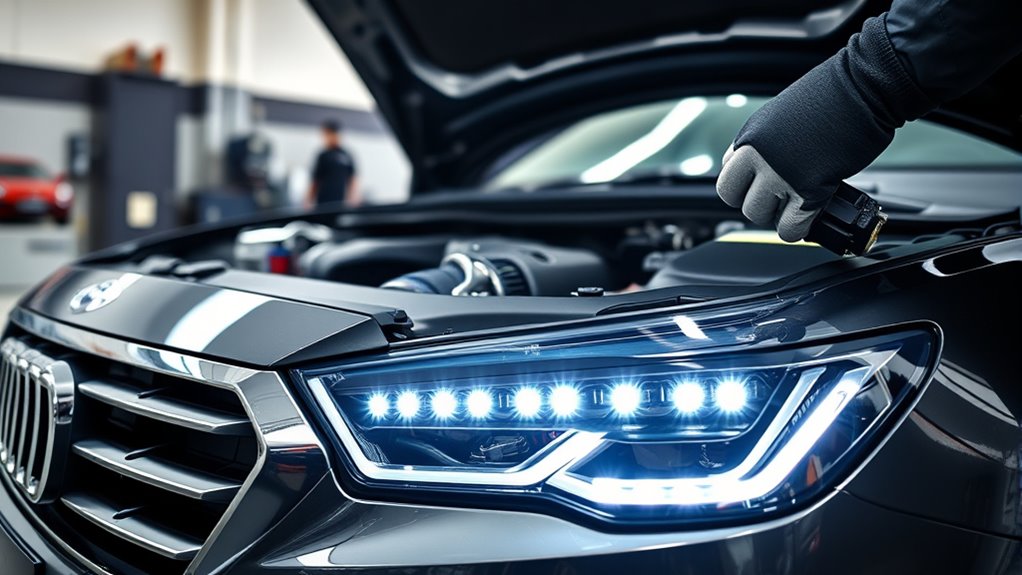
Buying car LED lights is not as simple as matching a bulb number. A light that fits the socket can still cause glare, dashboard warnings, or an inspection failure. Before choosing an upgrade, check the vehicle’s lighting system, the complete beam pattern, and the rules where you drive.
Quick Answer
Choose car LED lights by matching the original bulb application, checking the headlamp’s approval and beam pattern, and confirming electrical compatibility. For headlights, a bulb that physically fits is not automatically road-legal. In Great Britain, only qualifying ECE-approved LED replacements may be fitted to compatible halogen headlamps under the revised MOT rules.
Last checked: October 23, 2026. Dates and figures were verified against official sources.
Key Takeaways
- Check the bulb’s function as well as its size: headlights, brake lamps, indicators, and cabin lamps have different requirements.
- LEDs can use less power, but advertised lumens and cool-white color do not prove better road illumination.
- LED turn signals may hyperflash, while other replacements can flicker or trigger false bulb-failure warnings.
- UK MOT acceptance of approved LED replacements changed on October 14, 2026; the required approval sticker matters.
- A complete approved LED headlamp assembly differs legally and technically from putting an LED bulb in a halogen unit.
Which LED Lights Fit Your Car?
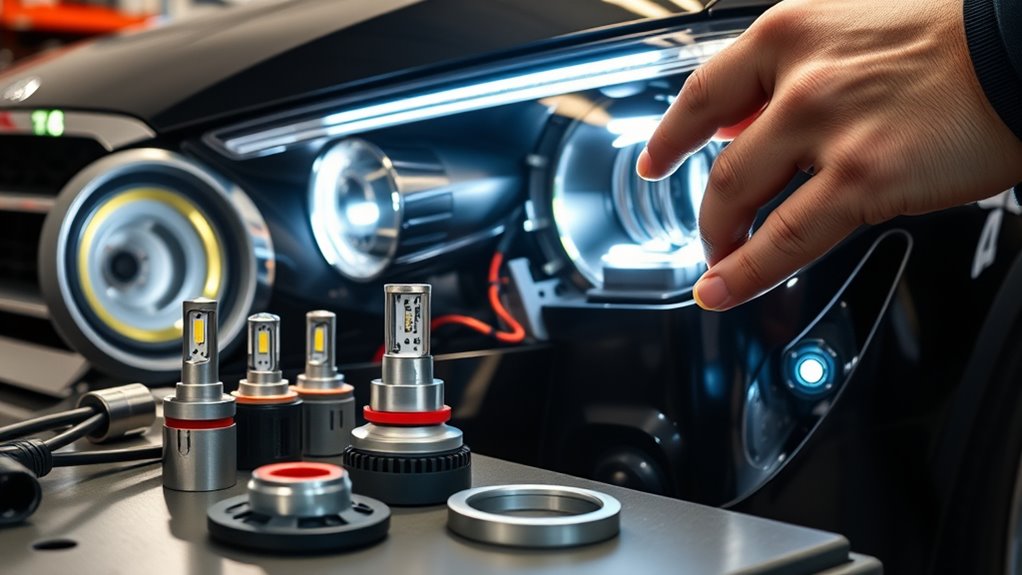
The right LED depends on where the lamp is used, the original bulb specification, and the vehicle’s wiring. Start with the owner’s manual or the Sylvania automotive bulb finder, then compare the result with the bulb already fitted.
- Identify the light: low beam, high beam, daytime running light, fog lamp, brake lamp, indicator, reverse lamp, or interior light.
- Confirm the bulb code and connector: examples include H7, H11, and 7440, but the correct code varies by vehicle and lamp position.
- Check the housing: a matching base does not confirm that an LED will form the correct beam in a halogen reflector or projector.
- Check physical clearance: the LED’s heat sink, fan, driver, and wiring must fit without crushing cables or leaving a dust cover improperly sealed.
- Check approval and electronics: confirm the product is permitted for that headlamp and whether an adapter is specified.
- Test after fitting: check both beams, turn signals, warning lights, and headlamp aim before road use.
Some small LED bulbs are polarity-sensitive. If a compatible wedge bulb does not illuminate, it may need to be removed and turned around; never force or modify the socket. Use the correct amber or red light output for the lamp’s required function and local regulations.
For approved replacement headlight products, OSRAM’s LED compatibility guidance illustrates why the lamp category, headlamp approval, and any specified accessories matter. Check the rules in your country separately; a manufacturer’s fitment listing is not a universal legal approval.
What Are Car LED Lights For?
Car LEDs provide light for seeing, signalling, or styling. Factory-designed LED headlamps, daytime running lights, tail lamps, and indicators can deliver efficient light from compact assemblies, while separate accent and underbody lights mainly change appearance.
LEDs usually draw less power than comparable incandescent bulbs. They also offer quick illumination and flexible design. However, a complete LED lamp engineered for a vehicle is not the same as an aftermarket LED replacement bulb inserted into an older housing.
LED technology alone does not guarantee a better headlight. The complete lamp must put usable light on the road without excessive glare.
For exterior lights, correct colour, placement, and visibility are as important as the LED itself. Styling kits should not obscure or imitate required brake lights, indicators, or emergency lights.
LED Headlights vs Halogen Bulbs
LED headlamps are generally more energy-efficient than halogen designs and can offer longer service life. But one technology is not automatically brighter or safer: the optics, aim, and complete assembly determine how well a driver can see.
| Factor | LED headlamp | Halogen headlamp |
|---|---|---|
| Power use | Typically lower for comparable output | Typically higher |
| Service life | Often longer, but varies by design and heat control | Usually shorter; replacement bulbs are common |
| Light appearance | Often white or cool white | Typically warmer |
| Replacement cost | Can be high for integrated assemblies | Often cheaper when only a bulb is replaced |
| Road visibility | Depends on optics and aim | Also depends on optics and aim |
The Insurance Institute for Highway Safety’s headlight research evaluates road illumination and glare, not just bulb technology. Likewise, Consumer Reports’ headlight testing found that LEDs do not always outperform halogen or HID lamps.
Many halogen headlights use replaceable bulbs rated around 1,000 hours, although individual ratings vary. Halogen bulbs can be simpler and cheaper to change. Integrated LEDs may last longer, but a failed sealed unit can require replacing much more than a bulb. Treat claims that all LEDs last the vehicle’s lifetime, or always improve fuel economy, with caution.
Why LED Car Lights Cost More
LED lighting may cost more because the purchase includes electronic drivers, light-emitting chips, cooling parts, and carefully designed optics. The total expense also depends on whether you are changing a small bulb or replacing a complete headlamp assembly.
Higher Upfront Prices
Premium LED bulbs and complete LED housings often cost more upfront than basic halogen bulbs. That premium can buy better heat control, a longer warranty, or a more carefully engineered optical system. It does not guarantee longer road reach.
Compare the full cost of parts and installation, not just the advertised bulb price. The original article’s specific claim of a 50% LED price premium is not a reliable rule across vehicles or product types.
Better Parts And Build
Better LEDs use suitable drivers, heat sinks or fans, durable connectors, and moisture protection. These parts help prevent dimming, flicker, and early failure, especially inside a hot, confined headlamp housing.
Some quality LED products advertise service lives reaching 25,000 hours, but ratings vary widely. Check the actual manufacturer’s rated life, warranty terms, and whether the figure applies to a bulb, module, or complete lamp. An LED is not maintenance-free by definition.
Installation And Compatibility
A low-priced LED bulb may become an expensive upgrade when it needs vehicle-specific adapters, warning-cancel modules, wiring work, or professional aiming. Some headlamps cannot be converted legally by changing the bulb alone.
- Check whether the lamp is a simple service bulb or a sealed assembly.
- Confirm any required bulb holder, wiring harness, or dust-cover clearance.
- Budget for electrical fault diagnosis if the vehicle monitors bulb load.
- Check whether the proposed setup can pass the local roadworthiness test.
Before spending more, consider whether new approved halogen bulbs, cleaning cloudy lenses, or restoring headlamp aim would solve the problem without a conversion.
Will LED Lights Pass MOT?
Yes, some LED lights can pass a Great Britain MOT, but the type of conversion matters. Factory LED headlamps and compliant complete replacement units are different from fitting LED bulbs into an existing halogen headlamp.
From October 14, 2026, MOT testers in England, Scotland, and Wales must accept ECE-approved LED replacement (LEDr) bulbs in compatible halogen headlamp units for vehicle classes 3, 4, 5, and 7. Under the DVSA’s October 2026 special notice, the vehicle must display a corresponding manufacturer-issued security approval sticker.
Warning: The new MOT exception does not make every LED bulb sold online legal. An LED replacement in a halogen headlamp can still fail if it lacks the required approval, has a missing or unreadable sticker, or produces an unacceptable beam.
The sticker must be permanently attached, visible to the tester, and show details including the bulb category, rated voltage, ECE approval number, and manufacturer. The change does not cover halogen-to-HID conversions, and other MOT checks on aim, output, and condition still apply. Northern Ireland uses a separate inspection system.
In the United States, rules differ. A NHTSA interpretation of FMVSS No. 108 distinguishes compliant complete LED headlamps from LED replacement light sources put into headlamps designed for replaceable halogen bulbs. NHTSA found the latter did not meet the federal replacement-light-source rules addressed in its interpretation; state law also governs owner modifications. Do not assume UK approval makes a product legal in the US.
Will LED Lights Work With CANBUS?
Many LED lamps work in vehicles with a CAN bus network, but their lower power draw can confuse the car’s bulb-out monitoring. Depending on the vehicle, an incompatible replacement may cause a bulb-failure warning, flicker, or hyperflash.
CAN bus is the communication network used by vehicle control modules. The issue is often the lamp-check circuit or pulse-width-modulated power supply, rather than the CAN bus itself. Philips’ LED CANbus adapter guide explains these warning and flicker problems and the use of matched adapters.
- False bulb warning: check the lamp and wiring first, then use an approved adapter only if the manufacturer specifies one.
- Turn-signal hyperflash: confirm every indicator works, then investigate a compatible load correction or vehicle-specific setting.
- Flicker: check for pulse-width-modulation sensitivity and the proper LED driver or decoder.
- No light: confirm power, socket fit, and polarity on LED types designed to be reversible.
Note: Load resistors can become extremely hot. Do not attach them to plastic housings or wire them without the correct instructions; a qualified auto electrician is the safer choice for uncertain circuits.
A label saying “CANBUS-compatible” does not promise error-free operation in every vehicle. It also does not establish road legality or fix a bad headlight beam.
Best LED Lights for Styling
RGB and RGBW LED kits are flexible choices for interior accents and decorative lighting. RGBW products add a dedicated white channel, while app-controlled kits can make brightness and colour changes easier.
For underbody lights, favour secure mounts, weather-resistant connections, covered wiring, and controls that cannot distract the driver. Select a kit for the mounting environment rather than assuming an interior LED strip will survive underneath a car.
Accent lighting can change a car’s appearance, but it should never obscure required signals or confuse other road users.
Public-road restrictions vary by location. In Great Britain, the Road Vehicles Lighting Regulations restrict light colours shown toward the front or rear; other rules control flashing and distracting lights. Decorative LEDs should not be treated as headlight replacements or a visibility upgrade.
How to Choose Bright, Safe LED Headlights
The safest choice is a complete, road-approved headlight system designed for your vehicle, or a specifically approved replacement bulb where local rules allow one. Judge its light on the road, not only the lumen figure printed on the box.
- Fit and approval: match the vehicle, housing, bulb category, and legal approval.
- Beam performance: look for useful forward reach, even coverage, and a controlled cutoff.
- Colour: products around 5000–6500 K offer a white-to-cool-white appearance, but colour temperature alone does not indicate better sight or less glare.
- Cooling: check heat-sink clearance, driver placement, and whether the factory seals still close.
- Electrical behaviour: check for warning codes, flicker, and compatibility with automatic lighting functions.
- Support: prefer clear installation instructions, product approvals, and a usable warranty.
Lumens measure total emitted light. They do not tell you where the headlamp sends it. A poorly focused high-lumen bulb can waste light above the road and dazzle other drivers.
Why Beam Pattern Matters
A correct low-beam pattern lights the lane and roadside without sending too much light into oncoming eyes. The reflector or projector and the light source must work together to form that pattern.
A reflector uses shaped surfaces to direct light. A projector uses a lens and optical components to control the beam. Neither design makes a random LED retrofit safe just because its base fits or its light appears brighter against a wall.
After any headlamp repair, check both the horizontal spread and vertical aim using the vehicle manufacturer’s procedure or a professional aiming station. If drivers flash their lights at you, or the beam becomes patchy, investigate the setup instead of increasing brightness.
When to Hire a Pro for Installation
Hire a qualified technician when the upgrade changes the headlamp assembly, needs added electronics, or affects beam aiming. Professional help is especially useful when access requires removing trim, bumpers, or tightly fitted lamp covers.
Installation Complexity
A simple interior bulb swap may be straightforward. Headlamp retrofits are harder because the LED emitter must sit in the correct position, leave space for cooling, and preserve the housing’s water and dust protection.
If a full LED assembly is installed, the vehicle may also need matching control modules, wiring, or lighting-system calibration. An installer should confirm that the chosen replacement is intended and approved for the car.
Electrical Compatibility
Book electrical diagnosis if LEDs cause persistent warnings, flicker, unreliable turn signals, or heat near added resistors. Repeatedly swapping adapters without identifying the circuit problem can create more faults.
Before handing over the car, ask the installer to demonstrate low and high beams, hazard lights, indicators, brake lights, and any automatic lighting features affected by the work. Confirm the beam aim and keep the approval paperwork and sticker where required.
Frequently Asked Questions
Is There a Difference Between Cheap and Expensive LED Lights?
Yes. Better LED products may have stronger cooling, more reliable drivers, clearer fitment information, and longer warranties. Price alone does not establish legal approval or a safe beam. Compare the exact product’s test information, installation needs, and warranty rather than assuming the costlier bulb will shine farther.
Which Brand of LED Headlights Is Considered the Best?
No single LED brand is best for every vehicle. Hella, Osram, Philips, Morimoto, Diode Dynamics, and SEALIGHT offer different lighting products; Cree is also known for LED components. Choose a specific approved lamp or assembly that fits your vehicle and has documented beam performance, not a brand ranking alone.
What to Look for When Buying LED Lights?
Start with the correct bulb application and approved use. Then assess beam pattern, colour, cooling, electrical compatibility, and warranty. For headlights, a matching socket or very high lumen claim is not enough. The bulb must suit the housing, the car, and the rules that apply where you drive.
What Are the Downsides of LED Headlights?
LED headlights can cost more to buy or repair, especially when the light source is built into a sealed assembly. Aftermarket bulb swaps can cause glare, warning lights, flicker, or legal problems. Cooling parts and electronics also need room, so a physically fitting bulb may still be unsuitable.
Can I Put LED Bulbs in Halogen Headlights?
Not automatically. In Great Britain, qualifying ECE-approved LED replacements can be accepted at MOT in compatible halogen headlamps with the required manufacturer approval sticker. Ordinary unapproved bulb swaps can still fail. US federal replacement-light-source rules are different, and owner modifications may also be restricted by state law.
Conclusion
The best car LED lights are the ones that fit the vehicle, produce a controlled beam, and meet local lighting requirements. Start with the correct bulb or assembly specification, verify approval, and test every affected light. If an upgrade needs wiring changes or headlamp aiming, use a qualified fitter rather than guessing.
Sources
- Sylvania Automotive Bulb Finder: Bulb identification and vehicle fitment.
- OSRAM LED Replacement Guidance: Headlamp compatibility and required accessories.
- Insurance Institute for Highway Safety: Headlight visibility, glare, and technology comparisons.
- Consumer Reports: Performance limits of LED headlights versus other types.
- DVSA MOT Special Notice 05-26: Approved LEDr conversions and sticker requirements.
- NHTSA FMVSS No. 108 Interpretation: US rules on complete LED headlamps and replacement bulbs.
- Philips LED CANbus Adapter Guide: Load detection, flicker, polarity, and adapter issues.
- Road Vehicles Lighting Regulations 1989: Great Britain lamp-colour restrictions.

