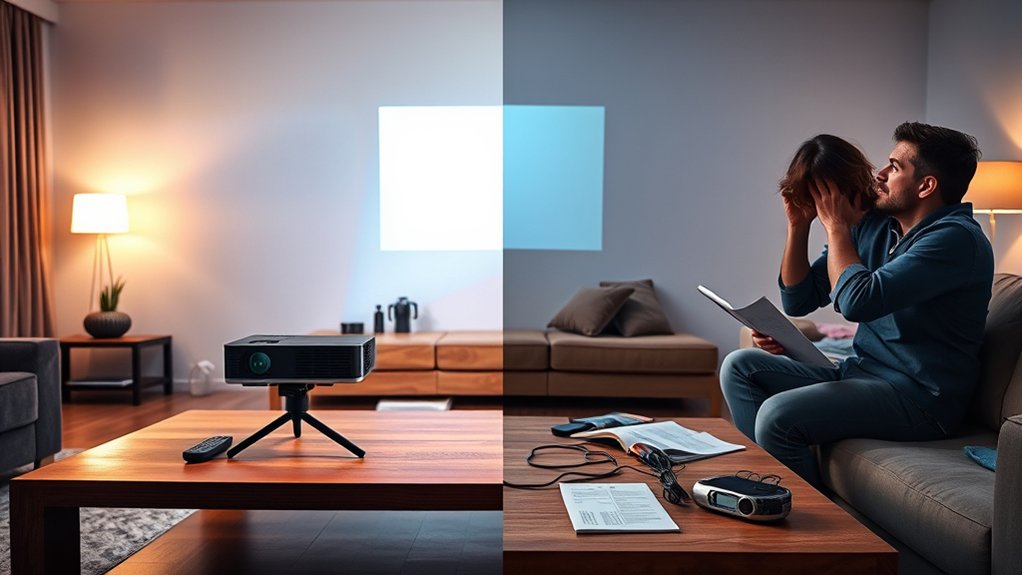
Portable projectors offer several advantages, including lightweight designs for easy transport, flexible use in various settings, and battery operation for off-grid capability. They also feature quick setups and built-in smart functions for streaming. However, they tend to have brightness limitations, especially in well-lit environments, and built-in audio may be inadequate. Users often experience a loss of detail when running on battery. For a deeper understanding of these devices, exploring further could reveal additional insights.
Key Features of Portable Projectors
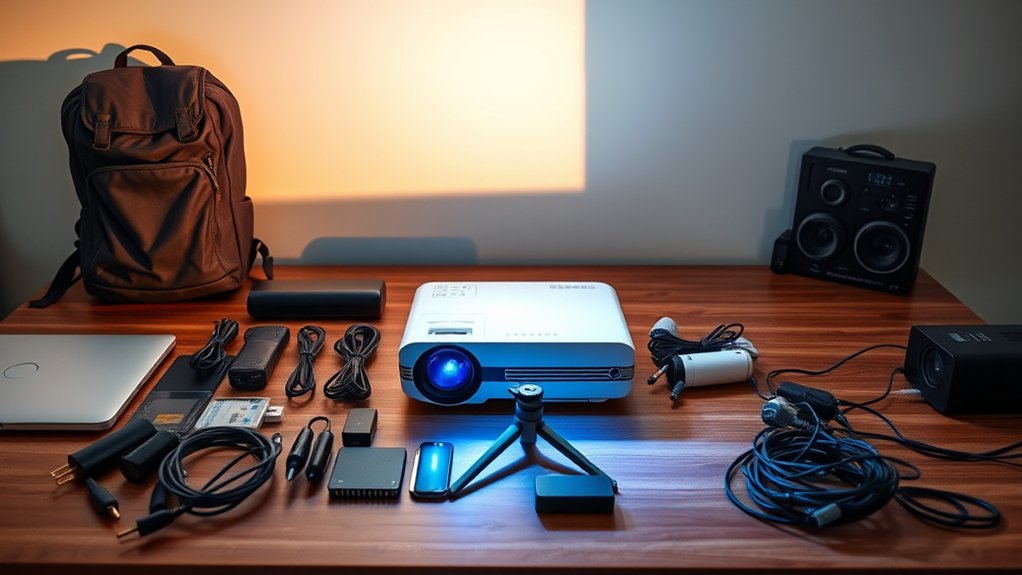
Portable projectors offer a range of features that enhance their appeal for users seeking convenience and quality. Weighing under four pounds, these compact devices are easily transportable, fitting snugly in bags or backpacks.
With image quality typically supporting at least 720p resolution and some models reaching 1080p, they cater to various viewing experiences. Brightness levels range from 100 to 800 ANSI lumens, with top-tier models like the Anker Nebula X1 providing up to 3500 ANSI lumens, guaranteeing clarity even in ambient light.
Image quality spans from 720p to 1080p, with brightness reaching up to 3500 ANSI lumens for exceptional clarity in any lighting.
Battery life spans from 1.5 to 3 hours, enabling extended use without the need for a power outlet. Connectivity options, including HDMI, USB, and wireless capabilities, guarantee compatibility with smartphones, laptops, and gaming consoles.
Additional smart features, keystone correction, and the option to connect external speakers enhance functionality, making portable projectors versatile tools for entertainment and presentations, including access to popular streaming services.
Benefits of Choosing a Portable Projector Over Fixed Options
When comparing portable projectors to fixed options, several advantages emerge that cater to modern users’ needs. Portable projectors offer remarkable flexibility, allowing setup in various locations for both indoor and outdoor use without permanent installation. Their ease of transport, often weighing under four pounds, makes them ideal for anyone who travels frequently or presents on the go.
Additionally, many models feature battery operation, facilitating off-grid use for camping trips or outdoor movie nights. Quick setup is another significant benefit, with features such as auto-focus and keystone correction streamlining the process.
| Feature | Portable Projectors |
|---|---|
| Flexibility | Indoor & Outdoor Use |
| Ease of Transport | Weighs Under 4 Pounds |
| Battery Operation | Off-Grid Capability |
| Built-in Smart Features | Direct Streaming Access |
These attributes collectively enhance the user experience, making portable projectors a compelling choice.
Key Drawbacks of Portable Projectors in Various Environments
Portable projectors face significant challenges in various environments due to their limited brightness capabilities, typically ranging from 200 to 400 ANSI lumens.
This restriction often results in poor image quality, particularly in well-lit settings where colors may wash out.
Additionally, built-in speakers frequently fall short in larger spaces, necessitating external audio solutions to enhance the viewing experience.
Limited Brightness Capability
Brightness limitations pose a significant challenge for portable projectors, particularly in varied lighting conditions. Typically offering between 200 to 400 ANSI lumens, these devices struggle in well-lit environments, leading to diminished image quality.
- Washed-out images become prevalent during daytime use.
- Clarity and sharpness suffer when projecting on larger screens.
- Optimal performance is achieved only in dimly lit environments.
Battery-powered models further exacerbate this issue, often operating at reduced brightness when unplugged.
As a result, viewers may find themselves frustrated by the loss of detail and vibrancy in their presentations.
For those seeking liberation in visual experiences, understanding these limitations is essential for maximizing the potential of portable projectors.
Sound Quality Issues
Although portable projectors offer impressive versatility, sound quality often falls short in various environments. Built-in speakers typically lack the power and clarity needed for immersive viewing, particularly in larger spaces. The compact design of these projectors results in weak bass response and tinny audio, diminishing the overall experience. In outdoor settings, ambient noise can overwhelm the projector’s sound, making external speakers essential for a satisfactory auditory experience.
| Environment | Sound Quality Issues |
|---|---|
| Larger Spaces | Weak audio clarity, distant sound |
| Outdoor Settings | Competes poorly with ambient noise |
| Compact Design | Tinny audio, weak bass response |
Users seeking liberation in their viewing experience may find that sound quality remains a significant drawback.
How Do Portable Projectors Stack Up Against Home Theaters?
How do portable projectors compare to traditional home theater systems? The choice between these devices hinges on several factors, each with distinct pros and cons.
- Portability: Lightweight and compact, portable projectors excel in travel scenarios.
- Brightness: Home theater projectors typically deliver more brightness, making them ideal for controlled environments.
- Cost: Portable projectors are budget-friendly, often ranging from $100 to $1,000.
In terms of image quality, home theater projectors generally offer superior resolution, often achieving native 1080p or true 4K, while portable options usually max out at 720p.
Moreover, audio quality varies greatly; home theaters often require external audio systems, whereas portable projectors come equipped with built-in speakers, though these may lack power for larger gatherings.
Ultimately, the decision depends on whether the user prioritizes portability and cost over image and audio performance.
Choosing the Right Portable Projector for Your Needs
When selecting a portable projector, it’s essential to assess key features such as resolution, brightness, and connectivity options to meet specific viewing needs.
Budget considerations also play a significant role, influencing the choice of projector models available. Understanding these factors can help guarantee a satisfying viewing experience tailored to individual preferences.
Key Features to Consider
Selecting the right portable projector involves careful consideration of several key features to guarantee it meets specific needs. The following elements are critical for an ideal viewing experience:
- Resolution: Aim for at least 720p; 1080p is perfect for movies and gaming.
- Brightness: Look for a minimum of 450 ANSI lumens, especially for outdoor use.
- Battery Life: Choose a model with 2-3 hours to support extended sessions.
Additionally, portability is important; make certain the projector is compact and lightweight, ideally under 4 pounds.
Connectivity options like HDMI, USB-C, and built-in Wi-Fi are essential for compatibility with various devices and streaming services.
Prioritizing these features will enhance both image quality and user experience with portable projectors.
Budget and Pricing Options
Portable projectors are available across a wide price spectrum, catering to various budgets and needs. Starting around $100, budget options like the TCL A1 provide decent features, making them accessible for casual movie nights without financial strain.
For those seeking superior brightness and performance, higher-end models, such as the Anker Nebula X1 at about $2,199, deliver exceptional quality.
When selecting a projector, it’s vital to take pricing into account alongside factors like battery life—typically 2-3 hours—and brightness, which ranges from 100 to 800 lumens.
Understanding the intended use, whether for casual entertainment or professional presentations, guarantees a balanced choice that meets both performance and budget requirements effectively.
Frequently Asked Questions About Portable Projectors
How do portable projectors enhance the viewing experience for users on the go? These compact devices offer a mix of convenience and versatility, making them perfect for spontaneous movie nights or presentations.
- Brightness Levels: With a range of 100 to 800 ANSI lumens, users can choose models suited for various lighting conditions.
- Connectivity Options: Many portable projectors support HDMI and Wi-Fi, along with built-in streaming services like Netflix and YouTube for easy access.
- Audio Considerations: While integrated speakers suffice for small spaces, external audio systems elevate sound quality, particularly in larger settings.
The built-in battery typically lasts 1 to 3 hours, depending on brightness settings, affecting overall image quality.
Users must weigh the pros and cons of these features to find the ideal portable projector for their needs, ensuring an enjoyable viewing experience no matter the location.
Frequently Asked Questions
What Are the Disadvantages of Using a Portable Projector?
Disadvantages of using a portable projector include limited image quality, short battery life, potential portability issues, inadequate sound quality, longer setup time, low brightness levels, restricted connectivity options, varying price ranges, increased heat generation, and heightened maintenance needs.
What Is the 4 6 8 Rule for Projectors?
The 4-6-8 rule states that ideal viewing distance is four times the screen size for 4K, six times for 1080p, and eight times for 720p, enhancing image resolution and projector brightness while ensuring clarity.
Why Can’t You Watch Netflix on a Projector?
Projector compatibility issues hinder Netflix access due to streaming service limitations, HDMI requirements, and app installation barriers. Additionally, resolution concerns, brightness challenges, and audio quality differences impact the overall viewing experience and internet connectivity needs.
Are Portable Projectors Worth Buying?
Portable projectors can be worthwhile for those seeking flexibility and portability. However, potential buyers should consider image quality, brightness levels, battery life, sound quality, and user reviews to guarantee compatibility with their unique needs and preferences.
Conclusion
To summarize, portable projectors present a promising pathway for presentation enthusiasts and casual viewers alike. Their versatility, vivid visuals, and ease of use make them a favorable choice for various venues. However, potential purchasers must weigh their limitations against the luxuries of traditional home theaters. Ultimately, selecting the suitable model can greatly satisfy one’s specific screening scenario, ensuring that users enjoy a splendid spectacle, whether at home or on the go.

