
Disclosure: This article contains affiliate links. If you buy through one of these links, we may earn a commission at no additional cost to you. As an Amazon Associate I earn from qualifying purchases.
If you are comparing these Hasselblad 100MP medium format listings, start by choosing the type of system you want. The X2D 100C body is the most versatile all-around option in this comparison, the 907X & CFV 100C is the modular choice for classic and technical-camera workflows, and the X2D 100C with the XCD 75mm f/3.4 P lens is the simplest body-and-lens package for portraits, street photography, and still life.
All three prioritize still-image quality, natural color, and high-resolution files. Before buying, compare stabilization, autofocus behavior, lens compatibility, included accessories, storage needs, seller identity, warranty coverage, and whether the listing is for a body only or a body-and-lens bundle.
Quick Verdict
Choose the X2D 100C body if you want the best balance of handheld usability among these three listings and prefer to select your own XCD lens.
Choose the 907X & CFV 100C if modular design, waist-level composition, V System compatibility, or technical-camera use matters more than in-body stabilization.
Choose the X2D 100C + XCD 75mm bundle if you want the same X2D body with a compact 59mm-equivalent prime lens included. Hasselblad offers this kit configuration in some regions, but you should still confirm the Amazon seller, contents, condition, return policy, and regional warranty before ordering.
Top Picks
| Category | Product | Best For |
|---|---|---|
| 🏆 Best All-Around X2D Listing | X2D 100C | Handheld stills with flexible XCD lens selection |
| 🎞️ Best Modular System | 907X & CFV 100C | Waist-level shooting, V System integration, and technical-camera use |
| 📷 Best Bundle Convenience | X2D 100C + XCD 75mm | Portraits, street photography, editorial work, and still life with a first lens included |
Selection Criteria
This comparison uses published Hasselblad specifications and the visible retailer listing details. It does not claim hands-on testing. We focused on the factors that materially affect image quality and day-to-day use: sensor resolution, color depth, dynamic range, autofocus, stabilization, storage, viewfinder design, and lens compatibility.
We also considered how each listing changes the buying decision. The X2D 100C listing is primarily a camera-body choice, the 907X & CFV 100C is a modular camera-and-digital-back system, and the X2D 75mm listing is a bundle built around the same X2D 100C body. Ergonomics, portability, workflow demands, included equipment, and the intended subject matter shaped each recommendation.
Retailer bundles can change, so verify the exact lens, battery, charger, regional plug, seller identity, condition, warranty coverage, return policy, and other included accessories before purchase. Prices, discounts, stock status, ratings, and review counts are intentionally not quoted because they can change quickly.
The X2D 100C is the most balanced option among these three listings for photographers who want high-resolution files without giving up handheld flexibility. Its 100MP BSI CMOS sensor, 16-bit color, and broad tonal range suit portraits, landscapes, product photography, architecture, and fine-art printing.
Its major practical advantage over the modular 907X setup is 5-axis in-body stabilization. Combined with phase-detection autofocus, an electronic viewfinder, and built-in storage, that makes the X2D easier to use on location and less dependent on a tripod. This listing appears to be centered on the camera body, so confirm whether a lens or any retailer-added accessories are included.
Why You’ll Like It
You get medium format detail with a body that is comparatively straightforward to use. The large internal SSD reduces card-management friction, while the tilting rear screen, electronic viewfinder, stabilization, and XCD lens compatibility support a wide range of professional stills assignments.
Who Should Buy This
Choose it if you already know which XCD lens you want, own compatible lenses, or prefer to build a system around portraits, landscapes, commercial stills, or fine-art work.
Who Should Avoid This
Skip it if your work depends on lightweight travel gear, continuous subject tracking, long bursts, or a video-first hybrid workflow. Compare the newer X2D II 100C if AF-C, subject detection, LiDAR-assisted focusing, HDR capture, or stronger stabilization would materially improve your work. Also budget for a capable editing computer and at least one suitable lens.
| Pros | Cons |
|---|---|
| ✅ 100MP resolution, 16-bit color, and wide tonal latitude | ❌ Large RAW files demand substantial storage and processing power |
| ✅ 5-axis 7-stop stabilization improves handheld usability | ❌ Body-only purchases require a separate lens budget |
| ✅ 294-zone phase-detection autofocus | ❌ No AF-C subject tracking; the newer X2D II offers a more advanced focus system |
| ✅ Built-in 1TB SSD plus CFexpress Type B expansion | ❌ Full system cost rises quickly once lenses and accessories are added |
When To Use
| Situation | How It Helps |
|---|---|
| Studio Portraits | High resolution and natural color support detailed skin work, large prints, and controlled retouching. |
| Landscape Photography | Fine detail and broad tonal latitude preserve textures and subtle highlight-to-shadow transitions. |
| On-Location Handheld Work | In-body stabilization and phase-detection autofocus reduce tripod dependence when conditions allow. |
| Commercial and Product Work | Accurate color and high resolution help with faithful product reproduction and large-format deliverables. |
Durability and Handling
The machined aluminum-alloy body is designed as a premium professional tool. Because the product page does not publish an IP weather-resistance rating, use a protective cover and sensible precautions around heavy rain, blowing dust, salt spray, and impacts.
Key Benefits
- 100MP BSI CMOS sensor with 16-bit color
- 5-axis 7-stop in-body stabilization for more flexible handheld shooting
- 294-zone phase-detection autofocus
- Built-in 1TB SSD plus CFexpress Type B expansion
Check Product Details on Amazon
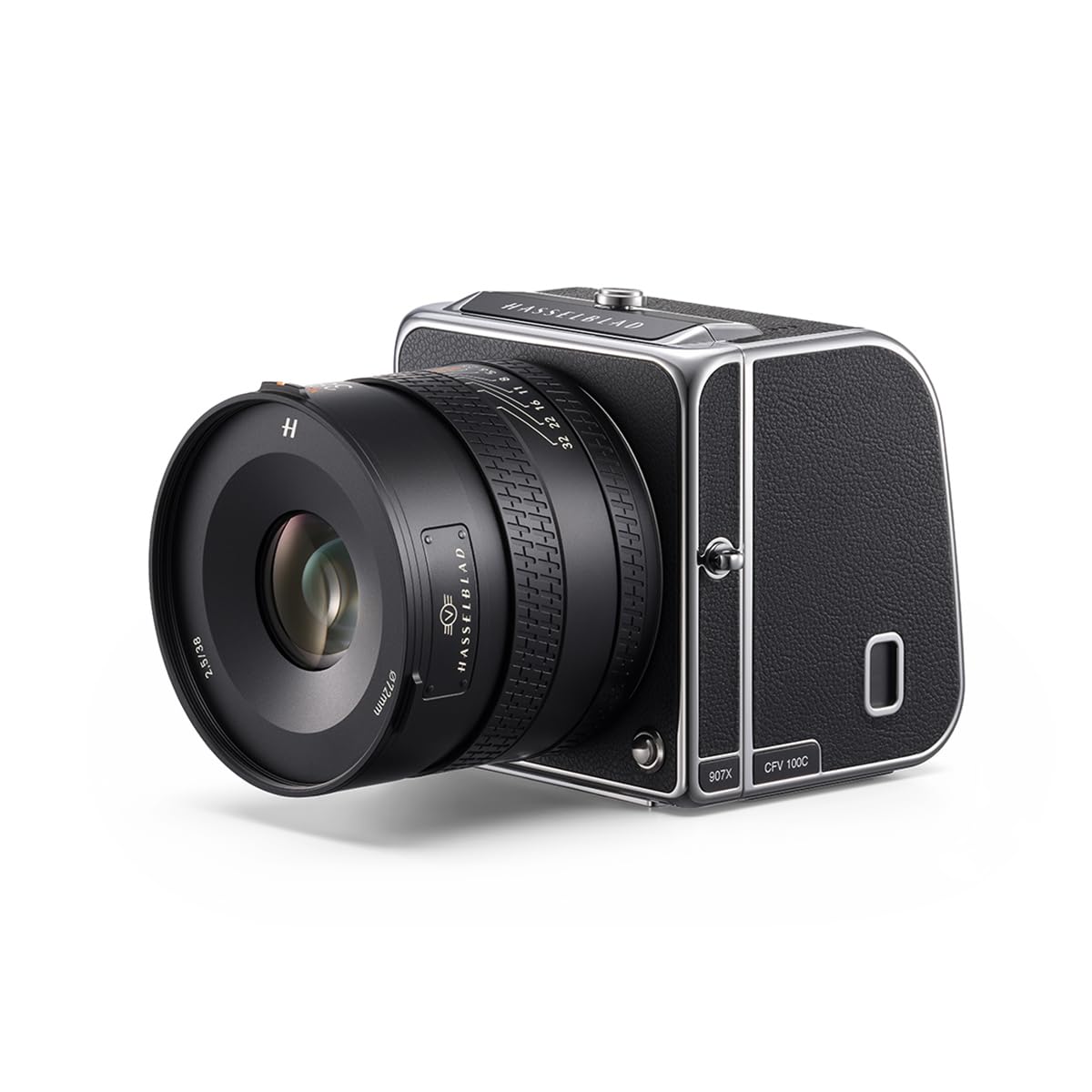
The 907X & CFV 100C is the most distinctive option in this comparison. The CFV 100C digital back can be used with the compact 907X body, compatible V System film-camera bodies, or certain technical cameras, giving photographers several ways to work with the same high-resolution back.
Autofocus depends on the configuration. With the 907X body and compatible XCD lenses, the system supports phase-detection autofocus and face detection. When the CFV 100C is attached to classic V System film cameras or technical cameras, focusing is manual. The system does not provide in-body image stabilization, so careful technique, faster shutter speeds, support, or lighting may be needed.
Why You’ll Like It
It offers a tactile, waist-level shooting experience and a modular path between contemporary XCD lenses and classic Hasselblad equipment. The built-in SSD and modern 100MP sensor make the workflow more current than the retro exterior suggests.
Who Should Buy This
Choose it if you value deliberate composition, already own compatible V System equipment, use a technical camera, or want a modular studio and fine-art platform.
Who Should Avoid This
Skip it if you need in-body stabilization, a built-in electronic viewfinder, rapid action performance, or a conventional eye-level mirrorless-camera experience without optional accessories.
| Pros | Cons |
|---|---|
| ✅ Modular design supports multiple camera configurations | ❌ No in-body image stabilization |
| ✅ 100MP, 16-bit files with broad tonal latitude | ❌ Manual focus when used on classic V System bodies or technical cameras |
| ✅ PDAF and face detection with the 907X body and compatible XCD lenses | ❌ No built-in electronic viewfinder |
| ✅ Built-in 1TB SSD and CFexpress Type B expansion | ❌ Best suited to deliberate rather than fast-paced shooting |
When To Use
| Situation | How It Helps |
|---|---|
| Studio Portraits | High resolution, natural color, and tether-friendly workflows suit controlled portrait sessions. |
| Editorial and Fine-Art Shoots | The waist-level screen and modular handling encourage deliberate framing and a distinctive shooting rhythm. |
| Classic V System Integration | The CFV 100C can bring digital capture to compatible film-era bodies, with manual focusing and compatibility checks required. |
| Technical-Camera Work | The detachable digital back supports specialized architectural, product, and landscape configurations. |
Durability and Handling
The premium modular construction is compact, but the detachable components and lack of a published IP rating call for care in rain, dust, and rough transport. Use a protective case, secure every connection, and verify accessory compatibility before field use.
Key Benefits
- Modular 907X, V System, and technical-camera workflows
- 100MP BSI CMOS sensor with 16-bit color
- PDAF and face detection with compatible XCD lenses on the 907X body
- Built-in 1TB SSD plus CFexpress Type B expansion
Check Product Details on Amazon
This is not a different camera from the X2D 100C above. It is a body-and-lens purchase configuration built around the same camera. Hasselblad lists this kit in some regions, and its appeal is convenience: the XCD 75P is a compact standard-to-short-telephoto prime suited to portraits, street photography, editorial work, and still life. Confirm that the Amazon offer includes both items in the stated condition and check the seller, regional warranty, and return terms.
The lens weighs 398g, measures 71mm long, and uses a leaf shutter that supports flash synchronization throughout its shutter-speed range. Its 59mm-equivalent field of view is versatile, but it is still a single focal length, so photographers who need wide-angle landscapes or tighter headshots may want additional lenses.
Why You’ll Like It
You can start shooting without selecting a separate first lens, and the 75P balances portability with a useful portrait and everyday perspective. It also retains all of the X2D 100C body’s stabilization, autofocus, color, and storage advantages.
Who Should Buy This
Choose it if you want a streamlined first Hasselblad kit for portraits, environmental portraiture, street work, editorial assignments, or still life and the retailer confirms that both the body and lens are included.
Who Should Avoid This
Skip it if you already own a similar XCD focal length, need a wider or longer lens first, or prefer to build a custom kit. Compare the bundle with buying the body and lens separately, and verify whether the seller or manufacturer provides warranty service for each item.
| Pros | Cons |
|---|---|
| ✅ Body-and-lens configuration can be ready to shoot immediately | ❌ Bundle contents and warranty should be verified carefully |
| ✅ Compact 59mm-equivalent lens suits portraits and everyday subjects | ❌ One prime lens does not cover wide-angle or long-telephoto needs |
| ✅ 5-axis 7-stop IBIS and phase-detection autofocus | ❌ Large files and premium lenses require a substantial total budget |
| ✅ Leaf shutter supports flash synchronization throughout its shutter-speed range | ❌ Not intended as a fast-action or video-first kit |
When To Use
| Situation | How It Helps |
|---|---|
| Portrait Sessions | The 59mm-equivalent field of view works well for environmental, full-length, and half-length portraits. |
| Street and Editorial Work | The compact prime lens keeps the kit simpler and lighter than many larger medium format lens combinations. |
| Location Shoots With Flash | The leaf shutter enables flexible flash synchronization while the body’s IBIS supports handheld framing. |
| Still Life and Product Details | The 100MP sensor and sharp prime lens provide detailed files for controlled commercial work. |
Durability and Handling
The X2D body uses machined aluminum construction, while the 75P lens has a compact metal barrel. The lens has some sealing at its seams but no published dust- or water-resistance rating. Protect both components from severe rain, dust, impact, and poor packing, and check that the retailer package includes the expected caps, battery, charger, and documentation.
Key Benefits
- X2D 100C body and XCD 75mm f/3.4 P lens in one purchase configuration
- 59mm-equivalent field of view for portraits, street photography, and still life
- Compact 398g lens with a leaf shutter
- 100MP sensor, 5-axis 7-stop IBIS, PDAF, and built-in 1TB SSD
Check Bundle Details on Amazon
Before You Buy
- Confirm the configuration: Body-only, 907X plus CFV back, and body-plus-lens listings are not directly equivalent.
- Compare the generation: The X2D II 100C is the newer flagship. Compare it before buying an X2D 100C if autofocus tracking, HDR, or stronger stabilization matters.
- Check lens compatibility: XCD lenses provide the most direct modern experience; adapted V, H, and XPan lenses may have different focusing and shutter behavior.
- Plan the workflow: 100MP 16-bit RAW files require fast storage, reliable backups, sufficient RAM, and a capable processor.
- Match the camera to the subject: These systems favor portraits, landscapes, architecture, product work, and fine art more than fast action or video-led production.
- Verify retailer details: Confirm seller identity, condition, included accessories, regional power plug, return policy, and warranty before ordering.
FAQ
Is Medium Format Right for You?
Medium format is most compelling when you value resolution, color depth, tonal latitude, cropping flexibility, and large-print quality. It is less compelling when speed, low weight, long telephoto reach, or video features are the priority. The files also require more storage and processing power than typical full-frame files.
What Is the Difference Between the X2D 100C Body and the X2D 75mm Kit?
The camera body is the same core X2D 100C. The kit adds the XCD 3.4/75P lens, a compact 59mm-equivalent prime. Compare the exact package contents and total cost because retailer bundles may include different accessories or warranty arrangements.
Does the 907X & CFV 100C Have Autofocus?
Yes, when the CFV 100C is paired with the 907X body and compatible XCD lenses, the system supports phase-detection autofocus and face detection. When the digital back is attached to classic V System film bodies or technical cameras, focusing is manual.
Is the X2D 100C Still the Newest Hasselblad X Camera?
No. The X2D II 100C is the newer flagship and adds continuous autofocus, subject detection, LiDAR-assisted focusing, HDR capture, and stronger stabilization. The original X2D 100C still offers a 100MP sensor, 7-stop IBIS, 294-zone PDAF, and 1TB internal storage, so it can remain a sensible choice when its feature set and listing terms fit your needs.
How Portable Is the X2D System?
The X2D is compact for a 100MP medium format camera, and its in-body stabilization makes handheld work more practical. It is still heavier and more expensive to outfit than many full-frame systems, so choose lenses carefully and use a supportive strap or bag for long days.
How Do You Manage Large Files and Workflow?
Use a fast offload routine, maintain at least two backups, and edit from an SSD-equipped computer with ample RAM. The built-in 1TB SSD reduces card swapping, while CFexpress Type B storage provides expansion. Lower-resolution previews or proxies can make initial culling and rough edits more responsive.
Can the CFV 100C Be Used With Classic Hasselblad Cameras?
It can be used with supported Hasselblad V System film cameras and certain technical cameras, but compatibility varies by body, lens, cable, shutter, and accessory configuration. Expect manual focusing in these legacy setups and verify the exact combination before purchasing adapters or accessories.
Wrapping Up
Choose the X2D 100C body if you want the strongest all-around balance among these listings and prefer to select your own lens. Choose the X2D 100C with the XCD 75mm lens if the confirmed bundle gives you a convenient first lens for portraits, street photography, editorial work, or still life.
Choose the 907X & CFV 100C if modularity, waist-level composition, V System compatibility, or technical-camera use is central to your workflow. Before ordering either X2D configuration, compare the newer X2D II 100C and confirm that the older body still gives you the best feature-to-cost fit. Model generations and retailer packages change, so verify the exact seller, contents, condition, return policy, and warranty.
Quick Specification Comparison
| Hasselblad X2D 100C 100MP Medium Format Mirrorless Camera | Hasselblad 907X & CFV 100C Medium Format Mirrorless Camera | Hasselblad X2D 100C 100MP with XCD 75mm f/3.4 P Lens | |
|---|---|---|---|
 |
 |
 |
|
| Configuration | Camera body | 907X camera body plus detachable CFV 100C digital back | X2D 100C camera body plus XCD 75mm f/3.4 P lens |
| 2026 Model Context | Earlier-generation X2D body; X2D II 100C is the newer flagship | Current modular CFV 100C system for 907X, supported V System bodies, and technical-camera workflows | Same earlier-generation X2D 100C body paired with an XCD 75P lens |
| Photo Sensor Resolution | 100 MP class | 100 MP class | 100 MP class |
| Color and Dynamic Range | 16-bit color; up to 15 stops | 16-bit color; up to 15 stops | 16-bit color; up to 15 stops |
| Autofocus | 294-zone PDAF | 294-zone PDAF and face detection with compatible XCD lenses; manual focus on classic bodies and technical cameras | 294-zone PDAF |
| Image Stabilization | 5-axis 7-stop IBIS | No in-body stabilization | 5-axis 7-stop IBIS |
| Built-In Storage | 1TB SSD plus CFexpress Type B slot | 1TB SSD plus CFexpress Type B slot | 1TB SSD plus CFexpress Type B slot |
| Included Lens | Confirm retailer listing; generally body-focused | Confirm retailer listing; XCD lens normally selected separately | XCD 75mm f/3.4 P lens, subject to listing confirmation |
| Best For | Versatile handheld professional stills | Modular, legacy, waist-level, and technical-camera workflows | Ready-to-shoot portraits, street photography, editorial work, and still life |
| Main Limitation | No AF-C subject tracking; newer X2D II has more advanced autofocus and stabilization | No IBIS or built-in EVF; manual focus in legacy configurations | Single included focal length; seller, condition, contents, and warranty must be verified |
| Check Product Details on Amazon | Check System Details on Amazon | Check Bundle Details on Amazon |
This roundup is reader-supported. When you click through affiliate links, we may earn a referral commission on qualifying purchases.
