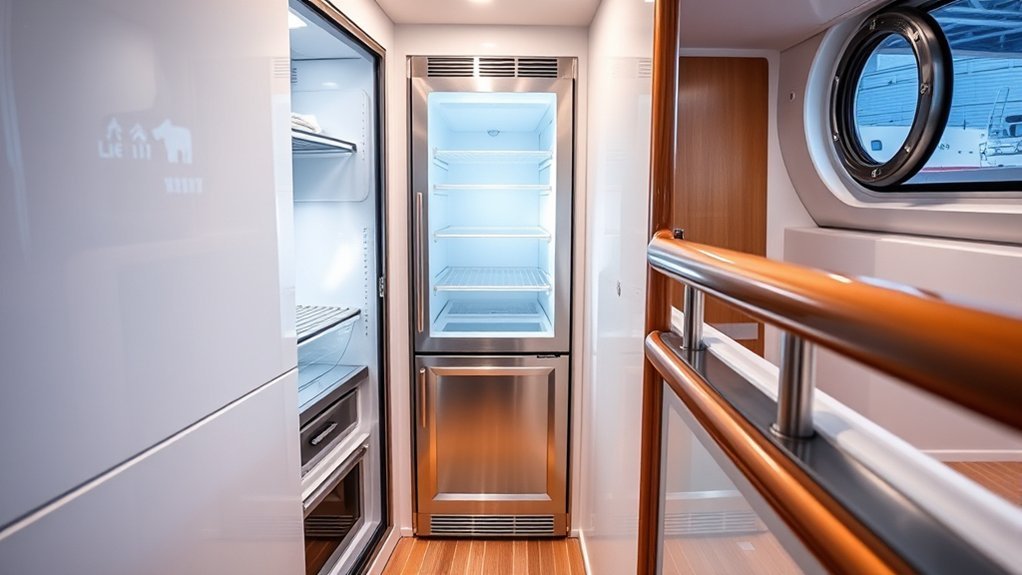
Choosing a galley kitchen refrigerator involves more than finding an appliance that fits between the cabinets. The refrigerator must also leave room for walking, opening doors, and reaching storage drawers. This guide explains which refrigerator styles work in narrow kitchens, how to measure your space, and which features are worth prioritizing.
Quick Answer
For most narrow galley kitchens, a compact top-freezer, bottom-freezer, or counter-depth refrigerator is a practical choice. French-door and side-by-side models can also work if the opening is wide enough. Measure the refrigerator’s full depth, door swing, ventilation clearance, and delivery route before choosing a model.
The Best Refrigerator Types for Galley Kitchens
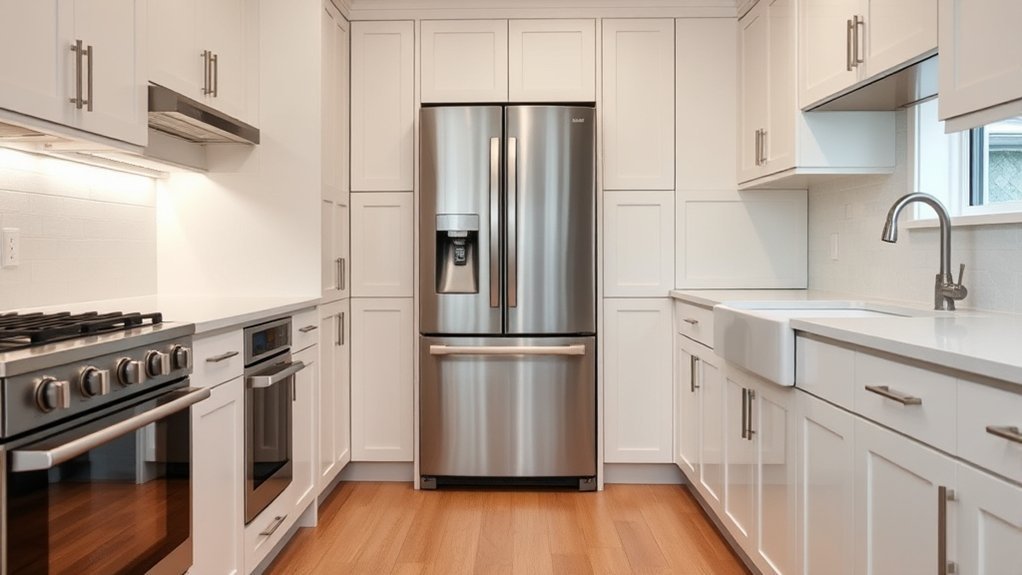
The best refrigerator type depends on your cabinet opening, available floor space, and storage needs. A narrow top-freezer model can suit a compact kitchen, while a French-door refrigerator offers broader fresh-food shelves when more width is available.
According to Whirlpool’s refrigerator dimension guide, common refrigerator widths vary considerably by configuration.
| Refrigerator type | Typical width | Main advantage | Main limitation |
|---|---|---|---|
| Top-freezer | 24–33 inches | Compact options and generally efficient operation | A single wide door needs room to swing |
| Bottom-freezer | 24–33 inches | Frequently used fresh food stays near eye level | The freezer drawer needs forward clearance |
| French-door | 29–36 inches | Two narrower upper doors and wide interior shelves | Often requires a wider cabinet opening |
| Side-by-side | 30–36 inches | Narrower doors and convenient access to both compartments | Narrow compartments restrict wide food containers |
These are general ranges, not guaranteed installation dimensions. Individual models may be smaller or larger.
Counter-depth refrigerators are another useful option. They have shallower cabinets that sit closer to the front of surrounding countertops, reducing how far the appliance extends into the walkway.
Counter-depth describes the refrigerator’s depth, not its door configuration. You can find counter-depth versions of several refrigerator styles.
Compact and mini fridges can provide supplemental storage for drinks and snacks. However, their limited capacity makes them less suitable as a primary refrigerator for households that store substantial amounts of fresh and frozen food.
Measuring Your Space: How to Ensure a Perfect Fit
Measure the available opening before comparing refrigerator models. Width, height, and depth all matter, but a refrigerator can fit inside a cabinet opening and still be difficult to use.
Use a tape measure and record the following dimensions:
- Opening width: Measure between the cabinets or walls at the top, middle, and bottom. Use the smallest measurement.
- Available height: Measure from the finished floor to the underside of any overhead cabinet.
- Available depth: Measure from the back wall to the front of the countertop. Account for outlets, water connections, and anything that prevents the refrigerator from sitting farther back.
- Open-door depth: Compare the manufacturer’s dimensions with the space available across the galley walkway.
- Delivery route: Measure doorways, hallways, turns, and other narrow areas between the entrance and the kitchen.
Do not assume the refrigerator’s advertised depth includes its handles. Manufacturers often provide separate measurements for cabinet depth, overall depth, and depth with the door open.
Also check the height to the top of the hinge. It may be greater than the height of the refrigerator cabinet itself.
Allow Space for Ventilation and Door Swing
Refrigerators need space for airflow and door movement. The exact requirements depend on the model, so use its installation instructions rather than applying one clearance rule to every refrigerator.
Pay particular attention to the hinge side when placing a refrigerator beside a wall. The door may need extra room to open far enough for shelves and storage drawers to slide out.
For example, the GE GZE24NGYBB specifications list 1/8-inch side clearance, 1-inch top clearance, and 2-inch rear clearance. These measurements apply to that particular model.
A 90-degree door-opening measurement is useful for estimating how far the appliance extends into the room. However, some refrigerators need a wider opening to remove drawers or shelves fully.
Before ordering, compare the installation diagram with your actual floor plan. This is especially important when the refrigerator faces another countertop, cabinet, or appliance.
Addressing Common Challenges With Galley Kitchen Refrigerators
Galley kitchens often have limited floor space and cabinets along opposite walls. The main challenge is preserving access when the refrigerator door is open.
Consider these common problems and practical solutions:
- Restricted walkway: Consider a shallower counter-depth refrigerator rather than a deeper standard-depth model.
- Cabinet opening is too narrow: Compare compact top-freezer and bottom-freezer models before considering wider configurations.
- Door hits a wall: Look for a compatible reversible-door design or a configuration with narrower doors.
- Limited storage: Prioritize adjustable shelves, useful door bins, and drawers that can accommodate your usual groceries.
- Insufficient ventilation: Select a refrigerator whose installation requirements fit the available space.
A refrigerator that fits the cabinet opening must also allow its doors and drawers to function without obstructing the kitchen.
Positioning the refrigerator at the end of a cabinet run may provide more flexibility than installing it tightly between cabinets. However, the appliance must still meet its ventilation and door-clearance requirements.
Why Energy Efficiency Matters for Small Kitchens
Energy efficiency affects a refrigerator’s long-term operating cost, regardless of kitchen size. Choosing a properly sized, efficient model can reduce electricity use without sacrificing the storage you need.
According to ENERGY STAR refrigerator guidance, certified refrigerators are approximately 9% more energy efficient than models meeting the federal minimum efficiency standard.
ENERGY STAR also estimates that replacing an old refrigerator with a certified model and properly recycling the old unit can save about $150 over the product’s 12-year lifetime.
Actual savings depend on the refrigerator being replaced, electricity rates, and how the appliance is used.
Several features can influence energy consumption:
- Refrigerator size: Larger models generally consume more electricity.
- Freezer location: Top-freezer configurations tend to use less energy than comparable bottom-freezer or side-by-side designs.
- Cooling technology: Efficient compressors, insulation, and temperature controls help reduce unnecessary energy use.
- Additional features: Ice makers and dispensers may increase energy consumption.
Good installation also supports efficiency. Keep the refrigerator away from unnecessary heat exposure, maintain its door seals, and provide the airflow specified by the manufacturer.
Key Features to Prioritize in a Galley Refrigerator
A refrigerator’s interior layout can matter as much as its advertised capacity. In a narrow kitchen, look for features that make everyday storage and access easier.
- Adjustable shelving: Allows you to accommodate tall bottles, large containers, and changing grocery needs.
- Flexible door bins: Help organize frequently used items without occupying the main shelves.
- Suitable freezer storage: Choose shelves, baskets, or drawers that accommodate the frozen foods you regularly buy.
- Door-open alerts: Can help you notice when a door has not closed completely.
- Temperature controls: Make it easier to adjust cooling settings for your household.
- Smart features: Some models provide remote temperature monitoring, door alerts, and maintenance notifications.
Smart connectivity is convenient, but it should not outweigh essential features such as usable storage, reliable cooling, and proper installation.
Pay attention to the layout of the refrigerator compartment. A narrower model with well-designed shelves may accommodate your groceries more effectively than a larger model with poorly arranged storage.
For food safety, the FDA recommends keeping refrigerators at 40°F or below and freezers at 0°F. An appliance thermometer helps confirm that the refrigerator maintains the required temperature.
Top Recommendations for Galley Kitchen Refrigerators
The most suitable refrigerator depends on the available opening and how your household uses the kitchen. Rather than choosing by appearance alone, compare models using their actual dimensions, capacity, and features.
Size Considerations for Space
For particularly narrow openings, start by examining compact top-freezer and bottom-freezer refrigerators. These configurations offer smaller-width options than many full-size side-by-side models.
If the kitchen has sufficient width but limited depth, a counter-depth refrigerator may provide a better fit.
According to Whirlpool’s counter-depth measurements, these refrigerators commonly range from approximately 15 to 25 cubic feet in capacity, with an average near 22 cubic feet. Individual models vary.
For a small household, an 18- to 22-cubic-foot refrigerator can be a useful starting point. However, smaller kitchens and households may benefit from a more compact model.
Larger households may prefer greater capacity, but a refrigerator approaching 30 cubic feet is not automatically suitable for a narrow galley layout.
Consider how often you shop, the amount of frozen food you store, and whether you need room for large containers.
Energy Efficiency Ratings
Compare refrigerators using their annual energy consumption rather than relying on capacity or product descriptions alone.
The yellow EnergyGuide label provides estimated yearly electricity use in kilowatt-hours (kWh) and estimated operating costs.
The Federal Trade Commission explains how EnergyGuide labels work and how they help consumers compare similar appliances.
For a useful comparison, look at models with similar capacity and features. A compact refrigerator and a full-size refrigerator serve different storage needs, so their electricity consumption should not be compared without considering size.
Also check whether the refrigerator carries ENERGY STAR certification.
Features to Look For
Choose features according to how you use the refrigerator, not simply how many extras it offers.
For a galley kitchen, the final buying checklist should include:
- Cabinet width, height, and depth.
- Manufacturer-required ventilation clearance.
- Door swing and freezer-drawer clearance.
- Usable fresh-food and freezer storage.
- EnergyGuide consumption and ENERGY STAR certification.
- Warranty terms and access to local repair service.
- Noise levels and optional smart features.
If you want a built-in appearance, examine the refrigerator’s full installed depth, including its doors and handles. Counter-depth does not necessarily mean the entire front sits flush with the cabinets.
Finally, confirm that any required electrical outlet and water connection are accessible at the installation location.
Frequently Asked Questions
What Refrigerator to Stay Away From?
Avoid refrigerators that do not fit your available space, lack adequate ventilation clearance, or prevent nearby cabinets from opening. Also consider warranty coverage, noise, energy consumption, and repair availability. If you want fewer components to maintain, compare simpler models with those offering additional dispensers and electronic features.
What Should I Check Before Buying a Refrigerator?
Check the refrigerator’s dimensions, required clearances, interior capacity, and energy rating. Confirm that its doors and drawers can open without hitting surrounding cabinetry. Review its cooling features, warranty, installation needs, and delivery requirements before purchasing.
What Brand of Refrigerator Is Most Reliable?
Refrigerator reliability varies by model and configuration, so no single brand is the best choice for every household. Whirlpool and GE offer several refrigerator styles. Compare independent reliability information for the specific model you are considering, along with its warranty and local repair support.
What Should I Consider When Buying a New Refrigerator?
Consider your available space, household size, food storage habits, budget, and preferred refrigerator style. Compare energy efficiency, cooling performance, noise levels, warranty coverage, and maintenance requirements. In a galley kitchen, prioritize a model that preserves usable walkway space.
Is a Counter-Depth Refrigerator Better for a Galley Kitchen?
A counter-depth refrigerator can work better when walkway space is limited because its cabinet is shallower than that of many standard-depth models. However, some counter-depth refrigerators are wider or taller to compensate for reduced depth. Compare the complete dimensions before choosing one.
Are Top-Freezer Refrigerators More Reliable Than French-Door Models?
Top-freezer refrigerators generally have a simpler configuration and tend to have fewer reported problems than more complex refrigerator styles. Consumer Reports identifies top-freezer refrigerators as a comparatively reliable category in its refrigerator buying guide. Actual reliability still depends on the individual model.
Conclusion
The right galley kitchen refrigerator provides enough storage while preserving room to move and work. Compact top-freezer and bottom-freezer models suit many narrow openings, while counter-depth designs can help reduce how far the appliance extends into the walkway.
Start with accurate measurements, compare refrigerator configurations, and examine the complete installation specifications. Prioritizing proper fit, practical storage, and energy efficiency will help you choose an appliance that works comfortably in your kitchen.
Sources
- Whirlpool — Refrigerator Sizes and Dimensions: Refrigerator configurations, typical dimensions, measuring procedures, and installation considerations.
- Whirlpool — Counter-Depth Refrigerator Measurements: Counter-depth dimensions, capacity, and installation considerations.
- GE Appliances — GZE24NGYBB Specifications: Model-specific ventilation and installation clearance.
- ENERGY STAR — Refrigerators: Efficiency standards, energy savings, and refrigerator buying guidance.
- Federal Trade Commission — EnergyGuide Labeling: Annual electricity consumption and estimated operating-cost information.
- FDA — Refrigerator Thermometers and Food Safety: Safe refrigerator and freezer temperatures.
- Consumer Reports — Refrigerator Buying Guide: Refrigerator configurations and reliability considerations.
