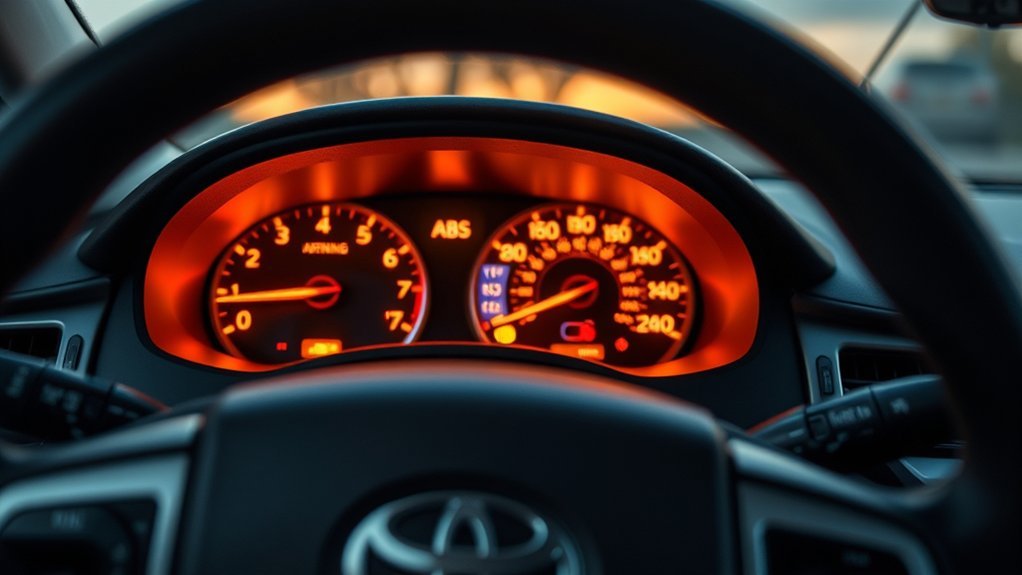
If your Toyota Camry’s ABS light stays on after startup or returns while you drive, the anti-lock braking system has detected a fault. Your basic friction brakes may still operate, but ABS, Brake Assist, traction control, or stability control may be limited depending on the model year and fault. Check the other warning lights, brake-fluid level, and pedal feel before deciding whether the car is safe to move.
Quick Answer
A steady Toyota Camry ABS light means the brake-control computer has detected an ABS or related Brake Assist fault. Common causes include a wheel-speed signal problem, damaged wiring or an encoder, low system voltage, a blown fuse, or an actuator fault. Stop and arrange towing if a red brake warning or abnormal braking appears.
Key Takeaways
- An ABS-only warning normally means the anti-lock function needs service; it does not automatically prove that all braking has failed.
- Stop driving if the red brake warning is also on, the pedal feels soft or unusually hard, fluid is below MIN, the car pulls strongly, or stopping performance changes.
- Use a scan tool that can access Toyota ABS or chassis codes. A basic engine-code reader may not communicate with the brake-control module.
- Do not replace a wheel-speed sensor from the code description alone. Wiring, connectors, a hub bearing, or a magnetic encoder can create the same fault.
- Use the owner’s manual and Toyota repair information for your exact year, powertrain, market, and VIN.
At a Glance
| Time Required | 10 to 20 minutes for preliminary checks; scan-data, wiring, hydraulic, or calibration work can take substantially longer |
| Difficulty | Beginner for warning-light, fluid, fuse, and visual checks; advanced for circuit testing, bleeding, calibration, or replacement |
| Tools Needed | Owner’s manual, flashlight, clean cloth, fuse puller, digital multimeter if qualified, and an ABS-capable scan tool |
| Cost | Preliminary checks may cost nothing; diagnostic labor and repair cost depend on the code, model year, part design, calibration needs, and local labor rate |
Last updated: July 13, 2026
What Does the ABS Light Indicate on a Toyota Camry?

The ABS light monitors your Camry’s anti-lock braking system and, on some model years, related Brake Assist functions. It should illuminate briefly during the startup self-check and then turn off. A light that remains on or returns while driving means the brake-control computer has detected a malfunction.
ABS uses wheel-speed information to recognize when a wheel is approaching lockup during hard braking. The actuator then holds, reduces, and reapplies hydraulic pressure at the affected wheel. Toyota explains that this pressure modulation helps the tires retain the traction available from the road and helps the driver maintain directional control. See the Toyota Camry Quick Reference Guide for an official example.
If the ABS system switches itself off because of a fault, conventional braking may remain available, but the exact functions disabled vary by Camry generation, powertrain, and brake-control system. Do not assume that Brake Assist, traction control, stability control, or every brake-related function remains available.
What the Warning-Light Combination Means
| What you see | What it may mean | Recommended action |
|---|---|---|
| Amber ABS light only; pedal feels normal | ABS or a related Brake Assist function has detected a fault. Conventional braking may remain, but wheel-lock protection may be unavailable. | Drive cautiously only as far as needed for prompt diagnosis. Reduce speed, leave extra space, and avoid abrupt braking. |
| ABS plus traction-control, slip, or stability-control warnings | One wheel-speed or brake-control fault may have disabled several systems that share sensor data. | Arrange ABS-capable scanning promptly. Use extra caution on wet, snowy, icy, or loose surfaces. |
| ABS plus a red brake-system warning | The vehicle may have low brake fluid or a more serious hydraulic or electronically controlled brake-system malfunction. | Stop in a safe place and arrange towing or immediate professional assistance. |
| ABS plus charging-system or multiple electrical warnings | Low or unstable system voltage, a charging fault, a poor connection, or a communication problem may be affecting several control modules. | Avoid unnecessary driving. Check the 12-volt battery, terminals, grounds, and charging system before condemning ABS parts. |
| Any brake warning with a soft, sinking, unusually hard, or inconsistent pedal | Hydraulic pressure, brake assistance, actuator operation, or another safety-critical function may be affected. | Do not continue driving. Arrange a tow. |
An amber ABS-only warning calls for prompt diagnosis. An ABS warning combined with a red brake light, low fluid, or abnormal pedal feel calls for an immediate safe stop.
Toyota warning symbols and required actions vary by model year and market. Select your exact Camry through the official Toyota manuals page before relying on a generic description.
Common Causes of a Toyota Camry ABS Light
The stored diagnostic trouble code is the best starting point. The dashboard light cannot tell you whether the failed item is a sensor, wire, connector, hub, power supply, or actuator. Replacing a part from the light alone can waste money and leave the original fault unresolved.
| Possible cause | What may be happening | Useful next check |
|---|---|---|
| Wheel-speed sensor or wiring | The brake-control computer receives a missing, erratic, intermittent, or implausible wheel-speed signal. | Record the ABS code, compare live wheel-speed data, and inspect the indicated harness and connector. |
| Encoder ring, tone ring, or wheel bearing | Rust, debris, impact damage, excessive bearing play, an incorrect replacement bearing, or an internal magnetic encoder fault distorts the signal. | Inspect the hub, sensor mounting surface, bearing condition, and recent repair history. |
| Low or unstable 12-volt system voltage | A weak battery, poor terminal connection, bad ground, or charging fault may set supply-voltage or communication codes on some models. | Test battery condition, terminal tightness, grounds, and charging performance, then interpret the result with the stored codes. |
| Fuse, relay, connector, power, or ground fault | The actuator or control circuit loses power, ground, or reliable communication. | Use the model-specific fuse chart and wiring diagram rather than a generic Camry layout. |
| Brake actuator, pump, accumulator, or control module | The hydraulic or electronic brake-control assembly detects an internal, pressure-control, pump, or communication fault. | Confirm all detail codes and follow Toyota’s diagnostic procedure before authorizing replacement. |
| Steering-angle, yaw-rate, or calibration issue | Related chassis data may be missing, implausible, or uncalibrated after alignment, collision, suspension, battery, or steering work. | Read every brake and stability-control code and review recent repairs before performing calibration. |
| Incorrect tire or wheel condition | A major tire-size mismatch, very low tire, damaged wheel, or abnormal bearing movement may create implausible wheel-speed relationships. | Confirm tire sizes, inflation, wheel condition, and bearing play on all four corners. |
Low brake fluid deserves immediate attention, but Toyota manuals commonly associate it with the brake-system warning rather than an ABS-only warning. Worn pads also do not normally switch on the ABS light directly. Pad wear can lower the reservoir level as caliper pistons extend, so the complete hydraulic and friction-brake system still needs inspection.
Risks of Ignoring the ABS Light in Your Toyota Camry
An illuminated ABS light may mean that the wheel-lock control normally available during emergency braking is unavailable. Camry brake, traction, and stability systems can share wheel-speed and brake-control data, so one fault may disable more than one driver-assistance function.
How an ABS Fault Affects Stopping
Do not assume that every ABS fault adds a fixed number of feet to the stopping distance. Tire condition, vehicle speed, brake condition, load, road surface, weather, and driver input all affect the result. The central concern is that one or more wheels may lock during hard braking, especially on a wet or slippery surface.
ABS is also not designed to guarantee the shortest possible stop on every surface. Loose gravel, deep snow, rough pavement, and other uneven surfaces can produce different results. Its primary benefit is limiting wheel lock so that available tire grip and directional control can be managed more effectively.
If the pedal remains firm, the vehicle stops normally, and only the amber ABS light is on, drive cautiously only as far as needed for prompt inspection. Leave extra space, reduce speed, avoid sudden lane changes, and do not deliberately test ABS operation on a public road.
When Steering Control Can Be Reduced
A locked wheel cannot provide the same steering response as a rolling wheel. Without working ABS, you may have less ability to steer around an obstacle while braking hard. This concern becomes greater in rain, snow, ice, mud, loose gravel, or other low-grip conditions.
Warning: Stop in a safe place and arrange towing if the red brake warning is on with the ABS light, the pedal feels soft or unusually hard, the vehicle pulls strongly while braking, fluid is below MIN, you see a leak, or stopping performance has changed.
Troubleshooting Your ABS Light: What to Do Next
Use the following sequence to separate safe owner checks from testing that requires professional equipment. Record the dashboard lights, messages, ABS codes, detail codes, and available data before clearing memory or disconnecting the 12-volt battery.
- Identify every warning light and message. Note whether ABS appears alone or with the red brake, traction-control, slip, stability-control, charging-system, or other warnings.
- Check brake feel before moving. Confirm that the pedal feels normal, remains firm under steady pressure, and does not sink toward the floor.
- Inspect the brake-fluid level. Park on level ground and compare the translucent reservoir level with its MIN and MAX marks.
- Check the 12-volt electrical system. Look for loose or corroded terminals, damaged grounds, slow starting, recent jump-starting, or other voltage-related symptoms.
- Check the correct fuses. Use the fuse chart for the exact Camry year. Replace a blown fuse only with the specified physical type and amperage.
- Scan the brake-control module. Use a tool that can read Toyota ABS or chassis codes, not merely generic engine-emissions codes.
- Inspect the indicated circuit or mechanical area. Check the related sensor, harness, connector, hub, encoder, bearing, power supply, and ground before ordering a part.
- Complete required repair and calibration. Some procedures require bleeding, initialization, zero-point calibration, actuator commands, or other model-specific steps.
- Verify the result. Clear codes only after repair, recheck live data, and confirm that the warning does not return during a controlled test performed safely.
What Not to Do
- Do not clear codes or disconnect the battery before recording the diagnostic information.
- Do not assume the component named in a code description is automatically defective.
- Do not install a higher-amperage fuse or repeatedly replace a fuse that keeps blowing.
- Do not pierce sealed sensor wiring unless the factory test procedure specifically requires it.
- Do not look at scan-tool live data while personally driving. Use a helper, a safely mounted recording tool, or a qualified technician.
- Do not open brake hydraulic lines or attempt actuator bleeding without the exact Toyota procedure and suitable equipment.
Inspect Brake Fluid Levels
Check the translucent reservoir without opening it unless dirt or poor visibility prevents an accurate reading. Park on a level surface and make sure the vehicle is secure. If the fluid is below MIN, do not treat topping it off as the complete repair.
A low level can result from pad wear, but it can also indicate a leak. Look for wet areas around the master cylinder, brake lines, flexible hoses, calipers, wheel areas, and the ground beneath the vehicle. A rapidly falling level, visible leak, or soft pedal requires immediate professional inspection and towing.
Note: Use only the brake-fluid specification listed in the owner’s manual for your exact Camry. Keep dirt and moisture out of the reservoir, and do not mix in power-steering fluid, engine oil, or any other liquid.
Check the Battery and Charging System
A brake-control module needs stable voltage and reliable power and ground connections. If the ABS light appeared after a weak-battery event, jump-start, battery replacement, terminal repair, or charging-system problem, scan for supply-voltage and communication codes before replacing a brake component.
Inspect the 12-volt battery terminals for looseness and corrosion. Check visible body and engine grounds. A qualified person can test battery condition and charging voltage with a suitable meter or battery tester. Do not use one universal voltage reading to diagnose every state of charge, temperature, hybrid operating mode, or charging strategy.
Test Wheel-Speed Sensors
Start with the ABS code and live data. During a safely performed low-speed test, one wheel that drops to zero, spikes, lags, or disagrees with the others can direct attention toward its sensor circuit, encoder, hub, or bearing.
A single resistance range does not apply to every Camry wheel-speed sensor. Some designs require voltage, frequency, waveform, magnetic-encoder, or scan-data testing instead of a basic resistance check. Follow the procedure in Toyota repair information for the exact vehicle.
Inspect the harness where it flexes near the steering knuckle, strut, control arm, and suspension. Look for rubbing, stretched wiring, broken clips, bent terminals, corrosion, impact damage, water entry, and debris or rust beneath the sensor mounting point.
If the fault followed hub or bearing replacement, confirm that the correct part was installed in the proper orientation. Some magnetic encoders are built into the bearing seal and may not be visibly damaged from outside.
Check ABS Fuses
Find the ABS, brake-control, pump, actuator, or related fuse locations in your exact owner’s manual and on the fuse-box cover. Camry fuse positions, abbreviations, ratings, and box layouts change by year, market, and powertrain.
Switch the vehicle off before removing a fuse unless the model-specific procedure says otherwise. Replace a failed fuse only with one of the same physical type and amperage. If the replacement fuse blows again, stop replacing it. A repeated failure indicates a short, wiring fault, or failed component that requires electrical diagnosis.
Turning the ignition or hybrid system off and back on may allow another self-check, but it does not repair a persistent problem. The light will return if the brake-control computer detects the fault again.
Read ABS Codes and Live Data Safely
Record every brake, ABS, traction-control, stability-control, and communication code rather than focusing only on the first result. Some Toyota systems provide additional information or detail codes that narrow the failed circuit or operating condition.
When comparing live wheel speeds, keep the test controlled and legal. The driver must watch the road, not the scan tool. A second person can monitor the data, or a technician can record it for review after the vehicle is stopped.
Gasoline Versus Hybrid Camry ABS Diagnosis
Gasoline and hybrid Camry models can use different brake actuators, control strategies, warning messages, and service procedures. A traditional gasoline model mainly uses friction braking, while a Camry Hybrid blends regenerative braking with the hydraulic friction brakes. Toyota explains that braking on a hybrid can generate electricity that is returned to the traction battery.
An ABS or brake-control fault on a hybrid may therefore affect several coordinated functions, and the pedal feel, warning combination, pump operation, and diagnostic steps may differ from those of an older gasoline Camry. Some pump or actuator sounds can occur during normal system checks, but frequent operation combined with warnings or stored codes needs diagnosis.
Warning: Do not touch orange high-voltage cables or components, open hydraulic lines, or attempt electronically controlled brake bleeding on a Camry Hybrid without the correct Toyota procedure, training, protective equipment, and scan-tool capability.
Use the exact model and powertrain in Toyota’s manual selector. For professional repair procedures, wiring diagrams, diagnostic trees, and Techstream information, use the Toyota Technical Information System.
When to Consult a Mechanic for ABS Issues
Arrange professional diagnosis when the ABS light remains on after startup, returns after a short drive, or appears with traction-control or stability-control warnings. Professional help is also appropriate when the tests require live wheel-speed comparison, wiring diagrams, connector-terminal measurements, actuator operation, hydraulic bleeding, or calibration.
Seek immediate assistance when:
- The red brake-system warning is on with the ABS light.
- The pedal feels soft, sinks, becomes unusually hard, or changes from normal.
- You see leaking brake fluid or the reservoir is below MIN.
- The car pulls strongly, grinds, vibrates severely, or does not stop normally.
- An ABS-related fuse blows repeatedly.
- The scan tool reports actuator, pump, accumulator, pressure-control, communication, or internal control-module faults.
- The vehicle is a hybrid and the repair requires opening the brake system, actuator commands, or high-voltage precautions.
Toyota’s Technical Information System provides factory repair manuals, electrical wiring diagrams, diagnostic information, service bulletins, training material, and Techstream resources for model-specific service.
Checking Brake Fluid and Related Components
A complete inspection should cover more than the part named in the code. For example, a wheel-speed sensor code can result from the sensor itself, a damaged connector, a broken harness, rust beneath the sensor, an incorrect air gap, a failing hub bearing, or an encoder incorporated into the bearing assembly.
- Brake fluid: Confirm the level and inspect for leaks, moisture entry, or visible contamination.
- Brake pedal and friction components: Check pedal feel, pad condition, rotor condition, caliper operation, and signs of uneven braking.
- Battery and grounds: Check the 12-volt battery, terminal tightness, body and engine grounds, and charging performance.
- Fuses and connectors: Look for heat damage, loose terminals, pushed-back pins, corrosion, water intrusion, or an incorrect fuse.
- Wheel hubs and bearings: Check for looseness, noise, impact damage, incorrect installation, and encoder problems.
- Tires and wheels: Confirm compatible tire sizes, proper inflation, and no major wheel or tire damage.
- Recent work: Consider hub replacement, collision repair, suspension work, alignment, battery replacement, brake work, or wiring modifications performed before the warning appeared.
Pro Tip: Ask the repair shop for the exact ABS code, any associated detail code, and the test result that proves the recommended part failed. A code identifies a circuit or operating condition; it does not always prove that the named component requires replacement.
How Wheel-Speed Sensors Support ABS, Traction Control, and Stability Control
Each wheel-speed sensor reports rotational information to the brake-control computer. The computer compares the signals to recognize when a wheel is slowing much faster than expected and may be approaching lockup.
During an ABS event, the actuator changes hydraulic pressure at the affected wheel. The driver may feel rapid pedal pulsation and hear mechanical or pump noise. Those sensations can be normal during hard braking when the system is operating properly.
A faulty wheel-speed signal can affect more than ABS. Depending on the Camry year and equipment, the same information may support traction control, vehicle stability control, hill-start assistance, brake-force distribution, and other chassis functions. This shared data explains why several amber warning lights can appear at the same time even when the original fault is at one wheel.
Clean visible debris carefully, but do not assume dirt on the sensor tip is the only possible cause. Many designs read a magnetic encoder incorporated into the wheel bearing. Encoder damage, incorrect bearing orientation, excessive bearing play, or corrosion at the sensor mounting surface may not be obvious from an external inspection.
Replacing Faulty ABS Components: A Step-by-Step Guide

Replace an ABS component only after the stored code, wiring checks, live data, and model-specific tests identify the failure. Some Camry wheel-speed sensors are separate parts, while others may be serviced with a hub or bearing assembly.
- Record codes and data. Save all ABS, brake, stability-control, voltage, and communication codes before disconnecting power or clearing memory.
- Confirm the repair procedure. Check factory instructions, torque specifications, cautions, one-time-use fasteners, connector procedures, and required calibrations for the exact model.
- Make the vehicle safe. Park on level ground, secure the vehicle, and use properly rated lifting and support equipment if wheel removal is required. Never rely on a jack alone.
- Inspect before replacing. Verify connector condition, terminal fit, wiring continuity where appropriate, sensor mounting, encoder condition, tire size, and wheel-bearing play.
- Install the correct part. Match the component to the VIN or exact application. Route the harness through every original clip so that the tire, axle, steering, and suspension cannot rub or stretch it.
- Use the specified torque. Incorrect hub, axle, sensor, or fastener torque can damage parts or alter bearing and sensor operation.
- Complete required service steps. Depending on the repair, Toyota may require bleeding, actuator operation, zero-point calibration, steering-angle initialization, or another scan-tool command.
- Verify the repair. Clear codes only after the work is complete. Confirm that live wheel speeds agree, no code resets, the pedal feels normal, and all warning lights complete their self-check correctly.
Brake actuator, pump, accumulator, hydraulic-unit, and control-module replacement should normally be left to a qualified technician. These jobs can require pressure-control precautions, specialized bleeding, Techstream functions, calibration, high-voltage awareness on hybrids, and careful handling of safety-critical hydraulic components.
Tips for Maintaining Your ABS System and Preventing Problems
ABS electronics do not have a separate routine tune-up, but good brake, wheel-bearing, tire, battery, and wiring maintenance can prevent related faults or identify them before they become intermittent.
- Follow the brake-service schedule. Use the maintenance guide for the exact Camry year and driving conditions.
- Address fluid loss promptly. Do not repeatedly top off the reservoir without finding why the level dropped.
- Protect sensor wiring. After brake, hub, axle, steering, or suspension work, confirm every harness clip is secure and clear of moving parts.
- Use correct hubs and bearings. Match parts by VIN or exact application and follow installation-orientation and torque instructions.
- Repair noisy or loose wheel bearings. Excessive movement can disturb the sensor gap or encoder signal.
- Maintain the 12-volt electrical system. Weak voltage, loose terminals, and poor grounds can create warning lights or communication faults.
- Use matching tires. Maintain the specified size and pressure and avoid major rolling-circumference differences.
- Check recalls by VIN. Use Toyota’s Safety Recall and Service Campaign Lookup or the NHTSA recall lookup before paying for a potentially covered repair.
- Do not ignore intermittent warnings. Early diagnosis can preserve useful codes and make a wiring, voltage, bearing, or connector problem easier to reproduce.
Frequently Asked Questions
Why is my ABS light on in my Toyota Camry?
The brake-control computer has detected an ABS or related fault. Common areas include a wheel-speed sensor or harness, a damaged encoder or hub bearing, low or unstable 12-volt voltage, a fuse or ground problem, or the brake actuator. Read the ABS code before replacing parts.
What is the most common cause of an ABS light?
Wheel-speed signal faults are common, but the sensor itself is not always defective. Wiring, connectors, corrosion, an encoder ring, bearing play, or an incorrectly installed hub can create a similar code. Confirm the cause with codes, live data, inspection, and the model-specific test procedure.
Is it okay to drive with the ABS light on?
If only the amber ABS light is on, the pedal feels completely normal, fluid is at the correct level, and the car stops normally, you may be able to drive cautiously for prompt service. Stop and arrange towing if the red brake warning is also on, the pedal feels abnormal, fluid is low, a leak is visible, or braking changes.
Why did the ABS and traction-control lights come on together?
ABS, traction control, and stability control can share wheel-speed and brake-control information. One failed sensor signal, wiring fault, voltage problem, or brake-control code may cause several systems to switch off and illuminate their warnings together.
Can low brake fluid turn on the ABS light?
Low fluid more commonly activates the brake-system warning, but warning combinations and messages vary by model year. Treat fluid below MIN as a safety issue regardless of which light appears. Check for pad wear or a leak, and do not continue driving if the pedal or stopping performance is abnormal.
How much does it cost to fix the ABS on a Toyota Camry?
No single price applies. A connector repair, damaged wire, or separate sensor can cost far less than a hub assembly, hydraulic actuator, pump, or control module. Diagnostic labor, model year, part availability, calibration, bleeding requirements, and local labor rates determine the total. Request an itemized estimate tied to the confirmed fault.
Will disconnecting the battery reset the ABS light?
Disconnecting power may erase some stored information or temporarily turn off a warning on certain vehicles, but it does not repair the fault. The light normally returns when the system detects the problem again. Read and record all codes and related data before clearing memory or disconnecting the battery.
Conclusion
A Toyota Camry ABS light needs timely diagnosis, but an amber ABS-only warning does not automatically mean complete brake failure. First identify every other warning, confirm the pedal feels normal, and check the brake-fluid level. Then inspect the correct fuses and 12-volt connections, read ABS-specific codes, and test the circuit or component indicated by the diagnostic results.
Stop driving when a red brake warning appears, the pedal changes, fluid is below MIN, a leak is visible, or the car does not brake normally. Gasoline and hybrid Camrys can use different brake-control systems, so use the exact Toyota manual and repair procedure for the vehicle before testing, bleeding, calibrating, or replacing components.
Sources
- Toyota Owners: Warning Lights — Toyota warning-light meanings, safety-system cautions, and owner-manual guidance
- Toyota Owners: Manuals and Warranties — model-year and powertrain-specific owner publications
- Toyota 2025 Camry Quick Reference Guide — ABS operation, directional-control explanation, hybrid regenerative braking, and related safety systems
- Toyota Technical Information System — factory repair manuals, wiring diagrams, diagnostics, service information, training, and Techstream resources
- Toyota Safety Recall and Service Campaign Lookup — VIN- and license-plate-based Toyota campaign checks
- National Highway Traffic Safety Administration: ABS Technical Interpretation — wheel-speed sensing and brake-pressure modulation principles
