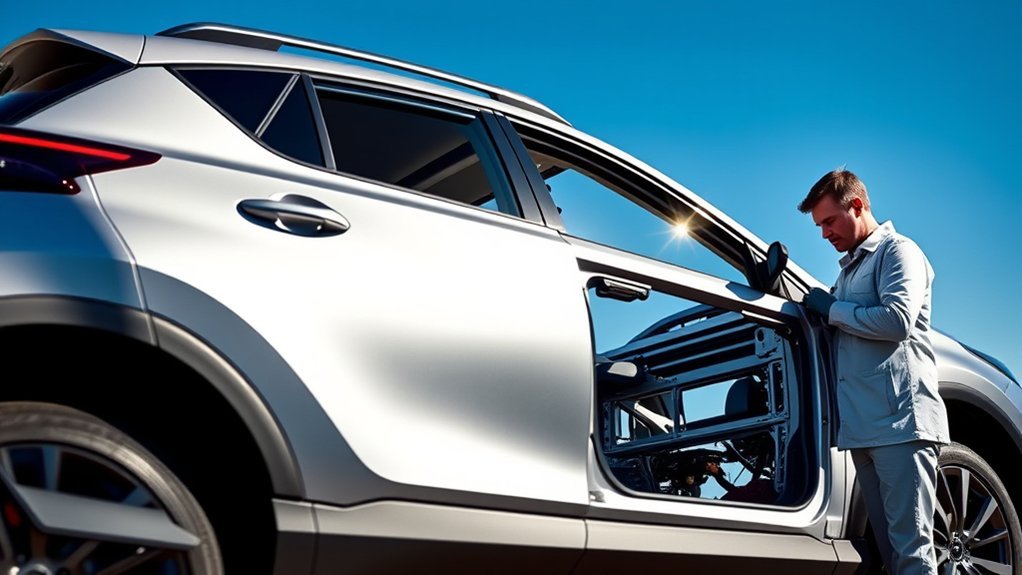
People often use the phrase Toyota RAV4 safety frame to describe the SUV’s crash-protection structure, but it is not a single bolt-on frame or a named driver-assistance system. The RAV4 uses a unibody structure in which the body shell, occupant compartment, designed crush areas, seat belts, airbags, and head restraints work together. Exact construction, equipment, and safety ratings vary by model year, trim, drivetrain, and market.
Quick Answer
The Toyota RAV4’s “safety frame” is best understood as its reinforced unibody safety structure. Designed crush areas manage crash energy, while the occupant compartment, seat belts, airbags, and head restraints help protect passengers. Driver-assistance technology may help avoid or reduce some crashes, but equipment and ratings vary by model year.
Key Takeaways
- “Safety frame” is an informal description of the RAV4’s unibody body structure and occupant-protection systems.
- Crush areas are intended to deform in a managed way, while the occupant compartment is designed to preserve survival space.
- Seat belts and airbags are supplemental restraint systems. Airbags do not replace seat belts or create the vehicle’s structural integrity.
- The current 2026 U.S. RAV4 lists Toyota Safety Sense 4.0, while older model years use different safety-suite versions.
- Crash ratings, airbag layouts, sensor features, warranty terms, and repair methods must be checked for the exact model year and vehicle.
Why the Toyota RAV4 Safety Structure Is Essential for Your Safety

The RAV4’s body structure is part of its passive safety system. Passive safety features do not prevent a crash. Instead, they are designed to reduce injury risk when a collision occurs.
The body includes areas intended to deform and manage energy around a comparatively rigid occupant compartment. The exact steel grades, reinforcements, joints, and load paths differ among RAV4 generations, so broad descriptions should not be used as collision-repair instructions.
Toyota describes the RAV4 as a monocoque SUV. For the latest generation, Toyota also reports body-rigidity improvements. These descriptions are more precise than treating the vehicle as though it has a separate ladder-style frame.
A safe body structure does two different jobs: selected areas manage crash energy, while the occupant compartment is designed to resist harmful intrusion.
No structure can make occupants invulnerable. Collision speed, impact angle, the object struck, vehicle mass, seat position, restraint use, and secondary impacts can all change the outcome.
How the Structure Enhances Passenger Protection
During a crash, the vehicle’s structure provides paths through which impact loads travel. Designed crush areas can deform to manage part of that energy before it reaches the occupant compartment.
The occupant compartment, sometimes called the safety cage in crash-test reporting, is intended to maintain usable survival space. Reinforced roof, pillar, sill, floor, and door structures may also help manage front, side, rear, and rollover-related loads, although performance differs by crash type.
Structural protection works with several restraint components:
- Seat belts help control occupant movement and spread loads across stronger areas of the body.
- Pretensioners can remove belt slack during certain crashes.
- Load limiters may reduce excessive belt force under defined conditions.
- Airbags cushion occupants and help reduce contact with parts of the interior.
- Head restraints support the head and neck, particularly in certain rear impacts.
These systems are designed and tested as a package. Changing seat mounting points, belt anchors, structural joints, airbag components, or sensor locations can affect how that package performs.
What Makes the RAV4 Safety Structure Strong?
The RAV4’s structural strength does not come from one material or one beam. It comes from the way materials, shapes, joints, reinforcements, and restraint systems work together.
- Managed crush areas: Selected body sections are intended to deform during particular impact conditions and help manage energy.
- Occupant-compartment reinforcement: Pillars, roof rails, sills, crossmembers, floor sections, and door structures help resist intrusion.
- Model-specific materials and joints: Toyota may use different steel grades, adhesives, welds, fasteners, and repair procedures in different locations and model years.
- Validated system performance: Manufacturers and independent organizations use controlled tests to examine intrusion, restraint movement, injury measures, and other outcomes.
Note: A general article cannot identify safe cutting, heating, pulling, sectioning, or welding procedures. Collision technicians should follow the Toyota repair information for the exact model year, body location, and VIN when applicable.
The Role of Airbags With the RAV4 Safety Structure
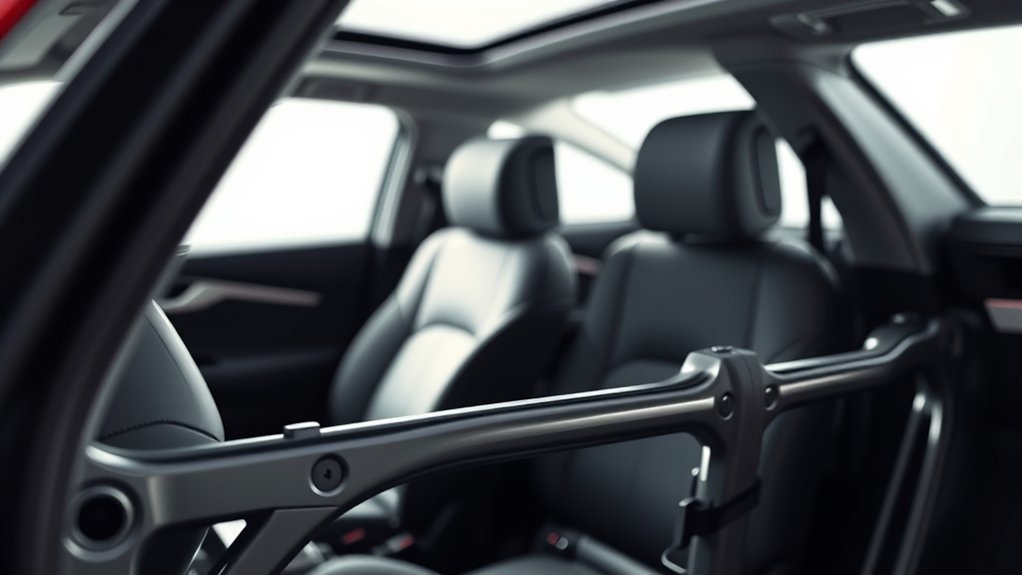
Airbags are supplemental restraints. They do not create structural strength, and they do not replace a properly worn seat belt. Instead, they can inflate during qualifying crash conditions to cushion an occupant and reduce contact with the steering wheel, instrument panel, door, glass, or other interior surfaces.
The number, type, location, and deployment logic of RAV4 airbags vary by model year and market. Check the airbag-label information and owner’s manual for the exact vehicle rather than relying on a universal airbag count.
Airbags are not designed to deploy in every collision. Deployment depends on factors such as crash direction, severity, sensor data, and system programming. The body structure manages crash loads, while seat belts and airbags help manage occupant movement inside the compartment.
The National Highway Traffic Safety Administration explains that airbags work with seat belts and are not a substitute for them. NHTSA also advises that children younger than 13 ride in the rear seat.
Warning: If an airbag deploys, do not treat the vehicle as ready for normal use after cosmetic repairs. Have the restraint system, sensors, seat belts, structural damage, and related components inspected and repaired by a qualified facility before the vehicle returns to service.
How the Structure Works Alongside Advanced Technologies
The RAV4’s body structure and driver-assistance technology have different roles. The structure is part of passive protection during a crash. Driver-assistance features are active systems that may warn the driver, support steering or braking, or reduce the severity of some situations.
Toyota’s current U.S. information lists Toyota Safety Sense 4.0 on the 2026 RAV4. Older RAV4s may use TSS 2.0, 2.5, 3.0, or another configuration. Availability and operating limits must be checked for the exact vehicle.
Depending on the Toyota Safety Sense generation and model specification, functions may include:
- Pre-Collision System with Pedestrian Detection: Can warn of certain detected hazards and may provide braking support under qualifying conditions.
- Lane Departure Alert with Steering Assist: Can warn when the vehicle appears to leave a detected lane and may provide limited steering support.
- Dynamic Radar Cruise Control: Helps maintain a selected following interval when the system detects a vehicle ahead.
- Lane Tracing Assist, Road Sign Assist, Automatic High Beams, and Proactive Driving Assist: These functions provide different forms of lane, sign, lighting, or driving support when their operating conditions are met.
Toyota describes the functions and limitations of its current suites on the official Toyota Safety Sense page. These systems do not make the RAV4 autonomous, and they cannot recognize or respond correctly to every road user, lane marking, object, weather condition, or traffic situation.
RAV4 Safety Structure: What Crash Tests Can and Cannot Tell You
Independent crash tests provide useful, repeatable comparisons, but a rating applies only to the model years, configurations, and test procedures identified by the testing organization. A result from one test should not be described as the vehicle’s universal safety score.
As of July 14, 2026, the Insurance Institute for Highway Safety’s 2026 RAV4 page reports the following headline crashworthiness results:
| IIHS Test | Listed Rating | Practical Context |
|---|---|---|
| Driver-side and passenger-side small overlap front | Good | Assesses occupant protection in a defined frontal impact involving a small portion of the vehicle’s front end. |
| Updated moderate overlap front | Marginal | The updated procedure places added emphasis on protection for a rear-seat passenger. |
| Updated side | Acceptable | Examines performance in a defined side impact using the updated barrier and evaluation method. |
The 2026 IIHS listing shows why one broad label is not enough: the RAV4 receives Good, Marginal, and Acceptable results across different updated crash tests.
Laboratory results do not recreate every real collision. A crash may involve a different speed, angle, barrier shape, vehicle, occupant size, seating posture, restraint use, or sequence of impacts. Use ratings as comparison tools, not as guarantees of survival or freedom from injury.
Additional Safety Features That Complement the Structure
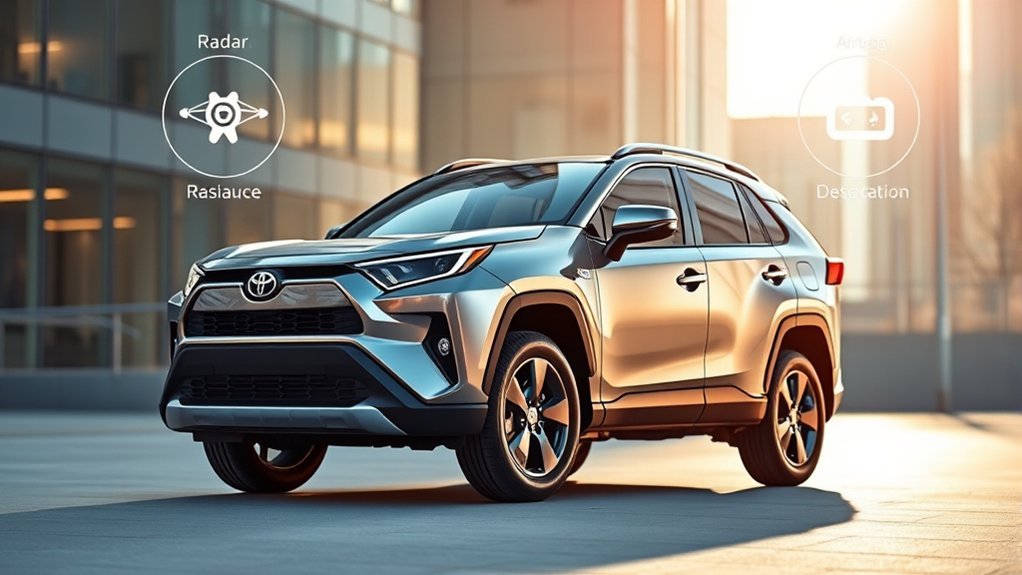
Several systems can complement the RAV4’s passive structure. Their availability and exact operation depend on model year, trim, options, market, road conditions, and maintenance.
- Pre-Collision System: May warn the driver and provide braking assistance when it detects certain vehicles, pedestrians, cyclists, or other hazards covered by the system’s design.
- Lane Departure and Lane Tracing functions: Can provide warnings or limited steering support when visible lane markings and other operating conditions are suitable.
- Dynamic Radar Cruise Control: Can adjust speed to help maintain a selected following interval, but the driver remains responsible for braking and vehicle control.
- Blind Spot Monitor and parking-support features: May help identify certain nearby vehicles or obstacles. Availability varies, and mirrors plus direct observation remain necessary.
The RAV4 also uses Toyota’s Star Safety System and other safety technologies, depending on the model. Electronic stability, traction, braking, tire condition, lighting, visibility, and driver attention all affect the vehicle’s overall safety performance.
Why Families Consider the RAV4 for Safety
Families often consider the RAV4 because it combines a practical cabin with structural crash protection, restraint systems, driver-assistance features, and child-seat anchors. Those features still require correct setup and responsible use.
The LATCH system can help secure compatible child restraints, but the vehicle seat, restraint type, child’s size, anchor limits, recline angle, and installation method all matter. Follow both the RAV4 owner’s manual and the child-restraint manufacturer’s instructions.
IIHS currently gives the 2026 RAV4’s LATCH ease-of-use evaluation a Good+ rating. That rating describes installation-related access and hardware characteristics; it does not confirm that every child seat will fit equally well in every seating position.
All occupants should use the appropriate restraint on every trip. Children should ride in the rear seat in a correctly selected and installed restraint until they are ready for the vehicle’s seat belt under applicable safety guidance and law.
Pro Tip: Check the vehicle identification number through the official NHTSA recall lookup, including after purchase. A recall can be announced after a vehicle was built or sold, so one previous check is not permanent confirmation.
What to Check After a Collision or Structural Repair
Visible bumper or body damage may not show the full extent of a collision. Loads can travel into mounting points, rails, pillars, suspension areas, seat-belt components, sensors, wiring, and restraint-control modules.
A post-collision assessment may need to address:
- Body dimensions and structural alignment.
- Cracked, stretched, kinked, torn, or separated metal and joints.
- Seat belts, pretensioners, airbags, sensors, and warning lights.
- Suspension, steering, wheels, tires, and alignment.
- Camera, radar, parking, and driver-assistance calibration requirements.
- Corrosion protection, seam sealing, adhesives, welds, and refinishing.
- Pre-repair and post-repair diagnostic scans where appropriate.
Repairs should follow Toyota’s current procedures for the exact model. Substituting a generic welding or sectioning method can change material properties, joint strength, sensor alignment, corrosion protection, or future crash behavior.
Warning: Cutting, drilling, heating, welding, straightening, lifting, or attaching accessories near structural members, restraint anchors, sensors, or wiring can affect safety performance. Consult qualified repair professionals and model-specific Toyota information before modifying these areas.
How to Check Your RAV4’s Model-Year Safety Information
- Identify the exact vehicle: Record the model year, trim, drivetrain, market, and VIN.
- Read the owner’s manual: Confirm airbag locations, warning lights, child-restraint instructions, and driver-assistance limitations.
- Review Toyota’s specifications: Verify which safety suite and optional systems are installed rather than assuming every RAV4 has the same equipment.
- Check independent ratings: Use the exact model year on IIHS and NHTSA pages and read the individual test categories.
- Search for recalls: Use the VIN because recall applicability can depend on production date and configuration.
- Review repair and warranty records: For a used RAV4, obtain documentation for previous structural, restraint, glass, bumper, suspension, and calibration work.
For warranty wording and model-specific manuals, use Toyota’s official Warranty and Owner’s Manuals portal. Warranty terms do not replace a collision-damage inspection and should not be interpreted as a guarantee that crash damage or modifications are covered.
Experience the RAV4 Safety Features at Premier Toyota of Amherst
A dealership visit can help you understand how a particular RAV4’s controls, alerts, cameras, and driver-assistance settings operate. A test drive cannot demonstrate crash-structure performance, so use it to evaluate visibility, control layout, warning behavior, braking feel, seating position, and feature usability.
Test Drive Availability Today
Before visiting Premier Toyota of Amherst, confirm that the exact model year and trim you want to evaluate are available. Safety-suite versions and optional equipment can differ among vehicles that look similar.
During the drive, ask how to identify the installed systems through the instrument display and vehicle settings. Observe whether the seating position, mirrors, head restraints, controls, and warnings are comfortable and understandable.
Do not intentionally create a dangerous situation to trigger automatic braking, steering assistance, blind-spot warnings, or another intervention. Some functions can be explained while the vehicle is parked or demonstrated in a controlled setting.
Hands-On Feature Demonstrations
Ask for a parked demonstration of the driver-assistance menus, warning indicators, camera views, parking sensors, cruise-control settings, lane-support controls, and feature-status icons installed on the vehicle.
Confirm how to turn permitted functions on or off, how the vehicle reports an unavailable or blocked sensor, and where the owner’s manual explains operating limitations.
A demonstration should also cover basic safety items that buyers sometimes overlook, including head-restraint adjustment, rear-seat-belt access, child-seat anchor locations, spare-tire or mobility-kit equipment, and tire-pressure information.
Expert Staff Assistance Offered
Dealership staff can help identify installed equipment and locate model-specific instructions. Ask them to distinguish standard features from optional packages and to explain any differences between the vehicle being demonstrated and the one you plan to buy.
For a used RAV4, also request:
- A vehicle-history report and available repair invoices.
- Confirmation of open-recall status using the VIN.
- Documentation for previous airbag, windshield, bumper, suspension, or structural work.
- Evidence of required camera or radar calibration after relevant repairs.
Verify important claims in Toyota documentation rather than relying only on a verbal explanation.
Frequently Asked Questions
Is “Toyota RAV4 safety frame” an official Toyota term?
It is better treated as an informal phrase for the RAV4’s unibody body structure, occupant compartment, crush areas, and related protection systems. Toyota and testing organizations generally discuss the body, safety cage, structural performance, restraints, and named safety technologies rather than one standalone component called the safety frame.
What materials are used in the RAV4 safety structure?
The RAV4 body uses model-specific structural materials, reinforcements, joints, adhesives, and joining methods. The exact material and repair procedure can differ by generation and body location. Do not assume every structural section is made from the same steel grade or that it can be heated, straightened, or welded using a general method.
How does the RAV4 compare with competitors for safety?
A fair comparison requires the same model year and the same IIHS or NHTSA test. Avoid comparing one vehicle’s overall marketing claim with another vehicle’s result from a different procedure. Review individual crashworthiness, crash-avoidance, headlight, restraint, and child-seat-anchor results for every model on your shortlist.
Is the RAV4 safety structure effective in every type of collision?
No vehicle structure can guarantee protection in every collision. Performance depends on speed, impact direction, the object or vehicle involved, intrusion, occupant position, restraint use, and other factors. Crash tests show performance under defined conditions rather than every possible real-world event.
What warranty covers the RAV4 safety structure?
Toyota does not provide one universal standalone “safety frame warranty” that can be summarized for every RAV4. Basic, corrosion, restraint, and other coverage terms vary by model year and market and include exclusions. Check the warranty guide for the exact vehicle. Collision damage, wear, outside influence, improper repair, and modifications are different from a covered manufacturing defect.
Can modifications affect the RAV4’s structural safety?
Yes. Drilling, cutting, welding, heating, lifting, changing suspension geometry, relocating restraint components, or installing incompatible bumpers and accessories may affect load paths, sensor aim, handling, or restraint performance. Review the modification with qualified professionals who have access to model-specific Toyota information.
How can I check my RAV4’s crash ratings and recalls?
Search IIHS and NHTSA using the exact model year, then read each individual test rather than relying on a general statement. Use the VIN on NHTSA’s recall page to check whether a specific recall applies to your vehicle. Repeat the recall check periodically because new campaigns can be announced later.
Sources
- Toyota 2026 RAV4 — current U.S. model information and Toyota Safety Sense 4.0 identification.
- Toyota Safety Sense — official descriptions of active-safety functions, Star Safety System, airbags, and LATCH.
- Toyota Global: All-New RAV4 World Premiere — vehicle architecture and latest-generation body-development context.
- IIHS 2026 Toyota RAV4 Ratings — named crashworthiness, restraint, and LATCH evaluations.
- NHTSA Air Bags — seat-belt, deployment, child-passenger, and post-deployment guidance.
- NHTSA Recalls — VIN-specific recall lookup and recall-check guidance.
Conclusion
The Toyota RAV4’s “safety frame” is not one isolated component. It is better understood as the vehicle’s unibody structure working with the occupant compartment, designed crush areas, seat belts, airbags, head restraints, and electronic safety systems.
That protection has limits, and it changes across model years. The current 2026 RAV4 uses newer driver-assistance technology, while independent crash results differ by test rather than supporting one universal rating. Check the exact vehicle’s manual, specifications, IIHS and NHTSA results, VIN-based recalls, and repair records before drawing conclusions about its safety.
After a collision or modification, proper structural repair, restraint-system service, diagnostics, and sensor calibration are essential. Accurate model-specific information provides more protection than broad claims about an indestructible frame or guaranteed crash performance.
