
The current U.S.-market Toyota RAV4 is a two-row compact SUV with seating for five people. The redesigned 2026 RAV4 remains a five-seat vehicle, as does the 2025 model. No current RAV4 offers a factory third row, although some older third-generation RAV4s were available with an optional two-passenger third row. Space, cargo measurements, safety equipment, and comfort features still vary by model year, powertrain, trim, and installed equipment.
Last updated: September 19, 2026 — current-model specifications and child-restraint guidance rechecked against Toyota, IIHS, and NHTSA sources.
Quick Answer
The current U.S.-market Toyota RAV4 seats up to five passengers in two rows: two in front and three on the rear bench. It does not offer a current factory third-row option. Some older third-generation RAV4s could be equipped with an optional two-passenger third row, so used-vehicle shoppers should verify the exact model year and equipment. Cargo space and interior measurements also vary by year, powertrain, trim, and installed equipment.
Key Takeaways
- Every current U.S.-market RAV4 uses a two-row, five-seat layout, with no factory third-row option.
- Toyota offered an optional two-passenger third row on certain older third-generation RAV4s, including some 2012 RAV4 and Limited models.
- The 2025 RAV4 LE lists 41.0 inches of front legroom, 37.8 inches of rear legroom, and 37.6 cubic feet of cargo room behind the rear seat.
- Toyota redesigned the RAV4 for 2026, added Toyota Safety Sense 4.0, and lists up to 37.8 cubic feet of cargo capacity.
- The 2026 owner’s manual provides lower LATCH anchors at the rear outboard positions; the center has no dedicated lower anchors, although specified outboard anchors may be borrowed when the child-restraint instructions permit the 17.3-inch spacing.
- Measurements do not prove that a particular car seat, three-across setup, or tall passenger will fit comfortably. Test the real combination before buying.
Toyota RAV4 Seating Capacity: How Many Passengers Fit?

The current Toyota RAV4 accommodates five passengers: two in front and three on the rear bench. It has no current factory third row, so families that regularly carry six or more people should consider a three-row vehicle instead.
There is one important historical exception. Toyota offered an optional 50/50 Split-and-Stow third-row seat for two additional passengers on certain older third-generation models. For example, Toyota documented the option for the 2012 RAV4 and Limited grades. Used-vehicle shoppers should therefore verify the exact year, market, and factory equipment rather than assuming every older RAV4 has the current five-seat layout.
For a useful newer-model reference, the 2025 Toyota RAV4 LE specifications list 41.0 inches of front legroom, 37.8 inches of rear legroom, 37.7 inches of front headroom, and 39.5 inches of rear headroom. Toyota redesigned the vehicle for 2026, so you should not automatically apply those measurements to the newer generation.
A current RAV4 is a five-seat SUV, but an older used RAV4 may have different seating equipment. Always match passenger and cargo specifications to the exact model year, trim, powertrain, and factory configuration.
RAV4 Seating and Space by Model Year
| Specification | 2025 RAV4 LE | 2026 RAV4 |
| Seating capacity | Five | Five |
| Third row | Not available | Not available |
| Cargo room behind rear seat | 37.6 cu. ft. | Up to 37.8 cu. ft. |
| Standard safety suite | Toyota Safety Sense 2.5 | Toyota Safety Sense 4.0 |
| Powertrain range | Gas, hybrid, or plug-in hybrid | Hybrid or plug-in hybrid |
Note: The often-quoted 98.9-cubic-foot passenger volume, 41.0/37.8-inch legroom figures, and 69.8-cubic-foot maximum cargo figure appear in Toyota specifications for the previous-generation RAV4. Use them only with the matching model year and trim.
What Makes the RAV4’s Interior Comfortable?
The RAV4 balances passenger room with a compact exterior, but comfort depends on who is sitting where. Front occupants receive the most legroom. The rear bench works well for two adults or a mix of adults and children, while three adults may feel tight across the shoulders on a long trip.
For 2025, Toyota lists 57.8 inches of front shoulder room and 56.4 inches in the rear. Those numbers help with vehicle comparisons, but they cannot predict comfort for every body type or car-seat combination.
- Flexible rear seating: Previous-generation models use a 60/40 split reclining fold-flat rear seat, letting you carry a passenger beside longer cargo.
- Trim-dependent seat comfort: Fabric, SofTex-trimmed upholstery, power adjustment, heating, ventilation, and memory functions vary by grade.
- Climate and charging features: Automatic climate control, rear vents, wireless charging, and extra USB-C ports also depend on model year and trim.
For a realistic comfort check, first adjust the driver and front-passenger seats to their normal positions. Then sit in the rear and check knee room, head clearance, shoulder space, buckle access, rear-door entry, and visibility. If you regularly carry three rear passengers, have all three sit together during the test drive rather than judging fit from published dimensions alone.
How Many Adults Fit Comfortably?
Five adults can wear seat belts in the RAV4, but that does not mean five adults will be equally comfortable. Four adults are usually the easier long-trip arrangement because the rear center position is narrower. For occasional short trips, the middle seat can carry a fifth passenger when the seat belt fits correctly and everyone remains within the vehicle’s load limits.
Toyota RAV4 Safety Features for All Passengers
Safety equipment must be matched to the model year. The 2025 RAV4 uses Toyota Safety Sense 2.5, which includes features such as a pre-collision system, lane departure alert with steering assist, adaptive cruise control, automatic high beams, lane tracing assist, and road sign assist.
The redesigned 2026 RAV4 uses Toyota Safety Sense 4.0. Toyota also lists a rear-seat reminder, a backup camera with dynamic gridlines, Blind Spot Monitor, and Rear Cross-Traffic Alert as standard convenience features for 2026. A panoramic view monitor and other parking aids vary by grade.
Warning: Driver-assistance systems have operating limits and do not replace attentive driving, correct seat-belt use, or a properly installed child restraint. Review the owner’s manual before relying on any feature.
Crash-test results also need model-year context. The IIHS ratings for the 2025 RAV4 include a Good small-overlap front rating, an Acceptable updated side rating, a Marginal updated moderate-overlap front rating, and a Good+ LATCH ease-of-use rating. The 2026 RAV4 is a redesign, so those results should not automatically be carried over to the newer generation.
Why Is the RAV4 Practical for Families and Trips?
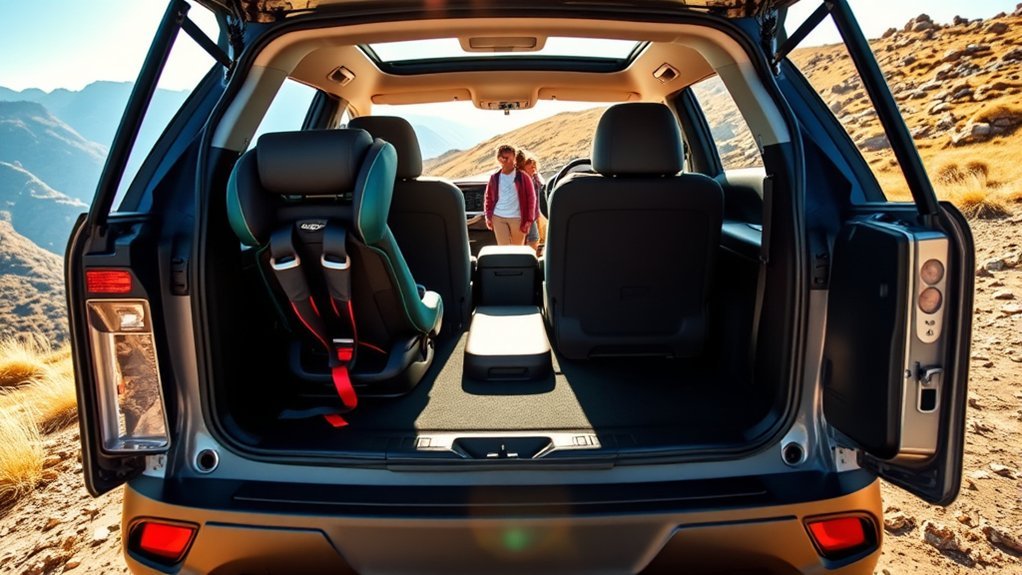
The RAV4 works well for many small families because it combines five seat belts, a foldable rear seat, a wide liftgate opening, and useful cargo room. In the 2025 RAV4 LE, Toyota lists 37.6 cubic feet behind the rear seat and 69.8 cubic feet with the rear seat folded. Toyota lists up to 37.8 cubic feet of cargo capacity for the redesigned 2026 RAV4.
Cargo measurements can change with the powertrain. For example, the 2025 RAV4 Plug-in Hybrid lists 33.5 cubic feet behind the rear seat, which is lower than the standard 2025 RAV4 LE figure. Always compare the exact gas, hybrid, or plug-in hybrid model rather than using one number for the entire lineup.
- Daily family use: Two rear outboard positions provide the simplest starting point for many child-restraint setups, while the center position may remain available when every restraint and seat belt can be used independently and correctly.
- Weekend cargo: Folding one side of a split rear seat can create room for longer gear while preserving a rear passenger position.
- Road-trip organization: The cargo area can hold luggage and everyday equipment, but every item should be secured so it cannot move during sudden braking.
Pro Tip: Bring your largest stroller, suitcase, or child seat to the dealership. A real test fit reveals more than cargo-volume and cabin-width numbers alone.
Car Seat Installation Tips for the RAV4
Start with the instructions from both the child-seat manufacturer and the Child Restraint section of your RAV4 owner’s manual. Toyota gives the same advice in its official child-seat installation guidance.
- Confirm the approved seating position and anchor hardware. For the 2019-2025 generation, IIHS documents two rear positions with complete LATCH hardware, while the center position has a tether anchor and may permit borrowed lower anchors. For the redesigned 2026 RAV4, the Toyota owner’s manual states that lower LATCH anchors are provided for the rear outboard seats. The center has no dedicated lower anchors, although the inboard anchors of the outboard seats are 17.3 inches (440 mm) apart and may be used only when the child-restraint manufacturer permits that anchor spacing.
- Use one approved installation method. Install with either the vehicle seat belt or the lower anchors unless both the vehicle and car-seat manufacturers specifically allow another method.
- Attach the top tether for a forward-facing seat. Use the approved tether anchor and routing described in both manuals.
- Tighten at the belt path. According to NHTSA installation guidance, the seat or base should not move more than one inch from side to side or front to back when checked at the belt path.
- Check the recline and front-seat clearance. Follow the car-seat angle indicator and the RAV4 manual. Do not force a front seat against a child restraint unless the manuals allow contact.
- Check adjacent buckles and belts. A restraint must not block another passenger from correctly using a seat belt or cause an adjacent belt to route incorrectly.
- Get help when needed. A certified child-passenger-safety technician can inspect the installation and explain the approved seating positions.
Can Three Car Seats Fit in a RAV4?
A three-across setup may work with some carefully selected restraints, but it is not guaranteed. Seat shape, buckle access, lower-anchor spacing, front-seat position, restraint mode, and each child’s size all affect the result. Never assume that 47.7 inches of previous-generation rear hip room or 39.5 inches of rear headroom proves three restraints will fit safely.
For planning purposes, two outboard child restraints are the simpler setup. If you need three across, test the exact three restraints in the exact RAV4 and confirm that each installation remains independently secure and that every required buckle stays usable.
Warning: Do not use borrowed lower anchors, combine a seat belt with lower anchors, or place a restraint in the center position unless the exact RAV4 owner’s manual and car-seat manual approve that setup. Never attach two child-restraint connectors to the same lower anchor.
Related Guides
Frequently Asked Questions
What is the maximum cargo capacity of the Toyota RAV4?
It depends on the model year and powertrain. The 2025 RAV4 LE lists 69.8 cubic feet with the rear seat folded and 37.6 cubic feet behind it. Toyota lists up to 37.8 cubic feet of cargo capacity for the 2026 RAV4. Check the exact trim and powertrain for the correct figure.
Does the current RAV4 have third-row seating?
No. Current U.S.-market Toyota RAV4 models have two rows and seat up to five people. If you regularly need six or more passenger positions, compare a three-row SUV or minivan instead.
Did any older Toyota RAV4 have seven seats?
Yes. Certain older third-generation RAV4s offered an optional two-passenger third row. Toyota documented an optional 50/50 Split-and-Stow third-row seat on some 2012 RAV4 and Limited models. Availability varied, so verify the individual used vehicle rather than assuming every RAV4 from that generation has seven seats.
How does the 2025 RAV4 perform in IIHS crash tests?
IIHS gives the 2025 RAV4 a Good small-overlap front rating, an Acceptable updated side rating, a Marginal updated moderate-overlap front rating, and a Good+ LATCH ease-of-use rating. Because Toyota redesigned the RAV4 for 2026, do not automatically carry those 2025 results over to the new generation.
Are optional interior upgrades available?
Yes. Depending on the year and grade, upgrades may include SofTex-trimmed upholstery, power-adjustable seats, heated or ventilated front seats, heated rear outboard seats, a larger multimedia display, premium audio, a digital rearview mirror, and a panoramic view monitor.
Can three car seats fit across the rear bench?
Sometimes, but not with every restraint combination. You need compatible restraints, usable buckles, an approved installation method for each position, and enough front-seat clearance. Test the actual seats in the exact RAV4 before relying on a three-across plan.
Does the RAV4 have lower LATCH anchors in the rear center seat?
The 2026 RAV4 does not have dedicated lower LATCH anchors behind the rear center seat. Toyota states that the inboard lower anchors from the outboard positions are 17.3 inches apart and may be borrowed only if the child-restraint manufacturer’s instructions permit that spacing. Always follow the exact vehicle and restraint manuals.
Is the rear middle seat suitable for an adult?
It has a seat belt and can carry a passenger, but it is narrower than the two outboard positions. It is usually better for occasional or shorter trips than for a long journey with three adults across the rear bench.
Conclusion
A current U.S.-market Toyota RAV4 seats five people in two rows and offers no factory third-row option. Certain older third-generation RAV4s are an exception because Toyota offered an optional two-passenger third row on some configurations. For current shoppers, the RAV4 can be practical for a small family, especially when you normally carry two rear passengers and need flexible cargo space.
Before choosing one, match the passenger measurements, cargo capacity, safety equipment, and child-restraint hardware to the exact model year, trim, and powertrain. If car seats are part of the decision, test the real restraints in the intended positions and confirm every installation with both manuals rather than relying on cabin-width measurements alone.
Sources
- Toyota: 2026 RAV4 overview – current cargo capacity, fuel-economy range, trims, and current-model information.
- Toyota: 2026 RAV4 owner’s manual – rear outboard lower LATCH anchors, center-seat anchor spacing, tether guidance, and child-restraint installation rules.
- Toyota: 2025 RAV4 specifications – seating, legroom, headroom, shoulder room, and cargo measurements.
- Toyota: 2024 RAV4 brochure – previous-generation passenger volume, 60/40 rear seat, dimensions, and cargo figures.
- Toyota USA Newsroom: 2025 RAV4 – Toyota Safety Sense 2.5 and trim-dependent safety features.
- Toyota USA Newsroom: 2012 RAV4 – historical optional 50/50 Split-and-Stow two-passenger third-row seating.
- Insurance Institute for Highway Safety: 2025 Toyota RAV4 – crash-test and child-seat-anchor ratings.
- NHTSA: Car Seats and Booster Seats – child-restraint selection, installation, tightness, and top-tether guidance.
