Your Toyota Tacoma does not have one universal brake-fluid replacement interval that applies to every model year and driving situation. Toyota’s U.S. maintenance guides focus on regular inspections of the fluid’s level and condition. You should combine those inspections with your exact owner’s manual, the truck’s service history, and any brake-system symptoms.
Quick Answer
Toyota’s U.S. Tacoma maintenance guides do not give every model year a universal two-year or 20,000-mile brake-fluid replacement rule. They call for regular checks of fluid level and condition. Replace the fluid when your exact manual requires it, inspection shows contamination, the hydraulic system is opened, or a qualified technician recommends service.
Key Takeaways
- Toyota’s published Tacoma schedules emphasize inspecting brake-fluid level and condition rather than following one replacement interval for every truck.
- Use the fluid grade printed on the reservoir cap and specified in the owner’s manual for your exact model year.
- A soft or sinking pedal, a warning light, visible leakage, or an unexplained drop in fluid requires diagnosis, not just a routine flush.
- Dark color can support a replacement decision, but color alone does not reveal moisture content, boiling performance, or the source of a pedal problem.
- A reservoir-only fluid exchange is not a complete flush of the brake lines, calipers, and hydraulic control components.
At a Glance
| Time Required | About 5–10 minutes for a basic inspection; a complete exchange takes longer and varies by brake system and equipment. |
| Difficulty | Basic for reservoir inspection; intermediate to advanced for a full fluid exchange and brake bleeding. |
| Tools Needed | Flashlight and clean cloth for inspection; a full exchange may require the specified fluid, line wrench, clear hose, catch container, lifting equipment, torque data, and model-specific service information. |
| Cost | Varies by model year, fluid specification, local labor rates, and whether diagnosis or hydraulic repairs are needed. |
Understanding Brake Fluid and Its Importance for Your Tacoma
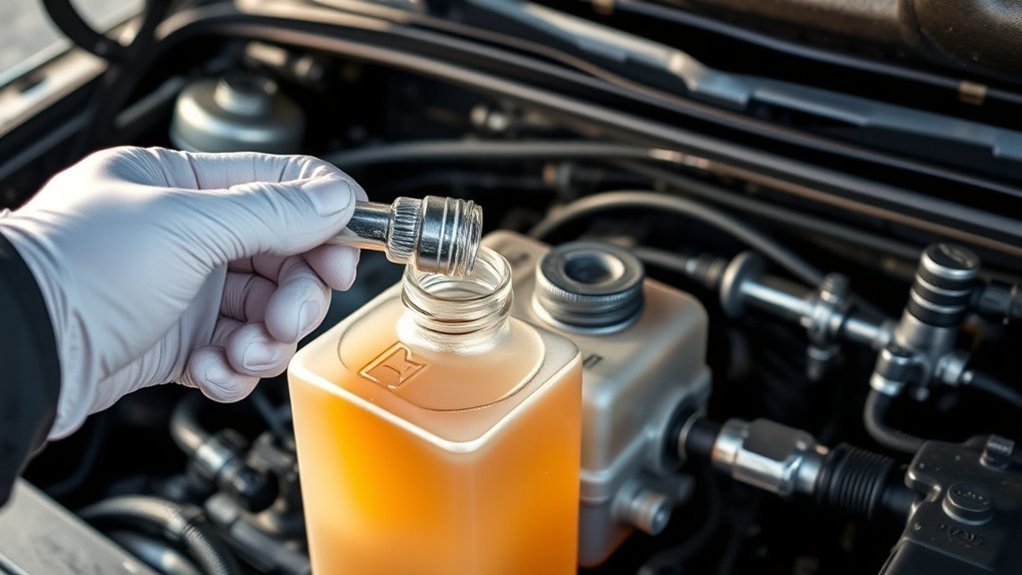
Brake fluid transfers force from your Tacoma’s brake pedal through the hydraulic system. That pressure helps operate the calipers or wheel cylinders that apply the brakes.
Common DOT 3, DOT 4, and DOT 5.1 fluids are non-silicone fluids that must be kept clean and dry. Moisture and contamination can reduce fluid performance and contribute to corrosion or braking problems. Federal brake-fluid rules therefore require container warnings about contamination, moisture, and following the vehicle manufacturer’s instructions.
The federal motor-vehicle brake-fluid standard also distinguishes dry and wet boiling performance. The wet value is lower because it represents fluid after standardized moisture exposure.
Federal standards set DOT 3 minimum boiling points at 205°C (401°F) dry and 140°C (284°F) wet, which shows why moisture control matters.
Recommended Brake Fluid Change Intervals for the Toyota Tacoma
Toyota’s U.S. maintenance schedules should be your starting point. In the official guides reviewed for the 2018, 2023, and 2025 Tacoma, Toyota calls for regular inspection of brake-fluid level and condition. Those schedules do not list one blanket two-year or 20,000-mile replacement requirement for every Tacoma.
The 2025 Tacoma Warranty and Maintenance Guide, for example, includes brake-fluid inspection among the truck’s recurring fluid checks. Toyota also notes that a dealer may recommend maintenance after evaluating inspection results.
Note: A repair shop may suggest a preventive two-year or three-year exchange based on local conditions, test results, or its service policy. That can be reasonable advice, but it should not be described as Toyota’s universal Tacoma requirement.
Manufacturer Recommendations
Use these sources in order:
- Your exact model-year owner’s manual: Check the brake-fluid specification, reservoir instructions, warnings, and any replacement requirement.
- Your Warranty and Maintenance Guide: Follow the inspection schedule and any special operating-condition instructions.
- Model-specific service information: Use this for bleeding order, ABS procedures, torque values, and repair steps.
- A qualified inspection: Consider fluid condition, leaks, repair history, and test results before approving extra maintenance.
You can retrieve current and older documentation through Toyota’s manual and warranty portal.
Driving Conditions Impact
Severe use can justify closer inspections, but it does not create the same automatic replacement schedule for every truck.
| Driving Condition | Recommended Action |
|---|---|
| Normal road use | Inspect the level and condition during scheduled maintenance. Follow the exact model-year guide. |
| Humid or wet climate | Keep the reservoir sealed, inspect the fluid and cap condition, and use verified testing when contamination is suspected. |
| Road salt or coastal exposure | Inspect brake lines, fittings, hoses, and underbody components for corrosion or damage. |
| Frequent towing or mountain driving | Inspect the complete brake system more often because repeated heavy braking increases heat load. |
| Off-road use, mud, or water crossings | Inspect hoses, lines, calipers, wheel areas, and the fluid level after demanding use. Address physical damage or leakage immediately. |
Signs of Fluid Degradation
Consider replacement or professional testing when you find one or more of these conditions:
- Cloudy fluid, suspended particles, sludge, or obvious contamination
- Unknown fluid or accidental mixing with an incorrect product
- A verified condition test that fails the limits used by your service provider or Toyota procedure
- A hydraulic component replacement or repair that opened the system
- Air entering the hydraulic system
- A manufacturer requirement listed for your exact model year
Some test strips estimate corrosion-inhibitor condition by measuring copper, while electronic pens may estimate moisture through conductivity. Neither tool should be treated as a universal Toyota replacement command without checking its instructions and your truck’s service documentation.
Signs Your Brake Fluid Needs Replacing
Fluid condition matters, but several brake symptoms point to a mechanical or hydraulic problem rather than routine aging. Diagnose the complete system before assuming fresh fluid will correct the complaint.
Brake Fluid Color Change
New DOT 3, DOT 4, and DOT 5.1 brake fluid is generally colorless to amber under federal labeling standards. Fluid can become darker with age and use, but color alone does not reveal its boiling point or moisture percentage.
Schedule an inspection when the fluid looks cloudy, contains particles, has separated layers, or appears to contain the wrong substance. Do not open the reservoir repeatedly just to check the color because exposing the fluid and reservoir to dirt or moisture works against proper maintenance.
Soft Brake Pedal
A soft, spongy, or sinking brake pedal may indicate air in the lines, a fluid leak, a damaged hose, a master-cylinder problem, or another hydraulic fault. Old fluid is only one possible factor.
Warning: Do not continue driving if the pedal sinks toward the floor, braking ability drops, fluid is visibly leaking, or the red brake warning light remains on. Park safely and arrange professional diagnosis or towing.
An unexplained low reservoir level also needs attention. Normal brake-pad wear can gradually change the level, but a rapid drop may indicate leakage. Do not repeatedly top off the reservoir without finding the cause.
What Happens If You Ignore Brake Fluid Maintenance?
Ignoring inspections can allow contamination, leakage, or deteriorating components to go unnoticed. Moisture-contaminated fluid may have less boiling resistance under repeated heavy braking. Contamination can also affect hydraulic components and corrosion protection.
The consequences depend on the actual fault:
- Moisture or degraded fluid: Reduced boiling margin during demanding braking
- Air in the system: Increased pedal travel or a spongy pedal
- External leak: Falling fluid level and possible loss of hydraulic pressure
- Incorrect fluid: Possible seal, performance, or compatibility problems
- Corroded or damaged lines and hoses: Increased risk of leakage or sudden failure
A scheduled inspection costs less and is safer than waiting for a pedal problem or visible leak.
How Driving Conditions Impact Brake Fluid Life

Climate and driving style can affect the brake system even when they do not create a fixed fluid-change interval.
- Humidity: Makes it especially important to keep the reservoir cap secure and the fluid container tightly closed.
- Towing and mountain driving: Can create repeated high brake temperatures, so pads, rotors, fluid condition, and pedal behavior deserve closer attention.
- Stop-and-go driving: Increases brake use but does not by itself prove that the fluid needs annual replacement.
- Road salt: Makes line, fitting, and hose inspections especially important.
- Mud and off-road use: Can hide damage or collect around brake components, hoses, and wheels.
- Water crossings: Call for a brake-system inspection afterward, particularly when braking behavior changes.
Use these conditions to adjust inspection frequency rather than relying on an unsupported one-year or 18-month rule.
How Regular Brake Fluid Flushing Enhances Brake Performance
A properly performed fluid exchange removes old fluid and replaces it with the correct fresh product. It can restore the fluid’s intended boiling performance and remove dissolved or suspended contaminants when replacement is due.
Brake bleeding and fluid replacement are related but different services:
- Bleeding: Removes air from the hydraulic system.
- Fluid exchange or flush: Replaces old fluid throughout the hydraulic circuit.
- Reservoir extraction: Replaces only the fluid removed from the reservoir and does not service the complete system.
If the pedal is spongy because air entered through a leak, replacing the fluid without repairing the leak will not provide a lasting fix.
Which Brake Fluid Does a Toyota Tacoma Use?
Do not assume every Tacoma uses the same brake fluid. Check both the reservoir cap and the owner’s manual for your exact model year. Use fluid that meets the listed DOT and manufacturer specification.
DOT 5.1 and DOT 5 are not the same product. Federal labeling identifies DOT 5 as silicone-based and DOT 5.1 as non-silicone. A higher number does not give you permission to substitute fluids without confirming compatibility.
Warning: Never add silicone DOT 5 fluid to a Tacoma unless Toyota documentation for that specific vehicle explicitly requires it. Do not use an opened, dirty, or unmarked container.
Keep new brake fluid tightly sealed until use. Follow the warnings on the container, avoid introducing dirt into the reservoir, and do not return removed fluid to the original bottle.
How to Handle DIY Brake Fluid Maintenance
You can inspect the reservoir at home, but a complete fluid exchange requires accurate service information and careful control of the hydraulic system. Some procedures may require special equipment to operate or bleed ABS and electronically controlled components.
How to Inspect the Reservoir
- Park the Tacoma on level ground and switch it off.
- Locate the brake-fluid reservoir using the owner’s manual.
- Check the level through the reservoir wall before removing the cap.
- Confirm that the level sits within the marked range.
- Inspect the reservoir, cap, nearby lines, and surrounding area for wetness, damage, or contamination.
- Arrange diagnosis if the level is unexpectedly low or continues to fall.
Prepare for a Complete Fluid Exchange
Before starting, obtain:
- The exact model-year service procedure
- The specified brake fluid in sealed containers
- A suitable line wrench
- Clear bleed hose and a stable catch container
- Approved lifting points, wheel chocks, and properly rated jack stands if wheel removal is required
- The correct bleed order and fastener torque data
- Any scan tool or pressure-bleeding equipment required by the procedure
Safer Brake-Fluid Exchange Process
- Confirm the fluid and procedure. Read the reservoir label, owner’s manual, and service information before opening the system.
- Secure the truck. Park on a level surface, set the parking brake where appropriate, chock the wheels, and support the vehicle correctly if lifting it.
- Clean around the reservoir cap. Prevent dirt from falling into the hydraulic system.
- Remove only an appropriate amount from the reservoir. A clean extraction tool may remove old reservoir fluid before refilling, but do not expose the outlet ports or let the reservoir run dry.
- Refill with the specified fluid. Use fresh fluid from a sealed container.
- Follow the model-specific bleed sequence. Use the pressure, vacuum, or two-person method permitted by the service procedure.
- Monitor the reservoir continuously. Keep the level safely above the outlet ports so air does not enter the master cylinder or ABS unit.
- Close each bleeder correctly. Follow the specified torque and inspect for seepage.
- Check the pedal before moving. The pedal should be firm and consistent. Recheck the fluid level and inspect every serviced point for leakage.
- Dispose of used fluid properly. Store it in a labeled, closed container and take it to an appropriate automotive-fluid or hazardous-waste collection facility.
Pro Tip: Record the date, mileage, fluid specification, test result, and reason for service. That history helps you avoid unnecessary repeat work and makes future diagnosis easier.
Note: Removing fluid with a turkey baster and refilling the reservoir is not a complete flush. Most old fluid remains in the lines, calipers, wheel cylinders, and hydraulic control components.
Choose professional service if you cannot confirm the correct procedure, if air has entered the master cylinder or ABS unit, if a hydraulic part was replaced, or if the pedal remains soft after service.
Next Steps for Brake Fluid Maintenance

Use this checklist to build a practical maintenance plan:
- Download the owner’s manual and maintenance guide for your exact Tacoma model year.
- Check the reservoir level and look for leakage during routine maintenance.
- Ask what test or inspection supports any recommended fluid exchange.
- Replace the fluid when required by Toyota documentation, when verified condition warrants it, or when hydraulic work opens the system.
- Address a warning light, sinking pedal, active leak, or reduced braking immediately.
- Keep a written record of fluid type, date, mileage, and completed repairs.
Recall and service-campaign coverage is VIN-specific. Use the official NHTSA recall lookup to check whether your Tacoma has an open brake-related recall.
Related Guides
Frequently Asked Questions
How often should I flush brake fluid on my Tacoma?
Follow the maintenance guide and owner’s manual for your exact model year. Toyota’s U.S. Tacoma schedules reviewed here call for recurring inspections rather than one universal replacement interval. Replace the fluid when the manual requires it, its condition warrants service, or the hydraulic system has been opened.
How often does my brake fluid need to be flushed?
The answer depends on the vehicle documentation, fluid condition, climate, repair history, and how the truck is used. A shop may suggest a preventive time interval, but ask whether it is a Toyota requirement, a test-based recommendation, or the shop’s general maintenance policy.
Is it really necessary to change brake fluid every two years?
Not as a universal Toyota Tacoma rule. A two-year exchange may be a preventive recommendation from a shop or fluid supplier, but Toyota’s published Tacoma schedules should be checked before presenting it as mandatory manufacturer maintenance.
Is a brake fluid flush really necessary?
It is necessary when required by the vehicle documentation, supported by a reliable condition assessment, needed after hydraulic repairs, or required to remove incorrect or contaminated fluid. An unnecessary flush provides little value, while ignoring fluid or hydraulic problems can compromise braking.
Can I replace DOT 3 with DOT 5.1 in a Toyota Tacoma?
Do not make that substitution based only on the higher number. Use the specification printed on the reservoir cap and listed in your exact owner’s manual. DOT 5.1 is not silicone DOT 5, but compatibility and performance still must be confirmed for the vehicle.
Does dark brake fluid always mean it needs replacement?
No. Darkening can support a replacement recommendation, but color alone does not measure boiling performance or identify a hydraulic fault. Cloudiness, particles, separation, incorrect fluid, failed testing, or repair history provide stronger reasons for service.
Can I drive my Tacoma with a spongy brake pedal?
A spongy or sinking pedal needs prompt diagnosis. Do not drive if braking ability has dropped, the pedal approaches the floor, a leak is visible, or a brake warning light remains on. Arrange towing or professional service instead.
Sources
- Toyota 2025 Tacoma Warranty and Maintenance Guide — supports scheduled brake-fluid level and condition inspections.
- Toyota 2023 Tacoma Warranty and Maintenance Guide — supports the inspection-based maintenance guidance for an earlier model year.
- Toyota 2018 Tacoma Warranty and Maintenance Guide — provides an additional model-year comparison.
- Toyota Manuals and Warranties Portal — provides access to model-specific owner documentation.
- 49 CFR §571.116, Motor Vehicle Brake Fluids — supports DOT classifications, labeling, contamination warnings, and boiling-point standards.
- NHTSA Recall Lookup — allows owners to check VIN-specific safety recalls.
Conclusion
Do not rely on a universal two-year or 20,000-mile rule for every Toyota Tacoma. Start with Toyota’s maintenance guide, inspect the level and condition during routine service, and verify the correct fluid in your model-year manual.
Replace the fluid when documentation, reliable testing, contamination, or hydraulic repairs support the service. Treat a sinking pedal, active leak, warning light, or reduced braking as an immediate diagnosis issue rather than a routine maintenance reminder.