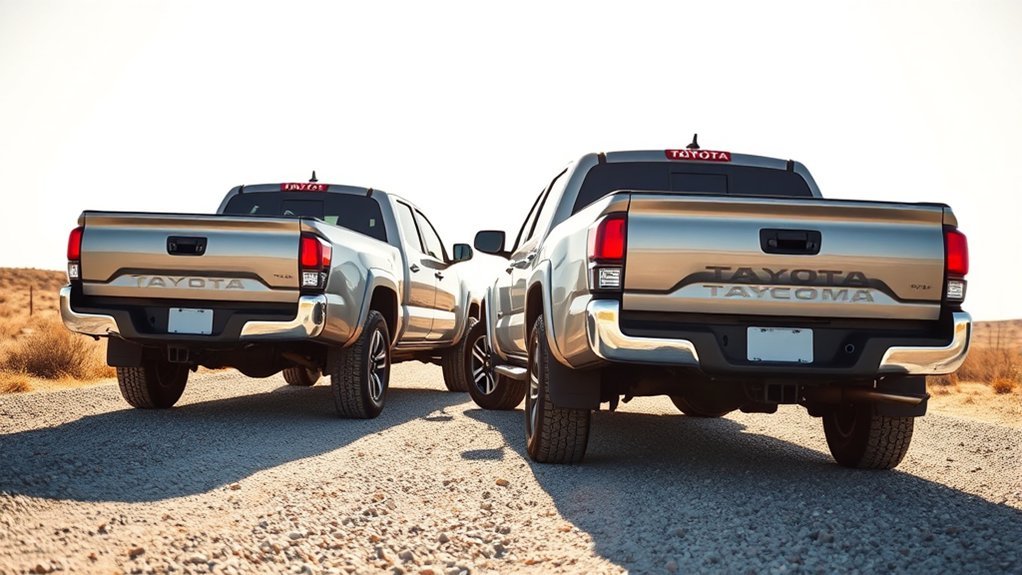
Choosing between a Toyota Tacoma short bed and long bed starts with one question: do you need easier daily driving or more usable cargo length? Bed size matters, but your cab, trim, suspension, drivetrain, and exact truck configuration matter just as much. A long bed does not automatically provide better fuel economy, towing capacity, payload, or ride quality.
Quick Answer
Choose the Tacoma 5-foot bed when easier parking, tighter trail maneuvering, and a shorter overall truck matter most. Choose the 6-foot bed when you regularly carry tools, camping equipment, bicycles, lumber, or bulky cargo. Compare the complete cab, trim, drivetrain, payload, and towing specifications before buying.
Key Takeaways
- The 5-foot bed works best when parking, garage space, and tight-road maneuverability are top priorities.
- The 6-foot bed gives you more floor length and reduces how often cargo must rest on an open tailgate.
- Passenger space comes from the cab configuration, not the bed length by itself.
- Fuel economy, towing, payload, and ride quality vary by the complete truck configuration.
- Check the truck’s certification labels, owner’s manual, and Toyota specifications before carrying or towing heavy loads.
Last updated: July 13, 2026. This comparison uses U.S.-market 2026 Tacoma information. Equipment and ratings vary by configuration.
Which Tacoma Bed Size Is Right for You?
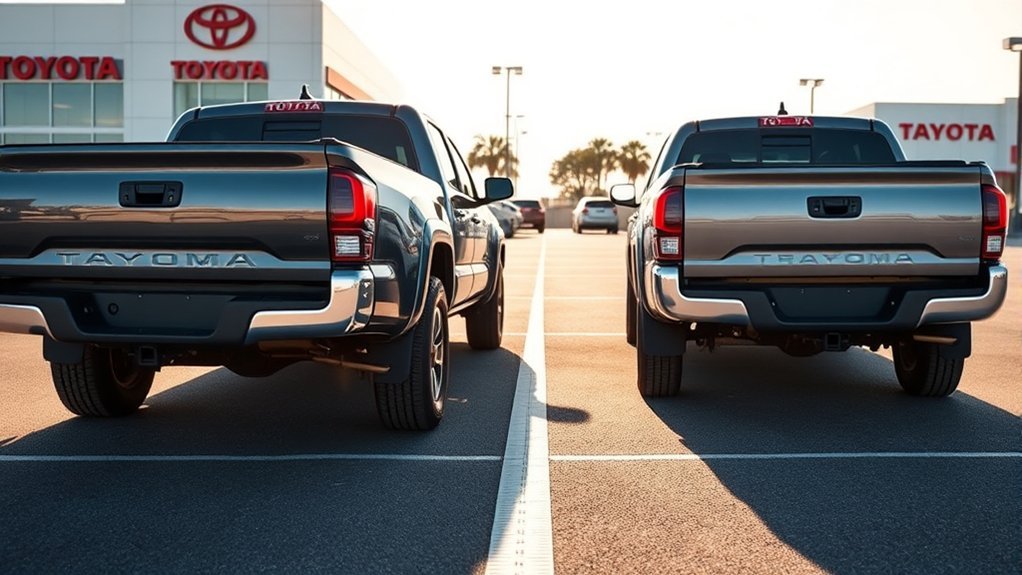
The right Tacoma bed depends on what you carry, where you drive, and which cab you need. Toyota offers the 2026 Tacoma with 5-foot and 6-foot bed options, but availability varies by trim and cab.
The 5-foot bed is the practical choice for many daily drivers. It keeps a Double Cab Tacoma more compact, which can help in parking lots, residential garages, narrow streets, and tight trail areas. You still get useful space for groceries, coolers, recovery equipment, luggage, and smaller home-improvement loads.
The 6-foot bed adds about a foot of nominal cargo length. That extra space helps when you carry long toolboxes, camping bins, bicycles, fishing equipment, furniture, or building materials. It can also reduce how far longer cargo extends beyond the tailgate.
| Consideration | 5-Foot Short Bed | 6-Foot Long Bed |
|---|---|---|
| Best suited for | Daily driving, urban parking, garages, and tight trails | Work equipment, camping gear, longer cargo, and frequent hauling |
| Cargo-floor length | More compact, but long items may require an open tailgate or extender | More room for long items and covered storage systems |
| Parking | Usually easier when comparing similar Double Cab configurations | A Double Cab long bed needs more parking and garage space |
| Passenger space | Determined by the cab, not the short bed itself | A Double Cab long bed can retain rear seating; XtraCab prioritizes storage |
| Off-road use | A shorter overall configuration may feel easier on tight trails | Useful for overlanding gear, but exact wheelbase and overhang matter |
| Towing and payload | Configuration-specific | Configuration-specific; not automatically higher |
The short bed is easier to live with when you seldom carry long cargo. The long bed earns its extra length when you use that space regularly.
Which 2026 Tacoma Cab and Bed Combinations Are Available?
The 2026 Tacoma offers two cab styles: Double Cab and XtraCab. Toyota lists the XtraCab on SR, SR5, and TRD PreRunner grades. It seats two people and uses the area behind the front seats for lockable storage and utility space.
The Double Cab provides a rear seating area and is the better choice when you regularly carry passengers. Depending on the trim, it may be available with a 5-foot or 6-foot bed.
| Configuration | Main Advantage | Main Tradeoff |
|---|---|---|
| Double Cab with 5-foot bed | Rear seating with a more manageable overall length | Less bed floor length for long cargo |
| Double Cab with 6-foot bed | Rear seating plus additional cargo length | Longer truck that needs more parking and garage space |
| XtraCab with 6-foot bed | Work-focused cargo capacity and secure interior storage | No conventional rear passenger row |
Note: Not every bed, cab, powertrain, transmission, or drivetrain combination is offered on every trim. Confirm availability using Toyota’s current build tool or the vehicle’s window sticker.
How Do Tacoma Bed Sizes Affect Your Driving Experience?
A shorter Tacoma configuration is generally easier to place in a parking space and may require less room for low-speed turns. You may notice the difference when using an urban garage, navigating a narrow driveway, or turning around on a tight trail.
A Double Cab with the 6-foot bed has more body and wheelbase length than a comparable Double Cab short bed. That can make the truck feel less compact. It can also affect breakover clearance and how much space the rear of the truck needs while turning.
However, do not judge every 5-foot and 6-foot Tacoma by bed length alone. A 6-foot XtraCab and a 6-foot Double Cab are different body configurations. Compare the exact wheelbase, overall length, turning circle, suspension, tires, and curb weight of the trucks you are considering.
Does the Long Bed Ride More Smoothly?
A longer wheelbase can feel settled on some roads, but bed length does not guarantee a smoother ride. Toyota uses different suspension layouts and grade-specific tuning across the Tacoma lineup. Tire type, tire pressure, rear suspension, shock tuning, cargo weight, and trim can create a larger difference than the bed itself.
For example, Toyota describes sport-tuned shocks for TRD Sport, Bilstein shocks for TRD Off-Road, FOX equipment for TRD Pro, Old Man Emu components for Trailhunter, and Adaptive Variable Suspension for Limited. Test-drive the exact configuration rather than assuming that every long-bed Tacoma rides the same way.
Does Bed Length Change Fuel Economy?
Bed length alone does not determine fuel economy. Toyota publishes estimates for specific trims and powertrains, and those numbers vary across gas, hybrid, two-wheel-drive, four-wheel-drive, manual, automatic, tire, and equipment combinations.
Compare the EPA estimate shown on the window sticker for the exact truck. Do not assume that a long bed saves fuel or that a short bed always uses less.
Pro Tip: Measure your parking space and garage before choosing a Double Cab long bed. Include room for the hitch, bumper, garage door, and space needed to walk around the truck.
Comparing Cargo Capacity and Usability of Tacoma Beds
The 6-foot bed gives you more usable floor length. It is helpful when you regularly carry fishing rods, folded tents, recovery boards, large storage bins, tool cases, bicycles, landscaping equipment, or home-improvement materials.
The 5-foot bed still handles many daily loads. Grocery totes, coolers, suitcases, sports equipment, compact tools, and smaller furniture can fit without giving up the short bed’s easier parking.
Long items can sometimes be carried in a short bed with the tailgate lowered, a suitable rack, or a properly installed bed extender. The load must remain supported, visible when required, and securely restrained.
Cargo Volume Is Not the Same as Payload
A longer bed creates more space, but it does not automatically allow more weight. Payload is the amount the truck can carry after accounting for its configuration and equipment. Passengers, cargo, accessories, aftermarket parts, and trailer tongue weight can all use part of the available payload.
Toyota states that the 2026 Tacoma lineup offers payload of up to 1,705 pounds. “Up to” represents the highest-rated configuration, not every Tacoma.
Check the certification and tire-information labels on the truck before loading it. You can also consult Toyota’s 2026 Tacoma owner-manual portal for loading instructions.
Warning: Never use bed space as proof that the truck can safely carry the load. Stay within the truck’s payload, axle, tire, and gross vehicle weight ratings. Include passengers, accessories, cargo, and trailer tongue weight in your calculation.
How Bed Length Affects Towing and Payload
The long bed does not automatically tow more than the short bed. Toyota lists a maximum 2026 Tacoma towing capacity of up to 6,500 pounds, but the actual rating depends on the engine, drivetrain, cab, trim, transmission, equipment, and other configuration details.
A truck with the longer bed may have a lower or higher payload than another Tacoma because its curb weight and equipment can differ. Hybrid components, four-wheel drive, off-road equipment, larger tires, luxury features, and accessories may change the available capacity.
Before towing, verify all of the following:
- The exact towing rating for the truck’s configuration
- The trailer’s loaded weight, not only its empty weight
- The hitch and receiver ratings
- The trailer tongue weight
- The truck’s remaining payload after passengers and cargo
- The gross combined weight and axle limits
- Whether a brake controller or other towing equipment is required
Choose the long bed for cargo length, not because you expect it to provide a higher towing number.
Aesthetic vs. Practical: Choosing Your Tacoma Bed
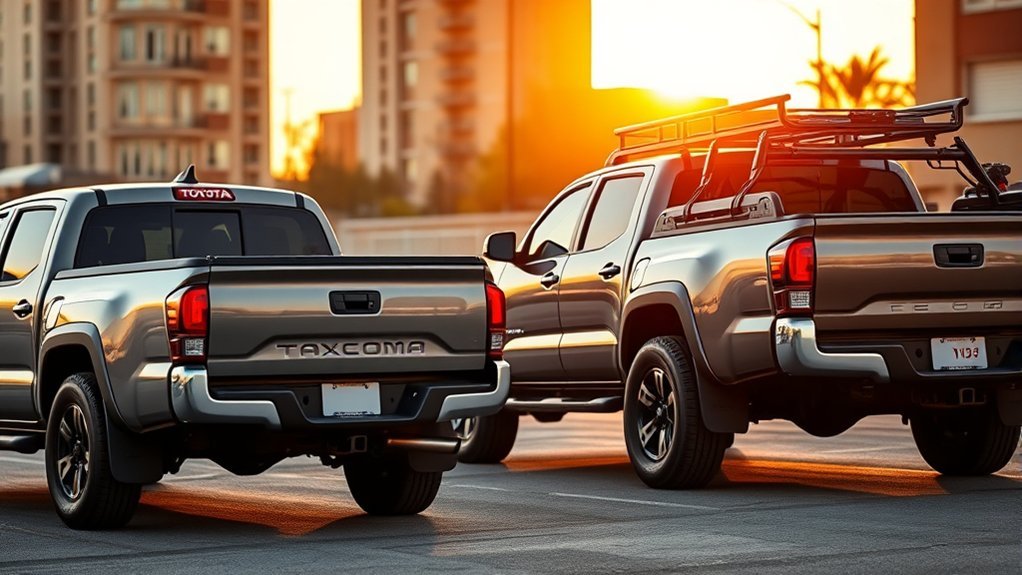
Appearance can influence your choice, but practical needs should come first. Some drivers prefer the balanced, compact appearance of a Double Cab short bed. Others like the traditional truck proportions and added visual length of a 6-foot bed.
Consider how often you will use the extra space. Choosing a long bed for one yearly project may leave you managing a longer truck every day. Choosing a short bed when you haul long equipment every weekend may lead to frequent tailgate-down trips or added rack costs.
Choose the 5-Foot Bed If
- You regularly park in urban areas or compact garages.
- You want a Double Cab without the longest body configuration.
- Most of your cargo fits in boxes, bins, coolers, or smaller cases.
- You drive on narrow trails or tight access roads.
- You only carry long items occasionally.
Choose the 6-Foot Bed If
- You frequently carry tools, camping gear, bicycles, or long equipment.
- You want more room beneath a tonneau cover or truck cap.
- You regularly use the Tacoma for work or home-improvement projects.
- You prefer to keep more cargo inside the bed with the tailgate closed.
- You have enough parking and garage space for the longer configuration.
What Accessories Enhance Tacoma Bed Functionality?
Bed accessories can make either Tacoma bed more useful. Confirm the model year, exact bed length, rail system, cab, and trim before ordering. A cover or liner made for a 5-foot bed will not fit a 6-foot bed.
| Accessory | Purpose | What to Check |
|---|---|---|
| Bed liner or mat | Protects the composite bed surface and reduces cargo movement | Bed length, drain access, and tie-down clearance |
| Tonneau cover | Shields cargo from weather and casual visibility | Exact bed length, rail compatibility, and toolbox clearance |
| Bed extender | Supports some longer cargo with the tailgate lowered | Rated capacity, attachment method, and load securement |
| Tie-downs and straps | Restrains cargo during braking, turning, and acceleration | Working-load ratings, strap condition, and anchor placement |
| Sliding tray | Improves access to cargo near the front of the bed | Tray weight, payload use, mounting, and cover compatibility |
| Bed rack | Carries kayaks, ladders, rooftop tents, or long equipment | Static and dynamic ratings, roof clearance, and payload impact |
Accessories add weight to the truck. A heavy cap, drawer system, rack, tray, or steel toolbox reduces the remaining payload available for people and cargo.
How to Load and Secure Cargo Safely
Place heavy cargo low in the bed and distribute the weight as evenly as practical. Avoid concentrating a heavy load behind the rear axle when you can position it farther forward without exceeding axle limits.
Use suitable anchor points and straps rated for the load. Inspect each strap for cuts, damaged stitching, worn hooks, or weakened hardware. Restrain items that could slide, roll, tip, or leave the bed during a sudden stop.
The FMCSA cargo-securement rules govern commercial motor vehicles, but their central principle is useful for any pickup: cargo should be immobilized or secured against shifting and falling.
When cargo extends beyond the bed, follow applicable state and local marking rules. Confirm that the load does not block lights, the license plate, the camera, or your view. Recheck straps after driving a short distance.
Related Guides
Frequently Asked Questions
What is the difference between the short-bed and long-bed Tacoma?
The short bed is nominally 5 feet long, while the long bed is nominally 6 feet long. The short bed favors easier parking and a more compact Double Cab. The long bed provides more floor length for tools, outdoor gear, and bulky cargo. Exact dimensions and availability depend on the model year and configuration.
Should I buy a long-bed or short-bed Tacoma?
Buy the short bed when you prioritize parking, garage fit, rear seating, and daily maneuverability. Buy the long bed when you regularly use the added cargo length. Measure your common cargo and parking space before deciding.
Which Tacoma configuration should I stay away from?
Avoid any configuration that does not fit your real passenger, cargo, parking, payload, towing, or trail needs. For example, an XtraCab may not work if you need rear passenger seats, while a Double Cab long bed may not fit a short garage. Check the exact ratings and dimensions instead of rejecting an entire trim by name.
Why do people prefer short-bed trucks?
Many drivers prefer a short bed because the truck is easier to park, store, and maneuver when comparing similar cab configurations. A short bed also provides enough room for many recreational and household loads without adding length that the owner rarely uses.
Does the Tacoma long bed tow more than the short bed?
Not automatically. Towing capacity depends on the complete engine, drivetrain, cab, trim, transmission, axle, equipment, and body configuration. Toyota lists a lineup maximum of up to 6,500 pounds for the 2026 Tacoma, but you must verify the rating for the exact truck.
Does a long bed have a higher payload?
Not necessarily. Payload changes with the truck’s curb weight, powertrain, drivetrain, cab, suspension, trim, tires, and installed equipment. Use the label on the specific truck rather than a general short-bed or long-bed estimate.
Conclusion
Choose the Tacoma 5-foot bed when you want a more manageable daily truck and rarely carry long cargo. Choose the 6-foot bed when extra floor length will save you from frequent tailgate-down trips, roof-rack loading, or cramped equipment storage.
Do not base the decision on unsupported assumptions about MPG, towing, payload, or ride quality. Compare the complete cab, trim, drivetrain, suspension, dimensions, and ratings. The best Tacoma bed is the one you will use without creating a daily parking, passenger, or loading problem.
Sources
- Toyota: 2026 Tacoma Overview and Trim Information — bed options, cab styles, utility features, and published fuel-economy estimates.
- Toyota USA Newsroom: The 2026 Toyota Tacoma — current powertrains, cab availability, towing maximum, payload maximum, and suspension information.
- Toyota Owners: 2026 Tacoma Manuals and Warranties — official owner information and vehicle-specific guidance.
- Federal Motor Carrier Safety Administration: Cargo Securement Rules — principles for preventing cargo from shifting or falling during transport.
