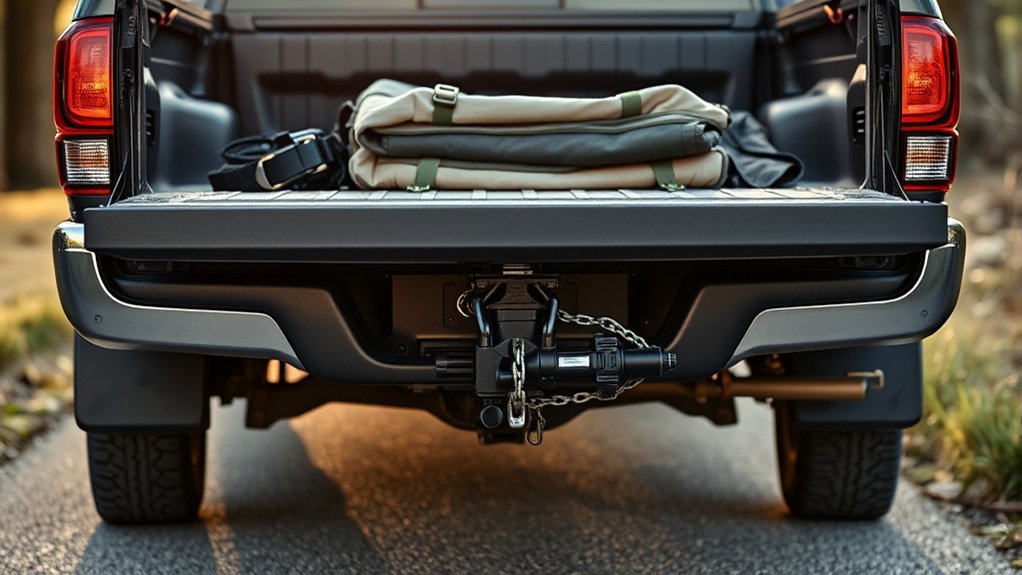
Your 2017 Toyota Tacoma’s safe towing limit is not determined by one number. You must keep the truck, each axle, the trailer, the hitch hardware, and the complete combination within their separate ratings. A 6,400-pound tow rating may apply to the described V6 Double Cab configuration, but the exact model code and door labels must confirm it.
Quick Answer
Check your Tacoma’s certification label for GVWR, GAWR, and model code, then use Toyota’s 2017 owner’s manual for the matching GCWR and trailer rating. Subtract passengers, cargo, hitch equipment, and loaded tongue weight from the door-label payload. Every rating must remain within its limit.
Key Takeaways
- A 5,600-pound GVWR and 6,400-pound trailer rating may apply to some 2017 Tacoma configurations, but your labels and model code control.
- The door-jamb payload must cover passengers, cab and bed cargo, aftermarket equipment, hitch hardware, and trailer tongue weight.
- Toyota specifies approximately 9% to 11% tongue weight for a conventional trailer, subject to the trailer and hitch manufacturers’ limits.
- GVWR, front and rear GAWR, GCWR, trailer rating, payload, and every hitch-component rating are separate limits.
- Airbags, heavier springs, shocks, or higher-capacity tires do not increase Toyota’s certified weight ratings.
At a Glance
| Time Required | About 20–30 minutes for label checks and calculations, plus time for a scale visit |
| Difficulty | Easy calculations; moderate care required when weighing and adjusting the hitch |
| Tools Needed | Owner’s manual, door labels, calculator, tire gauge, torque wrench, tongue-weight scale or commercial vehicle scale |
| Cost | Label checks are free; scale and inspection fees vary by location |
GVWR, GCWR and Towing Capacity for Your Tacoma
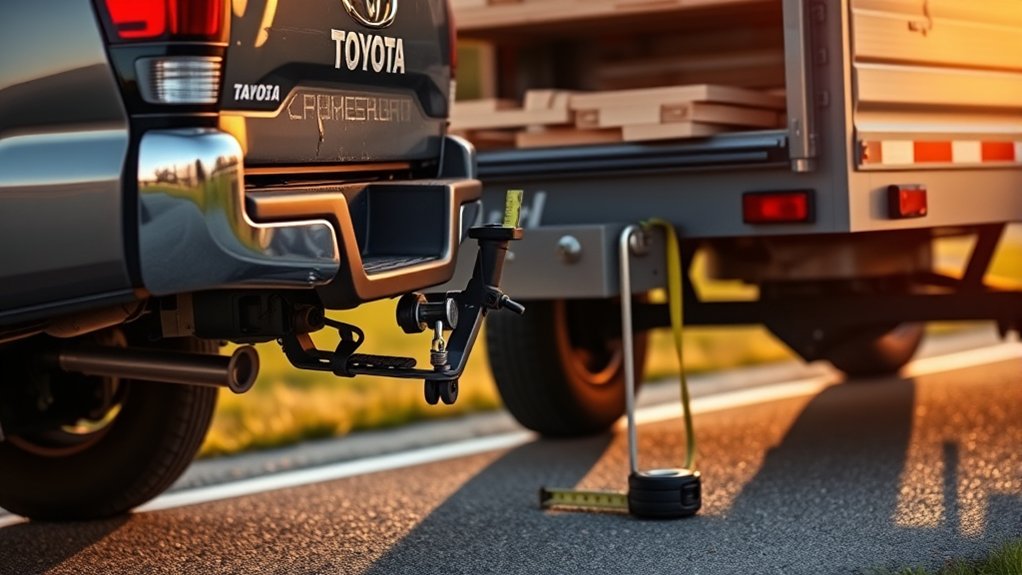
A 2017 Tacoma’s towing capacity depends on its engine, cab, bed, drivetrain, transmission, tow equipment, and model code. Toyota advertised up to 6,800 pounds for properly equipped third-generation Tacomas, while many V6 4WD Double Cab configurations are rated at 6,400 pounds.
Do not use the highest Tacoma rating unless the 2017 Toyota Tacoma Owner’s Manual assigns it to your exact model code. A rating from another cab, bed length, transmission, or drivetrain does not transfer to your truck.
| Rating | What It Limits | Where to Find It |
|---|---|---|
| GVWR | The maximum allowed weight of the loaded truck, including occupants, cargo, accessories, hitch hardware, and tongue load | Certification label on the driver-side door pillar |
| GAWR | The maximum load allowed on the front or rear axle | Certification label |
| Payload or vehicle capacity | The combined allowable weight of occupants and cargo before additional load is applied | Tire and Loading Information label |
| TWR or towing capacity | The maximum loaded trailer weight assigned to the exact truck configuration | Owner’s manual model-code table |
| GCWR | The maximum combined weight of the loaded truck and loaded trailer | Owner’s manual model-code table |
Your usable towing limit is the lowest limit reached first, not simply the advertised trailer rating.
Tongue Weight vs. Payload: Quick Math to Check Your Setup
Tongue weight is the downward load the trailer applies to the hitch. That load is carried by the truck, so it uses the same payload budget as passengers, tools, coolers, bed cargo, aftermarket accessories, and hitch hardware.
For a conventional trailer, Toyota’s 2017 Tacoma manual calls for tongue weight of approximately 9% to 11% of the loaded trailer weight. Follow the trailer manufacturer’s instructions as well, and never exceed the truck, receiver, ball mount, hitch ball, coupler, or axle limits.
Use this payload calculation before you hitch:
Remaining payload = door-label occupant-and-cargo limit − passengers − truck cargo − added accessories − hitch hardware − loaded tongue weight
Payload Example
Assume the truck’s Tire and Loading Information label permits 1,000 pounds of combined occupants and cargo. This is only an example, not a rating for every Tacoma.
- Driver and passenger: 350 pounds
- Cab and bed cargo: 100 pounds
- Ball mount or weight-distribution equipment: 75 pounds
- Payload remaining for tongue weight: 475 pounds
A 5,000-pound loaded conventional trailer would place about 450–550 pounds on the tongue at Toyota’s 9%–11% range. In this example, the upper part of that range would exceed the available payload even though the trailer remains below a 6,400-pound tow rating.
Warning: Never calculate allowable tongue weight from towing capacity alone. The truck’s remaining payload, GVWR, rear GAWR, hitch ratings, and Toyota’s maximum tongue-load instructions may impose a lower limit.
Read the Door Jamb: Step-by-Step Payload, GVWR and GCWR Checks
The driver-side door area normally contains two important labels, but they serve different purposes. The certification label identifies the truck and lists ratings such as GVWR and front and rear GAWR. The Tire and Loading Information label states the maximum combined weight of occupants and cargo.
- Record the model code. Find it on the certification label and match it to the towing table in the 2017 owner’s manual.
- Record GVWR and both GAWR figures. Do not focus only on GVWR because the rear axle can reach its limit first.
- Record the occupant-and-cargo limit. Treat this door-label number as the truck’s starting payload budget.
- Subtract permanent additions. Bumpers, skid plates, racks, bed caps, sliders, larger spare tires, tools, and other equipment consume payload.
- Add passengers and trip cargo. Include everything in the cab and bed.
- Add hitch hardware and loaded tongue weight. A weight-distribution hitch may be heavy enough to make a noticeable difference.
- Compare the loaded trailer with TWR. Use the trailer’s actual loaded weight, not its dry or shipping weight.
- Compare the complete combination with GCWR. Use scale readings rather than estimates whenever possible.
Note: The door labels do not replace Toyota’s towing table. Your certification label supplies the model code needed to select the correct GCWR and trailer rating from the manual.
Weigh Your Loaded Truck and Trailer Without Double-Counting
A commercial platform scale is the most reliable way to check the combination. Load the truck and trailer exactly as they will travel, including passengers, fuel, water, propane, batteries, food, tools, and recreational equipment.
First Weighing: Truck and Trailer Hitched
Place the front truck axle on the steer platform, the rear axle on the drive platform, and all trailer axles on the trailer platform. Add all three readings to obtain the actual gross combination weight.
- Steer axle must remain below the front GAWR.
- Drive axle must remain below the rear GAWR.
- Steer plus drive must remain below GVWR.
- Steer plus drive plus trailer axles must remain below GCWR.
Second Weighing: Loaded Truck Without the Trailer
Weigh the truck with the same passengers and cargo but without the trailer attached. Comparing this truck weight with its hitched weight helps show how much load the hitch places on the truck.
Do not add the trailer’s full loaded weight to a hitched truck weight that already includes tongue load. That would count the tongue load twice. Either add all axle readings from the hitched scale ticket or add the unhitched loaded truck weight to the trailer’s complete loaded weight.
Third Weighing: Check Weight-Distribution Adjustment
If you use a weight-distribution hitch, compare the front-axle reading before and after hitching. Follow Toyota and the hitch manufacturer’s instructions. Toyota directs owners to adjust the system so the front axle returns to approximately its pre-hitch weight rather than becoming lighter or being forced below its original weight.
Pro Tip: Keep the scale tickets with your trailer records. Reweigh after adding heavy accessories, changing the trailer’s battery or propane setup, carrying fresh water, or changing how cargo is loaded.
Essential Towing Equipment for a Tacoma
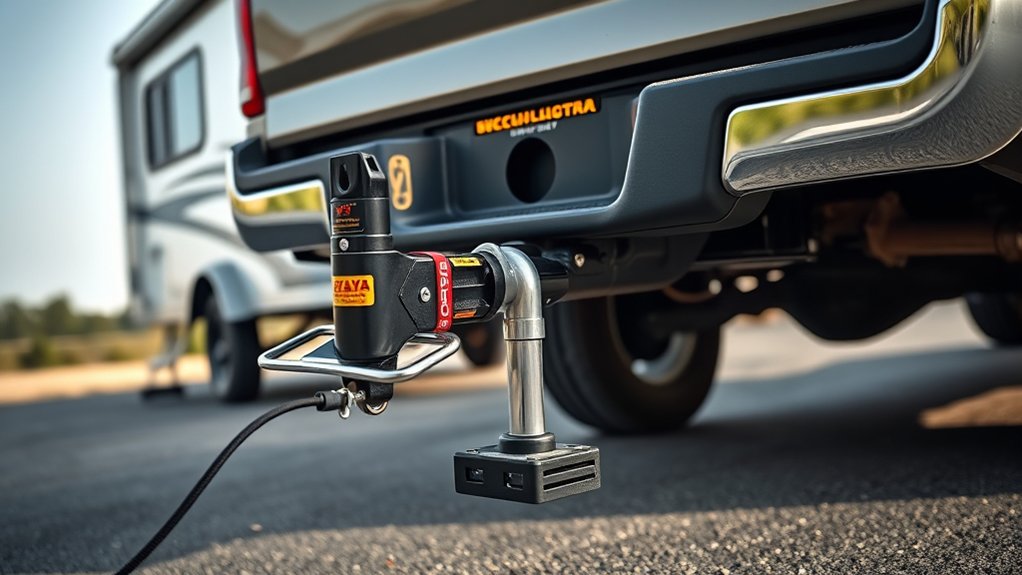
Every towing component must be compatible with the loaded trailer and rated for the weight it carries. A high truck tow rating cannot compensate for an underrated receiver, ball mount, hitch ball, coupler, safety chain, or trailer axle.
- Receiver and ball mount: Confirm both the weight-carrying and weight-distributing ratings, when applicable.
- Hitch ball: Match the coupler size and use a ball with a load rating at least equal to the trailer’s loaded rating.
- Safety chains: Cross them beneath the trailer tongue and leave enough slack for turns without allowing them to drag.
- Breakaway cable: Attach it to a secure point that is separate from the safety chains.
- Trailer wiring: Test running lights, brake lights, turn signals, and trailer-brake operation before departure.
- Brake controller: Use a compatible controller when the trailer has electric brakes. Adjust it so the trailer assists smoothly without locking its wheels.
- Weight-distribution and sway control: Use these only when Toyota, the receiver manufacturer, and the trailer manufacturer permit or require them.
- Tires: Use the specified tire size and adequate load capacity. Set the Tacoma’s cold pressures from its placard and the trailer pressures according to the trailer or tire manufacturer.
Airbags, helper springs, heavier leaf springs, upgraded shocks, and stiffer tires may change ride height or handling. They do not increase the truck’s certified GVWR, GAWR, payload, GCWR, or trailer rating. Their own weight also reduces available payload.
Warning: Do not use suspension aids to hide an overloaded condition. Weigh the combination and correct the load before relying on any ride-leveling product.
Pre-Trip Towing Safety Checklist
- Confirm the coupler is fully seated and latched on the correct-size ball.
- Install the coupler lock or safety pin.
- Cross and secure the safety chains.
- Connect the breakaway cable independently.
- Raise and secure the tongue jack.
- Test all trailer lights and electric brakes.
- Check the truck and trailer tires while cold.
- Inspect trailer wheel bearings, lug nuts, suspension, and visible brake components.
- Secure cargo so it cannot shift during braking or turns.
- Confirm mirrors provide a clear view along both sides of the trailer.
- Check that the trailer sits level and has adequate clearance through turns.
- Perform a low-speed brake-controller test before entering traffic.
Common Towing Problems and Quick Fixes for Tacoma Owners
| Problem | Likely Cause | Safe Response |
|---|---|---|
| Trailer sway | Low tongue weight, shifted cargo, excessive speed, crosswinds, tire problems, or improper hitch setup | Hold the steering wheel steady, ease off the accelerator, avoid abrupt steering, and stop safely to inspect and redistribute the load |
| Rear sag or light steering | Excessive tongue load, overloaded rear axle, or incorrect weight-distribution adjustment | Check scale readings, remove or relocate cargo, and adjust the WDH according to its instructions |
| Weak or jerky braking | Incorrect controller gain, failed trailer brakes, poor wiring, or overloaded combination | Stop towing until the brake system and weights are checked |
| Overheating or warning lights | High load, steep grade, high ambient temperature, excessive speed, or a mechanical fault | Reduce speed and load, follow the owner’s-manual warning procedure, and stop in a safe place if the warning continues |
| Tire heat or pressure loss | Underinflation, overload, damage, age, or an unsuitable tire | Stop safely, inspect the tire, and correct the cause before continuing |
Never correct sway by adding random ballast without recalculating trailer weight, tongue weight, payload, and axle loads. Moving cargo forward can increase stability, but it can also overload the Tacoma’s hitch or rear axle.
Frequently Asked Questions
Does GCWR include tongue weight?
GCWR covers the actual weight of the complete loaded truck-and-trailer combination. Tongue load is carried by the truck’s axles, while the remaining trailer load is carried by the trailer axles. Add all hitched axle-scale readings together, but do not add tongue weight a second time.
How much tongue weight can a Toyota Tacoma take?
You cannot determine allowable tongue weight from the trailer rating alone. For a conventional trailer, Toyota calls for approximately 9%–11% of loaded trailer weight. The actual limit is the lowest amount allowed by the remaining payload, GVWR, rear GAWR, receiver, ball mount, hitch ball, and Toyota’s model-specific instructions.
Is towing capacity tongue weight or total trailer weight?
Towing capacity refers to the trailer’s total loaded weight, including the trailer itself and everything carried in or on it. Tongue weight is only the portion transferred downward to the truck through the hitch.
What is the difference between gross trailer weight and tongue weight?
Gross trailer weight is the complete loaded trailer weight. Tongue weight is the part of that weight supported by the hitch. The trailer axles carry the remainder.
Do airbags or heavier springs increase Tacoma payload?
No. They may reduce sag or alter ride quality, but they do not change the GVWR, GAWR, payload label, GCWR, or trailer rating assigned by Toyota. Their added weight also consumes part of the existing payload.
Can you tow at the maximum published capacity?
Only when the exact truck configuration qualifies and every other rating remains within its limit. Passengers, cargo, accessories, elevation, heat, grades, wind, trailer shape, and mechanical condition can make a combination demanding even when the scale numbers are technically compliant.
Conclusion
Safe Tacoma towing begins with the individual truck rather than a general internet specification. Record the door-label payload, GVWR, GAWR, and model code. Match that code to Toyota’s GCWR and trailer-rating table, then weigh the fully loaded combination.
Keep passengers, cargo, hitch hardware, and tongue weight within payload and axle limits. Use Toyota’s approximately 9%–11% conventional tongue-weight guidance, and remember that suspension or tire upgrades do not raise the factory ratings. When any one limit is exceeded, reduce or relocate the load before towing.
Sources
- 2017 Toyota Tacoma Owner’s Manual — model-specific towing ratings, tongue-weight guidance, weight-distribution setup, and towing precautions
- Toyota Manuals and Warranties: 2017 Tacoma — official model-year manual access
- Toyota USA Newsroom: Third-Generation Tacoma Capability — properly equipped maximum towing information and configuration context
- NHTSA Occupant and Cargo Carrying Capacity Guidance — purpose of the vehicle’s occupant-and-cargo label
- NHTSA Tongue Weight and Axle Rating Guidance — checking loaded tongue weight against vehicle axle ratings

