To tow safely with a Toyota Tacoma, use the towing limits for your exact truck, not a lineup maximum or a generic rule. Verify the model-year towing section, payload, axle ratings, loaded trailer weight, tongue weight, hitch-component ratings, trailer brakes, tire pressures, and cargo security before you leave. For the 2026 Tacoma, Toyota also requires a sway-control device when gross trailer weight exceeds 2,000 lb and a weight-distributing hitch when it exceeds 5,000 lb; requirements can differ by model year, so your exact Toyota manual controls.
Last updated: September 11, 2026 — reviewed against current Toyota Tacoma towing guidance, Toyota’s 2026 towing information, and NHTSA tire-safety guidance.
Quick Answer
To tow safely with a Toyota Tacoma, confirm the towing and payload limits for your exact configuration, count passengers and tongue weight against payload, keep every truck, hitch, tire, and trailer component within its rating, load the trailer to Toyota’s model-year guidance, test the brakes and lights, and leave extra room for stopping, turning, and lane changes.
Key Takeaways
- Use the Toyota manual and specifications for your exact model year and configuration. Toyota advertises the 2026 Tacoma at up to 6,500 lb of towing capacity, but that is a lineup maximum, not a universal Tacoma rating.
- Tongue weight, passengers, accessories, and cargo in the bed all consume the truck’s available payload.
- The lowest-rated part of the combination controls the usable limit, including the truck, receiver, ball mount, hitch ball, coupler, trailer, and tires.
- Measure the trailer in its fully loaded travel condition, including water, fuel, batteries, propane, tools, and recreational equipment. For 2026 conventional Tacoma towing, Toyota specifies 9%–11% tongue weight; use the range in your own model-year manual.
- Inspect the setup before departure and again after the first short driving interval.
At a Glance
| Time Required | Varies by setup; allow extra time for first-time hitch setup, weighing, brake-controller adjustment, and a complete pre-trip check |
| Difficulty | Moderate; professional setup is recommended when equipment compatibility or weight calculations are uncertain |
| Tools Needed | Toyota owner’s manual, trailer instructions, tire-pressure gauge, wheel chocks, rated tongue-weight scale or public scale, and basic tools required by the hitch manufacturer |
| Cost | Varies by setup; a basic inspection may cost nothing, while scale fees and required towing equipment depend on the truck and trailer |
Warning: Never exceed the lowest applicable rating for the truck, axles, tires, receiver, ball mount, hitch ball, coupler, trailer, or safety equipment. A heavier-duty hitch or added accessory does not increase Toyota’s published vehicle ratings.
How Do You Verify Toyota Tacoma Towing Capacity?
Your Tacoma’s safe trailer limit depends on its exact configuration. Start with the towing section of the official Toyota owner’s manual for your model year. Confirm the cab, bed length, drivetrain, engine or hybrid powertrain, transmission, trim, model code, axle information, and factory towing equipment.
Toyota currently advertises the 2026 Tacoma at up to 6,500 lb of towing capacity and up to 1,705 lb of payload, but those are lineup maximums. Your truck can be rated lower. Do not assume that a more expensive, hybrid, or off-road-focused trim has the highest rating. For a configuration-by-configuration explanation, see Toyota Tacoma Towing Capacity Explained.
Which Weight Ratings Matter When Towing a Tacoma?
- GVWR: The maximum permitted weight of the loaded Tacoma, including occupants, accessories, bed cargo, and trailer tongue weight.
- GAWR: The maximum permitted load on each axle. Staying under GVWR does not guarantee that both axles remain within their ratings.
- GCWR: The maximum permitted combined weight of the loaded Tacoma and loaded trailer when specified by Toyota.
- Payload: The amount of weight the truck can carry. Occupants, installed accessories, cargo, and tongue weight all use payload.
- Loaded trailer weight: The trailer’s actual travel-ready weight, not its empty, dry, or advertised base weight.
- Tongue weight: The downward load the trailer places on the hitch.
Note: The driver-side Tire and Loading Information label helps you confirm payload-related information and recommended tire pressure. It should not be treated as a substitute for the vehicle-specific towing section of the Toyota manual.
How Do You Calculate Real Tacoma Payload Use?
Begin with the payload information for your truck. Subtract the weight of the driver, passengers, bed cargo, permanently installed accessories, aftermarket equipment, and trailer tongue weight. The remaining amount is your unused payload margin.
For example, if occupants, tools, a bed cover, cargo, and tongue weight use most of the available payload, you may reach the truck’s payload or rear-axle limit before reaching its published maximum trailer-weight rating. The related Tacoma towing capacity vs. payload guide shows why these two limits must be checked separately.
A trailer can be below the advertised towing limit while still overloading the Tacoma’s payload, rear axle, hitch, or tires.
Why Should You Use Loaded Trailer Weight?
Weigh the trailer as it will travel. Include cargo, water, batteries, propane, fuel, spare parts, tools, food, camping equipment, motorcycles, boats, or other gear. Published dry weight often excludes items that add substantial travel weight.
A public vehicle scale can provide the truck, trailer, axle, and combined weights needed to check the setup. Compare the measured values with every applicable Toyota, hitch, tire, and trailer rating. Do not calculate a new towing capacity from GCWR or assume unused capacity in one area cancels an overload somewhere else.
What Should You Inspect Before Towing With a Tacoma?
Inspect the complete truck-and-trailer connection before every trip. A familiar setup can still develop loose hardware, damaged wiring, low tire pressure, or shifted cargo.
- Receiver and hitch: Check for cracks, bent parts, corrosion, loose fasteners, missing pins, and damaged welds. Confirm that the receiver and ball mount are rated for the loaded trailer and tongue weight.
- Hitch ball and coupler: Verify that the ball size matches the coupler, the coupler fully closes, and the latch is secured according to the manufacturer’s instructions.
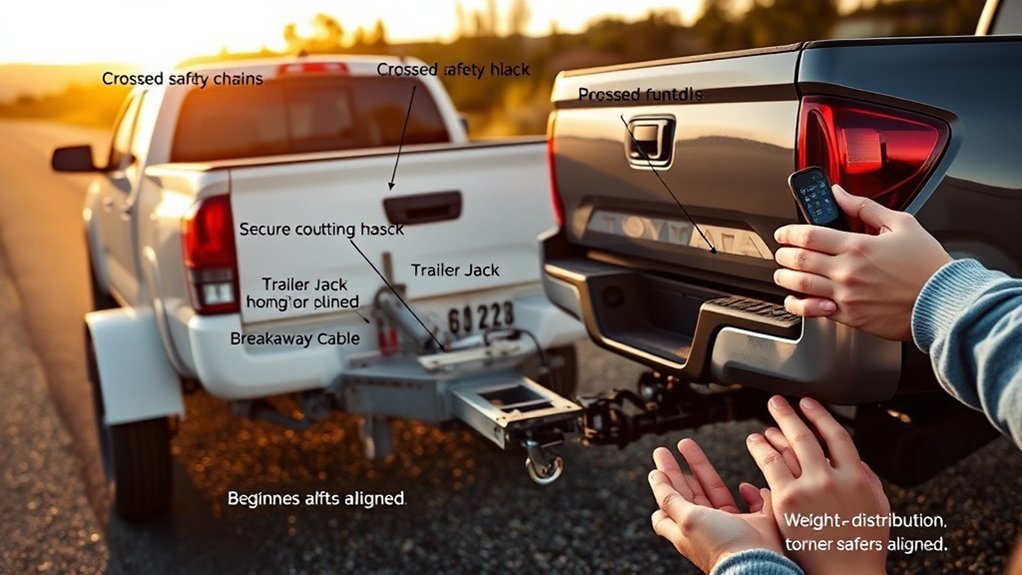
- Safety chains: Cross the chains beneath the trailer tongue when the equipment instructions call for it. Leave enough slack for turns without allowing the chains to drag.
- Breakaway cable: Attach it to an independent point on the tow vehicle as directed by the trailer manufacturer. Do not wrap it around the safety chains.
- Trailer lights: Test the running lights, brake lights, turn signals, hazard lights, and license-plate light.
- Brakes and controller: Confirm that the trailer brakes, breakaway battery, wiring, and compatible brake controller work correctly when required.
- Tires and wheels: Check cold tire pressure, tread, cuts, cracks, bulges, valve stems, wheel condition, and lug-nut security on the Tacoma and trailer.
- Cargo: Confirm that heavy items cannot slide, tip, leak, or become projectiles during a sudden stop.
- Visibility: Adjust towing mirrors so you can see along both sides of the trailer and monitor surrounding traffic.
Use the cold inflation pressure listed by the vehicle or trailer manufacturer. The maximum pressure molded into a tire sidewall is not automatically the correct operating pressure. The NHTSA TireWise guide explains how to find and check recommended tire pressure.
Pro Tip: After driving a short initial distance, stop in a safe location and recheck the coupler, hitch pin, chains, electrical connector, cargo straps, tires, and any equipment the manufacturer instructs you to retighten.
How Should You Set Up and Load a Tacoma Trailer?
A trailer should sit close to level when connected and loaded. Excessive nose-up or nose-down attitude can change axle loading, ground clearance, and stability. Use a properly rated ball mount with the correct rise or drop rather than trying to level the trailer by moving cargo to an extreme position.
Where Should You Place Trailer Cargo?
Place heavy cargo low and near the trailer’s axle area, following the trailer manufacturer’s loading instructions. Many conventional trailers need slightly more load ahead of the axle than behind it, but concentrating everything at the front can overload the hitch and Tacoma’s rear axle.
- Load the heaviest items first and keep them low.
- Distribute weight from side to side so one trailer tire or axle end is not overloaded.
- Secure every item against forward, rearward, sideways, and vertical movement.
- Recheck the final tongue weight after the trailer is completely loaded.
Do not use unsecured cargo as a quick way to correct sway. Stop safely and redistribute the load before continuing.
What Tongue Weight Does a Tacoma Need?
Use Toyota’s tongue-weight range for your exact model year instead of a generic trailer rule. For the 2026 Tacoma, Toyota specifies that conventional-trailer tongue weight should be 9% to 11% of gross trailer weight. The measured tongue weight must also remain within the truck’s payload, rear-axle, hitch, receiver, ball-mount, and trailer limits.
2026 Tacoma equipment thresholds: Toyota’s 2026 manual says trailer service brakes are required when gross trailer weight exceeds the truck’s unbraked TWR, a sway-control device with sufficient capacity is required over 2,000 lb, and a weight-distributing hitch with sufficient capacity is required over 5,000 lb. Check your own model-year manual because thresholds and equipment requirements can change.
A weight-distributing hitch transfers part of the hitch load among the tow vehicle and trailer axles. When Toyota requires or permits one, follow the Tacoma manual and the hitch and trailer manufacturers’ setup procedures rather than using a generic percentage rule.
Incorrect adjustment can overload an axle or change steering and braking behavior. Have the system installed and measured by a qualified professional when you are unfamiliar with its setup.
How Do You Measure Tacoma Tongue Weight?
Measure tongue weight with a purpose-built scale rated for the expected load, a suitable commercial scale procedure, or a professional weighing service. Avoid placing a heavy trailer tongue directly on a household bathroom scale.
- Load the trailer exactly as it will travel.
- Park on firm, level ground and chock the wheels.
- Measure at the coupling height specified for the scale or weighing method.
- Compare the result with the Tacoma, receiver, ball mount, hitch ball, and trailer limits.
- Reweigh after moving cargo or adding water, fuel, batteries, propane, or equipment.
Too little tongue weight can contribute to sway. Too much can overload the rear axle, reduce available payload, lighten the front axle, and affect steering or braking.
How Should You Drive a Tacoma While Towing?
Practice in a large open area before entering busy traffic. Learn how the trailer tracks through turns, how much space the combination needs, how the brakes feel, and how quickly the truck responds while accelerating.
- Increase following distance: Leave substantially more room than you use without a trailer. Add more space in rain, wind, darkness, traffic, or on downhill grades.
- Brake early: Apply the brakes smoothly and avoid last-second stops.
- Make wider turns: Trailer wheels track inside the Tacoma’s path and can strike curbs, signs, vehicles, or pedestrians.
- Watch speed: Obey the lowest applicable posted, trailer, tire, hitch, and manufacturer speed restriction.
- Use mirrors often: Check traffic, tire behavior, cargo covers, and trailer tracking without staring away from the road.
- Manage hills: Select the transmission mode or lower gear recommended by your manual before speed builds on a descent.
- Allow passing clearance: The trailer must fully clear the other vehicle before you return to the lane.
- Avoid abrupt inputs: Sudden steering, braking, or throttle changes can destabilize a loaded trailer.
How to Respond to Trailer Sway
If the trailer begins moving from side to side, follow Toyota’s model-year instructions. In the 2026 Tacoma manual, Toyota says to grip the steering wheel firmly, steer straight ahead, and release the accelerator immediately but gradually. Do not increase speed, make an extreme steering correction, or apply the tow vehicle’s brakes while the combination is swaying.
After the trailer stabilizes, move to a safe location and inspect the setup before continuing. Check the truck and trailer tires, shifted cargo, tongue weight, vehicle load, speed, wind, trailer level, hitch adjustment, and mechanical problems. Do not continue at the same speed simply because the sway stops temporarily.
Warning: Electronic stability features and trailer-sway assistance may help in certain situations, but they cannot correct an overloaded trailer, poor weight distribution, excessive speed, incompatible equipment, or unsafe driving.
What Safety Gear Should You Pack for Towing?
Carry equipment that fits both the Tacoma and trailer. Store heavy tools securely so they cannot move during a stop or collision.
- Warning triangles or approved roadside markers: Use them to increase visibility during a breakdown where local rules permit.
- First-aid kit: Keep basic supplies in an accessible, clearly marked container.
- Properly rated fire extinguisher: A secured multipurpose extinguisher can help with a small, controllable fire when you have a safe exit and know how to use it.
- Trailer spare tire: Confirm that it matches the trailer’s load and fitment requirements and is properly inflated.
- Jack and lug tools: Use equipment rated for the trailer and follow safe lifting instructions.
- Wheel chocks: Chock the trailer before coupling, uncoupling, weighing, or working near it.
- Tire-pressure gauge: Carry a gauge suitable for the pressures used by the truck and trailer.
- Flashlight and reflective vest: These improve visibility during nighttime inspections.
- Spare fuses and approved electrical supplies: Carry only the items recommended for your wiring and brake system.
A trailer-brake controller is not simply emergency gear stored in the truck. When required, it must be compatible, installed, adjusted, and tested according to Toyota, controller, trailer, and brake-manufacturer instructions. Confirm your local trailer-brake and breakaway-system laws before traveling.
Top 5 Towing Mistakes New Tacoma Owners Make
- Using an online maximum instead of the truck’s real rating: A general Tacoma number may not apply to your model year, drivetrain, cab, bed, powertrain, or installed equipment.
- Ignoring payload: Passengers, accessories, bed cargo, and tongue weight can overload the Tacoma even when trailer weight remains below its advertised maximum.
- Matching only the receiver: The ball mount, hitch ball, coupler, safety chains, tires, wheels, trailer frame, and brakes must also be properly rated and compatible.
- Loading by appearance: A trailer can look level while having poor tongue weight or an overloaded axle. Measure rather than guess.
- Skipping practice and reinspection: New drivers should practice turning, stopping, reversing, and parking, then recheck the setup shortly after departure.
Another common mistake is relying on accessories to increase capacity. Air springs, upgraded shocks, brake controllers, towing mirrors, weight-distributing hitches, and larger receivers may improve a specific function, but they do not raise Toyota’s GVWR, GAWR, GCWR, payload, or trailer-weight rating.
Related Guides
Frequently Asked Questions
What is the 85% rule for towing?
The 85% figure is an optional planning margin sometimes used by owners who prefer not to tow at the vehicle’s published maximum. It is not a Toyota rating, federal law, or substitute for checking payload, axle loads, tongue weight, GCWR, hitch limits, tires, brakes, and the fully loaded trailer weight.
What should you not tow with a Tacoma?
Do not tow a trailer that causes any truck, axle, tire, hitch, coupler, trailer, tongue-weight, payload, or combined-weight rating to be exceeded. You should also avoid towing with incompatible equipment, defective brakes or lights, damaged tires, unstable loading, or inadequate visibility.
How do you put a Toyota Tacoma in Tow/Haul mode?
Controls and operating steps vary by model year, transmission, and equipment. Follow the instructions in your exact Toyota manual and dashboard prompts. Tow/Haul mode may change shift timing, throttle response, or engine-braking behavior, but it does not increase towing capacity, payload, axle ratings, or hitch limits.
How should a beginner start towing?
Begin with a correctly matched and lightly loaded setup. Verify every rating, complete the hitching checklist, and practice low-speed turns, braking, lane positioning, and backing in an open area. Take a short first trip in good weather before attempting heavy traffic, steep grades, or long-distance towing.
How much tongue weight should a Tacoma have?
For the 2026 Tacoma, Toyota specifies 9% to 11% tongue weight for conventional towing. Other model years may differ, so use the range in your exact Tacoma manual. The measured tongue weight must also fit within the truck’s remaining payload, axle, receiver, ball-mount, hitch-ball, and trailer limits.
Does installing a stronger hitch increase Tacoma towing capacity?
No. A higher-rated receiver or hitch component cannot increase Toyota’s published towing, payload, axle, or combined-weight ratings. It only prevents that individual component from becoming a lower limit, provided the equipment is approved, compatible, and correctly installed.
Does a Tacoma need sway control or a weight-distributing hitch?
It depends on the model year and gross trailer weight. For the 2026 Tacoma, Toyota requires a sway-control device with sufficient capacity when gross trailer weight is over 2,000 lb and a weight-distributing hitch with sufficient capacity when gross trailer weight is over 5,000 lb. Follow the requirements in your exact Tacoma manual and the hitch and trailer instructions.
When are trailer brakes required with a Tacoma?
For the 2026 Tacoma, Toyota says trailer service brakes are required when gross trailer weight is over the truck’s unbraked Trailer Weight Rating. Brake laws can also vary by state or province, so confirm both the Tacoma manual and the rules for every jurisdiction on your route.
Conclusion
Your Tacoma can tow safely only when the complete combination stays within every applicable rating. Verify the specifications for your exact truck, count tongue weight and occupants against payload, weigh the loaded trailer, and inspect the hitch, brakes, lights, tires, chains, and cargo before departure.
Before your next trip, check the towing section for your exact model year and confirm the tongue-weight target and any sway-control, trailer-brake, or weight-distributing-hitch requirements. Once you are moving, slow down, leave extra stopping room, make wider turns, and follow Toyota’s instructions if sway begins. Recheck the setup after the first short driving interval and whenever cargo changes.
Sources
- Toyota Manuals and Warranties — vehicle-specific operating instructions, ratings, tongue-weight guidance, and towing-equipment requirements
- Toyota Vehicles for Towing — current Tacoma lineup towing-capacity guidance and towing disclaimers
- Toyota Tacoma Official Page — current configurations and available towing technology
- NHTSA: Towing a Trailer — Being Equipped for Safety (DOT HS 809 433) — trailer loading, connections, equipment, and road-safety guidance
- NHTSA TireWise — tire pressure, labeling, tread, maintenance, and replacement guidance
- SAE J2807 — standardized performance requirements used to determine tow-vehicle and trailer-weight ratings
