
A 2009 Jeep Grand Cherokee often needs more than a basic OBD-II reader to retrieve ABS faults. Standard code scanners usually miss brake-control data because the ABS module is separate from engine diagnostics. Tools such as the Innova 5610, BlueDriver, or JScan with a compatible adapter can access those codes and live data. The key question is which one can actually communicate with the Jeep’s ABS system without guesswork.
What OBD Reader Scans ABS Codes on a 2009 Jeep Grand Cherokee?
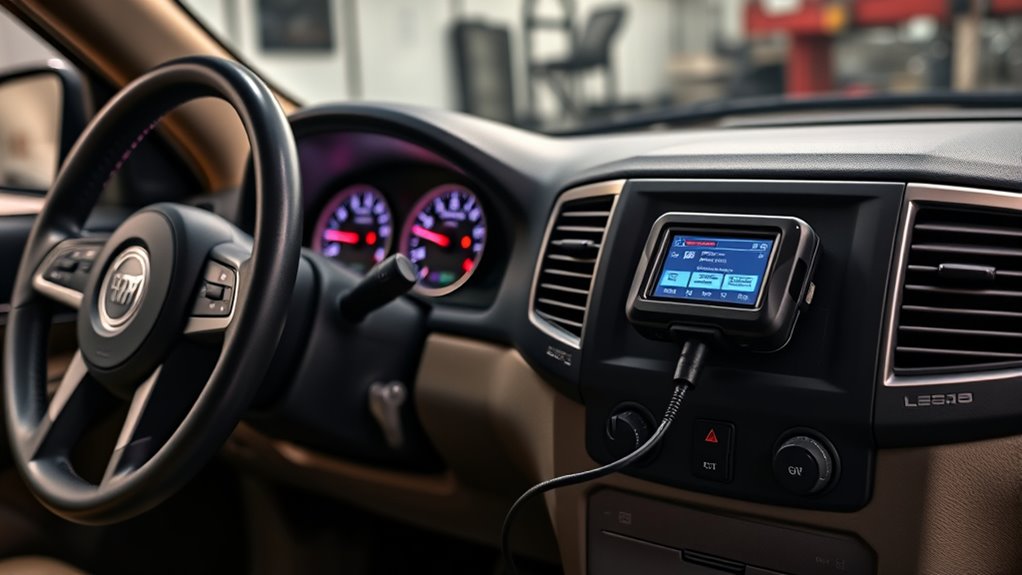
For a 2009 Jeep Grand Cherokee, the Innova 5610 is a strong choice because it supports full-system diagnostics and can scan ABS fault codes directly.
In practical use, it retrieves ABS codes from the brake module without forcing the operator into guesswork.
OBD JScan offers a more flexible route through a phone or tablet, with module access, live data, and direct ABS trouble-code reading. That makes it useful for technicians who want independent diagnostics and control over the process.
The Innova 1000 is also reported to read ABS and airbag codes, though with narrower capability.
BlueDriver and BAFX Bluetooth readers are likewise noted for ABS coverage and live data monitoring.
The critical requirement is confirmed ABS support, since many scanners only read engine faults.
Confirmed ABS support is essential, since many scanners only read engine faults and miss brake module codes.
For drivers seeking liberation from dealership dependency, the right reader exposes fault data, preserves autonomy, and supports exact, informed repair decisions on the Grand Cherokee.
Why Basic Code Readers Miss Jeep ABS Problems
Basic code readers often miss Jeep ABS problems because they are limited to generic OBD-II engine diagnostics and cannot reliably access the vehicle’s proprietary brake-control data. As a result, basic code readers may report no fault while Jeep ABS modules continue storing diagnostic trouble codes tied to wheel sensors, hydraulic components, or control-unit communication.
Standard scanners typically interrogate only powertrain memory, leaving brake-system faults invisible. This limitation produces incomplete assessments and can delay correct repair decisions. Jeep ABS faults often span multiple modules, requiring manufacturer-specific interpretation that generic readers cannot provide.
When the scanner cannot decode brand-specific identifiers, critical malfunctions remain hidden, reducing confidence in the vehicle’s braking status. For drivers seeking technical clarity and autonomy, a scanner must reach beyond engine data. Otherwise, essential ABS-related failures can persist unnoticed, affecting stopping performance, warning lights, and safety margins.
Specialized equipment is thus necessary to expose the full diagnostic picture and restore informed control over the system.
How to Use JScan for Jeep ABS Codes?
JScan requires a compatible OBD-II adapter, the Jeep connected at the OBD port, and the app paired on an Android device via Bluetooth or WiFi.
Once the vehicle profile is selected, the ABS module can be accessed to read diagnostic trouble codes and review related live data.
After verification, stored Jeep ABS codes can be cleared through the same module menu if the fault condition has been corrected.
JScan Setup Steps
To use JScan for ABS diagnostics on a 2009 Jeep Grand, a compatible OBD-II Bluetooth adapter should be connected to the vehicle’s OBD-II port under the steering wheel. Then, the JScan app should be installed on an Android device and paired to the adapter via Bluetooth or WiFi.
This OBD-II device enables access to ABS codes without dealer dependence, supporting informed, liberated maintenance.
- Confirm Android compatibility
- Install the JScan app
- Pair phone and adapter
- Select the Jeep model
- Enter the ABS module
After linkage, the app should identify the vehicle profile and expose the ABS module for diagnostic control.
The setup sequence must remain stable before any scan command is issued, ensuring accurate module communication and minimizing false communication faults.
Reading ABS DTCs
Once the OBD-II adapter is linked and the Jeep profile is loaded, the app can be directed to the ABS module to retrieve Diagnostic Trouble Codes (DTCs).
JScan operates as a Jeep-specific scan tool, exposing ABS fault memory without generic limitations. The user selects the ABS system, then reads stored DTCs, freeze-style fault context, and related status data.
Its Code Reader function identifies wheel-speed sensor faults, pump, valve, and communication errors with clear code definitions. Live data streams from ABS sensors support verification of signal loss, implausible readings, or intermittent dropout.
Module tests and active functions further isolate the defective circuit. This diagnostic path gives the owner control, replacing dealership dependency with direct access to the vehicle’s braking intelligence and fault architecture.
Clearing Jeep Codes
With the ABS fault source identified and corrected, the JScan app can be used to erase stored Jeep codes on a 2009 Grand Cherokee through the vehicle’s OBD-II interface. The Android phone pairs by Bluetooth with the OBD-II device under the steering wheel, granting direct access to the ABS module for verification before release.
- Install the JScan app
- Connect the OBD-II device
- Open the ABS module
- Confirm live sensor data
- Clear ABS codes
After the repair is confirmed, the ABS codes may be cleared, and dashboard warning lamps should reset. This procedure supports disciplined diagnostics and preserves control over the braking system.
Regular use of the JScan app enables ongoing troubleshooting, helping the vehicle owner remain free from avoidable faults and dependent service delays.
Best OBD Scanners for Jeep Grand Cherokee ABS
For the 2009 Jeep Grand Cherokee, a capable ABS-capable scanner should be prioritized over a basic code reader, since brake and stability diagnostics require access to manufacturer-specific modules.
Among proven options, the Innova 5610 stands out because it delivers full system diagnostics and can retrieve ABS codes with clear fault reporting.
OBD JScan offers broader module access through an app-based interface, reaching ABS and other control units on Jeep platforms for deeper analysis.
The Innova 1000 is a more limited but useful tool, reading ABS and airbag codes for essential safety checks.
BlueDriver is also effective for ABS scanning and live data, supporting structured troubleshooting when symptoms are intermittent.
A compatibility checker remains useful for confirming module access before purchase.
With the right scanner, diagnostic dependency is reduced, and owners gain direct visibility into brake-system faults, enabling a more liberated, informed repair path.
How to Check Jeep ABS Compatibility Before Buying?
Before purchasing an OBD reader for a 2009 Jeep Grand Cherokee, compatibility should be verified at the vehicle and module level. The first check is OBD-II compliance, which the Jeep Grand Cherokee should meet through its diagnostic port and standard emissions protocol.
Yet ABS codes require more than generic engine scanning.
- Confirm the owner’s manual lists OBD-II support.
- Select scanners explicitly rated for ABS codes.
- Review manufacturer data for Jeep Grand Cherokee coverage.
- Favor models like the Innova 5610 for broader module access.
- Scan user reviews to verify real-world ABS performance.
A scanner may communicate with the vehicle while still failing to read the ABS module. Consequently, product descriptions should specify Chrysler or Jeep support, not only universal OBD-II compliance.
Community feedback can expose weak coverage before purchase. Careful verification reduces wasted expense and restores diagnostic control to the owner.
What a Rear Differential Speed Sensor Code Means
A compatible scanner can reveal more than a generic ABS alert; on a 2009 Jeep Grand Cherokee, a rear differential speed sensor code points to a fault in the sensor that reports rear wheel rotational speed to the ABS and traction control modules.
The rear differential speed sensor may be failing, contaminated, or sending unstable data, and the stored DTC can include P0720. When this signal is degraded, the ABS warning light may illuminate, and braking may feel inconsistent, with erratic ABS activation or brief slipping during stops.
A technician should verify wiring, connector condition, and sensor output before replacing parts. Tire pressure should also be checked, because uneven inflation can complicate road testing and mask the fault pattern.
If the code returns after inspection, replacement of the defective rear differential speed sensor is the direct corrective path, restoring clear wheel-speed input and helping recover stable braking performance.
Why the Rear Differential Sensor Affects ABS
Rear sensor signal loss prevents the ABS module from receiving accurate wheel speed and position data, which it uses to regulate brake force.
A differential speed mismatch can be interpreted as wheel slip, causing the system to command unnecessary ABS intervention and trigger warning lights.
On a 2009 Jeep Grand, this fault can also reduce braking stability under downhill load where traction control depends on correct sensor input.
Rear Sensor Signal Loss
When the rear differential wheel-speed sensor loses signal, the ABS control module no longer receives reliable speed data from that axle and may interpret the condition as a brake-system fault.
In the Grand Cherokee, this interruption can illuminate ABS and brake lamps and, if ignored, permit unintended ABS intervention. A suitable OBD-II reader must make sure it can access manufacturer-specific ABS codes and live data for accurate diagnosis. Better thermal stability in the sensor circuit and connector helps preserve signal integrity under load.
- Confirm rear sensor voltage and continuity.
- Scan ABS-specific fault memory.
- Check harness damage at the differential.
- Verify signal return during wheel rotation.
- Replace a faulty sensor promptly.
Timely repair restores controlled braking, supporting safe, independent movement.
Differential Speed Mismatch
Differential speed data from the rear sensor is used by the ABS module to compare rear-axle rotation against the front wheels and maintain correct brake control across changing road conditions.
When wheel speed discrepancies appear, the controller interprets them as a potential traction or sensor fault, and the ABS warning lamp may illuminate. If the rear differential sensor reports unstable or incorrect values, the system can command premature ABS activation, even though hydraulic braking remains normal.
Reliable diagnosis requires an OBD-II scanner that can read Jeep manufacturer-specific ABS codes, not just generic powertrain data. Proper differential sensor calibration helps verify signal accuracy, preserve ABS system reliability, and prevent unnecessary intervention.
Regular inspection supports safer, more autonomous driving control and reduces avoidable brake irregularities.
How to Clear Jeep ABS Lights After Repairs?
After repairs are completed, the ABS warning on a 2009 Jeep Grand can be cleared with an OBD-II scanner that supports ABS diagnostics, such as an Innova 5610 or BlueDriver.
In practical ABS light troubleshooting, the process depends on OBD II scanner features that can read and erase brake module faults. Jeep maintenance tips begin with switching the ignition on, engine off, to establish communication.
- Connect the scanner to the OBD port.
- Enter the ABS menu and read stored codes.
- Confirm replaced sensors or components are installed correctly.
- Clear the codes and reset the ABS system.
- Drive a short route to confirm the lamp stays off.
If the light returns, the fault is still active or another sensor malfunction remains.
Further diagnosis is then required before the system can be considered free of warning states.
What Live Data Confirms the ABS Fix?
Once the ABS codes are cleared, the repair should be verified through live data from the ABS module. In ABS system diagnostics, Live data interpretation should show four wheel speed signals rising together during motion, with no erratic dropouts or fixed zeros. That pattern supports Sensor replacement verification and indicates the repaired circuit is not suppressing the system.
| Parameter | Expected reading | Diagnostic meaning |
|---|---|---|
| Wheel speeds | Even across wheels | Sensor output is coherent |
| Brake pressure | Changes during braking | Hydraulic response is normal |
| ABS status | Inactive unless needed | Module is not faulted |
| Traction control | Available when required | Safety network is intact |
During a controlled test drive, brake pressure data should respond predictably, and ABS engagement should appear only under demanding stops. The ABS warning light status should remain inactive, confirming restored control. If traction control also reports normal activation, the platform is operating freely and correctly after repair.
Best Scanner for DIY Jeep Owners
For DIY Jeep owners, a scanner must retrieve ABS codes while also supporting Jeep-specific module diagnostics.
The Innova 5610, BlueDriver, and JScan app are commonly selected because they expose full-system data needed for accurate fault isolation on a 2009 Jeep Grand.
Features such as live data, airbag code access, and repair guidance improve diagnostic efficiency and reduce unnecessary parts replacement.
ABS Code Scanners
When diagnosing ABS faults on a 2009 Jeep Grand Cherokee, the scanner must access more than generic powertrain codes, since safety-system modules often require full-system coverage.
For advanced diagnostics, the Innova 5610 stands out in scanner comparisons because it reads ABS, SRS, and other modules. User reviews often favor its broad coverage and clear data.
- Innova 5610: full-system diagnostics
- Innova 1000: simple ABS and airbag reading
- Blue Driver: strong live data monitoring
- BAFX Bluetooth reader: useful for basic live data
- OBD JScan app: deep module access and code clearing
A compatible tool should liberate the owner from guesswork by confirming ABS faults, monitoring sensor behavior, and clearing codes after repair.
Scanners that miss safety modules limit diagnosis and delay resolution.
Jeep-Specific Diagnostics
Jeep-specific diagnostics are often the most efficient route for a DIY owner because manufacturer-oriented tools can access modules that generic OBD2 readers cannot, including ABS on the 2009 Jeep Grand Cherokee.
For Jeep diagnostics, scanners such as the Innova 5610 offer strong coverage, with ABS code retrieval and structured fault review. The Innova 1000 extends ABS and airbag access, supporting safety-system inspection.
JScan broadens access to all vehicle modules, including ABS, and returns DTCs and live data for precise ABS troubleshooting. The Innova SD35 also supports enhanced Jeep coverage for brake-system faults.
These Scanner recommendations favor tools that speak the vehicle’s native language, allowing owners to diagnose beyond basic emissions data and reclaim control over hidden faults with measurable, module-level clarity.
DIY Tool Features
The Innova 5610 stands out as a strong DIY scanner for the 2009 Jeep Grand Cherokee because it provides full-system diagnostics, including ABS fault retrieval, in a tool that is straightforward to navigate.
Its diagnostic tools support rapid DTC access, often within 15 seconds, reducing downtime and giving the owner direct control over fault assessment. The user interface is designed for efficient menu traversal, enabling clear subsystem selection and code review.
The RepairSolutions2 App adds practical troubleshooting tips with plain-language definitions and likely fixes, helping users interpret ABS, airbag, and related system alerts without dependence on a shop.
- Full-system coverage
- ABS and airbag diagnostics
- Bi-directional testing
- Jeep-model compatibility
- Repair guidance integration
Frequently Asked Questions
Is There an OBD Reader That Can Read ABS Codes?
Yes—certain OBD technology readers can read ABS codes, but only models with ABS functionality and Jeep diagnostics support.
A basic code reader usually cannot access the brake module. For a 2009 Jeep Grand Cherokee, an Innova 5610, BlueDriver, or JScan-compatible adapter is appropriate.
Each can interrogate ABS faults, retrieve live data, and support informed self-repair. Compatibility should be verified by year, trim, and network protocol before purchase.
What Kind of OBD Scanner Can Read ABS Codes?
An OBD scanner that reads ABS codes must support enhanced diagnostics, not just generic engine fault retrieval.
A unit with OBD scanner features for ABS, airbag, and full-system access is required, because ABS code importance lies in safety-critical braking faults.
For Jeep troubleshooting tips, models like the Innova 5610, Innova 1000, or SD35 are suitable.
Compatibility should be verified with the vehicle-specific coverage checker before diagnosis.
What Scan Tool Can Program an ABS Module?
The Innova 5610, Autel MaxiCOM MK808, or OBD JScan with a compatible adapter can program an ABS module.
ABS module programming requires Diagnostic tool features such as bi-directional control, calibration, and manufacturer-specific Jeep Grand compatibility.
A fully updated scanner is essential for accurate module access and repair.
Freedom from dealership dependence comes from selecting a tool that supports Jeep systems, reads codes, and performs relearns with precision.
How Do I Reset the ABS Light on My Jeep Grand Cherokee?
It can be reset by clearing the ABS fault with a scanner that reads ABS codes; about 70% of warning-light cases return if the underlying issue remains.
In ABS light troubleshooting, a technician should verify repairs, connect the diagnostic tool, read stored codes, and erase them through the OBD port.
A diagnostic tool comparison favors ABS-capable units for Jeep Grand maintenance, restoring control and confidence while preserving safety.
Conclusion
For a 2009 Jeep Grand Cherokee, a basic OBD-II reader will usually miss ABS faults because those codes live in the brake module, not the powertrain ECU. A scanner with full-system access, such as the Innova 5610, or an app-based setup like JScan with a compatible adapter, is the correct choice. With proper ABS coverage, the diagnostic process becomes almost 8-bit simple: read codes, verify live wheel-speed data, repair, then clear the light.

