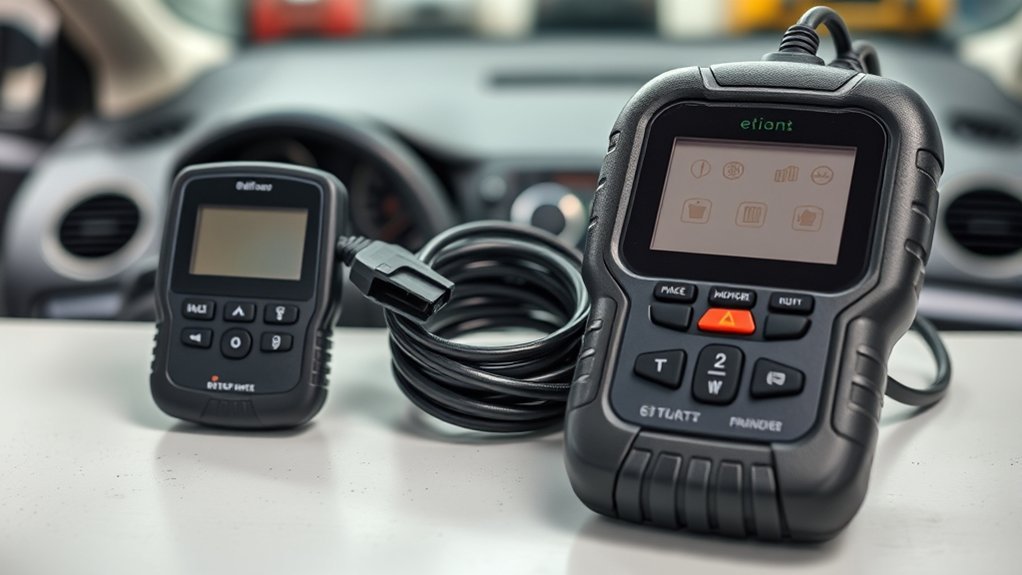
Choose an OBD2 code reader if you mainly need to identify a check-engine light, review basic engine and emissions data, save freeze-frame information, and check inspection readiness. Choose an enhanced OBD2 scanner when you need deeper live-data analysis, ABS or airbag access, service functions, coding or adaptations, or bi-directional tests. The names “code reader” and “scanner” are used inconsistently, so the deciding factor is the exact function and vehicle coverage, not the label on the box.
Last updated: September 19, 2026
Quick Answer
Choose a code reader for basic check-engine codes, freeze-frame data, emissions readiness, and simple live-data checks. Choose an OBD2 scanner when you need broader module access, graphing or recording, service resets, coding, or bi-directional tests. Generic OBD2 compatibility does not guarantee ABS, SRS, transmission, or service-function access, so verify support for your exact year, make, model, engine, trim, and required function before buying.
Key Takeaways
- A code reader is usually enough for basic powertrain trouble codes and emissions checks.
- A scanner may add live-data graphing, ABS, SRS, transmission, service functions, and active tests, but support varies by vehicle.
- “Code reader” and “scanner” are marketing labels, not guaranteed feature levels.
- Generic OBD2 support does not automatically include ABS, airbags, body modules, or vehicle-specific service procedures.
- Do not erase codes before saving the code numbers, freeze-frame data, and readiness status.
- Check exact vehicle and function coverage, update costs, adapters, software licensing, and subscription requirements before purchase.
Understanding the Basics: What Are OBD2 Scanners and Code Readers?

Both tools connect to a vehicle’s diagnostic system and retrieve information stored by one or more control modules. The vehicle’s onboard diagnostic system monitors emissions-related components, stores diagnostic trouble codes, and can illuminate the malfunction indicator lamp when it detects a qualifying fault. The California Air Resources Board describes OBD as a self-diagnostic system built into the vehicle’s computers.
A basic code reader commonly reads and clears generic powertrain codes, checks inspection readiness, displays freeze-frame data, and may show a limited live-data list. Some inexpensive products offer more than the label suggests. For example, the official ANCEL AD310 and ANCEL AD410 pages both list live-data functions even though these products sit near the basic-reader end of the market.
An enhanced or professional scan tool may communicate with additional modules, graph or record several data parameters, run service procedures, perform coding or adaptations, and send commands to supported components. Those capabilities depend on the tool’s software and the vehicle’s control modules. Owning a bi-directional scanner does not mean every active test will work on every vehicle.
Note: There is no universal rule that cleanly separates every product sold as a “code reader” from every product sold as a “scanner.” Compare functions, vehicle coverage, software licensing, and update terms instead of relying on the product name.
Key Differences Between Code Readers and OBD2 Scanners
| Feature | Basic Code Reader | Enhanced OBD2 Scanner |
| Generic engine and emissions codes | Usually included | Included |
| Freeze-frame and readiness status | Common | Common, often with more detail |
| Live data | Sometimes included, often limited | Usually broader, with graphing or recording |
| ABS, airbag, transmission, body modules | Usually not included | Available on supported vehicles and software packages |
| Service resets and relearns | Rare | May include oil, battery, steering, brake, DPF, and other functions |
| Bi-directional active tests | Not typical | Available only when the tool and vehicle support the test |
| Updates and subscriptions | Often simple or free | May require paid updates, brand software, or subscriptions |
| Best fit | Checking a CEL, readiness monitors, freeze frame, and basic engine data | Intermittent faults, multiple modules, service work, relearns, or active testing |
Functionality Overview
A code reader is best viewed as a fast first-step tool. It can tell you which diagnostic trouble codes are stored, whether readiness monitors are complete, and what conditions were recorded when a fault set. That information helps you decide whether to inspect a loose connector, perform further testing, or schedule professional service.
A scan tool can provide a deeper view, but only when its coverage matches the vehicle. Multi-system access, graphing, special functions, coding, and active tests are separate features. A tool may support some of them on one model and fewer on another.
Price and Compatibility
Basic readers often occupy the lowest price tier. Enhanced handheld or app-based scanners usually cost more, while professional platforms can cost hundreds or thousands of dollars when they include broad vehicle coverage, pass-through programming, technical databases, or ongoing subscriptions.
Do not assume a higher price guarantees the functions you need. Check whether the advertised feature works on your exact vehicle and whether extra brand software, cables, adapters, annual updates, subscriptions, or additional manufacturer licenses are required.
OBD2 Scanner vs Code Reader: 60-Second Decision Rule
Choose the least complicated tool that completes the job you actually perform. Use these four questions before comparing brands or prices:
- Do you only need check-engine codes, freeze frame, readiness status, and basic engine data? Start with a code reader.
- Do you need to graph or record live data for an intermittent engine problem? Move to an enhanced scanner with confirmed graphing and recording capability.
- Do you need ABS, SRS/airbag, transmission, electronic parking brake, battery registration, relearns, or active tests? Buy only a scanner that explicitly supports that module and function on your exact vehicle.
- Do you work on several vehicle brands? Check how many makes are included, what additional software costs, and whether updates or subscriptions are required before comparing the purchase price.
Simple rule: If your diagnostic question can be answered by a stored engine code, freeze frame, readiness status, or a short list of engine parameters, a basic reader may be enough. If the job requires another control module or commanding the vehicle to do something, you are shopping for enhanced scan-tool coverage.
Who Should Use a Code Reader vs. an OBD2 Scanner?
Choose a Code Reader If
- You mainly want to investigate a steady check-engine light.
- You need generic and manufacturer-specific powertrain codes supported by the tool.
- You want freeze-frame data and emissions readiness status.
- You prefer a simple handheld device with no phone pairing or subscription.
- You rarely perform repairs beyond basic maintenance and visual checks.
Choose an Enhanced Scanner If
- You diagnose intermittent problems using graphed or recorded live data.
- You need access to ABS, SRS, transmission, body, or chassis modules.
- You perform service resets, relearns, adaptations, or electronic parking brake work.
- You need active tests such as commanding a fan, pump, solenoid, or other supported actuator.
- You work on several vehicles and need broader software coverage.
Professional technicians also need durable hardware, frequent software updates, report generation, topology maps, programming support, and reliable manufacturer coverage. Those needs usually exceed what a casual owner should pay for.
Must-Have Features in an OBD2 Scanner for Effective Diagnostics
Live Data Streaming
Live data lets you watch values such as engine speed, coolant temperature, fuel trims, oxygen-sensor information, throttle position, and vehicle speed while the engine runs. Graphing and recording are more useful than a simple scrolling list because they help you spot patterns and compare sensors under the same conditions.
More data is not automatically better. The scanner should let you select only the parameters needed for the test. A shorter list refreshes faster and is easier to interpret.
Bi-Directional Control Functions
Bi-directional control lets the scan tool send a command to a supported module. Depending on the vehicle, that may include cycling a cooling fan, commanding a purge valve, operating a fuel pump, running an ABS bleed, or testing another actuator.
The Foxwell NT530 Plus, for example, is advertised with bi-directional tests and multi-system functions, but Foxwell also states that available tests depend on the vehicle and ECU. That limitation applies broadly across aftermarket scan tools.
Warning: Active tests can move components or change system operation. Keep hands, clothing, tools, and cables away from fans, belts, pedals, windows, and other moving parts. Follow the vehicle service procedure and do not run a test you do not understand.
Other Features Worth Checking
- Freeze-frame data: captures selected operating conditions when a code sets.
- Pending and permanent codes: help distinguish a newly detected issue from a confirmed or emissions-retained fault.
- Readiness monitor status: shows whether emissions self-tests have completed.
- Module coverage: confirms which systems the tool can access on your vehicle.
- Service functions: may include battery registration, steering-angle calibration, oil reset, DPF service, or brake maintenance.
- Software support: includes update frequency, operating-system compatibility, brand licensing, and subscription terms.
- Data export: lets you save reports or recordings for comparison or professional review.
When Should You Choose an OBD2 Scanner or Code Reader?
Choose by the job, not by the tool’s name.
- Steady check-engine light with normal drivability: start with a basic reader that can save codes, freeze-frame data, and readiness status.
- Intermittent hesitation, fuel-trim issue, or sensor comparison: use a scanner with fast live-data graphing and recording.
- ABS, airbag, transmission, or electronic parking brake warning: use a scanner with confirmed access to that module on your vehicle.
- Component activation or post-repair relearn: use a scanner with the exact active test or service function required.
- Pre-OBD2 vehicle: use a tool, cable, adapter, and software specifically designed for that manufacturer’s earlier diagnostic system.
A diagnostic trouble code identifies the system that detected a problem. It does not prove that the part named in the code description is defective.
How Much Should You Spend on a Code Reader or Scanner?
Set your budget after listing the functions you will actually use. Prices change often, so the ranges below are shopping tiers rather than fixed market quotes.
- Entry level: basic code reading, code clearing, freeze-frame data, and readiness checks. Some models also include limited live data.
- Mid-range: better graphing, recording, more module coverage, and selected service functions for supported vehicles.
- Advanced DIY or small-shop level: broad system access, active tests, adaptations, coding, reports, and wider vehicle coverage.
- Professional level: large vehicle databases, topology views, programming or pass-through support, technical information, and paid update plans.
A low-cost tool is good value when it answers your recurring questions. An expensive scanner is poor value when its advanced menu does not support your vehicle or the repair work you perform. Compare total ownership cost as well as purchase price, including extra vehicle-brand licenses, updates, subscriptions, cables, and adapters.
Ensuring Compatibility With Your Vehicle’s Systems
For U.S.-market passenger cars and light trucks, standardized OBD II requirements broadly apply from the 1996 model year for gasoline and alternate-fuel vehicles, with different implementation timing for some diesel vehicles. That standardization primarily covers emissions-related diagnostics. It does not guarantee that an aftermarket tool can access ABS, SRS, body, transmission, security-gateway-protected functions, or manufacturer-specific service procedures on every vehicle.
European vans are the sharpest example of this gap. A basic reader will pull engine codes from a Mercedes Sprinter, but ABS, SRS, and transmission faults sit in modules it cannot reach at all. Our comparison of full-system scanners that read Mercedes Sprinter modules shows which tools actually go past the engine.
Before buying, confirm all of the following:
- Year, make, model, engine, transmission, trim, and market region.
- Gasoline, diesel, hybrid, plug-in hybrid, or battery-electric powertrain support.
- The exact module you need, such as engine, ABS, SRS, transmission, body control, or TPMS.
- The exact function you need, such as ABS bleeding, battery registration, injector coding, steering calibration, or an active test.
- Whether additional software, adapters, security-gateway access, brand licenses, or subscriptions are required.
- Whether the app supports your phone, tablet, or computer operating system.
Pro Tip: Use the manufacturer’s coverage checker or ask support to confirm one exact function for your VIN or full vehicle configuration. A general “compatible” label may only mean the tool can read basic engine and emissions data.
How to Use a Code Reader or Scanner Without Losing Diagnostic Evidence
- Check the warning light. A flashing check-engine light can indicate a severe, catalyst-damaging misfire. Reduce speed and load, follow the vehicle manufacturer’s guidance, and obtain service promptly. The U.S. Environmental Protection Agency gives similar guidance for a flashing malfunction indicator light.
- Connect with the ignition in the position required by the tool. Keep battery voltage stable during longer scans or service procedures.
- Run a full initial scan. Save all stored, pending, and permanent codes before changing anything.
- Record freeze-frame and readiness data. This evidence can help identify the conditions under which the fault occurred.
- Research the code using service information for the exact vehicle. Test the circuit or system before replacing parts.
- Repair the confirmed cause. Inspect connectors, wiring, hoses, grounds, power supplies, and related components as required.
- Clear codes only when appropriate. Then complete the required drive cycle and rescan to confirm the repair.
Warning: Clearing codes can erase freeze-frame information and reset readiness monitors. California’s Bureau of Automotive Repair explains that readiness monitors must run again after actions such as clearing diagnostic data, disconnecting the battery, or completing certain repairs. Permanent DTCs cannot simply be erased with a scan tool.
OBD2 Tool Tiers: Current Manufacturer-Documented Examples
The examples below illustrate different capability levels rather than universal winners. Feature claims are based on current manufacturer documentation; this article does not represent an independent hands-on test of these three models. Always confirm current specifications and exact vehicle coverage before purchase.
Basic Handheld Reader: ANCEL AD310
The AD310 is a simple corded reader with code reading and clearing, freeze-frame data, readiness checks, and live data according to its official product page. It suits owners who want a dedicated screen and basic engine or emissions diagnostics without phone pairing.
Enhanced Basic Reader: ANCEL AD410
The AD410 adds a color display, graphical live data, onboard monitor information, oxygen-sensor testing, EVAP-related testing, report functions, and manufacturer-advertised lifetime software updates. It remains focused on OBD2 engine and emissions functions rather than broad all-module diagnostics.
Brand-Focused Bi-Directional Scanner: Foxwell NT530 Plus
The NT530 Plus is a more advanced option with multi-system diagnostics, service functions, basic coding or adaptations, and bi-directional tests on supported vehicles. Foxwell currently states that one vehicle-brand software package is included, additional brand software can be purchased separately, and the platform can be expanded to as many as five makes. Foxwell also advertises lifetime free updates. Function depth still varies by vehicle and ECU, so confirm the exact function you need before purchase.
Bluetooth or Wi-Fi Adapter With an App
An app-based adapter can be compact and convenient for dashboards, logging, and code checks. Review the app’s supported vehicles, operating-system requirements, update history, privacy policy, and paid-feature structure. Also check the adapter manufacturer’s guidance on whether the device is designed to remain plugged into the diagnostic port when it is not being used.
Related Guides
Frequently Asked Questions
Which is better, a code reader or an OBD2 scanner?
A code reader is better for basic check-engine diagnostics, readiness checks, freeze-frame data, and simple ownership. An OBD2 scanner is better when you need broader module access, detailed live-data analysis, service functions, or active tests. The right choice is the least expensive tool that fully supports the functions you actually need.
What is the difference between OBD and OBD2?
OBD is the general term for onboard diagnostics. OBD2 refers to the later standardized emissions-diagnostic requirements used on modern vehicles. Earlier OBD systems were more manufacturer-specific, so a standard OBD2 scanner does not automatically work on an older OBD1 vehicle.
Can a code reader show live data?
Yes. Some low-cost products marketed as code readers display live data, freeze-frame information, and readiness status. The label does not define the feature set, so check the specifications and vehicle coverage.
Will an OBD2 scanner diagnose ABS or airbag lights?
Only if the scanner includes access to the ABS or SRS module for your exact vehicle. Generic OBD2 engine and emissions support does not guarantee access to chassis, body, or safety modules.
Do all OBD2 scanners work on all cars?
No. Standard OBD2 communication gives compatible tools access to standardized engine and emissions information, but enhanced modules, service functions, coding, and active tests vary by vehicle, scanner software, market region, and manufacturer. Confirm the exact vehicle and function before buying.
Is it safe to clear a check-engine code?
Clear a code only after saving the diagnostic information and addressing the cause. Erasing codes can remove useful freeze-frame data and reset readiness monitors, which may delay an emissions inspection. Permanent DTCs remain until the vehicle’s OBD system verifies that the qualifying fault is no longer present.
Can an OBD2 scanner tell me which part to replace?
Not reliably. A code identifies a fault detected by a system or circuit. The cause may be a sensor, wiring problem, vacuum leak, connector, power supply, mechanical fault, software issue, or another component. Use the code as the starting point for testing.
Is buying an OBD reader worth it?
Yes, for many owners. A basic reader can provide an initial code check, show whether emissions monitors are ready, preserve freeze-frame information, and help you communicate more clearly with a repair shop. It does not replace proper testing or professional diagnosis.
Conclusion
A code reader is the practical choice for basic engine and emissions checks. An enhanced OBD2 scanner makes sense when you need deeper live-data analysis, access to additional modules, service functions, or bi-directional tests. Because product labels overlap, list the exact jobs you need the tool to perform and verify those functions for your vehicle before spending more. Whichever tool you choose, save the diagnostic evidence before clearing codes and test the fault instead of replacing parts based on a code description alone.
Sources
- California Air Resources Board: OBD II Systems Fact Sheet: OBD II purpose, vehicle coverage, warning lights, and readiness indicators.
- California Bureau of Automotive Repair: On-Board Diagnostic Test Reference: readiness monitors, communication, and permanent DTC rules.
- U.S. Environmental Protection Agency: Frequently Asked Questions About On-Board Diagnostics: check-engine-light behavior and guidance for a flashing malfunction indicator light.
- ANCEL AD310 Official Product Page: listed code-reader functions and compatibility claims.
- ANCEL AD410 Official Product Page: live data, readiness, freeze-frame, emissions-test functions, and update claims.
- Foxwell NT530 Plus Official Product Page: multi-system, service, coding, bi-directional, update, and vehicle-software limitations.