The Toyota Tundra is available with three nominal bed lengths, but the correct dimensions and cab pairings depend on the model year. Current-generation U.S. trucks offer 5.5-, 6.5-, and 8.1-foot beds. Before choosing a truck or ordering a tonneau cover, toolbox, camper, or rack, confirm the year, cab style, usable cargo-box measurements, and payload rating of the exact vehicle.
Quick Answer
Current Toyota Tundra trucks offer nominal 5.5-, 6.5-, and 8.1-foot beds. CrewMax models pair with the 5.5- or 6.5-foot bed, while Double Cab models use the 6.5- or 8.1-foot bed. Exact dimensions and payload vary by model year, trim, drivetrain, and equipment.
Key Takeaways
- The 5.5-foot bed is the easiest to maneuver and is available with the current CrewMax cab.
- The 6.5-foot bed offers the broadest cab compatibility and balances passenger space with cargo length.
- The 8.1-foot bed provides the longest floor but is paired with the current Double Cab.
- Nominal bed names are rounded; measure the actual cargo box before buying fitted accessories.
- Payload comes from the certification label on the individual truck, not from bed length alone.
Overview of All Tundra Bed Sizes

For current-generation U.S. Toyota Tundra trucks, the main cab-and-bed combinations are straightforward. Toyota pairs the CrewMax cab with a 5.5- or 6.5-foot bed and the Double Cab with a 6.5- or 8.1-foot bed. Toyota confirms these combinations in its official Tundra model information.
| Nominal Bed | Approx. Inside Length | Current Cab Pairing | Best Suited For |
|---|---|---|---|
| 5.5 feet | About 65.6 inches | CrewMax | Daily driving, urban parking, recreational gear, and buyers who prioritize rear-seat room |
| 6.5 feet | About 77.6 inches | CrewMax or Double Cab | Mixed work and personal use, home projects, camping equipment, and greater cargo flexibility |
| 8.1 feet | About 96.5 inches | Double Cab | Long lumber, larger equipment, job-site use, and loads that benefit from a longer closed-tailgate floor |
Current-generation cargo boxes are approximately 58.7 inches wide at their broadest point, about 48.7 inches between the wheel housings, and roughly 20.9 inches deep. These measurements are approximate and may be reduced by liners, mats, dividers, storage systems, or other accessories.
Note: The table is intended for current-generation U.S. Tundra trucks. A 2007–2021 Tundra uses different dimensions and cab pairings. Consult the Toyota owner’s manual portal and measure the actual bed before ordering fitted equipment.
Essential Measurements for the 5.5-Foot Tundra Bed
The current 5.5-foot Tundra bed has an approximate inside floor length of 65.6 inches with the tailgate closed. Its maximum inside width is about 58.7 inches, while the space between the wheel housings is approximately 48.7 inches. The bed is roughly 20.9 inches deep.
This short bed is paired with the CrewMax cab. It is a practical choice when passenger space, maneuverability, and easier parking matter more than carrying long materials with the tailgate closed. It can handle coolers, bicycles, camping gear, tools, landscaping supplies, and many home-project loads.
A standard sheet of plywood or drywall is nominally 48 inches wide, so it can generally lie flat between the current bed’s wheel housings. Clearance is limited, however. A thick liner, divider, damaged panel, or protruding accessory can change the available width, so measure before loading.
Pro Tip: If you regularly carry bicycles, motorcycles, tool chests, or sheet goods, mark their required length and width on a tape measure before visiting a dealer. Checking the actual truck is more reliable than choosing from the nominal bed name alone.
Measurements for the 6.5-Foot Bed
The current 6.5-foot Tundra bed provides approximately 77.6 inches of inside floor length. It uses roughly the same 58.7-inch maximum width, 48.7-inch wheel-housing clearance, and 20.9-inch depth as the other current bed lengths.
Its main advantage is flexibility. Toyota offers the current 6.5-foot bed with both CrewMax and Double Cab configurations, although grade, powertrain, and drivetrain availability can vary. This makes it the middle choice for drivers who want more enclosed cargo length without moving to the longest truck configuration.
Overall Dimensions Overview
With the tailgate closed, the 6.5-foot bed is nearly one foot longer than the short bed. Lowering the tailgate creates a longer support surface for some cargo, but the tailgate does not increase the truck’s payload rating or eliminate the need for proper support and securement.
The useful dimensions are not limited to floor length. When comparing equipment, check the width between the top rails, the width at floor level, the distance between wheel housings, the depth below the rails, and the location of cleats, outlets, lights, and rail-system hardware.
Cargo Capacity Considerations
Bed volume and payload are different. A 6.5-foot bed can provide more room than a 5.5-foot bed, but the amount of weight the truck can legally and safely carry depends on the complete vehicle configuration.
Find the statement on the driver-side certification label that identifies the combined weight of occupants and cargo the vehicle can carry. Subtract the weight of passengers, aftermarket steps, a tonneau cover, toolboxes, a bed rack, a camper, trailer tongue weight, and other added equipment from that figure. The amount left is the practical capacity available for cargo.
The 8.1-Foot Bed: Dimensions and Uses
The current 8.1-foot Tundra bed has an approximate inside length of 96.5 inches with the tailgate closed. It is available with the Double Cab and is the strongest choice when cargo length matters more than maximum rear-seat room or compact overall dimensions.
Its maximum inside width is approximately 58.7 inches, with about 48.7 inches between the wheel housings. The cross-sectional dimensions are similar to those of the shorter current beds; the primary difference is the longer floor.
The long bed is well suited to lumber, ladders, job-site equipment, landscaping materials, and recreational gear. It also reduces the amount of rear overhang for many long loads. The tradeoff is a longer wheelbase and overall truck length, which can make garages, parking structures, drive-through lanes, and tight trail approaches more challenging.
Recent Tundras use a sheet-molded-compound cargo bed reinforced by aluminum crossmembers. Toyota says this construction helps resist dents, impact dings, and rust compared with a traditional steel deck. Current features also include a power-release tailgate, with power-close operation available on applicable configurations.
Choosing the Right Bed Size

Choosing the right Toyota Tundra bed size requires more than comparing cargo-floor lengths. The cab and bed work together to determine passenger space, wheelbase, overall length, turning needs, parking convenience, and accessory compatibility.
- Choose the 5.5-foot bed when you want a CrewMax cab, frequently park in urban areas, and mainly carry compact or recreational cargo.
- Choose the 6.5-foot bed when you need a flexible middle ground for home projects, outdoor equipment, and occasional longer loads.
- Choose the 8.1-foot bed when long cargo is a regular part of your work and the truck’s additional overall length will fit your parking and storage space.
Before deciding, measure the garage from the closed door to the nearest wall, account for shelving or a trailer hitch, and verify overhead clearance if a rack or camper will be installed. Also consider where the truck will be driven. A long bed may be ideal on an open work site but inconvenient in a compact parking garage.
The best Tundra bed is the shortest one that safely handles your regular cargo without forcing you to compromise on passenger room, parking, or payload.
How to Measure a Tundra Bed for Accessories
Accessories are normally listed by model year, cab, and nominal bed length, but measuring provides an extra check. Use a rigid tape measure and record these four dimensions:
- Floor length: Measure from the inside front wall of the cargo box to the inside surface of the closed tailgate.
- Width between wheel housings: Measure the narrowest clear distance between the two wheel wells.
- Maximum inside width: Measure the widest usable point from one inner bed wall to the other.
- Rail and depth measurements: Measure between the bed rails and from the bed floor to the top of the rails.
For a tonneau cover, camper shell, rack, or slide-in unit, follow the accessory manufacturer’s measurement instructions as well. Rail caps, spray-in liners, drop-in liners, deck systems, cleats, and power outlets can affect fit even when the nominal bed length matches.
Warning: Do not install a camper, rack, toolbox, or other heavy accessory based only on physical fit. Confirm its weight, mounting requirements, center-of-gravity limits, and effect on the truck’s available payload.
How Bed Dimensions Affect Tundra Payload Capacity
A longer bed increases cargo floor area, but it does not automatically increase payload. Toyota lists a maximum available Tundra payload of 1,940 pounds for an appropriately configured truck. That is a lineup maximum, not the rating for every Tundra.
Payload varies with cab style, drivetrain, powertrain, grade, suspension, wheels, factory options, and installed equipment. A highly equipped truck can have less available payload than a simpler configuration, regardless of bed length.
Use this process before loading:
- Read the combined occupant-and-cargo limit on the truck’s certification label.
- Add the weight of every person who will ride in the truck.
- Add permanently or temporarily installed accessories.
- Add cargo weight and, when towing, the trailer’s actual tongue or pin weight imposed on the truck.
- Keep the combined total within all applicable payload, axle, tire, and hitch limits.
Do not rely only on visible suspension sag. A truck can exceed a tire, axle, or payload limit without appearing dramatically overloaded.
Benefits of Different Tundra Bed Sizes
Each Tundra bed size serves a different set of priorities:
- 5.5-foot bed: Provides the most compact current CrewMax configuration and works well for everyday driving, family use, and shorter recreational cargo.
- 6.5-foot bed: Offers the widest current cab compatibility and enough additional length to simplify many home-improvement and outdoor loads.
- 8.1-foot bed: Provides nearly eight feet of usable closed-tailgate floor length for work equipment and long materials.
- Common wheel-housing clearance: The current beds provide approximately 48.7 inches between the wheel housings, allowing many nominal 4-foot-wide sheets to lie flat after actual clearance is confirmed.
The right choice depends on what you carry most often. Occasional long cargo can sometimes be transported with suitable supports and securement, while a long bed may be unnecessary if most trips involve passengers and compact gear.
Smart Tips for Loading Your Tundra Bed
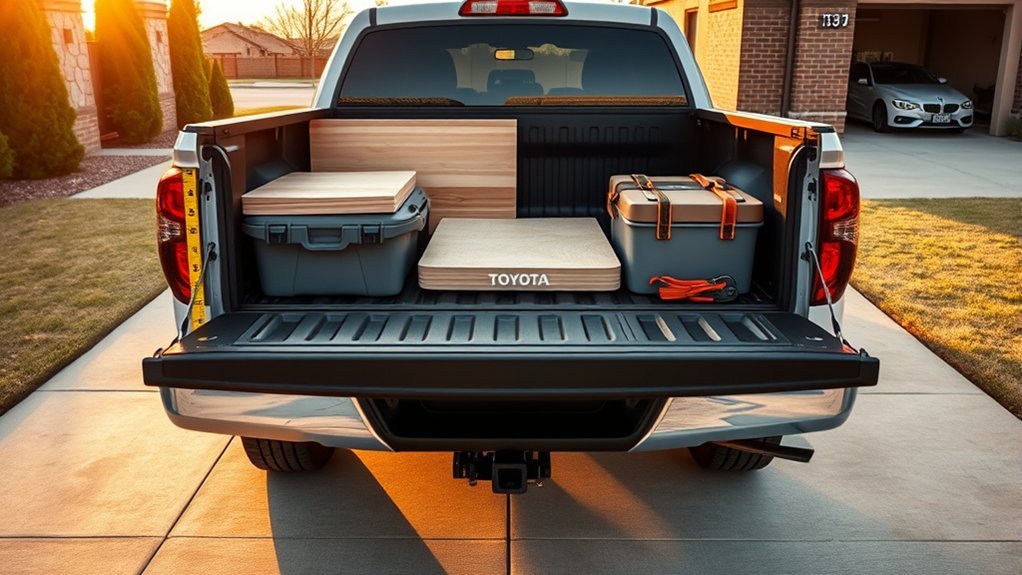
Safe loading begins with the truck’s weight limits and continues with stable placement, suitable restraints, and regular inspection. Cargo should not be able to slide, roll, tip, lift, or leave the bed during braking, cornering, acceleration, or travel over rough roads.
Proper Weight Distribution Techniques
- Keep heavy cargo low: A lower center of gravity reduces body movement and the tendency of cargo to tip.
- Place weight toward the front: Put dense items near the front of the bed when practical, while staying within front- and rear-axle limits.
- Balance side to side: Avoid concentrating the entire load over one side of the truck.
- Prevent point loading: Use suitable supports or dunnage beneath concentrated loads that could damage the bed.
- Support long material: Use an appropriate rack or support system rather than allowing excessive unsupported overhang.
- Maintain visibility: Do not block required lamps, the license plate, mirrors, or the driver’s field of view.
Utilize Tie-Down Accessories
Use undamaged straps, chains, ropes, hooks, cleats, or other restraints that are suitable and rated for the cargo. Connect them only to secure attachment points. Do not attach a restraint to trim, a movable rail component that has not been locked, or an accessory not designed to carry the force.
Use enough restraints to prevent movement in every direction. Protect straps from sharp edges, close or secure loose strap tails, and recheck the load shortly after starting the trip and at reasonable intervals. Commercial operators must follow applicable cargo-securement regulations; private drivers should follow the owner’s manual and all provincial, state, and local laws. The FMCSA cargo-securement overview explains the forces that securement systems must resist in regulated commercial service.
Warning: An open tailgate, bed extender, or rack does not secure a load by itself. Follow applicable rules for rear overhang, warning flags, lamps, and nighttime marking, and never exceed the truck’s payload, axle, tire, hitch, or accessory limits.
Future Trends in Toyota Tundra Bed Configurations
Future model-year equipment should be verified when Toyota publishes the specifications rather than predicted from earlier trucks. Several features once described as future possibilities are already present on recent Tundras, including sheet-molded-compound bed construction, aluminum reinforcing crossmembers, a power-release tailgate, available power-close operation, rail-mounted cargo accessories, bed lighting, and available in-bed power equipment on applicable configurations.
Changes are most likely to appear through grade availability, packages, tailgate features, storage accessories, cameras, power equipment, and material updates. Cab-and-bed combinations can also change between generations. Anyone buying a new truck or transferring accessories from an older one should verify the exact model-year specifications instead of assuming that a familiar nominal bed name guarantees the same dimensions.
Related Guides
Frequently Asked Questions
What year was the worst year for the Toyota Tundra?
There is no official worst Tundra model year. Reliability varies by engine, configuration, maintenance, operating conditions, repairs, and the condition of the individual truck. For a used Tundra, search its VIN through the NHTSA recall database, review service records, scan for diagnostic codes, inspect for corrosion or collision repairs, and arrange an independent pre-purchase inspection.
How long is a Toyota Tundra 6.5-foot bed?
A current-generation 6.5-foot Tundra bed is approximately 77.6 inches long inside at the floor with the tailgate closed. Earlier generations can have different measurements, so verify the model year and measure from the inside front wall to the inside of the closed tailgate.
What is the difference between the Tundra short bed and standard bed?
On a current Tundra, the short bed is nominally 5.5 feet and measures about 65.6 inches inside. The standard 6.5-foot bed measures about 77.6 inches, providing approximately 12 additional inches of floor length. The 5.5-foot bed is CrewMax-only, while the 6.5-foot bed can be paired with CrewMax or Double Cab configurations.
How wide is the bed of a 2019 Toyota Tundra?
The 2019 Tundra belongs to the previous generation and should not be measured using current-generation figures. Its cargo box is roughly 66 inches wide at its broadest point and about 50 inches between the wheel housings, depending on the measurement location and installed liner. Measure the individual truck before ordering a cover, toolbox, camper, or divider.
Can a 4-by-8 sheet of plywood lie flat in a Tundra bed?
A nominal 48-inch-wide sheet can generally lie flat between the wheel housings of current-generation Tundra beds because the approximate clearance is 48.7 inches. A full 8-foot sheet extends beyond the closed tailgate in the 5.5- and 6.5-foot beds. Confirm actual clearance, support the material, and secure it against movement.
Does the longest Tundra bed have the highest payload?
Not necessarily. Bed length is only one part of the truck’s configuration. Cab style, drivetrain, engine, hybrid equipment, trim, wheels, options, passengers, accessories, and trailer tongue weight all affect available payload. Use the certification label on the individual truck rather than a general bed-size comparison.
Conclusion
The current Toyota Tundra’s 5.5-, 6.5-, and 8.1-foot beds serve distinct needs. The short bed favors CrewMax passenger room and easier maneuvering, the 6.5-foot bed provides the most flexible cab pairing, and the 8.1-foot bed offers the longest closed-tailgate cargo floor. Because dimensions and availability changed between generations, always confirm the model year, measure the actual bed, and check the truck’s certification label before choosing accessories or planning a heavy load.
Sources
- Toyota USA Newsroom: 2025 Toyota Tundra — current cab-and-bed combinations, bed construction, tailgate equipment, and maximum available payload.
- Toyota USA Newsroom: 2026 Toyota Tundra — current model-year updates, SMC bed construction, and tailgate features.
- Toyota Manuals and Warranties — model-year-specific owner information, limitations, and operating guidance.
- National Highway Traffic Safety Administration Recall Lookup — VIN and model-specific recalls, investigations, complaints, and manufacturer communications.
- Federal Motor Carrier Safety Administration Cargo Securement Rules — securement principles and regulated commercial-vehicle performance requirements.