You want a welder that travels with you, starts easily, and handles the rods you use for on-site repairs. Portable Amico stick welders with dual-voltage support, stable inverter arc control, and practical duty-cycle ratings can help with farm fixes, trailer repairs, fence work, light fabrication, and shop projects without forcing you to move a heavy machine.
This guide compares the most relevant Amico welder options from the original roundup so you can match the right model to your work style, power source, and budget. Product details, package contents, ratings, and availability can change, so always confirm the current Amazon listing before buying.
Affiliate disclosure:. As an Amazon Associate I earn from qualifying purchases. This roundup is reader-supported. Product details, ratings, review counts, and package contents can change, so confirm the latest information on Amazon before buying. When you click through links, we may earn a referral commission on qualifying purchases.
Top Picks
|
Category |
Product |
Best Fit |
|---|---|---|
|
🏆 Best Overall |
All-around portable stick welding |
|
|
💰 Best Value |
Home, garage, and lighter repairs |
|
|
🎯 Best 200A Alternative |
Wide-voltage 200A-class stick/Lift-TIG option |
|
|
🚀 Best Heavy Duty |
Tougher maintenance and thicker material |
|
|
🚚 Best Portability |
Grab-and-go repairs and field use |
Quick Verdict
If you want one portable stick welder for the widest range of repair work, start with a 200A ARC model because it gives you useful amperage headroom, broad voltage support, and flexibility for common repair rods. If you mainly handle light garage, fence, farm, or trailer repairs, the ARC-160 or ARC-185 keeps the setup lighter and easier to carry. If you expect tougher maintenance work, compare the ARC-220 for its higher output ceiling.
- Best all-around direction: choose the ARC-200DC for a balanced mix of power, portability, and stick/Lift-TIG flexibility.
- Best lighter-duty direction: choose the ARC-160 when lower weight, lower cost, and simple repair work matter most.
- Best 200A alternative: choose the ARC-200 when you want another wide-voltage 200A-class stick/Lift-TIG option for common repair work.
- Best heavier-duty direction: choose the ARC-220 when you want extra amperage headroom for demanding maintenance work.
How We Picked
You need a welder that fits the way you work. We prioritized machines that combine portability with useful power: dual-voltage operation for on-site flexibility, a practical duty cycle so you can weld longer without constant pauses, stable arc control for different electrode types, and compatibility with common rods such as E6010, E6011, E6013, E7014, and E7018.
We also weighed build quality, included accessories, ETL or third-party listings where noted, user-reported reliability, and overall value. That mix helps you match a model to jobs ranging from light farm repairs to heavier fabrication while staying within a practical price and weight for portable use.
Because many Amico welders share similar names, the comparison focuses on the buying factors that matter most: amperage range, input voltage, duty cycle, electrode support, arc-start help, included leads, portability, and whether the machine still makes sense away from a fixed shop outlet.
Quick Comparison
|
Model |
Main Strength |
Best Buyer |
|---|---|---|
|
Amico ARC-200DC |
Balanced 200A portable stick/Lift-TIG setup |
Buyers who want one versatile welder for home, farm, and shop repairs |
|
Amico ARC-160 |
Compact size and value-focused output |
Homeowners and hobby welders doing lighter repair work |
|
Amico ARC-200 |
More output and rod flexibility than smaller units |
Users who weld thicker material or want more 200A headroom |
|
Amico ARC-220 |
Higher amperage ceiling for tougher maintenance |
Farm, construction, and shop users who expect harder duty |
|
Amico ARC-185 |
Lightweight grab-and-go design |
Mobile repair users who value portability first |
Buyer-feedback note: The feedback themes and sentiment charts below come from the supplied source summary. They are not a live snapshot of current Amazon ratings or review counts, so confirm the latest listing details before buying.

You get a capable, portable stick welder that suits backyard projects, farm fixes, and on-the-road repairs. It is designed around wide-voltage support, and the inverter tech helps deliver a smooth, reliable arc that can make rod starts easier. With a compact body and 200A-class output, it is useful for thin stainless work, trailer fixes, fence repairs, and tougher field jobs.
It comes with long cables, an adapter for common voltage setups, and simple controls, making it a strong pick if you want a no-fuss machine you can move between a garage, truck, and jobsite.
Why You’ll Like It
The ARC-200DC gives you a practical middle ground: more output than a small beginner welder, but still portable enough for mobile repairs. It is the easiest recommendation here if you want one machine to cover the widest range of common stick-welding jobs.
Who Should Buy This
Choose this model if you repair trailers, gates, equipment brackets, fencing, or general steel projects and want a portable welder that can run from more than one power setup.
Who Should Avoid This
Skip it if you only need a very light-duty welder for occasional thin-metal repairs, or if TIG is your primary process and you want a dedicated TIG-first machine with a torch-focused setup.
Buyer Feedback Themes
Buyer feedback in the source summary highlights easy starts, steady beads, auto-voltage convenience, and long supplied cables as major positives. Some heavier users mention upgrading the clamp or stinger over time.
Source-summary sentiment: Positive; current Amazon review distribution was not independently verified.

Versatility
You can use this for small shop projects, farm repairs, trailer fixes, and welding practice. It covers thin stainless to heavier plate and can work with household, shop, or generator power when the setup is properly rated.
Durability
Customers describe it as a solid, work-ready unit rather than a toy. A few users swap out the supplied clamps or leads for heavier-duty versions, but most find the stock hardware adequate for portable and hobby use.
Key Benefits
- Works with common electrodes including E6010, E6011, E6013, and E7018
- Wide-voltage input support for more flexible power options
- 200A-class output for longer and tougher portable repairs
- Lift-TIG plus stick combo gives more flexibility for different jobs
- Built-in hot start, anti-stick, and arc-force adjustments for easier strikes
Check Current Amazon Availability

The ARC-160 is the value-focused choice if you want a compact stick welder for home, garage, farm, and light jobsite use. It offers wide-voltage support, responsive arc behavior, and Lift-TIG flexibility for thinner metals and stainless repairs.
The compact size and included accessories help reduce setup friction when you need a simple welder for quick repair work.
Why You’ll Like It
The ARC-160 is easier to justify if you do not need maximum amperage. It keeps the setup lighter, simpler, and more budget-friendly while still covering many common household and farm repair tasks.
Who Should Buy This
Choose it if you weld brackets, gates, small equipment parts, practice coupons, and basic steel repairs more often than thick plate or heavy fabrication.
Who Should Avoid This
Skip it if you expect long, high-amperage sessions or frequent work on thicker material. In that case, a 200A or 220A-class model gives you more breathing room.
Buyer Feedback Themes
Buyer feedback in the source summary points to reliable arc performance, a sturdy portable build, light weight, and useful included cables. Some users recommend using a properly rated outlet and upgrading clamps for heavier daily work.
Source-summary sentiment: Positive; current Amazon review distribution was not independently verified.

Versatility
Use it for small shop projects, trailer fixes, fence repairs, farm equipment touch-ups, and portable maintenance. The Lift-TIG option is helpful when you want cleaner starts on thinner material.
Durability
The metal-bodied design and ETL listing give it a work-ready feel. For heavy continuous industrial cycles, some users upgrade cables or clamps, but for portable and hobby work the stock setup is practical.
Key Benefits
- Works with common electrodes like E6010, E6011, E6013, E7014, and E7018
- Auto-sensing 100-250V input for flexible power options
- Lift-TIG and stick combo gives more ways to handle stainless and standard repairs
- Compact value-focused design for lighter portable work
- Built-in hot start, anti-stick, and protection features
Check Product Details on Amazon

If you need a portable welder that can handle tougher jobs without becoming a burden to carry, this ARC-200 is a solid pick. You get automatic 100-250 V sensing, IGBT inverter stability, and both stick and Lift-TIG functionality.
With 200A-class output on higher-voltage power, it is built for longer repair or fabrication tasks while still fitting into a truck or busy workshop.
Why You’ll Like It
The ARC-200 makes sense when you want more output than a 160A machine but do not want to step up to the heavier-duty ARC-220. It is a strong middle option for common repair rods, outdoor repairs, and general shop use.
Who Should Buy This
Choose it if you work on trailers, fencing, farm equipment, brackets, and thicker repair pieces where a smaller welder may feel limited.
Who Should Avoid This
Skip it if portability is your top priority and most of your work is thin, light material. The ARC-160 or ARC-185 may be easier to move and store.
Buyer Feedback Themes
Buyer feedback in the source summary commonly praises the steady arc and reliable auto-voltage sensing. People also call out the Lift-TIG option and stronger duty-cycle story for longer jobs.
Source-summary sentiment: Positive; current Amazon review distribution was not independently verified.

Versatility
Use it for quick garage repairs, trailer fixes, fence repairs, farm equipment maintenance, light fabrication, and stainless patchwork.
Durability
The metal housing and ETL listing give it a work-ready feel. Its protections help it handle voltage swings and overloads, while heavier users may upgrade the stock leads.
Key Benefits
- Auto 100-250 V input for outlets, shop power, and generators
- IGBT inverter tech for a concentrated, stable arc
- 200A-class range for thin sheet up to heavier repairs
- Lift-TIG function for TIG-style starts on cleaner stainless work
- Includes electrode holder, grounding clamp, and 230 V-to-115 V adapter
Check Product Details on Amazon
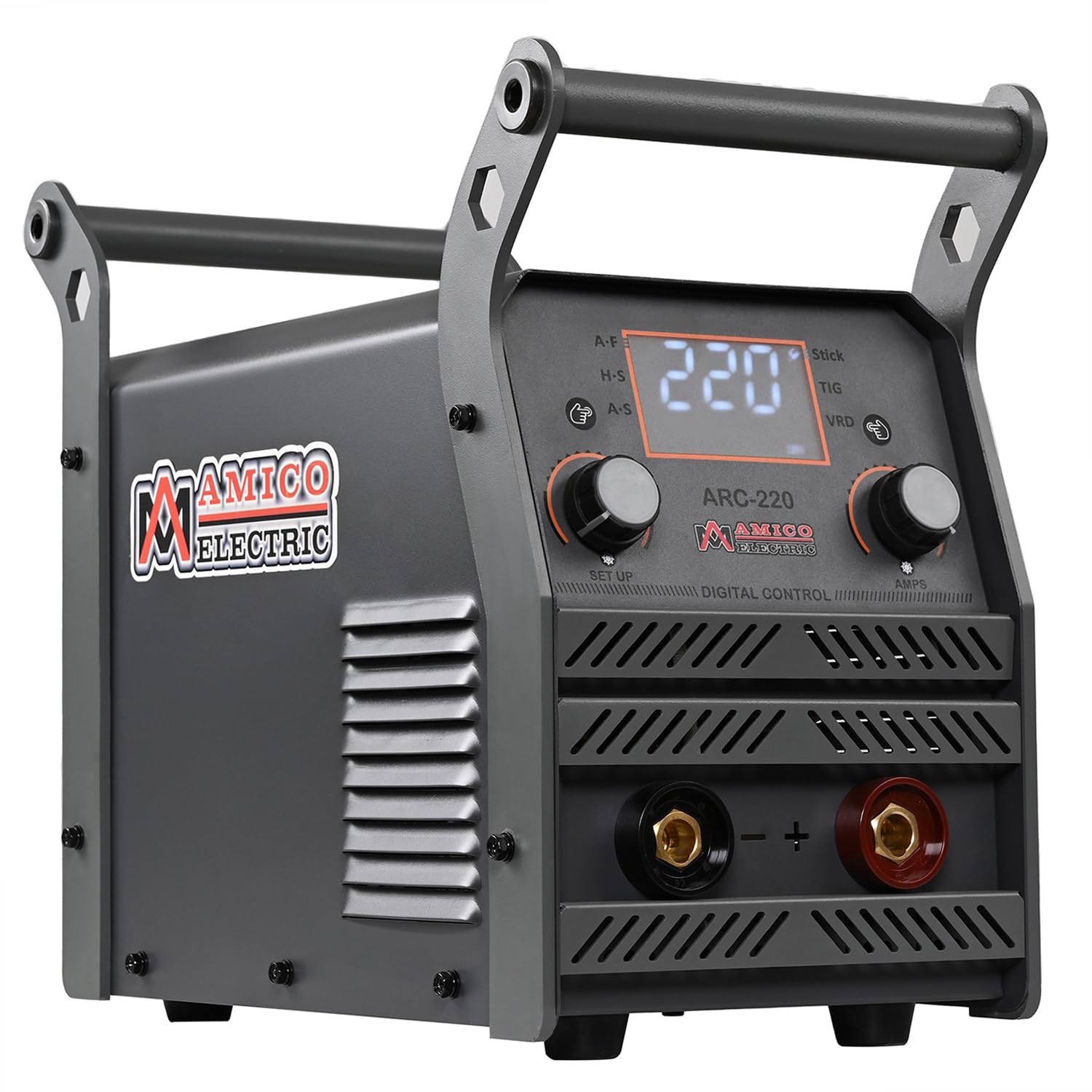
The ARC-220 is the heavier-duty pick when you want more amperage headroom than a 160A or 200A unit. It is still portable enough for jobsite movement but better suited to buyers who expect tougher maintenance work, longer runs, or thicker material.
It supports Stick and Lift-TIG use, auto-detects 100-250V, and includes features such as hot start, adjustable arc force, anti-stick, and VRD support for better usability.
Why You’ll Like It
The ARC-220 gives you more output ceiling when repairs become less predictable. That extra headroom helps when you move from light garage work to thicker steel, maintenance brackets, equipment repairs, or longer sessions.
Who Should Buy This
Choose this model if you repair farm equipment, construction pieces, heavier trailers, gates, or shop projects where a smaller welder might feel underpowered.
Who Should Avoid This
Skip it if you only need a compact welder for occasional thin metal or quick household repairs. You may spend less and carry less with the ARC-160 or ARC-185.
Buyer Feedback Themes
Buyer feedback in the source summary commonly praises the ARC-220 for stable arc control, wide electrode support, auto-voltage switching, memory settings, fan behavior, and long lead capability. Some note that the stock clamps and connectors may feel light for heavy daily work.
Source-summary sentiment: Positive; current Amazon review distribution was not independently verified.

Versatility
Use it for routine garage fixes, trailer repairs, fence work, farm equipment maintenance, construction touchups, and heavier maintenance tasks.
Durability
The thick steel casing and industrial-style construction give it a solid worksite feel. Built-in protections help it handle voltage swings and overload situations.
Key Benefits
- Wide 10-220 A output to handle thin sheet metal up to heavier repair work
- Stick and Lift-TIG combo covers dirty surfaces and cleaner thin-metal starts
- Auto 100-250 V input for different outlets or generators
- IGBT inverter for stable arc and improved bead control
- Memory function and intelligent fan support repeat jobs
- Supports long extension runs when the cord, outlet, and circuit are properly rated
Check Current Amazon Availability

The ARC-185 is the grab-and-go pick if you want a lighter welder with more output than a small beginner unit but less bulk than heavier models. It works on 115V or 230V, supports generator use, and is portable enough for garage, trailer, farm, and field repairs.
The ARC-185 is compact enough for frequent transport, while the supplied source identifies a 20-180 A range and a 60% duty-cycle claim at 180 A. Because weight and duty-cycle details can vary across listings or revisions, confirm the current Amazon listing and manual before relying on exact figures.
Why You’ll Like It
The ARC-185 is useful when the welder has to move often. It gives you more headroom than many smaller machines while staying easier to carry, store, and load into a truck.
Who Should Buy This
Choose it if you do mobile repairs, move between work areas, or want a compact welder that can still handle many trailer, fence, and farm touch-ups.
Who Should Avoid This
Skip it if you regularly weld thick material at higher amperage. The ARC-200 or ARC-220 gives you more output headroom.
Buyer Feedback Themes
Buyer feedback in the source summary praises the ARC-185 for steady arc output, reliable performance on both 120V and 240V supplies, and the ability to handle long extension runs without overheating in regular use.
Source-summary sentiment: Positive; current Amazon review distribution was not independently verified.

Versatility
Use this for quick garage fixes, trailer and fence repairs, farm equipment maintenance, and on-site touch-ups. Stick welding handles dirty or painted metal with less surface prep than cleaner TIG-style work.
Durability
The unit’s metal construction and ETL listing give it a solid worksite-ready feel, while protective electronics help with voltage swings and overloads.
Key Benefits
- Dual 115 V / 230 V input for household power, generators, or shop outlets
- IGBT inverter gives a stable, concentrated arc and cleaner starts
- Wide current range from 20-180 A
- Source-stated 60% duty-cycle claim at 180 A; verify against the current manual/listing
- LED amperage display and simple controls
- Compact and light enough to move between sites
Check Product Details on Amazon
Before You Buy A Portable Stick Welder
Power Source Check
Confirm whether you will use 115/120V household power, 230/240V shop power, or a generator. A dual-voltage machine is helpful, but the best output usually comes from the higher-voltage supply. Use a properly rated outlet, breaker, and extension cord so the welder can run safely without nuisance trips or weak arc performance.
Rod And Material Check
Match the welder to the rods you use most. E6013 and E7018 are common for many repairs, while E6010 and E6011 can be more demanding. If you plan to weld dirty farm steel, painted trailer parts, or thicker plate, prioritize amperage headroom and stable arc control.
Duty Cycle Check
Duty cycle tells you how long the welder can work before it needs a cooling break. Treat duty-cycle numbers as a guide because real performance depends on input voltage, ambient temperature, rod size, amperage setting, and ventilation.
Accessory Check
Look at the included leads, clamp, stinger, voltage adapter, and any optional Lift-TIG torch requirements before you buy. The included parts may be enough for occasional projects, but heavy daily users often upgrade clamps, holders, or cables.
Portability Check
Weight matters if you load the welder into a truck, carry it around a farm, or move it between job areas. If portability is your top concern, the ARC-160 or ARC-185 may be easier to handle. If output matters more, compare the ARC-200, ARC-200DC, and ARC-220 first.
Portable Welding Safety Notes
Use proper PPE every time: a welding helmet with the correct shade, gloves, flame-resistant clothing, eye protection, and safe ventilation. Keep flammable materials away from the work area, clamp the ground securely, protect leads from sharp edges, and avoid welding on containers or coated materials unless you know they are safe to weld. A portable machine makes field repairs easier, but the same fire, shock, and fume risks still apply.
Also check your circuit, breaker, plug, and extension cord before welding. Undersized cords or weak power can reduce performance, overheat components, or trip breakers. When in doubt, follow the welder manual and use a qualified electrician for outlet or circuit questions.
Related Guides
FAQ
Are These Stick Welders Good For Portable, On-Site Work?
Yes. These Amico series machines were selected with portability in mind, and you will appreciate the compact size and manageable weight when you move between jobs. Many models offer dual-voltage operation so you can run on 115/120V or 230/240V, they include lead cables, and some come with a 230 plug plus an adapter.
Before you head out, make sure you have the correct outlet or a properly rated generator, secure the unit and leads in your truck to avoid damage, and remember that the supplied stinger and clamp may be upgraded for heavier daily use.
Which Electrodes And Materials Can You Weld With These Machines?
You can weld a wide range of electrodes commonly used in stick welding, including E6010, E6011, E6013, E7014, E7018, and similar rods. For thin sheet or light tubing, drop your amperage and use a short arc or tack-weld technique to reduce burn-through risk. For thicker plate, increase current and use the appropriate rod size.
If you plan to run fast-freeze or cellulose rods like 6010, be aware that starting some of those rods can be more demanding and benefits from a higher open-circuit voltage, proper polarity, dry rods, and a clean, solid ground.
Should You Choose 160A, 185A, 200A, Or 220A?
Choose based on the thickest material you expect to weld and how long your sessions usually run. A 160A machine is enough for many lighter repairs, while a 185A or 200A model gives more flexibility. A 220A model is better when you expect tougher maintenance work or want more output headroom.
Is Lift-TIG The Same As A TIG-First Welder?
No. Lift-TIG adds useful flexibility to a stick welder, but it does not turn the machine into a full TIG-focused package. If precise TIG starts, torch controls, and clean thin-metal work are your main priorities, compare dedicated TIG machines separately. If you mainly weld repair steel, a stick-first ARC model is usually simpler.
How Should You Set Up And Maintain Your Welder For Reliable Portable Performance?
Set up on a stable surface, use the correct voltage and a heavy-gauge extension cord or outlet, tighten cable connections, and test on scrap metal before your first weld so you can dial in arc force and amperage. Observe the rated duty cycle and give the unit cooling breaks during long runs.
Regular maintenance is simple: keep vents clear of dust, check cable insulation and clamp contact surfaces, store the machine dry, and always follow proper PPE and grounding practices.
Which Amico Welder Should You Choose?
Choose by job size first, then by power access and carry weight. A 200A ARC machine is the safest middle ground for buyers who move between home repairs, farm fixes, and light fabrication. The ARC-160 and ARC-185 make more sense when you value portability and lower weight over maximum output. The ARC-220 is better when you want more amperage headroom for tougher maintenance tasks.
Also check package contents before buying. These ARC models are stick-first machines, and Lift-TIG capability may require additional torch or gas equipment depending on the model and listing. If you already own upgraded leads or clamps, a simpler package may be enough; if you are starting from scratch, included accessories can make the first project easier.
Popular Buying Directions
When choosing between the Amico ARC-200 and ARC-160, the main tradeoff is output headroom versus a lighter, simpler setup. The ARC-200 suits buyers who expect tougher repairs or longer higher-output sessions, while the ARC-160 is easier to justify for lighter jobs. Compare arc controls, input voltage, included leads, carry weight, and the duty-cycle rating shown in the current manual before deciding.
Final Recommendation
If you want the most versatile all-around machine, start with the Amico ARC-200DC or another 200A-class ARC model. If you want the best lighter-duty value, choose the Amico ARC-160. If portability matters most, compare the Amico ARC-185. If you need extra headroom for harder maintenance work, look at the Amico ARC-220.
Wrapping Up
By focusing on portability, duty cycle, input voltage, and electrode compatibility, you make sure your next welder actually helps you finish portable projects. If you want the most versatile all-around setup, choose a 200A-class ARC model with dual-voltage input and enough duty-cycle headroom for the work you do most.