
If you are comparing the AHP AlphaTIG 203Xi vs 225Xi, both machines give you AC/DC TIG, AC/DC Stick capability, pulse control, and 120V/240V input for working with aluminum, stainless, and mild steel. The important differences are maximum TIG output, duty-cycle positioning, TIG starting methods, weight, and a few workflow features.
The AHP AlphaTIG 203Xi is the more approachable all-around option, with up to 200A TIG output on 240V, a manufacturer-rated 60% duty cycle at 200A, Rapid Set assistance, and both High Frequency and Lift Start. The AHP AlphaTIG 225Xi raises maximum TIG output to 225A on 240V, giving you more peak-amperage headroom for demanding work, although AHP rates that maximum output at a 35% duty cycle.
Affiliate disclosure:. As an Amazon Associate I earn from qualifying purchases. This article contains affiliate links. If you buy through a qualifying link, we may earn a commission at no additional cost to you.
Top Picks
|
Category |
Product |
Best Fit |
|---|---|---|
|
🎯 Best All-Around Value |
Hobbyists, TIG learners, repair work, and fabricators who value 200A output, Lift Start, and Rapid Set |
|
|
🚀 Best for Maximum TIG Output |
Frequent shop use and projects where up to 225A of TIG output on 240V provides useful extra headroom |
Quick Verdict
Choose the AHP AlphaTIG 203Xi if you want a versatile 200A-class AC/DC TIG welder with a 60% manufacturer-rated duty cycle at 200A on 240V, Rapid Set assistance, and both High Frequency and Lift Start. Those features make it especially appealing for buyers developing TIG skills or moving between varied garage and fabrication work.
Choose the AHP AlphaTIG 225Xi if your priority is maximum output headroom. AHP rates it for up to 225A TIG on 240V at a 35% duty cycle and 200A at a 60% duty cycle. It is the stronger pick when the additional 25A of peak TIG output matters more than Lift Start or lower machine weight.
Simple rule: the 203Xi is the more balanced value choice for most mixed TIG work; the 225Xi is the better fit when you specifically want the higher 225A maximum.
Selection Criteria
For this AHP AlphaTIG comparison, the most important factors are AC/DC TIG capability, TIG output on 120V and 240V, duty cycle, pulse adjustment, TIG starting method, AC controls, stick capability, included accessories, weight, and warranty coverage.
We also consider how clearly each machine fits different buyers. Maximum amperage alone does not determine which welder is better: the power circuit you use, material thickness, joint preparation, duty cycle, torch setup, shielding gas, technique, and welding procedure all affect real-world results. Manufacturer specifications and package contents can also change, so confirm the current manual and seller listing before ordering.
AHP AlphaTIG 203Xi

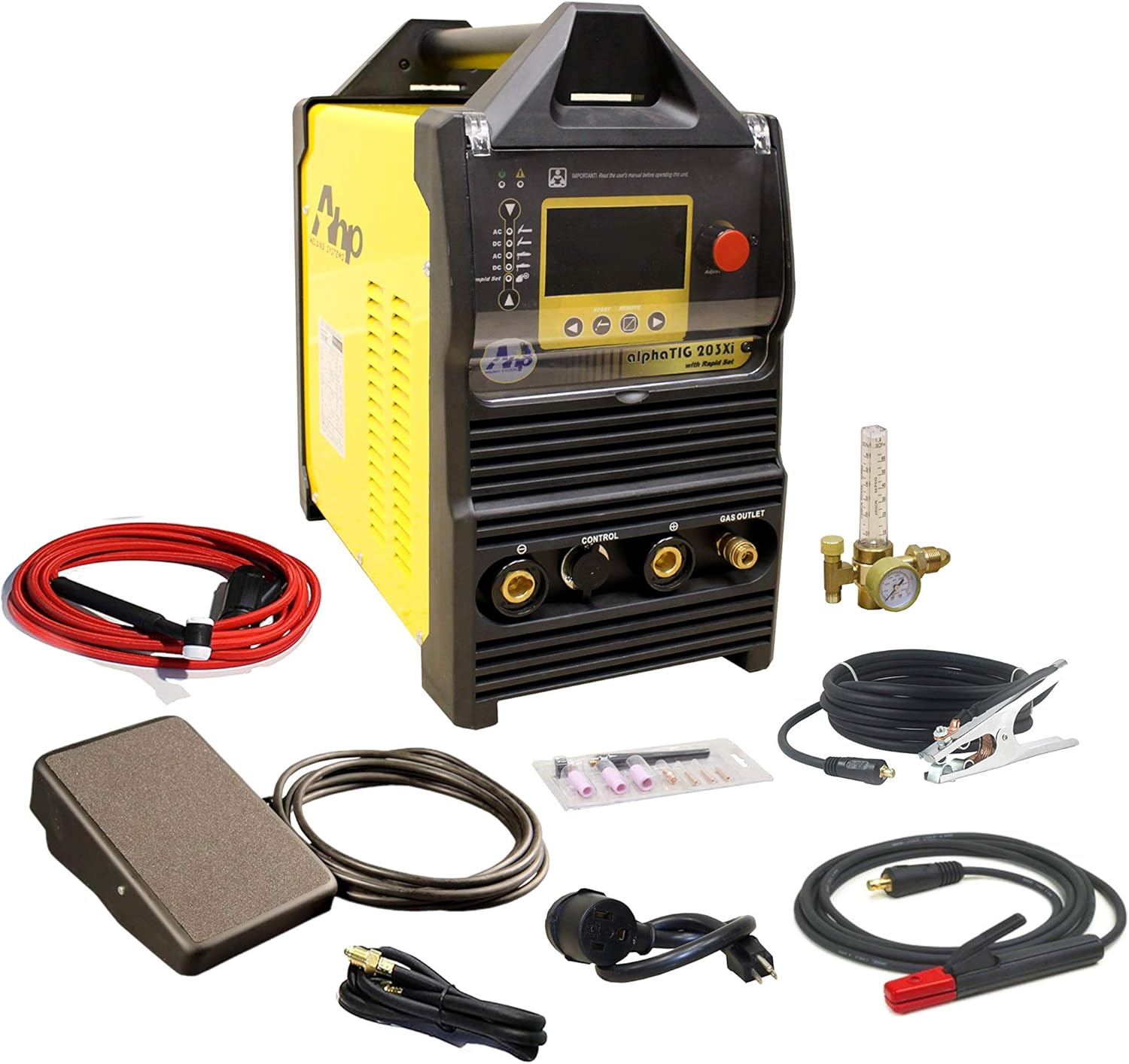
The AlphaTIG 203Xi is an AC/DC TIG and AC/DC Stick inverter welder built around a 120V/240V input design. AHP currently lists up to 150A of TIG output on 120V and 200A on 240V, with a 60% TIG duty cycle at 200A on 240V.
Its most useful differentiators are not simply that it is “beginner-friendly.” The machine also includes AHP’s Rapid Set function, adjustable AC frequency and balance, pulse in AC and DC TIG modes, 2T/4T operation, High Frequency Start, and Lift Start. Those features give you room to learn while remaining useful as your technique improves.
Why You’ll Like It
The 203Xi combines meaningful control with features that can reduce setup friction. Rapid Set can help establish a starting amperage range based on selected welding parameters, while the foot pedal supports real-time amperage adjustment. High Frequency Start helps you begin TIG arcs without touching the tungsten to the workpiece, and Lift Start gives you an additional starting method that the current 225Xi specification does not list.
Who Should Buy This
Buy the AlphaTIG 203Xi if you want one machine for aluminum AC TIG, DC TIG on steel or stainless, and occasional Stick work without paying primarily for the highest possible output number. It is particularly attractive for hobby fabrication, garage repair, motorsports projects, prototype work, and small-shop use where 200A of maximum TIG output is enough.
Who Should Avoid This
Skip it if you specifically need more than 200A of TIG output from these two AHP options. The 225Xi raises the 240V maximum to 225A, so it offers more peak-amperage headroom. Also remember that advertised machine capability does not replace proper joint preparation, multi-pass technique, or applicable welding-code requirements on thick or critical work.
What People Say
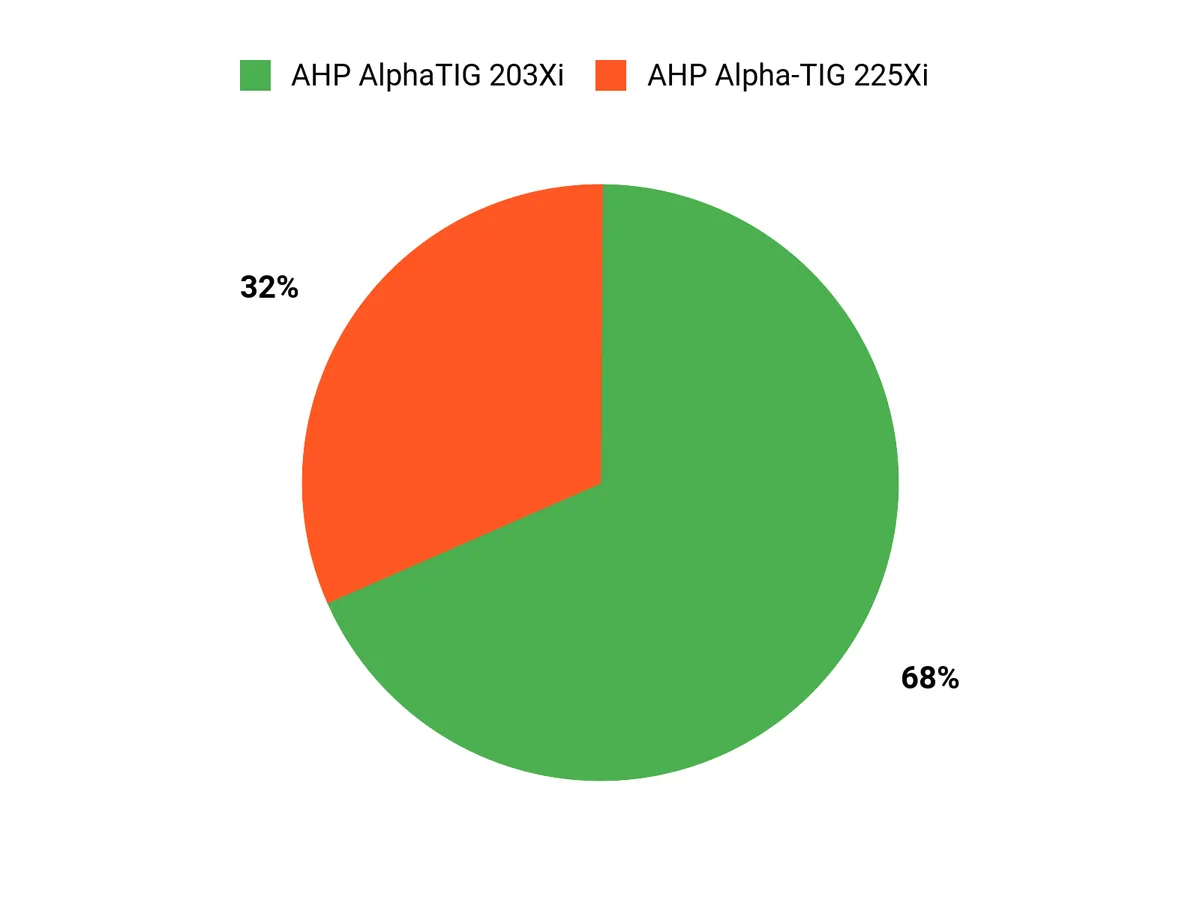
The sentiment chart below comes from the source article’s prior feedback analysis. Treat it as a snapshot rather than a substitute for checking current seller reviews, because review mixes, product revisions, included accessories, and seller conditions can change over time.
Source-Article Sentiment Snapshot: Positive

|
Pros |
Cons |
|---|---|
|
✅ Up to 200A TIG output on 240V |
❌ Lower maximum TIG output than the 225Xi |
|
✅ Manufacturer-rated 60% TIG duty cycle at 200A on 240V |
❌ Maximum output is reduced when operating on 120V |
|
✅ High Frequency Start plus Lift Start |
❌ Tungsten is not listed as included in the current manufacturer package |
|
✅ Rapid Set, AC/DC pulse, AC balance, and AC frequency controls |
❌ At about 40 lb according to AHP’s current specification, it is portable but not an ultra-light welder |
Versatility
The 203Xi works across AC TIG for aluminum, DC TIG for steel and stainless, and AC/DC Stick welding. AHP currently rates TIG output up to 150A on 120V and 200A on 240V, so the dual-voltage design is useful when you need to move between power sources, while the stronger 240V supply is the better choice when you need full machine output.
Its pulse controls, adjustable AC frequency and balance, foot-pedal compatibility, and 2T/4T sequencing also make it useful beyond basic practice. That gives you room to refine puddle control, heat input, starts, and finishes as your TIG skills improve.
Problem Solving
The AlphaTIG 203Xi addresses several common TIG-workflow problems. High Frequency Start allows non-contact arc initiation, Lift Start gives you another way to establish an arc, and the foot pedal lets you vary amperage while welding. Pulse and AC controls help you tune heat and arc characteristics, while TIG and Stick capability reduces the need to keep separate machines for every routine repair or fabrication task.
Key Benefits
- AC/DC TIG with pulse for aluminum, stainless, and steel work
- Up to 150A TIG output on 120V and 200A on 240V according to AHP
- 60% manufacturer-rated TIG duty cycle at 200A on 240V
- High Frequency Start and Lift Start
- Rapid Set function for TIG and Stick setup assistance
- Adjustable AC frequency and AC balance
- 2T/4T sequencing and foot-pedal support
- Current manufacturer-listed three-year parts-and-labor warranty
Check Product Details on Amazon
AHP AlphaTIG 225Xi

The AlphaTIG 225Xi is the higher-output option in this two-model comparison. AHP currently rates it for up to 150A TIG on 120V and up to 225A TIG on 240V. At its 225A maximum, the manufacturer lists a 35% TIG duty cycle; at 200A on 240V, AHP lists a 60% duty cycle.
It also supports AC/DC TIG with pulse, AC/DC Stick, adjustable AC frequency, AC balance, pre-flow, post-flow, down-slope, 2T/4T operation, and foot-pedal control. The current specification lists High Frequency Start only rather than the additional Lift Start offered on the 203Xi.
The 225Xi therefore makes the most sense when you have a 240V shop circuit and want the additional 25A of maximum TIG output. It is not automatically better for every buyer: the 203Xi still has meaningful control features and a strong duty-cycle specification at its own 200A maximum.
Why You’ll Like It
The strongest reason to choose the AlphaTIG 225Xi is its extra output ceiling. That 225A maximum gives you additional amperage headroom when a job demands more heat input than the 203Xi can provide. You still get the AC controls, pulse functionality, foot-pedal support, and 2T/4T sequencing expected from a feature-rich AC/DC TIG machine.
Who Should Buy This
Buy the 225Xi if you weld regularly on 240V, expect to work near or above the 200A range, or simply want the higher-output model so you have more peak capacity available as your fabrication work grows.
Who Should Avoid This
Skip it if the additional 25A of maximum TIG output does not benefit your projects. The 225Xi is also heavier than the 203Xi according to AHP’s current specifications, and it does not list Lift Start. If 200A is sufficient and you prefer Rapid Set plus a second TIG-starting method, the 203Xi may be the more sensible choice.
What People Say
The chart below reflects the source article’s prior sentiment analysis rather than a newly verified review study. Current customer feedback can change with product revisions, sellers, accessories, and time, so compare recent verified-purchase reviews and current manufacturer specifications before making your final decision.
Source-Article Sentiment Snapshot: Positive

|
Pros |
Cons |
|---|---|
|
✅ Up to 225A TIG output on 240V |
❌ Manufacturer rates maximum 225A TIG output at a 35% duty cycle |
|
✅ 60% manufacturer-rated TIG duty cycle at 200A on 240V |
❌ High Frequency Start only; Lift Start is not listed |
|
✅ AC/DC TIG, pulse, AC controls, 2T/4T, and AC/DC Stick capability |
❌ About 50 lb according to AHP’s current specification |
|
✅ Up to 185A Stick output on 240V |
❌ AHP says the 225Xi is not designed for E6010 electrodes |
|
✅ Current manufacturer-listed three-year parts-and-labor warranty |
❌ Tungsten is not listed as included in the current manufacturer package |
Versatility
The 225Xi can move from AC TIG on aluminum to DC TIG on steel or stainless, then switch to Stick when a rod-based process better suits the job. Its 120V/240V input lets you use the machine in different locations, but maximum TIG output is available on the higher-voltage supply.
AHP currently lists a pulse-frequency range of 0.5 to 200 Hz in both AC and DC TIG modes, plus adjustable AC frequency and balance. These controls can help you tune arc behavior and heat input, but they still require practice and proper setup to use effectively.
Problem Solving
The 225Xi’s main problem-solving advantage is output headroom. If 200A is not enough for the work you expect to tackle, the additional maximum amperage gives you more room before reaching the machine’s ceiling. High Frequency Start supports non-contact TIG arc initiation, while pulse, AC controls, gas timing, down-slope, 2T/4T, and foot-pedal control give you several ways to manage the welding cycle.
Key Benefits
- AC/DC TIG with pulse for aluminum, stainless, and steel work
- Up to 150A TIG output on 120V and 225A on 240V according to AHP
- 35% manufacturer-rated TIG duty cycle at 225A and 60% at 200A on 240V
- High Frequency TIG starting
- Adjustable AC frequency and AC balance
- 0.5-200 Hz pulse-frequency range in AC and DC TIG modes
- 2T/4T sequencing and foot-pedal support
- AC/DC Stick output up to 185A on 240V
- Current manufacturer-listed three-year parts-and-labor warranty
Check Product Details on Amazon
Before You Buy
- Check your power setup: Both models accept 120V/240V input, but their full rated TIG output requires 240V.
- Compare maximum output correctly: AHP lists the 203Xi at up to 200A TIG on 240V and the 225Xi at up to 225A.
- Compare duty cycle as well as amperage: The 203Xi is rated at 60% duty cycle at its 200A TIG maximum on 240V. The 225Xi is rated at 35% at 225A and 60% at 200A.
- Choose the starting method you want: AHP lists High Frequency and Lift Start for the 203Xi, but High Frequency Start only for the 225Xi.
- Plan for shielding gas: TIG welding requires a proper shielding-gas setup. Pure argon is commonly used for the aluminum, steel, and stainless TIG work these machines target.
- Budget for consumables: Tungsten, cups, collets, filler metal, gas lenses, and other consumables affect total setup cost. AHP’s current packages state that tungsten is not included.
- Know the 225Xi Stick limitation: AHP specifically states that the 225Xi is not designed for E6010 and suggests E6011 as an alternative where appropriate.
- Use proper safety gear: Wear an appropriate welding helmet, gloves, protective clothing, and other PPE, provide suitable ventilation, and follow safe electrical and gas-cylinder practices.
- Do not rely on advertised thickness alone: Joint design, preparation, technique, duty cycle, filler selection, code requirements, and multi-pass procedures all matter on thicker or safety-critical welds.
- Confirm the current package: Seller listings can change, so verify the torch, pedal, regulator, work clamp, electrode holder, adapter, consumables, warranty, and manual that apply to the exact unit you are buying.
Related Guides
FAQ
Why Are These Two AHP Welders Good for TIG Welding Projects?
Both combine AC/DC TIG, pulse functionality, AC/DC Stick capability, and 120V/240V input in one machine. That makes them useful when you want AC TIG for aluminum and DC TIG for mild steel or stainless without buying separate TIG machines.
They also provide adjustable TIG controls and foot-pedal support. The meaningful differences are that the 203Xi tops out at 200A TIG and includes both High Frequency and Lift Start, while the 225Xi increases maximum TIG output to 225A but lists High Frequency Start only.
Will These Welders Handle the Materials and Projects You Plan to Do?
They are designed for AC TIG on aluminum and DC TIG on materials such as mild steel and stainless steel. Whether either model is appropriate for a particular joint depends on much more than maximum amperage, including material thickness, joint design, preparation, power supply, duty cycle, filler metal, shielding gas, and technique.
If your work is governed by a welding code or involves structural, pressure, safety-critical, or load-bearing fabrication, follow the applicable qualified procedure rather than relying only on a manufacturer’s general capability range.
Which AHP TIG Welder Is Better for Beginners?
The AlphaTIG 203Xi is the stronger beginner-oriented choice in this comparison because it combines full AC/DC TIG capability with Rapid Set assistance and both High Frequency and Lift Start. At the same time, it is not merely a beginner machine: AHP currently rates it for up to 200A TIG output on 240V with a 60% duty cycle at that output.
Which AHP TIG Welder Is Better for Higher-Amperage Work?
The AlphaTIG 225Xi wins on maximum TIG output. AHP rates it for up to 225A on 240V versus 200A for the 203Xi. However, the duty-cycle difference matters: the 225Xi is rated at 35% at its 225A maximum and 60% at 200A, while the 203Xi is rated at 60% at its 200A maximum.
What Is the Duty-Cycle Difference Between the AHP 203Xi and 225Xi?
On 240V, AHP currently lists the 203Xi at 200A TIG with a 60% duty cycle. The 225Xi is listed at 225A TIG with a 35% duty cycle and 200A with a 60% duty cycle. In practical buying terms, the 225Xi adds a higher short-term output ceiling rather than automatically giving you a longer duty cycle at every setting.
Do You Need a 240V Outlet for These Welders?
No. Both are dual-voltage machines and AHP currently lists up to 150A of TIG output on 120V. You need 240V, however, to access their full rated output: up to 200A on the 203Xi or 225A on the 225Xi. Confirm the manual’s circuit, plug, breaker, and input-current requirements before installing or operating either machine.
Does the AHP AlphaTIG 203Xi Have Lift Start?
Yes. AHP currently lists both High Frequency Start and Lift Start for the AlphaTIG 203Xi. That gives it an extra TIG starting option compared with the current 225Xi specification.
Does the AHP AlphaTIG 225Xi Have Lift Start?
AHP’s current specification lists High Frequency Start only for the AlphaTIG 225Xi. If Lift Start is important to your workflow, that is one reason to consider the 203Xi instead.
Can You Use E6010 With the AHP AlphaTIG 225Xi?
AHP states that the 225Xi is not designed or intended to weld with E6010 because the arc will not be stable. The manufacturer suggests considering E6011 instead when appropriate for the job.
What Should You Consider Before Buying One of These AHP Welders?
Think about the maximum amperage you actually need, your available 120V or 240V circuit, duty cycle, material types, TIG starting preference, machine weight, shielding-gas setup, torch and consumable requirements, and whether Stick compatibility matters to you.
Also confirm the current seller’s package and warranty terms. AHP presently lists a three-year parts-and-labor warranty for both models, but you should verify that the unit and seller you are purchasing from qualify for the manufacturer’s current coverage.
What Customers Should Compare
The most useful decision points between the AHP AlphaTIG 203Xi and 225Xi are maximum TIG output, duty cycle, starting method, weight, and workflow features. The 203Xi gives you a 200A maximum on 240V, a 60% duty cycle at that output, High Frequency plus Lift Start, and Rapid Set. The 225Xi raises maximum TIG output to 225A, with a 35% duty cycle at that maximum and 60% at 200A, but AHP lists High Frequency Start only.
If the extra 25A solves a real need, choose the 225Xi. If 200A is enough and you value Lift Start, Rapid Set, and the lighter current specification, the 203Xi is likely the more balanced buy.
Wrapping Up
Both AHP AlphaTIG models are legitimate choices for buyers who want AC/DC TIG, pulse control, Stick capability, and 120V/240V flexibility. The decision is less about one machine being universally “better” and more about which specification differences matter for your work.
Choose the AHP AlphaTIG 203Xi if you want up to 200A TIG output, a 60% duty cycle at that maximum on 240V, Rapid Set, and both High Frequency and Lift Start. Choose the AHP AlphaTIG 225Xi if you specifically want the additional 225A peak-output capability and are comfortable with the manufacturer’s 35% duty-cycle rating at that maximum.
Before buying, confirm the current seller listing, included accessories, warranty eligibility, electrical requirements, and manual because model revisions and packages can change.
| AHP AlphaTIG 203Xi | AHP AlphaTIG 225Xi | |
|---|---|---|
 |
 |
|
| Best For | Balanced garage and fabrication use, TIG learners, and buyers who value Lift Start and Rapid Set | Buyers who specifically want higher 225A peak TIG output on 240V |
| TIG Output | Up to 150A on 120V; up to 200A on 240V | Up to 150A on 120V; up to 225A on 240V |
| 240V TIG Duty Cycle | 60% at 200A | 35% at 225A; 60% at 200A |
| TIG Start | High Frequency Start and Lift Start | High Frequency Start only |
| Pulse Range | 0.5-150 Hz AC; 0.5-250 Hz DC | 0.5-200 Hz AC or DC |
| Input Voltage | 120V / 240V | 120V / 240V |
| Welding Modes |
|
|
| Approx. Manufacturer-Listed Weight | 40 lb | 50 lb |
| Notable Feature | Rapid Set plus Lift Start | Higher 225A maximum TIG output |
| Warranty | Manufacturer currently lists 3-year parts and labor coverage | Manufacturer currently lists 3-year parts and labor coverage |
| Main Advantage | Strong balance of output, duty cycle, TIG-start flexibility, and setup assistance | More peak-amperage headroom when you need output above 200A |
| Check Price on Amazon | Check Price on Amazon |
This Roundup is reader-supported. When you click through links we may earn a referral commission on qualifying purchases.