
Buying kitchen essentials is easier when you focus on tools that handle several cooking tasks instead of collecting gadgets. A sharp knife, sturdy cutting board, reliable cookware, and a few preparation tools can support most everyday meals. This guide explains what to buy first, which materials last, and where an appliance such as an air fryer makes sense.
Quick Answer
Start with an 8-inch chef’s knife, cutting board, skillet, saucepan, and basic utensils. Add a Dutch oven for soups, braising, and baking. A paring knife, bread knife, food scale, and baking sheets complete a practical setup. Buy an air fryer only if its speed and cooking style suit your routine.
Key Takeaways
- Choose versatile tools before buying specialty gadgets or large cookware sets.
- A chef’s knife, serrated bread knife, and paring knife cover most everyday cutting tasks.
- Stainless steel and cast iron offer durability, while nonstick cookware helps with delicate foods.
- A Dutch oven suits slow cooking and large batches; an air fryer suits smaller, faster meals.
- Choose cookware based on your stove, storage space, cleaning preferences, and usual portion sizes.
- A food thermometer and separate cutting boards are important kitchen safety tools.
What Counts as Kitchen Essentials?
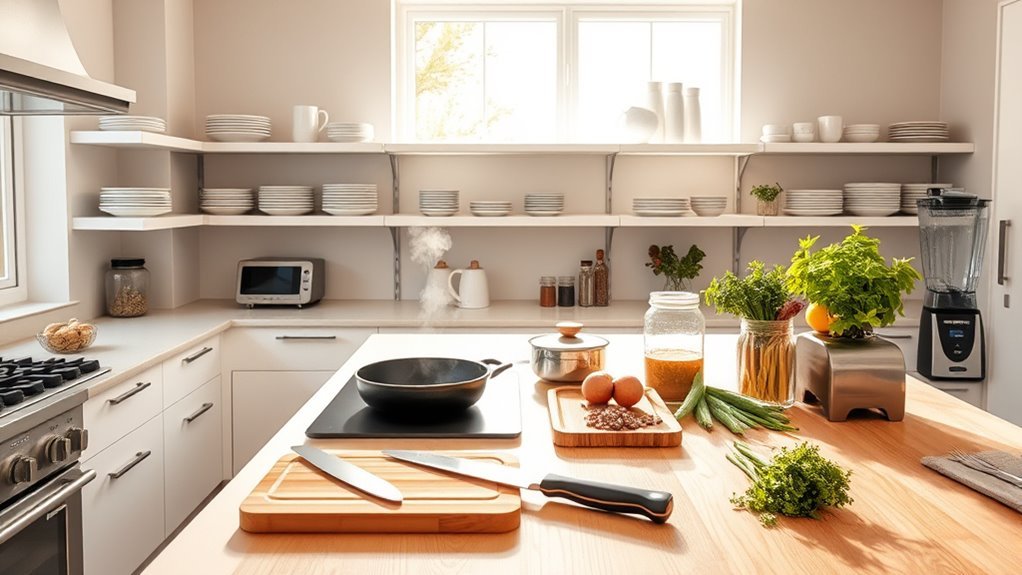
Kitchen essentials are the tools you need to prepare, cook, and serve everyday meals. They should handle several jobs, fit your space, and be easy to maintain.
A quality chef’s knife, sturdy cutting board, and heavy-bottomed pot form a practical starting point. Add a skillet for frying, a saucepan for boiling, and a few utensils for stirring and serving.
The Academy of Nutrition and Dietetics’ beginner kitchen guide also identifies mixing bowls, strainers, knives, peelers, and measuring tools as useful starting equipment.
A practical kitchen starts with tools you use repeatedly, not the largest collection you can afford.
A two-quart saucepan handles grains, sauces, and reheating. A nonstick skillet is useful for eggs, while stainless steel cookware offers a durable surface for everyday cooking.
Round out the setup with a silicone spatula, tongs, large spoon, measuring cups, and measuring spoons. Baking sheets extend your options to roasting vegetables, cooking fish, and baking.
Before buying anything else, consider your usual meals. Someone who cooks soups and stews needs different equipment from someone who mainly prepares quick skillet dinners.
The Best Knives for Everyday Cooking
Three knives can handle most home cooking: a chef’s knife, a serrated bread knife, and a paring knife. Each serves a different purpose, so there is little need to buy a large knife block immediately.
The Mercer Culinary Millennia, Victorinox paring knife, and Dexter-Russell Basics bread knife are practical examples from the original selection.
Essential Knife Types
An 8-inch chef’s knife handles chopping, slicing, mincing, and dicing. Its broad blade also helps transfer prepared ingredients from the cutting board to a pan.
A serrated bread knife works through crusty loaves without crushing the soft center. It is also useful for tomatoes and other foods with delicate interiors.
A small paring knife handles peeling, trimming, and detailed work that feels awkward with a larger blade.
You do not need to spend heavily on all three. Prioritize a comfortable chef’s knife, then choose simpler versions of the other two.
Store knives in a block, blade guard, or suitable magnetic strip so their edges do not strike other utensils.
Honing helps maintain an existing edge, while sharpening removes metal to restore a dull one. How often you sharpen depends on use, blade material, and cutting technique.
Top Everyday Picks
These three knives offer a practical combination of general cutting, bread slicing, and precision work.
- Mercer Culinary 8-Inch Millennia Chef’s Knife: A versatile everyday knife with a comfortable textured grip. The original price estimate is $21–$31.
- Dexter-Russell Basics 10-Inch Bread Knife: A long serrated blade suited to crusty bread and larger loaves. The original estimated price is $12–$24.
- Victorinox 3.25-Inch Paring Knife: A compact stainless steel knife for peeling, trimming, and delicate preparation. The original price estimate is $9–$15.
Mercer’s official Millennia specification identifies a one-piece high-carbon Japanese steel blade, textured Santoprene handle, and protective finger guard.
The knife uses stamped construction. Its comfortable handle and blade design matter more to everyday performance than simply choosing the heaviest knife available.
Before purchasing, check how each handle feels in your hand. A knife that fits your grip is easier to control during repeated cutting tasks.
Must-Have Prep Tools
Good preparation tools make cooking faster and more consistent. Start with a stable cutting board, measuring equipment, mixing bowls, a peeler, and utensils that can handle different ingredients.
The OXO Good Grips cutting board is one example worth considering. Its non-slip design helps keep the work surface stable, while the juice groove helps contain liquids.
The original estimated price is $18–$21, although the exact model and retailer affect the final price.
| Tool | Value |
|---|---|
| Chef’s knife | Chopping, slicing, and dicing |
| Cutting board | Stable preparation surface and blade protection |
| Digital kitchen scale | Accurate ingredient weights |
| Silicone spatula | Mixing, scraping, and gentle stirring |
| Measuring cups and spoons | Consistent ingredient quantities |
A digital scale such as the Escali Primo is especially useful for baking. Measuring flour by weight avoids the variation caused by packing different amounts into a measuring cup.
Stainless steel measuring cups are durable, while a Kuhn Rikon peeler makes preparing potatoes, carrots, and other produce easier.
A colander handles draining pasta and rinsing produce. A whisk helps combine sauces, eggs, and batters. Stackable mixing bowls provide room for combining ingredients without taking up excessive cabinet space.
Do You Need Separate Cutting Boards?
Using separate boards for raw meat and ready-to-eat foods reduces the risk of cross-contamination. You can choose wood or plastic, provided you clean and maintain the surface properly.
The USDA cutting board guidance recommends using one board for produce and bread and another for raw meat, poultry, and seafood.
Wash boards with hot, soapy water after use. Replace them when deep grooves become difficult to clean.
Cookware Worth Buying First
The most useful starter cookware includes a skillet, saucepan, and Dutch oven or another substantial pot. Together, these pieces handle frying, boiling, simmering, braising, and many oven dishes.
A stainless steel skillet is a strong everyday choice. A nonstick pan and baking sheets can then add convenience without requiring a complete cookware collection.
Essential Pots And Pans
Each core cookware item should have a clear purpose. The following selection covers most cooking methods without filling every cabinet.
- Dutch oven: Useful for soups, stews, braising, and bread baking.
- Stainless steel skillet: Handles searing, sautéing, browning, and pan sauces.
- Three-quart saucepan: Useful for grains, reheating, vegetables, and sauces.
- Nonstick skillet: Makes eggs, pancakes, and other delicate foods easier to release.
- Quarter-sheet pans: Useful for smaller portions, roasting, reheating, and baking.
A cast-iron skillet is another useful addition if you frequently cook foods that benefit from strong heat retention.
Choose cookware with a stable base, comfortable handles, and construction suited to your stove. If you use induction, confirm that the cookware is compatible.
For many households, buying individual pieces makes more sense than purchasing a large set containing several rarely used pans.
Dutch Oven Priority
A Dutch oven deserves consideration because one vessel can handle several cooking methods. It can brown ingredients on the stovetop, simmer a stew, and move into the oven for braising.
A 6-quart enameled cast-iron model offers useful capacity for soups, family meals, and batch cooking.
Lodge’s 6-quart Essential Enamel Dutch Oven is one example. Its official product information confirms stovetop compatibility, including induction, and oven use up to 500°F.
The original article estimated its price at about $90. Actual pricing varies with the color, model, retailer, and available promotions.
Enameled cast iron also handles acidic ingredients such as tomato sauce without requiring the seasoning routine used for bare cast iron.
However, a Dutch oven is heavy and takes more storage space than a saucepan. If you mainly cook single portions, a smaller pot may be the more practical first purchase.
Why Air Fryers Are So Useful
Air fryers are useful for preparing small meals quickly and achieving a crisp surface with less added oil than conventional deep-frying. They circulate hot air around food, working much like compact convection ovens.
They can roast vegetables, cook chicken, reheat leftovers, and prepare frozen foods without heating a full-size oven.
Air fryers offer several everyday advantages:
- Convenience: Their compact cooking chambers heat quickly and suit smaller meals.
- Less added oil: Many foods develop a crisp surface without being submerged in cooking oil.
- Versatility: Suitable models can roast, bake, grill, and reheat.
Some air fryer comparisons report oil-use reductions of up to 75% and cooking times around 20% shorter than conventional ovens. Actual results depend on the recipe, appliance, portion size, and cooking method.
An air fryer is not automatically the better choice for every household. Small baskets can require several batches when cooking for a family.
Overcrowding also restricts airflow and can lead to uneven cooking.
The USDA’s air fryer safety guidance recommends leaving enough room for air circulation and checking food with a thermometer.
Warning: Do not rely on a browned exterior to decide whether meat is safely cooked. Check its internal temperature with a food thermometer.
Why Dutch Ovens Earn Their Place
Dutch ovens stand out for heat retention, durability, and their ability to move between cooking methods. Their heavy construction helps maintain steady heat during simmering and braising.
Unlike an air fryer, a Dutch oven can hold substantial amounts of liquid. That makes it particularly useful for soup, chili, stews, and dishes that need a covered cooking environment.
The lid helps retain moisture during long cooking sessions. The heavy pot also works well for recipes that start with stovetop browning and finish in the oven.
How to Care for Enameled Cast Iron
Enameled cast iron requires less maintenance than traditional bare cast iron, but the coating still needs protection.
According to Lodge’s official cleaning and care instructions, you should avoid heating an empty enameled pot on the stovetop.
- Start with low to medium heat and allow the pot to warm gradually.
- Use wooden, silicone, or nylon utensils to protect the enamel.
- Allow the cookware to cool before washing.
- Wash gently and dry thoroughly before storage.
- Use suitable pot protectors when storing heavy cookware together.
Hand washing is generally recommended. Abrasive cleaning methods and sudden temperature changes can damage the finish.
With proper care, a durable Dutch oven can remain useful for many years.
Air Fryer vs. Dutch Oven: Which Should You Buy?
Choose according to the food you prepare most often. An air fryer favors speed and crisp results, while a Dutch oven is more useful for liquid-based cooking and larger batches.
| Consideration | Air Fryer | Dutch Oven |
|---|---|---|
| Main strength | Fast cooking and crisp surfaces | Heat retention and versatile cooking |
| Suitable meals | Vegetables, frozen foods, chicken, and reheating | Soups, stews, braises, and bread |
| Capacity | Depends on basket size | Useful for larger liquid-based meals |
| Storage | Requires counter or cabinet space | Heavy and bulky |
| Best fit | Quick everyday meals | One-pot meals and batch cooking |
How to Choose Durable Tools
Durable kitchen tools combine suitable materials, solid construction, and practical maintenance. Price alone does not show how well a product will perform over time.
Stainless steel and cast iron are useful choices for frequently used cookware. Their long service life can make them economical even when the initial cost is higher.
Use these checks before purchasing:
- Compare materials: Choose cookware that suits your cooking temperature, stove, and cleaning preferences.
- Inspect construction: Look for stable bases, secure handles, smooth joins, and comfortable grips.
- Check compatibility: Confirm whether cookware works with induction and whether the lid and handles are oven-safe.
- Review maintenance: Consider seasoning, hand washing, sharpening, and replacement needs.
- Verify warranty support: Read the actual coverage, exclusions, and care requirements.
A full-tang knife can offer a sturdy connection between blade and handle, but it is not the only indicator of quality. Blade geometry, balance, grip, and construction also affect performance.
For nonstick cookware, the coating is the main wear point. Even an expensive coated pan may eventually need replacing, while an uncoated stainless steel pan can remain useful for much longer.
Which Materials Work Best?
Different materials suit different cooking tasks. Rather than buying every pan in one material, choose a small combination that covers your needs.
- Stainless steel: Durable, versatile, and useful for browning and sauces.
- Cast iron: Strong heat retention and suitable for many stovetop and oven tasks.
- Enameled cast iron: Combines heat retention with a non-reactive cooking surface.
- Nonstick cookware: Convenient for delicate foods and easier food release.
- Silicone utensils: Useful for mixing and protecting coated cookware when used within their rated temperature limits.
Avoid assuming that every product labeled stainless steel or cast iron performs equally well. Thickness, construction, design, and manufacturing quality still matter.
Kitchen Essentials That Make Cleanup Easier
Easy-clean tools make home cooking more manageable. Choose utensils with simple shapes, cookware that suits your washing routine, and storage that lets cleaned items dry properly.
A sturdy dish rack is useful when you regularly wash pans and knives by hand. A multi-tiered rack can improve airflow while making better use of limited counter space.
Nonstick cookware helps release eggs and delicate foods with less scrubbing. However, its coating needs gentle treatment.
The Consumer Reports guide to nonstick pan care recommends avoiding empty-pan heating, excessive heat, and abrasive cleaning.
Use silicone or wooden utensils with coated pans. Replace cookware if its coating becomes badly damaged or begins flaking.
Silicone baking mats can reduce sticking and help keep baking sheets cleaner. Check the manufacturer’s temperature rating before oven use.
Wooden spoons and heat-resistant silicone spatulas are easy to work with, while smooth measuring spoons are generally simpler to wash than designs with awkward joints.
A compact food processor can reduce repetitive chopping and slicing. However, it adds a bowl, blade, and lid to the washing routine, so it is most useful when the preparation time saved outweighs the extra cleanup.
Kitchen Safety Tools You Should Not Skip
A food thermometer is one of the most useful safety tools in a home kitchen. It helps confirm that meat and other foods have reached the required internal temperature.
According to the FoodSafety.gov safe temperature chart, the following minimum temperatures apply:
| Food | Safe Internal Temperature |
|---|---|
| Chicken and other poultry | 165°F (74°C) |
| Ground meat | 160°F (71°C) |
| Whole cuts of beef, pork, and lamb | 145°F (63°C), followed by a 3-minute rest |
| Leftovers and casseroles | 165°F (74°C) |
Keep a clean thermometer within reach while cooking. This is especially useful when using an air fryer, roasting chicken, or preparing large portions in a Dutch oven.
Frequently Asked Questions
What Are 10 Basic Dishes Everyone Should Know How to Cook?
Ten useful beginner dishes are scrambled eggs, pasta with sauce, roast chicken, stir-fried vegetables, chili, rice bowls, omelets, soup, tacos, and roasted potatoes. Together, they teach essential skills such as boiling, roasting, sautéing, seasoning, and preparing simple meals from basic ingredients.
Is Kitchen Essentials a Good Brand?
The original brand assessment describes favorable reviews, customer satisfaction, and good value. However, Kitchen Essentials can refer to different sellers or product lines, and that assessment is not tied to an identifiable manufacturer here. Check the exact product, construction, warranty, and verified customer feedback before buying.
What Is the Number One Rule in the Kitchen?
Make food safety your first priority. Wash your hands, keep preparation surfaces clean, separate raw meat from ready-to-eat foods, and cook food to safe temperatures. Good knife handling and proper storage also help prevent avoidable kitchen accidents.
What Are the Most Essential Kitchen Equipment?
The most essential kitchen equipment includes a chef’s knife, cutting board, skillet, saucepan, measuring tools, can opener, and basic utensils. A Dutch oven adds versatility, while a food thermometer supports safe cooking. Choose additional appliances according to the meals you prepare regularly.
What Kitchen Essentials Should You Buy First for a Small Kitchen?
Start with a chef’s knife, compact cutting board, skillet, saucepan, and a few multipurpose utensils. Stackable mixing bowls and a small colander help save storage space. Add larger cookware or appliances only when your usual meals justify the space they occupy.
Conclusion
A useful kitchen depends on dependable tools rather than the number of items you own. Start with a sharp chef’s knife, sturdy cutting board, reliable skillet, and saucepan. Add a Dutch oven when your meals call for it.
The original article cites a figure that 75% of home cooks use only a small core of tools regularly, although a source for that statistic remains unconfirmed. The practical point is to prioritize equipment you will actually use.
Choose durable materials, maintain your tools properly, and add specialty appliances only when they solve a genuine cooking need.
Sources
- Academy of Nutrition and Dietetics: Essential kitchen tools for beginner cooks.
- Mercer Culinary: Millennia 8-inch chef’s knife specifications and construction.
- USDA Food Safety and Inspection Service: Cutting board cleaning, separation, and replacement guidance.
- Lodge Cast Iron: Dutch oven capacity, compatibility, and product specifications.
- Lodge Cast Iron Care Guide: Enameled cast-iron maintenance and safe handling.
- USDA Air Fryer Safety Guide: Air circulation, preparation, and cooking safety.
- Consumer Reports: Nonstick cookware maintenance.
- FoodSafety.gov: Safe minimum internal cooking temperatures.
