
Reader-supported disclosure:. As an Amazon Associate I earn from qualifying purchases. This roundup contains Amazon affiliate links. When you click through links, we may earn a referral commission on qualifying purchases at no extra cost to you.
Last updated: September 12, 2026
You want a MIG welder that can handle stainless steel without turning setup into a guessing game. Stainless is more sensitive to filler choice, shielding gas, contamination, and heat input than ordinary mild-steel repair work, so a useful machine should give you stable wire feed, adjustable parameters, and a true gas-MIG path.
In this guide, you’ll find five gas-capable multiprocess welders that make sense for stainless-focused buyers. The lineup includes simple dual-voltage garage machines, portable options, a higher-output model, and an advanced unit with pulsed MIG, TIG, and plasma cutting. Your best choice depends on material thickness, how often you weld, available input power, and whether you also need TIG, stick, aluminum capability, or cutting functions.
Quick Verdict
If you want a strong all-around starting point, the YESWELDER MIG-205DS PRO combines gas MIG, flux-core MIG, stick, lift-TIG support, dual voltage, and a spool-gun upgrade path. The ARCCAPTAIN MIG205MP is the most feature-rich choice here if you want pulsed MIG, TIG, stick, app-supported controls, and plasma cutting in one machine. The FEMEROL 250A has the highest advertised output in this group, while the ARCCAPTAIN MIG165 stands out for portability and the Ehomful 145A bundles useful starter accessories.
Important stainless note: A gas-capable welder is only part of the setup. Use filler wire appropriate for your stainless grade and a shielding-gas mixture recommended for that wire, transfer mode, and machine. Common mild-steel flux-core wire is not a substitute for stainless filler.
Top Picks
|
Category |
Product |
Best For |
|---|---|---|
|
🏆 Best Overall |
Balanced stainless, garage, and multiprocess use |
|
|
🔧 Most Versatile |
Pulsed MIG, TIG, cutting, and advanced controls |
|
|
⚡ Highest Advertised Output |
Buyers wanting more advertised amperage headroom |
|
|
🎒 Best Portable |
Dual-voltage garage and mobile work |
|
|
🌟 Best Beginner Package |
New users who want accessories bundled with the welder |
How We Chose
For a stainless-focused roundup, gas-MIG capability matters more than a long list of modes. We prioritized welders that can run solid wire with shielding gas, offer enough adjustment to manage heat and wire feed, and provide dual-voltage flexibility for both home and shop use.
Multiprocess capability also adds value when it solves a real need. Lift TIG can give you another stainless option when the required torch and accessories are added, pulsed MIG can improve heat control on compatible setups, and spool-gun support is useful if aluminum is also on your project list. We also considered portability, display clarity, synergic settings, manual adjustment, included accessories, and whether optional equipment is required to unlock advertised processes.
Before You Buy a MIG Welder for Stainless Steel
- Confirm gas-MIG support: Solid stainless MIG wire normally requires an external shielding-gas setup.
- Match the filler to the base metal: ER308L is common for many 304 stainless applications, while 316-series stainless generally needs a suitable 316-series filler. Follow the filler manufacturer or qualified welding procedure when requirements are critical.
- Use a stainless-appropriate shielding gas: Stainless MIG often uses low-CO₂ argon-based or helium-containing blends. Do not assume the common mild-steel gas mix is automatically correct.
- Do not confuse ordinary flux-core with stainless filler: Use flux-cored wire only if that consumable is specifically intended for the stainless alloy and process you are welding.
- Check optional accessories: “Lift TIG capable” or “spool-gun compatible” does not necessarily mean the TIG torch or spool gun is included.
- Consider input power: 110/120V is convenient for lighter work, while 220/240V generally gives a compatible machine more output headroom.
- Compare duty cycle, not just peak amps: A larger advertised amperage number does not automatically make a machine better for long welds.
- Protect stainless from contamination: Use dedicated stainless brushes and clean tools rather than equipment contaminated with carbon-steel particles.
Stainless Welding Safety Note
Welding stainless steel can generate hazardous metal fumes, including chromium-containing fumes. Use effective ventilation or local fume extraction, keep your head out of the plume, wear appropriate welding PPE, and follow applicable workplace and respirator requirements. Never weld in a confined or poorly ventilated space without the controls required for that environment.

The MIG-205DS PRO earns the overall position because its feature set covers the needs most stainless-focused DIY buyers are likely to encounter without moving immediately into a more complicated welding-and-cutting platform. You get gas MIG for solid stainless wire, plus flux-core, stick, and optional lift-TIG capability.
Dual-voltage input is useful if you sometimes work from a household circuit but also have access to higher-voltage shop power. The synergic and manual MIG controls also give beginners a starting point without preventing more experienced users from fine-tuning wire feed and voltage.
Stainless setup: Use suitable stainless solid wire, the shielding gas specified for the wire and transfer mode, correct polarity, and clean stainless-only preparation tools. The optional lift-TIG torch and optional spool gun should be budgeted separately if you intend to use those processes.
Buyer Considerations
The main attraction is flexibility: one chassis covers several common welding processes and two input-voltage environments. The tradeoff is that some advertised modes need additional accessories, and this remains a compact multiprocess machine rather than a dedicated high-duty-cycle production welder.
Overall fit: Strong for DIY, garage, maintenance, and light fabrication buyers who want room to grow.

The sentiment graphic above is retained from the supplied article. Its underlying sample and methodology were not independently verified for this update.
When It Helps
|
Situation |
How It Helps |
|---|---|
|
Stainless garage fabrication |
Gas-MIG capability lets you use suitable solid stainless wire and external shielding gas. |
|
Mixed-metal repair work |
MIG, flux-core, and stick modes give you options when your projects extend beyond stainless. |
|
Future TIG practice |
Lift-TIG support gives you another process path once the required torch and accessories are added. |
|
Different power locations |
110/220V support makes the machine more flexible between garage and shop environments. |
Control Notes
The combination of synergic MIG assistance and manual adjustment is useful because stainless settings often need fine-tuning for wire diameter, joint design, material thickness, shielding gas, and travel speed. Treat the preset as a starting point rather than a substitute for a test weld on scrap.
Why You’ll Like It
- Gas MIG plus several additional welding modes
- 110/220V dual-voltage input
- Synergic assistance with manual MIG adjustment
- Useful stainless path without limiting you to stainless-only projects
- Spool-gun and lift-TIG upgrade options for broader future use
Who Should Avoid It
Skip it if you need a dedicated industrial stainless production machine, a verified high-duty-cycle setup for continuous long beads, or every TIG and aluminum accessory included in the base package.

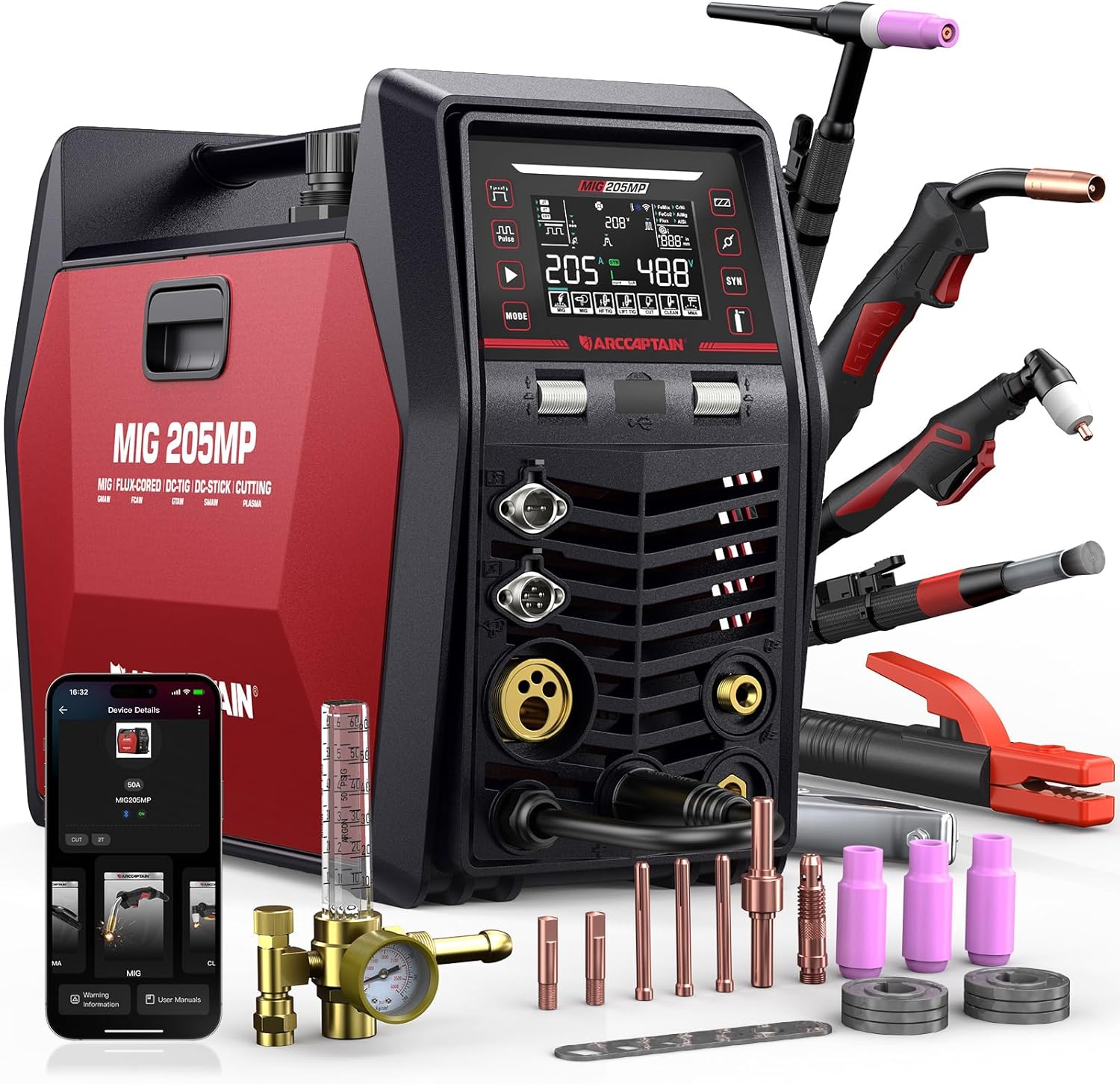
The MIG205MP is the feature-heavy option. Its main advantage for stainless work is not simply the number of modes; it is the combination of conventional MIG, pulsed MIG, and DC TIG choices with deeper parameter control than a basic entry-level welder.
Pulsed MIG can be useful when your wire, shielding gas, transfer mode, and machine settings are correctly matched because it gives you another way to manage heat and metal transfer. TIG support also broadens the machine’s usefulness for stainless fabrication, although required torches, gas equipment, a foot pedal, or other accessories can vary by configuration.
The built-in plasma cutter is valuable only if you will actually use it. If your work is almost entirely straightforward MIG welding, a simpler machine may cost less, weigh less, and be easier to learn.
Buyer Considerations
The strongest reason to choose this model is consolidation: welding and cutting functions share one platform. That saves space for a small fabrication area, but it also means more settings and accessories to understand.
Overall fit: Strong for technically inclined DIY users, small fabrication shops, and buyers who want pulsed MIG plus cutting capability.

The sentiment graphic above is retained from the supplied article. Its underlying sample and methodology were not independently verified for this update.
When It Helps
|
Situation |
How It Helps |
|---|---|
|
Heat-sensitive stainless work |
Pulsed-MIG and TIG modes provide additional ways to control the welding process when properly configured. |
|
Mixed welding jobs |
MIG, TIG, stick, and spool-gun support let one machine cover several fabrication tasks. |
|
Cutting and fabrication |
The integrated plasma function can reduce the need for a separate plasma-cutter power source. |
|
120V and 240V locations |
Dual-voltage input supports both common garage and shop power environments. |
Control Notes
This model offers more parameter control than the simpler machines in the roundup. That is useful for experienced users, but beginners should still start from the manual, wire recommendations, and scrap testing rather than treating automatic presets as universal stainless settings.
Why You’ll Like It
- Conventional and pulsed MIG capability
- DC TIG and stick welding options
- Integrated plasma cutting
- 120/240V dual-voltage input
- Expanded parameter control for users who want more than basic synergy
Who Should Avoid It
Skip it if you only want occasional basic MIG welding. You would be paying for controls, cutting functions, and process flexibility you may never use.

The FEMEROL appeals to buyers who want a larger advertised amperage figure without giving up the convenience of MIG, flux-core, stick, lift TIG, spot welding, and spool-gun compatibility.
For stainless, the feature that matters most is still gas MIG rather than the 250A label. Actual usable output depends on input voltage, settings, material, duty cycle, and the machine’s operating limits, so do not choose it solely because its headline number is higher.
Spool-gun compatibility can also broaden the machine’s usefulness for aluminum, while lift TIG provides another possible process for stainless once the necessary torch and gas equipment are added.
Buyer Considerations
This is a useful middle ground for someone who wants a feature-rich garage machine with more claimed output than smaller 145A-165A models. Published third-party weight figures are inconsistent, so buyers who care about portability should confirm the current listing specification before ordering.
Overall fit: Better for output-focused DIY and light fabrication than for buyers seeking the smallest carry-around machine.

The sentiment graphic above is retained from the supplied article. Its underlying sample and methodology were not independently verified for this update.
When It Helps
|
Situation |
How It Helps |
|---|---|
|
Stainless MIG projects |
Gas-MIG capability supports solid stainless wire with the appropriate shielding-gas setup. |
|
Mixed garage fabrication |
Multiple processes reduce the need to buy a separate machine for every basic repair method. |
|
Aluminum projects |
Spool-gun compatibility provides an upgrade path when properly equipped. |
|
110V and 220V work areas |
Dual-voltage operation increases flexibility between home and shop environments. |
Control Notes
Synergic control can help establish a baseline, but stainless parameters still depend on wire type, wire diameter, gas, joint design, and material thickness. Confirm the current manual and test on scrap before welding the finished part.
Why You’ll Like It
- Higher advertised output than the smaller machines in this lineup
- Gas MIG plus several secondary welding processes
- 110/220V dual-voltage operation
- Synergic controls and a large display
- Spool-gun compatibility for future aluminum work
Who Should Avoid It
Skip it if low weight is your top priority or if you need independently documented industrial performance for continuous stainless production work.
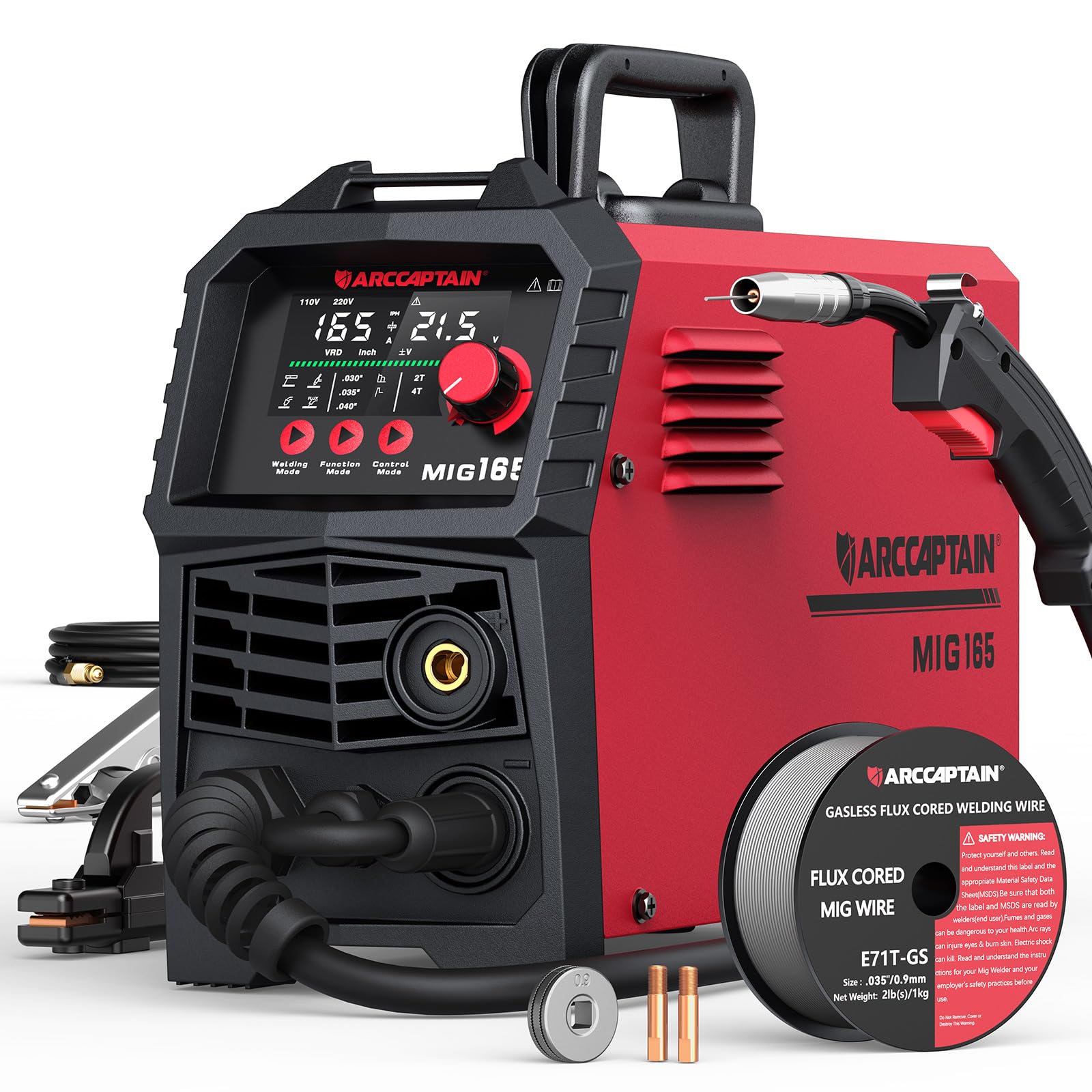
The MIG165 is the clearest portability-focused option in this group. Its documented compact size and light listed weight make it easier to move between a garage, driveway, vehicle, or small work area than the larger multiprocess machines.
You still get gas MIG, which is the important feature for this article. Pair the machine with suitable stainless wire and the shielding gas recommended for your process instead of relying on the included or commonly available mild-steel flux-core wire for stainless work.
Lift-TIG support adds versatility, although the required TIG torch is an additional purchase. The lower 165A-class output also means this model makes more sense for lighter fabrication than buyers who regularly weld thick sections for long periods.
Buyer Considerations
Portability is the main reason to choose this machine. Buyers trading up from a basic gasless flux-core unit also gain external-gas MIG capability, dual voltage, and more useful parameter controls.
Overall fit: Strong for mobile repairs, home shops, lighter stainless work, and users with limited storage space.

The sentiment graphic above is retained from the supplied article. Its underlying sample and methodology were not independently verified for this update.
When It Helps
|
Situation |
How It Helps |
|---|---|
|
Small stainless projects |
Gas-MIG capability gives you the correct machine path for suitable stainless solid wire. |
|
Mobile repair work |
The compact chassis is easier to move than heavier multiprocess units. |
|
Learning MIG settings |
Synergic assistance gives you a baseline while manual adjustment lets you learn how settings affect the weld. |
|
Different outlet types |
110/220V support gives you more flexibility than a 110V-only entry-level machine. |
Control Notes
Use the synergy function as a setup aid, then fine-tune according to the wire, gas, material thickness, and bead behavior. Thin stainless is especially sensitive to excess heat, so scrap testing and controlled travel speed matter.
Why You’ll Like It
- Compact and comparatively light design
- Gas and gasless MIG plus lift TIG and stick
- 110/220V dual-voltage operation
- Synergy and manual adjustment options
- Good step up from a basic gasless-only repair welder
Who Should Avoid It
Skip it if you need built-in plasma cutting, spool-gun capability, or substantially more output for frequent thicker fabrication.
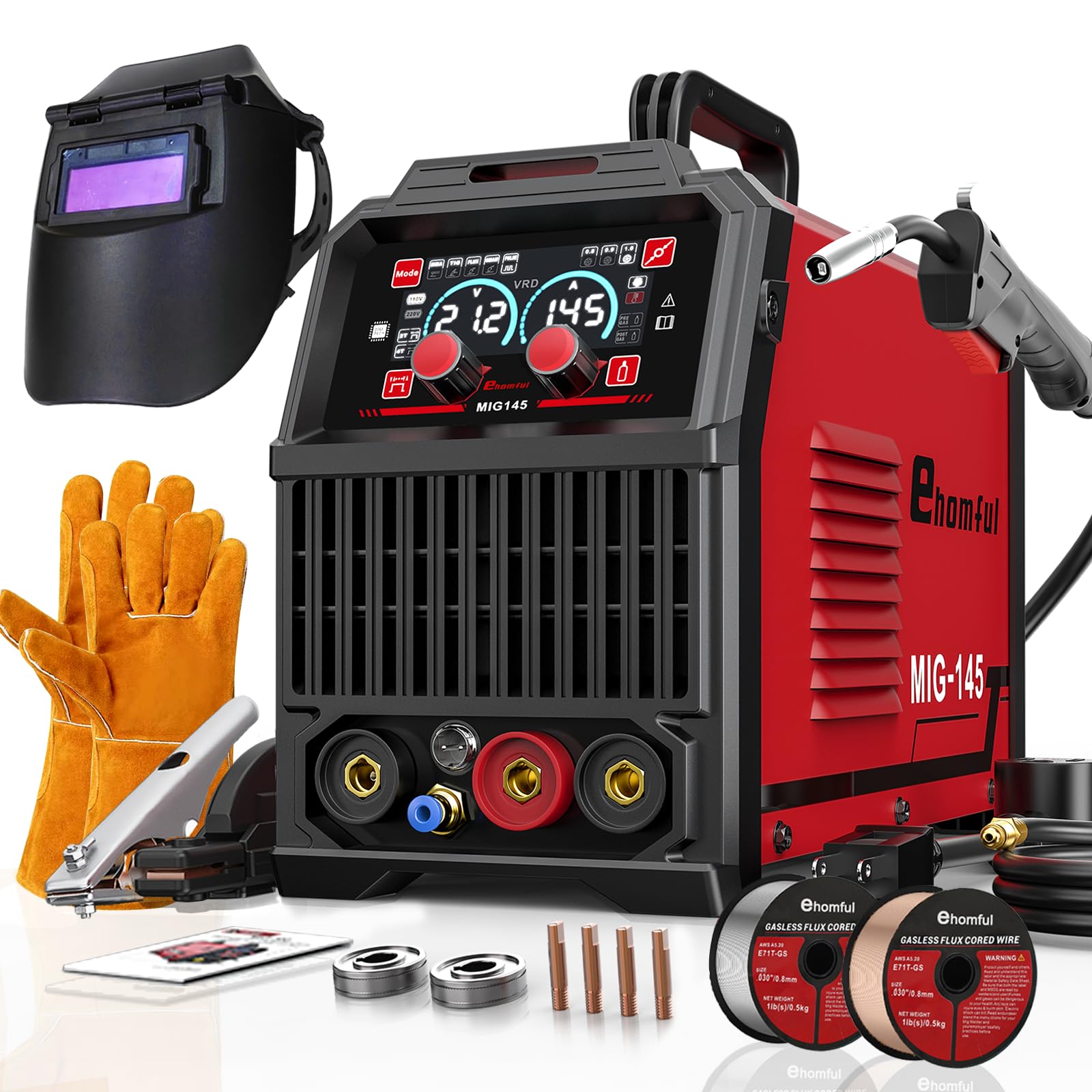
The Ehomful is aimed at buyers who want fewer separate purchases on day one. The welder combines gas MIG, gasless MIG, lift TIG, and stick with dual-voltage input, while the bundle adds items such as a helmet and gloves.
For stainless, the important feature is again the gas-MIG mode. Use appropriate stainless solid wire and matching shielding gas rather than assuming the supplied consumables are intended for stainless steel.
The bundled PPE adds convenience, but inspect the helmet, gloves, cables, clamps, and every included accessory before use. Replace any item that does not provide the protection, fit, condition, or specification required for your work.
Buyer Considerations
The main advantage is convenience rather than maximum output. This is better suited to learning, lighter repairs, and occasional fabrication than buyers planning frequent long welds on heavy material.
Overall fit: Beginner-friendly for a small garage when you value bundled accessories and dual-voltage flexibility.

The sentiment graphic above is retained from the supplied article. Its underlying sample and methodology were not independently verified for this update.
When It Helps
|
Situation |
How It Helps |
|---|---|
|
First welding setup |
The accessory bundle reduces the number of separate starter items you need to source immediately. |
|
Light stainless practice |
Gas-MIG capability lets you configure the machine for suitable solid stainless wire and external gas. |
|
Learning parameter changes |
Synergic assistance provides a baseline while manual adjustment lets you experiment on scrap. |
|
Home and small-shop outlets |
110/220V support gives you more flexibility as your workspace changes. |
Control Notes
Synergic control can simplify the first setup, but stainless still requires the correct consumables and heat management. Start on scrap of the same alloy and thickness before welding the finished part.
Why You’ll Like It
- Gas/gasless MIG, lift TIG, and stick capability
- 110/220V dual-voltage input
- Synergic controls aimed at easier setup
- Helmet, gloves, and starter accessories included
- Useful for lighter garage work and learning multiple processes
Who Should Avoid It
Skip it if your main goal is high-output production welding, frequent thick stainless fabrication, or professional work where you already own higher-grade PPE and accessories.
FAQ
Can These MIG Welders Weld Stainless Steel?
Yes. Each machine in this roundup provides a gas-MIG path, which means it can be configured for solid stainless MIG wire when the machine, wire diameter, shielding gas, polarity, and material thickness are compatible.
For many 304 stainless applications, ER308, ER308L, or ER308LSi filler is commonly used. 316-series stainless generally requires a suitable 316-series filler. Do not choose filler from the base-metal name alone when the weld is structural, pressure-retaining, sanitary, corrosion-critical, or otherwise specification-controlled; follow the applicable procedure or professional guidance.
What Shielding Gas Should You Use for Stainless MIG?
There is no single gas mixture that is best for every stainless MIG setup. Conventional short-circuit stainless MIG commonly uses a helium-containing tri-mix, while low-CO₂ argon-based blends can suit other machines and transfer modes. The correct choice depends on your welder, filler wire, transfer mode, joint, and application.
Do not automatically use a mild-steel gas setup just because it is already connected to your regulator. Check the welder manual and consumable manufacturer’s recommendations first.
What Should You Consider When Buying a MIG Welder for Stainless Steel?
Start with gas-MIG capability, wire compatibility, output range, duty cycle, and input power. A good stainless machine also needs enough manual adjustment to let you balance voltage, wire feed, and travel speed without overheating the joint.
Then consider secondary features. Dual voltage helps if you move between a home garage and shop. Pulsed MIG can be valuable for buyers who understand and need that process. Lift TIG adds another stainless option, but often requires another torch. Spool-gun compatibility matters if aluminum is also part of your workload.
How Do You Get Cleaner Stainless MIG Welds?
Start with clean base metal, uncontaminated stainless-specific preparation tools, suitable filler, and appropriate shielding gas. Keep oil, grease, carbon-steel grinding residue, and other contamination away from the joint.
Control heat input with appropriate settings and travel speed. Too much heat can increase distortion and heat tint and may reduce corrosion performance. Use the machine chart or synergy settings as a starting point, then test and fine-tune on scrap of similar alloy and thickness.
If wire feeding becomes inconsistent, inspect the contact tip, drive rolls, liner, spool tension, torch connection, and wire path. Stainless wire can expose feeding problems that are less obvious with some mild-steel setups.
Is Flux-Core Welding Good for Stainless Steel?
Only when the flux-cored consumable is specifically designed for stainless steel and is compatible with the application and machine. Ordinary carbon-steel self-shielded flux-core wire should not be treated as a substitute for stainless filler.
For the DIY machines in this roundup, gas MIG with suitable solid stainless wire is generally the clearer stainless path. Stainless flux-cored processes exist, but wire type, gas requirements, polarity, and procedure must match the job.
Do You Need 220V for Stainless MIG Welding?
No. A compatible 110/120V machine can handle lighter stainless work within its output range. However, 220/240V gives a dual-voltage welder more available input power and can provide useful headroom for thicker material or higher output.
Material thickness is only part of the decision. Joint type, wire diameter, transfer mode, duty cycle, and how long you weld continuously also matter.
Can You MIG Weld Food-Contact or Marine Stainless at Home?
You can physically weld many stainless components with suitable equipment, but food-contact, sanitary, structural, pressure, and corrosion-critical marine work can have additional requirements for alloy selection, procedure qualification, purge technique, surface finishing, inspection, and passivation.
For work where failure or corrosion could create a safety or sanitation problem, follow the applicable standard or use a qualified professional rather than treating a general DIY setup as sufficient.
What Buyers Should Prioritize
First, choose the process you actually need. If your main job is stainless MIG, gas-MIG capability and parameter control matter more than having nine advertised modes. The YESWELDER MIG-205DS PRO is the balanced choice, while the ARCCAPTAIN MIG205MP makes more sense when pulsed MIG, TIG, and plasma cutting will genuinely be used.
Next, match power to your workload. The ARCCAPTAIN MIG165 is attractive when portability matters. The FEMEROL appeals to buyers looking for more advertised output. The Ehomful package is easier to justify when you are starting from almost no equipment and value bundled accessories.
Finally, budget for the complete stainless setup. The welder is only one part of the purchase. Depending on the machine and process, you may also need stainless wire, shielding gas, a cylinder, regulator/flowmeter, contact tips, a dedicated stainless brush, TIG torch, spool gun, upgraded PPE, or fume-control equipment.
Wrapping Up
If you want the most balanced option in this group, the YESWELDER MIG-205DS PRO offers gas MIG, dual voltage, multiprocess flexibility, and useful upgrade paths without the complexity of the most advanced machine.
Choose the ARCCAPTAIN MIG205MP when you will actually use pulsed MIG, TIG, advanced parameter controls, and plasma cutting. Consider the FEMEROL 250A when advertised output headroom is a priority, the ARCCAPTAIN MIG165 when portability comes first, or the Ehomful 145A when a starter-oriented accessory bundle is more valuable than maximum power.
Whichever machine you choose, stainless results depend on the whole procedure: suitable filler, appropriate shielding gas, correct polarity, clean preparation, heat control, good ventilation, and settings matched to the material.
| Product | Image | Best For | Input Power | Key Advantage | Welding Modes | Amazon |
|---|---|---|---|---|---|---|
| YESWELDER MIG-205DS PRO MIG Welder |
 |
Balanced stainless and multiprocess use | 110/220V Dual Voltage | Strong all-around feature balance |
|
Check Price |
| ARCCAPTAIN MIG205MP MIG Welder |
 |
Advanced welding and cutting versatility | 120/240V Dual Voltage | Pulsed MIG, TIG, and plasma in one platform |
|
Check Price |
| FEMEROL 250A MIG Welder |
 |
Higher advertised output | 110/220V Dual Voltage | 250A-class advertised output with multiple processes |
|
Check Price |
| ARCCAPTAIN 165A MIG Welder |
 |
Portable dual-voltage welding | 110/220V Dual Voltage | Compact, light listed design |
|
Check Price |
| Ehomful 145A Mig Welder 110v/220v |
 |
Beginner package with accessories | 110/220V Dual Voltage | Welder plus basic starter gear |
|
Check Price |