You want to spend more time fishing and less time fighting wind, cold, and awkward shelter poles. A well-matched ice fishing tent creates a protected workspace for your chairs, holes, heater-approved equipment, electronics, and tackle while making long sessions more comfortable.
This guide compares five pop-up ice fishing shelters across insulation, usable space, entry design, portability, anchoring, and overall practicality. Manufacturer occupancy numbers are useful starting points, but your comfortable capacity will depend on how many holes, chairs, heaters, and gear bags you bring.
Quick Verdict
Best overall: The Eskimo Outbreak 450XD combines an insulated shell, generous fishable area, and a full no-trip door.
Best for a small group: The ThunderBay Ice Cube 2–3 Person keeps the footprint and transport demands more manageable.
Best for a larger group: The ThunderBay Ice Cube 6 Person provides substantially more fishable area for chairs, holes, and shared equipment.
Best compact insulated alternatives: The Garvee 3-4 and ShedOFF 2-3 focus on warmth and portability at a smaller scale.
This roundup is reader-supported. When you click qualifying links, we may earn a referral commission at no additional cost to you. As an Amazon Associate I earn from qualifying purchases.
Top Picks
| Category | Product | Best For |
|---|---|---|
| ⭐ Best Overall | Eskimo Outbreak 450XD | Insulated group fishing and easier entry |
| 🔝 Best Small-Group Value | ThunderBay Ice Cube 2–3 Person | Solo anglers, pairs, and compact setups |
| 🏆 Best for Larger Groups | ThunderBay Ice Cube 6 Person | Families and vehicle-supported group trips |
| 🎯 Best Compact Insulated | Garvee 3-4 | Buyers seeking insulation without a group-size hub |
| 💰 Best Budget Insulated Option | ShedOFF 2-3 | Short trips and occasional two-person use |
How We Chose These Ice Fishing Tents
We focused on the details that affect real use on the ice: insulation, fishable area, shelter footprint, hub construction, entry design, window and vent placement, anchoring options, packed size, and the amount of gear each shelter can reasonably hold.
We also considered whether each linked listing clearly identified the model being recommended. Products with unresolved capacity contradictions, generic search links, inaccessible listings, or unverified stove-related claims were excluded.
Before You Buy
- Check the currently selected size and color variation on Amazon.
- Compare fishable area rather than relying only on the advertised occupancy.
- Confirm packed weight and length if you will haul the shelter by hand.
- Check how many ice anchors, guy lines, windows, and doors are included.
- Confirm that replacement poles, hubs, windows, or warranty support are available.
Ice Fishing Tent Reviews
The Outbreak 450XD is the strongest all-around choice for anglers who value warmth, usable floor area, and easier entry. Its insulated shell is designed to reduce heat loss, while the flared footprint gives you more working room around chairs, holes, and equipment.
The oversized door opens down to ice level, reducing the raised threshold that can catch boots or bulky gear. Removable window panels, storage pockets, skirt grommets, and tie-downs also make this a more complete group-fishing setup than a basic compact hub.
Who Should Buy It
Choose the Outbreak 450XD for regular cold-weather fishing, vehicle-supported trips, or a group that wants a warmer shelter with easier loading and unloading.
Reasons to Choose It
- Insulated construction for improved heat retention
- Large fishable area for chairs, holes, and equipment
- No-trip entry that opens down to ice level
- Removable windows for adjustable ventilation
- In-skirt grommets and tie-downs for secure anchoring
- Interior pockets for frequently used tackle and tools
Limitations to Consider
This is a relatively large and heavy hub shelter. It makes the most sense when transported by vehicle, snowmobile, ATV, or a well-loaded sled rather than carried a long distance by hand. The 4–5-person label also represents maximum occupancy; fewer anglers will be more comfortable when each person has a chair, hole, and gear.
Check Current Amazon Availability
The smaller ThunderBay Ice Cube is a practical match for one angler who wants extra gear space or two anglers with a streamlined layout. Its hub construction avoids a loose-pole assembly process, while the darker interior can help control light for sight fishing.
Because this is the compact 2–3-person model, it is easier to position and transport than a six-person hub. The trade-off is that chairs, electronics, a heater, and several holes can consume its usable floor space quickly.
Who Should Buy It
It is best for solo anglers, pairs, short day trips, and buyers who prioritize a manageable shelter over maximum interior space.
Reasons to Choose It
- Compact footprint for solo and two-person layouts
- Hub-style setup without assembling individual support poles
- Blackout-style interior for improved light control
- Included anchoring points for securing the shelter
- Smaller packed package than a large group shelter
Limitations to Consider
This model should not be treated as a roomy four-person shelter. Its 2–3-person designation is a maximum, and two anglers will generally have more practical room for chairs, multiple holes, and equipment. It is also not positioned as a fully insulated shelter, so clothing and heater planning matter in severe cold.
The ThunderBay Ice Cube 6 Person is the better option when floor area matters more than low carrying weight. Its larger layout provides more flexibility for arranging chairs, several fishing holes, sonar equipment, tackle, and shared supplies.
The blackout-style interior can help with sight fishing, while windows and vents give you more control over light and airflow. The hub system also keeps setup more straightforward than shelters that require a conventional pole-and-sleeve pitch.
Who Should Buy It
Choose this model for family outings, groups of friends, long day sessions, and trips where the shelter will be transported by truck, ATV, snowmobile, or sled.
Reasons to Choose It
- Substantially more fishable area than a compact hub
- Space for multiple chairs, holes, and shared equipment
- Blackout-style panels for interior light control
- Multiple windows and vents
- Hub-style setup and included anchoring hardware
Limitations to Consider
A six-person shelter is heavier, bulkier, and more exposed to wind than a compact model. Proper anchoring is essential before fully opening the shelter. Six occupants may also feel crowded after chairs, holes, heaters, and tackle are placed inside.
Check Current Amazon Availability
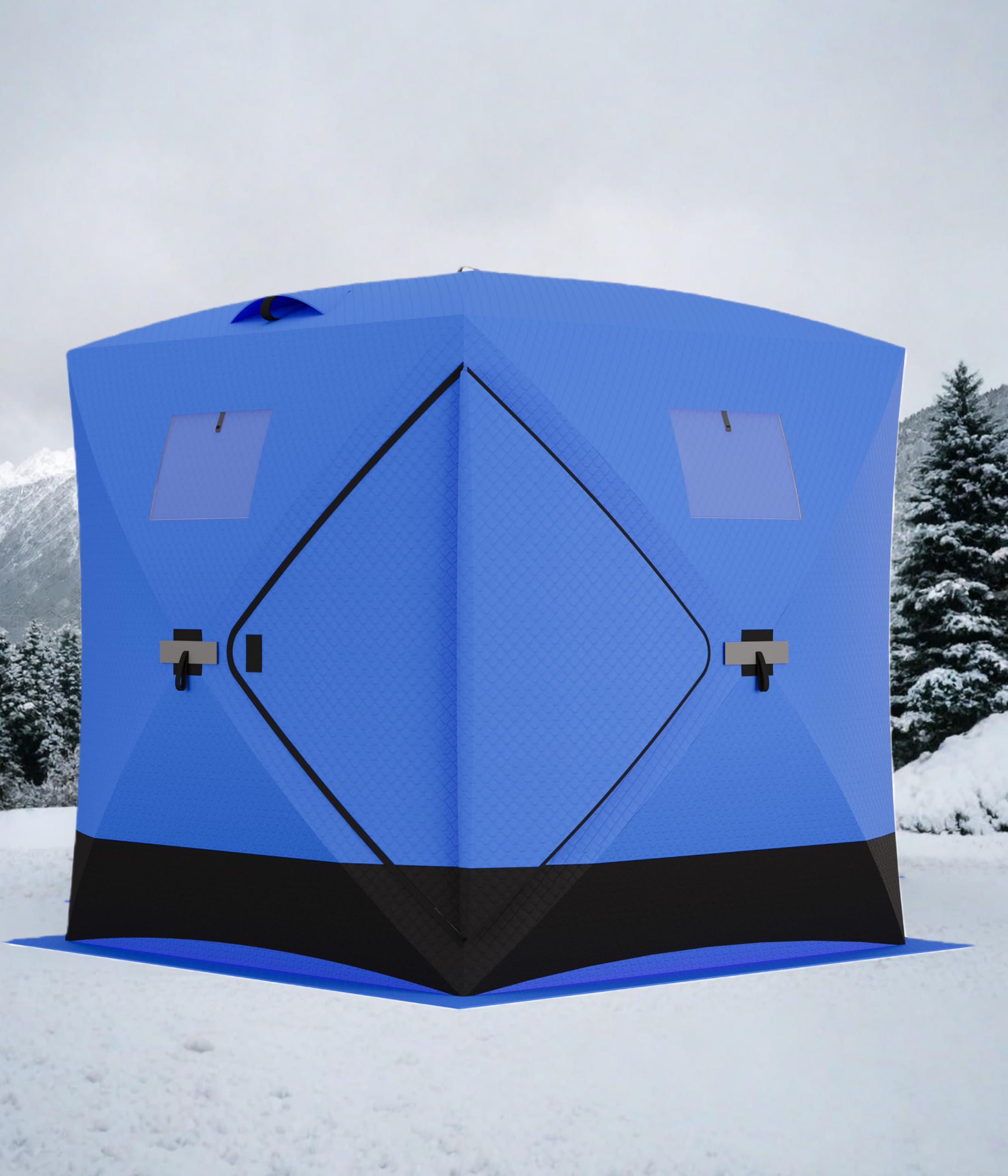
The Garvee 3-4 targets anglers who want an insulated shelter without moving up to a long or extra-wide group hub. The compact shape is easier to position, while the insulated shell and perimeter skirting help reduce exposure to wind.
Windows and vents let you adjust visibility and airflow, and the pop-up hub design is intended to simplify deployment. It is a practical middle ground for one or two anglers who want more space than a tiny solo shelter.
Who Should Buy It
This model is best for solo anglers with substantial gear, pairs who want an insulated workspace, and casual users who prefer a smaller package than a family shelter.
Reasons to Choose It
- Insulated construction in a compact footprint
- Hub-style deployment for simpler setup
- Windows and vents for adjustable light and airflow
- Perimeter skirting to help block drafts
- Portable format for sled or vehicle transport
Limitations to Consider
The 3–4-person label should be treated as a maximum occupancy figure. Two anglers will have more practical room once chairs, holes, a heater-approved device, and tackle are inside. Verify the selected listing variation, included anchors, dimensions, and current warranty information before ordering.
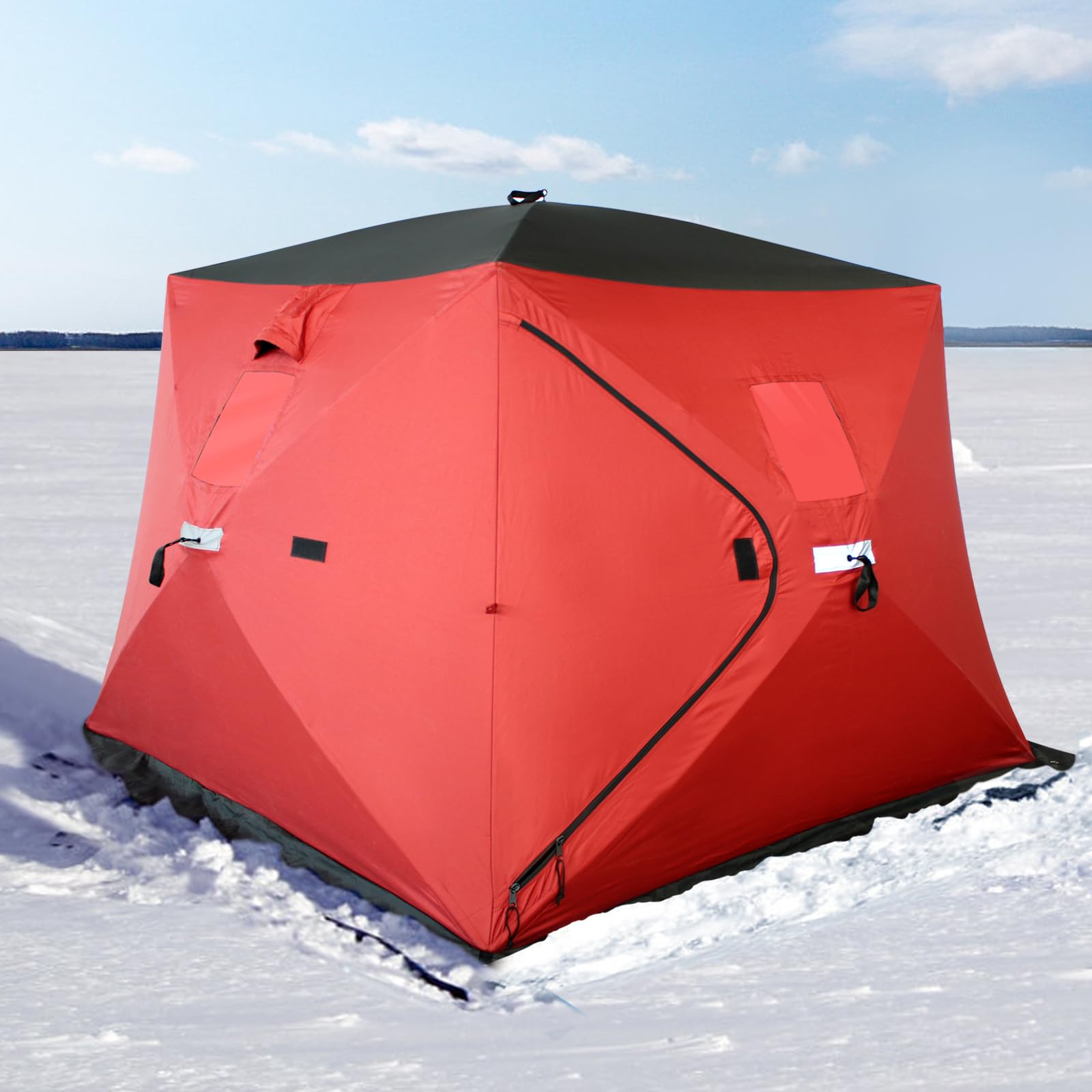
The ShedOFF 2-3 is an alternative for buyers who want insulation and a compact footprint without stepping up to a premium group shelter. Its wide-bottom shape is intended to create more usable room near the floor, where chairs, electronics, and tackle take up space.
Skirting helps reduce low drafts, while removable windows and vents provide options for managing visibility and airflow. The smaller format should also be easier to haul than a full-size family hub.
Who Should Buy It
Consider it for occasional trips, solo use with extra equipment, or two-person day sessions where insulation and portability are the main priorities.
Reasons to Choose It
- Insulated shell for better heat retention than a basic windbreak
- Wide-bottom footprint for improved floor-level space
- Skirting to help reduce drafts
- Removable windows and ventilation openings
- Compact hub-style format
Limitations to Consider
The listing appears to have multiple material or size references, so confirm the exact variation, dimensions, included hardware, and fabric specification before purchase. Its smaller review history and changing listing details also make it less established than the Eskimo and ThunderBay options.
Check Current Amazon Availability
How to Choose an Ice Fishing Tent
Start With Fishable Area, Not Just Occupancy
A shelter advertised for three or four people may not comfortably hold that many anglers once you add chairs, holes, a heater-approved device, sonar units, rods, and tackle. Sketch your normal floor layout and compare it with the listed fishable area and dimensions.
Choose Insulation for Your Conditions
An insulated shell generally holds warmth more efficiently and reduces fabric movement in wind, but it also adds weight, bulk, and drying time. A non-insulated shelter can be a better fit for mild days, frequent spot changes, or long hand-pulled approaches.
Check Packed Weight and Length
Large hubs may be easy to erect but difficult to transport. Confirm that the packed shelter fits your vehicle or sled and that you can safely move it with the rest of your equipment.
Look at Doors, Windows, and Vents
A no-trip or full-panel door is helpful when carrying an auger, heater, chair, or electronics. Removable windows provide more control over light, and dedicated vents are important for airflow. The number and location of openings matter as much as their total count.
Do Not Undervalue Anchoring
Hub shelters can catch wind quickly. Look for sturdy ice anchors, reinforced guy-out points, skirt grommets, and attachment points that remain accessible during setup. Anchor an upwind corner or side before fully opening the shelter in breezy conditions.
Confirm Replacement Parts and Support
Windows, poles, hubs, zippers, and carry bags can wear or become damaged. A slightly more expensive shelter may provide better long-term value when replacement parts and warranty support are readily available.
Ice and Heater Safety
Ice conditions can change across the same lake and from one day to the next. Follow local guidance, carry appropriate rescue equipment, and never rely on a shelter as protection from unsafe ice.
Use only heating equipment that the heater manufacturer specifically approves for enclosed use. Follow both the heater and shelter instructions, maintain required ventilation and clearances, and keep combustion equipment away from fabric and gear.
Never use a fuel-burning heater while sleeping in the shelter. Never use charcoal, a grill, or an outdoor-only stove or heater inside the tent.
FAQ
Which Ice Fishing Tent Should I Choose?
Choose according to your normal group and transport method. The Eskimo Outbreak 450XD is the most complete insulated group option in this guide. The smaller ThunderBay Ice Cube is easier to manage for one or two anglers, while the six-person ThunderBay provides more room for family or group layouts. The Garvee and ShedOFF models are compact insulated alternatives for buyers who prioritize warmth and portability.
How Many People Fit Comfortably?
Advertised occupancy is usually a maximum shelter designation rather than a guarantee of comfortable fishing space. A three-person model often works best for one or two anglers with chairs and equipment. A six-person shelter may be more comfortable for three or four people once multiple holes and shared gear are arranged.
How Do I Set Up and Secure a Hub Shelter?
Practice deployment and packing at home. On the ice, keep the folded shelter controlled, anchor the upwind side first, extend the remaining hubs, secure the skirt, and attach all recommended guy lines. Do not leave an erected shelter unsecured, even for a brief period.
Can I Use a Propane Heater Inside?
Only use a heater specifically approved by its manufacturer for enclosed spaces, and follow all heater and shelter instructions. Maintain ventilation and required clearances, place the heater on a stable surface, and keep fabric and gear away from it. Never use a fuel-burning heater while sleeping, and never use an outdoor-only heater, stove, grill, or charcoal appliance inside the shelter.
Is an Insulated Shelter Worth the Extra Weight?
Insulation is valuable when you regularly fish in low temperatures, strong wind, or for long periods. A lighter non-insulated hub may be preferable when you move frequently, fish in milder conditions, or pull all your equipment by hand.
Should I Upgrade the Included Ice Anchors?
Inspect the included anchors before relying on them. Additional anchors, compatible drill adapters, and extra guy lines can make setup faster and provide redundancy, but use only attachment points intended by the shelter manufacturer.
Quick Comparison
| Product | Image | Best For | Insulation | Main Trade-Off | Amazon |
|---|---|---|---|---|---|
| Eskimo Outbreak 450XD |
 |
Premium insulated group use | Yes | Heavier and bulkier to transport | Check Details |
| ThunderBay Ice Cube 2–3 Person |
 |
Solo anglers and pairs | No | Limited room after adding gear | Check Details |
| ThunderBay Ice Cube 6 Person |
 |
Families and larger groups | No | Requires more transport and anchoring effort | Check Details |
| Garvee 3-4 |
 |
Compact insulated use | Yes | Confirm selected variation and included hardware | Check Details |
| ShedOFF 2-3 |
 |
Occasional insulated two-person trips | Yes | Listing specifications may vary by selection | Check Details |
Final Recommendation
Choose the Eskimo Outbreak 450XD when insulation, interior space, a no-trip door, and a more complete anchoring system matter most.
Choose the ThunderBay Ice Cube 2–3 Person when you usually fish alone or with one partner and want a compact, straightforward hub.
Choose the ThunderBay Ice Cube 6 Person when you need additional fishable area for a family or group and have a practical way to transport it.
Choose the Garvee 3-4 or ShedOFF 2-3 when you want a smaller insulated shelter and are comfortable verifying the exact listing variation and included equipment before ordering.
The best ice fishing tent is not necessarily the model with the highest advertised occupancy. Match the shelter to your normal number of anglers, floor layout, transport method, weather, and anchoring routine. A correctly sized shelter that you can safely move, secure, ventilate, and pack will be more useful than a larger model that becomes difficult to manage.
This roundup is reader-supported. When you click through qualifying links, we may earn a referral commission at no additional cost to you.