Affiliate disclosure:. As an Amazon Associate I earn from qualifying purchases. This roundup is reader-supported. When you click an Amazon link, we may earn a commission from qualifying purchases at no extra cost to you. Product specifications and availability can change, so confirm the selected size and variant before ordering.
A lightweight 2-person tent can reduce pack bulk without giving up the weather protection and interior space you need for weekend backpacking, bikepacking, and compact car-camping trips. The best choice depends on whether you value minimum weight, two-door convenience, room for two adults, or extra fabric coverage for colder conditions.
This guide compares five distinct shelters that match that buyer intent. It removes duplicate color or listing variants and avoids treating seller marketing terms such as “ultralight” as a universal standard. For two people, always compare floor width, door layout, vestibule storage, and complete packed weight—not just the capacity label.
Use the quick comparison first, then read the individual limitations before choosing the tent that best fits your route, season, and carrying style.
Quick Verdict
Best overall lightweight choice: The Naturehike Cloud-Up Pro has the lowest verified listed weight in this group and includes a footprint, but its single front entrance is less convenient for two sleepers.
Best for two adults: The Naturehike Mongar offers two doors and two vestibules, giving each camper easier access and separate gear storage.
Best budget-oriented option: The Clostnature 3-season model provides two doors, two vestibules, and a straightforward freestanding pitch, though it is heavier than the Cloud-Up Pro.
Cold-weather note: The Clostnature 4-season model adds snow flaps and more fabric coverage, but it is the heaviest option here and should not be presented as an expedition or extreme-mountaineering shelter.
Top Picks
| Category | Product | Why It Stands Out | Amazon |
|---|---|---|---|
| 🏆 Best Overall Lightweight Pick | Naturehike Cloud-Up Pro | About 4 lb, compact packed size, full fly, and included footprint | Check Price on Amazon |
| ⛺ Best for Two-Person Livability | Naturehike Mongar 2 | Two doors, two vestibules, freestanding frame, and footprint included | Check Price on Amazon |
| 💰 Best Budget Pick | Clostnature 3-Season 2P | Roomy floor, dual doors and vestibules, simple aluminum-pole setup | Check Price on Amazon |
| 🚲 Best Value with Two Doors | ShinHye 2-Person | Two-door layout, double-wall construction, and compact freestanding pitch | Check Price on Amazon |
| ❄️ Best for Colder Conditions | Clostnature 4-Season 2P | Snow flaps, fabric-and-mesh doors, and more cold-weather coverage | Check Price on Amazon |
How We Picked These Tents
This is an editorial comparison based on currently available manufacturer and retailer specifications, product design, and practical buyer considerations; it is not a claim of hands-on laboratory testing. We prioritized complete packed weight, floor dimensions, door and vestibule layout, pole material, rainfly coverage, included footprint, setup style, and whether each tent offers a distinct reason to buy it.
We also removed duplicate listing or color variants so the comparison does not overrepresent one model. When seller data conflicts—especially weight or waterproof figures—the article uses cautious wording and tells you to confirm the exact selected variant.
Lightweight vs. Ultralight: A Reality Check
“Ultralight” is not a regulated tent category, and sellers use the term inconsistently. In this group, the Cloud-Up Pro is the clearest weight-first choice at about 4 lb for the listed setup. The other models are better described as lightweight or packable double-wall tents rather than cutting-edge ultralight shelters.
For shared use, weight per person matters too. A 5 lb tent split between two hikers can be reasonable, while the same tent carried solo may feel heavy. Compare the exact packaged weight, minimum trail weight definition, and what is included before making a decision.

The Cloud-Up Pro is the strongest fit for hikers who place packed weight and compact storage ahead of maximum two-person convenience. Its freestanding pole structure is straightforward to pitch, and the included footprint reduces the need to buy a separate ground protector.
The floor is listed around 82.7 inches long and roughly 49 to 51 inches wide depending on the listing field, so two standard pads may fit closely. The single front door and vestibule make it less convenient than a two-door tent when both occupants need to enter, exit, or reach gear at night.
Why You’ll Like It
- Lowest verified listed weight in this roundup at about 4 lb
- 20D silicone-coated nylon and a full double-wall layout
- Footprint included
- Compact packed size for backpacking and bikepacking
- Freestanding aluminum-pole structure
Who Should Buy This
Solo backpackers wanting extra room, couples who pack efficiently, and bikepackers who value a narrow packed bundle.
Who Should Avoid This
Two campers who strongly prefer separate doors and vestibules, broad sleeping pads, or generous shoulder room.
Buyer Feedback Snapshot
The chart below is preserved from the source article’s captured feedback snapshot. Treat it as historical context and check current Amazon reviews for recent durability, condensation, and fit comments.


The Mongar 2 is the most practical choice here for two people because each sleeper gets a side door and vestibule. That layout reduces climbing over a partner and gives both campers a sheltered place for footwear or a compact pack.
Its listed floor is about 82.7 by 53.2 inches with a peak height around 41.3 inches. Weight information varies across the current listing, with one field showing about 4.2 lb and the product copy describing roughly 5.3 lb for the full set including the footprint. Confirm the selected material and package before comparing it directly with other tents.
Why You’ll Like It
- Two doors and two vestibules improve shared use
- Freestanding Y-frame design
- Included footprint
- Large mesh inner for airflow and bug protection
- More balanced livability than a single-door weight-first tent
Who Should Buy This
Couples, hiking partners, or solo campers who want extra elbow room and easy access from both sides.
Who Should Avoid This
Hikers who need a confirmed sub-4 lb shelter or who want the smallest possible packed volume.
Buyer Feedback Snapshot
The preserved chart reflects the source article’s earlier feedback snapshot. Verify current comments about stakes, vestibule space, seam quality, and the exact included footprint.


This Clostnature model offers a useful two-door layout and a wider floor than the Cloud-Up Pro. The current listing gives dimensions of about 86.6 by 59 inches with a peak height around 45.3 inches, making it one of the roomier options in this comparison.
The seller lists a total weight around 5.29 lb and a minimum trail weight around 4.52 lb for the fly, inner, and poles. That makes it a practical budget-oriented backpacking tent, but not the best option for hikers chasing the lowest possible base weight. A footprint is not listed among the standard included components, so check the package and consider a correctly sized groundsheet for abrasive campsites.
Why You’ll Like It
- Two doors and two vestibules
- Roomy listed floor dimensions
- Simple freestanding two-pole setup
- Full mesh inner for warm-weather ventilation
- Repair sleeve, stakes, and guylines listed in the package
Who Should Buy This
Budget-conscious weekend backpackers, festival campers, and couples who value space and two-door access more than minimum weight.
Who Should Avoid This
Long-distance hikers seeking a genuinely ultralight shelter or campers who need a footprint included in the box.
Buyer Feedback Snapshot
This preserved chart is a historical snapshot from the source article. Check current reviews for updated comments about floor durability, supplied stakes, zipper operation, and storm performance.

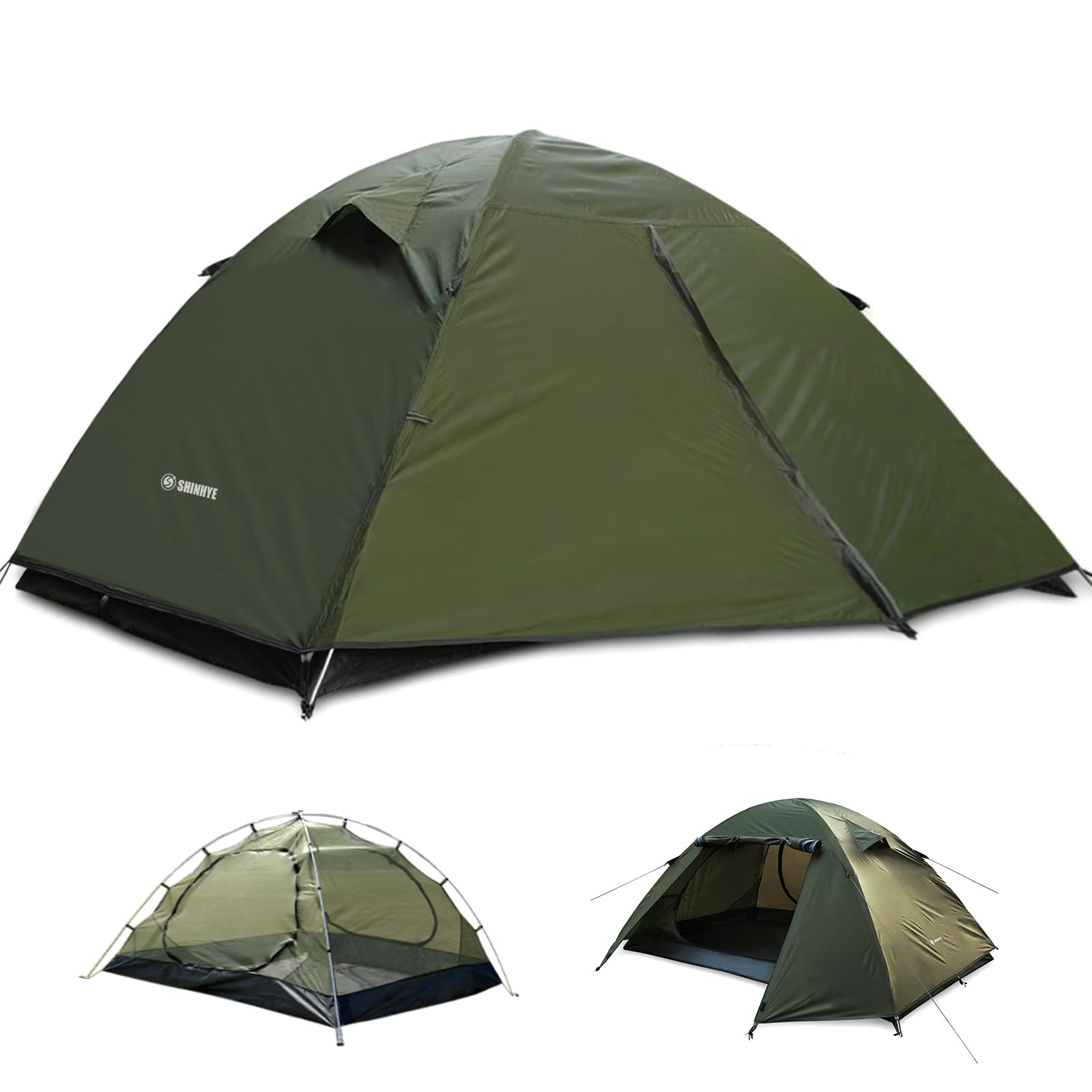
The ShinHye gives budget shoppers another two-door option with a listed floor around 82.7 by 55 inches and a peak height around 43.3 inches. The large mesh sections should help airflow in warm conditions, while the separate rainfly provides weather coverage when needed.
The current listing shows an item weight around 2.3 kg, or about 5.1 lb. Some listing fields are internally inconsistent, so confirm the exact 2-person variant, included accessories, warranty terms, and packed dimensions before ordering. It is better viewed as an affordable, packable camping tent than a specialist ultralight shelter.
Why You’ll Like It
- Two doors for easier shared access
- Freestanding aluminum-pole design
- Double-wall construction with large mesh panels
- Interior storage pocket and lantern hook
- Suitable for occasional backpacking, bikepacking, and compact car camping
Who Should Buy This
Occasional campers who want two-door convenience and a straightforward setup without paying primarily for minimum weight.
Who Should Avoid This
Thru-hikers, buyers who need tightly documented specifications, or campers who require a verified included footprint.
Buyer Feedback Snapshot
The chart below is retained from the source article and may not reflect the latest review mix. Check current feedback for seams, zippers, supplied stakes, and long-term use.


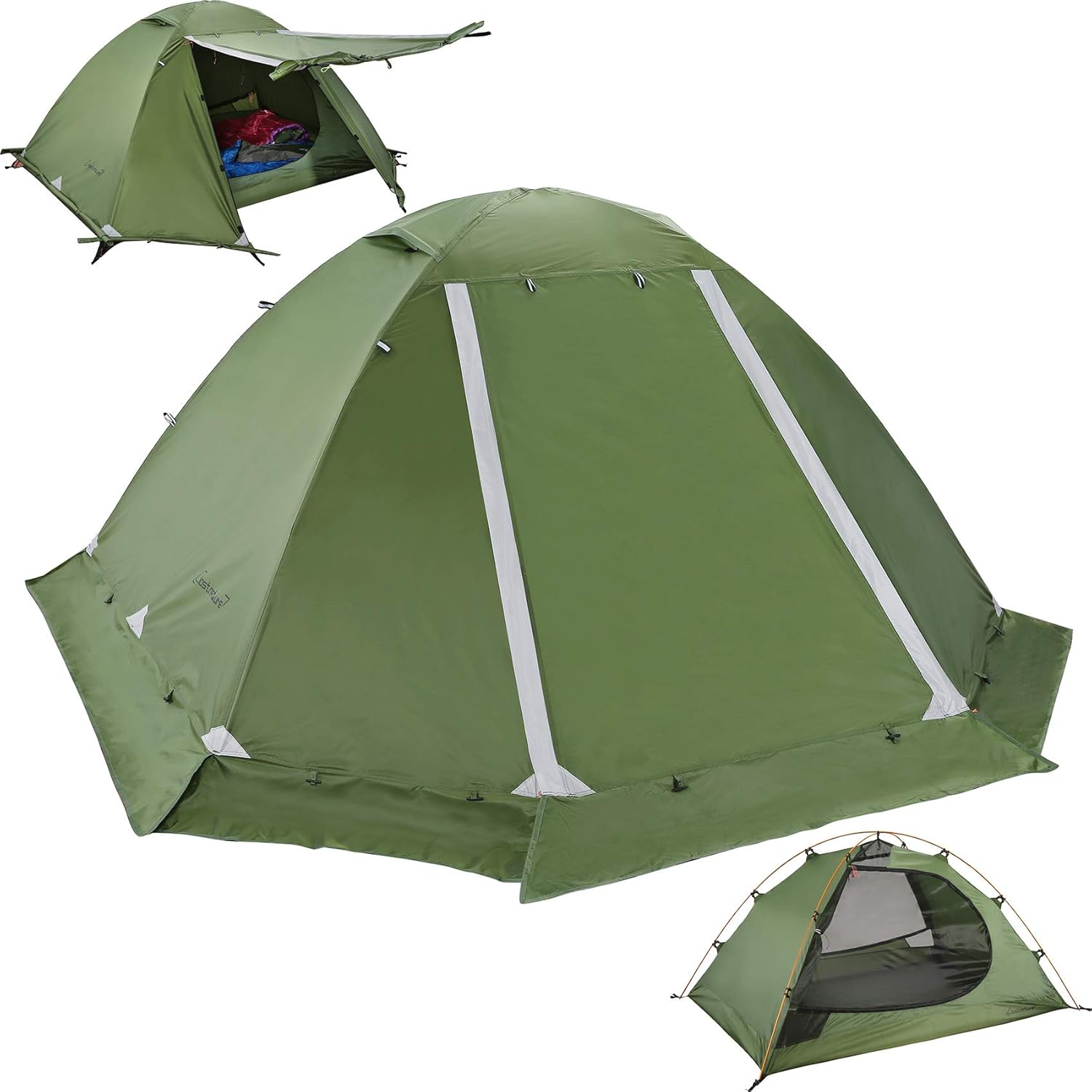
This Clostnature model is the niche choice for campers who expect colder, windier, or lightly snowy conditions and want more fabric coverage than a mesh-heavy 3-season tent. Snow flaps can help limit spindrift, while the fabric-and-mesh door layers let you trade ventilation for coverage.
It is also the heaviest tent in this roundup at about 6.3 lb total and roughly 5.33 lb minimum trail weight according to the current product copy. The listing contains conflicting waterproof figures, so the article does not repeat a single numeric hydrostatic-head claim. Verify the selected variant and do not assume that a “4-season” label makes it suitable for severe alpine storms, heavy snow loading, or exposed winter mountaineering.
Why You’ll Like It
- Snow flaps and more solid fabric coverage
- Two doors and two vestibules
- Freestanding aluminum-pole setup
- Roomy dimensions similar to the 3-season Clostnature model
- More appropriate for cold shoulder-season camping than mesh-dominant options
Who Should Buy This
Budget-minded campers taking lower-elevation cold-weather trips where extra coverage matters more than low weight.
Who Should Avoid This
Ultralight hikers, expedition users, and anyone who needs independently verified snow-load or extreme-wind performance.
Buyer Feedback Snapshot
This chart is preserved from the source article’s prior feedback snapshot. Read current reviews and recent questions for cold-weather condensation, snow-flap use, and seam performance.

Buying Guide: How to Choose a Lightweight 2-Person Tent
Compare Complete Weight, Not Marketing Labels
Check whether the stated number is packaged weight, total weight, or minimum trail weight. Packaged weight may include stakes, bags, guylines, and a footprint, while minimum trail weight may omit items you will still carry. Use the same definition when comparing tents.
Measure Your Sleeping Pads
Two 25-inch-wide pads require about 50 inches of usable floor width before accounting for curved walls. A tent near that width may technically fit two pads but still feel tight. Floor length also matters for tall sleepers because sloping end walls can reduce usable space.
Choose the Door and Vestibule Layout
Two doors and two vestibules are more comfortable for two people. A single front door can save weight, but one camper may need to climb over the other, and both packs may compete for the same vestibule.
Match the Tent to the Season
A 3-season tent is intended mainly for spring, summer, and fall conditions. A cold-weather-oriented model may add solid fabric and snow flaps, but product labels do not prove performance in severe wind or heavy snow. For exposed winter routes, prioritize a purpose-built shelter with documented structural testing and use experience appropriate to the conditions.
Check What Is Included
Confirm whether the footprint, stakes, guylines, repair sleeve, and storage bags are included. An included footprint adds value but also affects the full packed weight.
Before You Buy Checklist
- Verify the exact 2-person size and material variant.
- Check current total and minimum trail weights.
- Compare floor width with your actual sleeping pads.
- Confirm the number of doors and vestibules.
- Check whether a footprint is included.
- Read recent reviews for leaks, condensation, zipper issues, and pole durability.
- Choose a shelter appropriate for the forecast and terrain.
FAQ
Is a 2-person tent really comfortable for two adults?
Sometimes, but many 2-person backpacking tents are designed to fit two sleeping pads with limited spare floor space. Couples using wide pads or storing gear inside may be more comfortable in a 3-person tent. Two doors and vestibules make a compact 2-person floor much easier to share.
What weight counts as ultralight for a 2-person tent?
There is no regulated definition. In practice, dedicated ultralight backpackers often expect a substantially lower shelter weight than many mass-market tents labeled “ultralight.” Compare complete weight per person, durability, weather protection, and whether poles or trekking poles are required rather than relying on the label alone.
Will a lightweight tent keep me dry in prolonged rain?
Fabric ratings are only part of the answer. Seam construction, fly coverage, pitch quality, ventilation, campsite drainage, and fabric condition all matter. Stake and guy the tent correctly, avoid depressions where water collects, and keep the groundsheet from extending beyond the tent floor.
Should I always use a footprint?
A footprint is useful on abrasive, rocky, or wet ground, especially with thin floor fabrics. It should be slightly smaller than the tent floor so rain cannot collect between the footprint and bathtub floor. A footprint protects against abrasion but does not correct poor site selection or damaged seams.
Can the Clostnature 4-season model replace an expedition tent?
No assumption like that should be made from the seller’s season label alone. It may offer more cold-weather coverage than the 3-season options in this roundup, but severe alpine wind and snow loading require a shelter with a design and documented performance appropriate to those hazards.
Campers Top Picks
Choose the Cloud-Up Pro when weight and packed size lead the decision. Choose the Mongar 2 when two-door comfort matters most. The Clostnature 3-season model is the budget-oriented roomy option, the ShinHye is another affordable two-door choice, and the Clostnature 4-season model is reserved for colder trips where you accept a clear weight penalty.

Final Comparison
| Product | Image | Best For | Listed Weight | Listed Floor Size | Doors / Vestibules | Main Trade-Off | Amazon |
|---|---|---|---|---|---|---|---|
| Naturehike Cloud-Up Pro 2-Person Tent |
 |
Low weight and compact packing | About 4 lb | About 82.7″L x 49–51″W x 41.3″H | 1 / 1 | Less convenient for two people | Check Product Details |
| Naturehike Mongar 2-Person Tent |
 |
Two-person access and storage | Listing varies; about 4.2–5.3 lb | About 82.7″L x 53.2″W x 41.3″H | 2 / 2 | Weight data varies by listing field | Check Product Details |
| Clostnature 2-Person 3-Season Backpacking Tent |
 |
Budget-oriented room and two doors | About 5.29 lb total; 4.52 lb minimum trail | About 86.6″L x 59″W x 45.3″H | 2 / 2 | Heavier than weight-first choices | Check Product Details |
| ShinHye 2-Person Backpacking Tent |
 |
Affordable two-door convenience | About 5.1 lb | About 82.7″L x 55″W x 43.3″H | 2 / verify vestibule layout | Some listing fields are inconsistent | Check Product Details |
| Clostnature 2-Person 4-Season Backpacking Tent |
 |
Colder, lower-elevation trips | About 6.3 lb total; 5.33 lb minimum trail | About 86.6″L x 59″W x 45.8″H | 2 / 2 | Heavy; not an expedition shelter | Check Product Details |
Wrapping Up
Choose the Naturehike Cloud-Up Pro when low verified weight and compact packing are the priority. Choose the Naturehike Mongar 2 when two people need separate doors and vestibules. Choose the Clostnature 3-season model for a roomier, budget-oriented setup, or the ShinHye for another affordable two-door layout.
The Clostnature 4-season model belongs at the end of the list because it solves a narrower problem: more coverage for colder conditions at a substantial weight penalty. Whatever you choose, verify the exact variant, current package contents, and recent buyer feedback before purchase.