Assault weapon definitions can be confusing because the term does not mean the same thing everywhere. A firearm that is legal in one state may be restricted, banned, or subject to registration rules in another. That difference matters for gun owners, retailers, law enforcement, policymakers, and anyone trying to understand how firearm laws affect public safety.
Quick Answer
An assault weapon is usually defined by law, not by one universal technical standard. Federal law no longer has an active nationwide assault weapons ban, so many definitions now come from state laws that focus on named models, semi-automatic action, detachable magazines, and specific features.
Key Takeaways
- “Assault weapon” is a legal category, and the definition changes by jurisdiction.
- The 1994 federal ban expired in 2004, leaving no current nationwide federal assault weapon definition for ordinary civilian possession.
- Many state laws use feature-based tests, named-firearm lists, or both.
- Assault weapon laws are different from rules for machine guns, short-barreled firearms, suppressors, and other federally regulated items.
- Because laws can change quickly, gun owners should check current state and local rules before buying, modifying, transporting, or selling a firearm.
Warning: This article gives general educational information, not legal advice. Firearm laws change often and can include state, local, and federal rules. If you are unsure whether a firearm is legal where you live, check your state law or speak with a qualified attorney before taking action.
Federal Definition of Assault Weapons
At the federal level, the term assault weapon is best understood through the now-expired 1994 Assault Weapons Ban. That law restricted certain named semi-automatic firearms and other semi-automatic firearms that had specific military-style features. It also restricted newly manufactured magazines that held more than 10 rounds for civilian use.
The federal ban expired in 2004. Since then, the United States has not had a single active nationwide federal ban that defines assault weapons for ordinary civilian ownership in the same way the 1994 law did. Because of that, the phrase “assault weapon” often depends on the legal context being discussed.
This creates confusion because federal law still regulates many other firearm categories. For example, federal rules can apply to machine guns, short-barreled rifles, short-barreled shotguns, suppressors, and certain destructive devices. Those rules are separate from most state assault weapon laws. A semi-automatic rifle may be discussed as an assault weapon under one state law but still be treated differently from a machine gun under federal law.
Note: “Assault weapon” and “assault rifle” are not the same term. In common usage, “assault rifle” usually refers to a select-fire military firearm. “Assault weapon” is a broader legal label used in some laws for certain semi-automatic firearms.
[Amazon Products Picked for You]

Empty magazine indicator. High impact polymer case

RAPID FEED: Spring-fed 10-round magazine for reliable cycling even at high rates of fire up to 1400 rounds per minute.

Holds 10 round mages and ammo or other essentials
State Regulations: A Patchwork of Laws
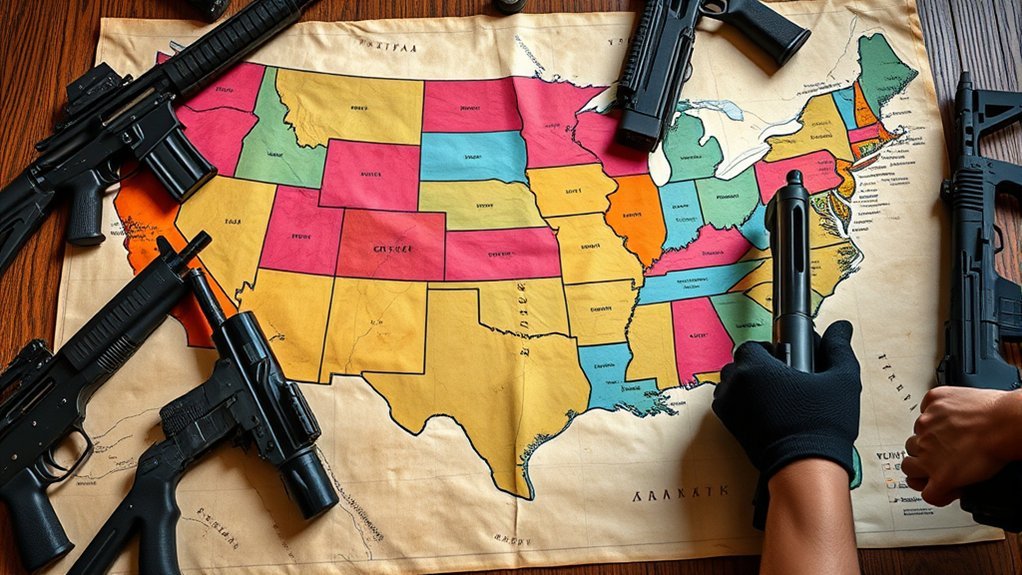
States have broad authority to regulate firearms, so assault weapon laws vary widely across the country. Some states ban or restrict specific models. Others use a feature-based test that looks at the firearm’s design. Some states combine both approaches. Many states do not use a separate assault weapon category at all.
California is one of the best-known examples of a feature-based approach. Its laws can classify certain semi-automatic rifles, pistols, and shotguns as assault weapons if they have listed features. Those features may include a detachable magazine paired with items such as a pistol grip, folding or telescoping stock, flash suppressor, or similar design elements. California also has rules for named firearm models and certain firearm configurations.
By contrast, states with fewer restrictions may not classify the same firearm as an assault weapon. A rifle that requires registration, modification, or may be prohibited in one state could be lawful in another state if it complies with that state’s rules. This patchwork makes compliance harder for gun owners who move, travel, inherit firearms, or buy firearms online through licensed dealers.
Retailers also face compliance challenges. They must understand which firearms can be sold in each state, what features are allowed, and whether local rules add more limits. A model that appears similar across listings may have state-compliant versions with different stocks, grips, magazine locks, or magazine capacities.
Pro Tip: When comparing state rules, look at the exact firearm configuration, not just the brand or model name. Small design changes can affect how a firearm is classified under feature-based laws.
Common Ways Laws Define Assault Weapons
Most assault weapon laws use one or more of these methods. Understanding the method helps explain why definitions can feel inconsistent.
- Named-model lists: Some laws list specific firearms by manufacturer, model, or series. If a firearm is named, it may be restricted even before looking at its features.
- Feature-based tests: Some laws focus on features attached to a semi-automatic firearm, such as a pistol grip, adjustable stock, forward grip, flash suppressor, barrel shroud, or threaded barrel.
- Magazine rules: Some laws treat detachable magazines, fixed magazines, or magazine capacity as key parts of the definition.
- Firearm type: Laws may define assault weapons differently for rifles, pistols, and shotguns.
- Configuration and modification: A firearm’s classification may change if the owner modifies the stock, grip, magazine system, barrel, muzzle device, or other parts.
This is why broad statements can mislead readers. A firearm is not automatically an assault weapon simply because it looks modern. The legal classification usually depends on the exact law, the firearm type, and the firearm’s current configuration.
Comparing Definitions: Assault Weapons vs. Other Firearms
Understanding the definition of assault weapons helps separate this legal category from other firearm categories. Assault weapon laws often focus on semi-automatic firearms with listed features. A semi-automatic firearm fires one round each time the trigger is pulled and uses energy from the fired round to load the next round. It does not keep firing with one continuous trigger press.
That distinction matters because machine guns are regulated under separate federal rules. A machine gun can fire more than one round with a single trigger action. Most state assault weapon laws do not turn a semi-automatic firearm into a machine gun. They create a separate state-law category based on model, features, magazine type, or configuration.
Traditional hunting rifles and shotguns may lack the features listed in assault weapon laws. However, intended use alone does not always control the legal outcome. Some firearms used for sport, hunting, home defense, or competition may still fall under an assault weapon definition if they meet a law’s specific criteria.
The key point is that assault weapon definitions usually depend on legal wording, not only on appearance, popularity, or marketing language. That is why two firearms with similar performance may be treated differently if one has restricted features and the other does not.
Impact of Definitions on Gun Policy
Definitions shape gun policy because they decide which firearms are restricted, exempt, registered, modified, or allowed. A broad definition may include many semi-automatic firearms. A narrow definition may apply only to named models or very specific configurations.
Those choices affect ownership, retail sales, manufacturing, transportation, inheritance, and enforcement. For example, a feature-based law may encourage manufacturers to create state-compliant versions of popular firearms. A named-model law may lead to disputes over whether a newer firearm is a banned model, a copy, a variant, or a legally distinct design.
Definitions also affect how laws are understood by the public. Supporters of assault weapon restrictions often argue that feature-based rules reduce access to firearms designed for rapid firing, faster reloading, or tactical handling. Critics often argue that the definitions focus too much on cosmetic or ergonomic features and may sweep in commonly owned semi-automatic firearms.
Both debates depend on the wording of the law. If a statute is vague, hard to apply, or inconsistent with neighboring states, it can create confusion for lawful owners and enforcement agencies. Clear definitions make compliance easier, even when people disagree about the policy itself.
Public Safety Implications of Varying Definitions
Varying definitions of assault weapons can affect public safety debates because they shape which firearms are available, how laws are enforced, and how communities judge the effectiveness of firearm regulations. When jurisdictions use different definitions, the same firearm may be treated differently across state lines.
This inconsistency can lead to several practical problems:
- Compliance confusion: Gun owners may misunderstand whether a firearm, magazine, or modification is legal in their state.
- Enforcement challenges: Law enforcement may need detailed training to identify restricted features and apply current rules consistently.
- Retail and transfer issues: Dealers must confirm whether a firearm configuration is legal before selling or transferring it.
- Public perception: Different definitions can make people question whether laws are targeted, fair, or effective.
- Policy disagreement: Supporters and opponents may use the same term while meaning different categories of firearms.
It is safer and more accurate to say that definitions can influence public safety outcomes, rather than claiming that any single definition automatically increases or decreases violence. The effect of a law depends on its wording, enforcement, exemptions, compliance rates, and the wider legal environment.
Why the Term Creates Public Confusion
The phrase assault weapon sounds simple, but it often combines legal, technical, political, and cultural meanings. News reports may use the term broadly. State statutes may use it narrowly. Gun owners may compare it with technical firearm categories. Policymakers may use it to describe a group of firearms they want to regulate.
This creates confusion in public debate. One person may use the term to describe a semi-automatic rifle with certain features. Another may think it means a fully automatic military firearm. A third may use it as a general label for any firearm that looks tactical. These differences can make discussions about regulation less clear.
Better wording helps. When possible, identify the exact firearm type, action, magazine system, and state law involved. For example, “a semi-automatic centerfire rifle with a detachable magazine and listed features under state law” is more precise than simply saying “assault weapon.”
What Gun Owners Should Check
If you own, buy, sell, transport, inherit, or modify a firearm, check the current law in the place where the firearm will be possessed or transferred. Do not rely only on general online discussions or product photos.
- State law: Check whether your state has an assault weapon definition, registration rule, possession ban, transfer restriction, or grandfathering rule.
- Local law: Some cities or counties may add rules beyond state law.
- Magazine capacity: A firearm may be legal while a magazine over a certain capacity is restricted.
- Features and parts: Stocks, grips, muzzle devices, threaded barrels, and magazine-lock systems may affect classification.
- Transportation rules: Moving a firearm across state lines can create legal issues if the destination state defines it differently.
- Updates to the law: Court decisions, new statutes, and agency guidance can change how rules apply.
Note: A firearm that was legal when purchased may become restricted later if the law changes, or if the owner modifies it. Keep purchase records, manuals, and compliance documents when available.
[Amazon Products Picked for You]

SPECIALLY DESIGNED FOR FIREARMS DEALERS & COLLECTORS: Skyline Firearms Record Book is designed for the specific needs of firearms dealers and collectors and follows all ATF standards for recording firearms transactions.

High Quality: These employee file folders are printed on white cover stock with color ink, and are durable and well-made.

[Heavy and Writer-Friendly Cover Stocks] These employee file folders are printed on heavy premium coverstocks, and are durable and well-made; the cover stock paper writes smoothly and the ink dries fast
Conclusion
In summary, assault weapon definitions vary because the term is mainly a legal category rather than one universal technical label. The expired 1994 federal ban shaped the national debate, but current rules often come from state laws that use named lists, feature tests, magazine rules, or firearm-specific definitions.
This patchwork can make compliance difficult and public debate confusing. A clear understanding of the exact law, firearm type, and configuration helps gun owners avoid mistakes and helps policymakers write rules that people can understand. If you are dealing with a real firearm purchase, sale, transfer, or modification, check the current rules in your jurisdiction before making a decision.
