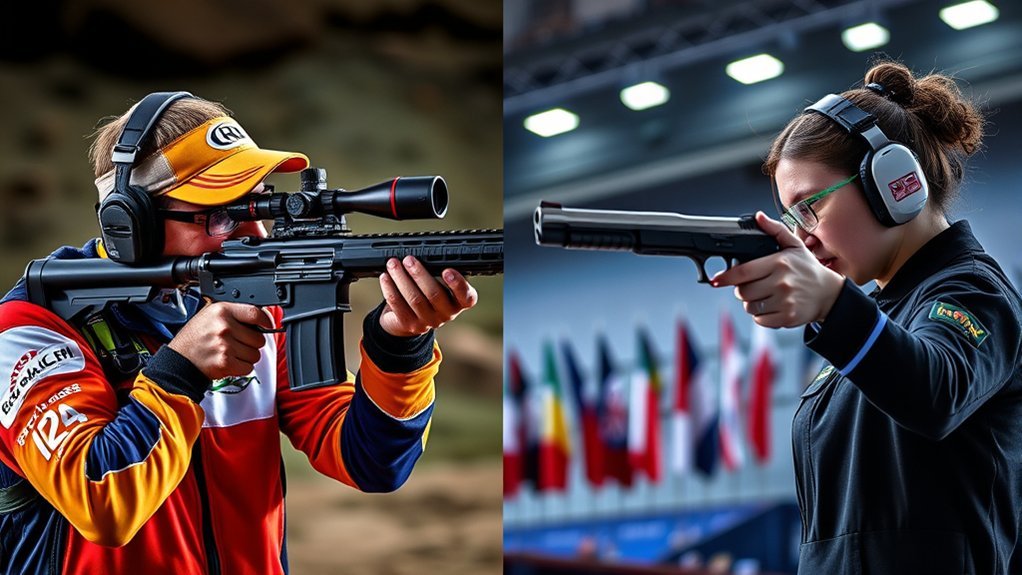
NRA vs ISSF Competitions: Key Differences
Last updated: September 22, 2026. NRA and ISSF competitions follow different rule systems. NRA competition covers a broad U.S. mix such as High Power Rifle, Precision Pistol, Action Pistol, Metallic Silhouette, and Smallbore. ISSF governs international rifle, pistol, and shotgun events, including the Olympic shooting program. The right path depends on the exact event you plan to enter, because distances, targets, scoring, finals, equipment limits, and match procedures differ.
Quick Answer
NRA competitions emphasize U.S. disciplines such as High Power Rifle, Precision Pistol, Action Pistol, Metallic Silhouette, and Smallbore. ISSF competitions use standardized international rules for rifle, pistol, and shotgun. Under the current 2026 ISSF rules, individual Olympic finals use eight athletes, while the Olympic mixed-team events in 10 m Air Rifle, 10 m Air Pistol, and Trap use a four-team medal final. Train to the exact rulebook and match bulletin for the event you plan to shoot.
NRA and ISSF competitions differ mainly in event structure, distances, scoring, and equipment control. The classic full-distance NRA High Power National Match Course uses 200-, 300-, and 600-yard stages, although the 2026 NRA rules also allow reduced-distance versions. A full four-event NRA Action Pistol aggregate has a 1920-point maximum. ISSF uses standardized international events at distances such as 10 m, 25 m, and 50 m, with event-specific decimal, hit-miss, and target-count scoring plus strict equipment controls.
Key Takeaways
- NRA competitions cover a broad U.S. mix, including High Power Rifle, Precision Pistol, Action Pistol, Silhouette, and Smallbore. Ring scoring, X-counts, aggregate points, and hit-miss scoring are common.
- ISSF competitions focus on standardized international rifle, pistol, and shotgun events. The 2026 rules changed several Olympic finals and equipment-control requirements.
- Choose your exact event before buying specialized equipment. Distances, positions, targets, clothing rules, firearm specifications, timing, and finals procedures can differ substantially.
Overview of NRA Competitions
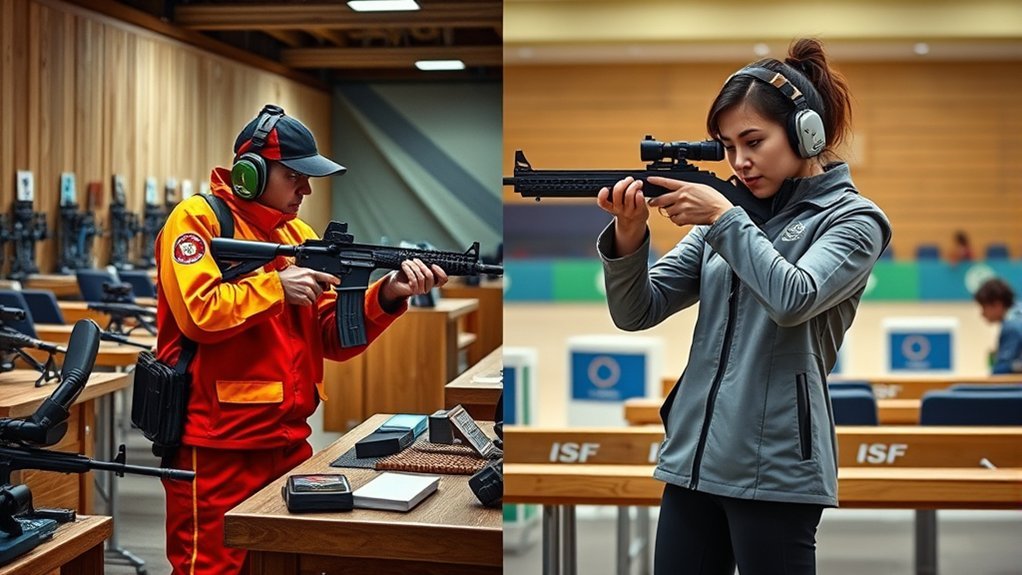
In NRA competitions, you’ll find formats that test precision, speed, position work, and stage management. Popular examples include High Power Rifle, Precision Pistol, Action Pistol, Metallic Silhouette, and Smallbore Rifle.
The classic full-distance High Power National Match Course uses standing slow-fire and rapid sitting or kneeling at 200 yards, rapid prone at 300 yards, and slow-fire prone at 600 yards. The current 2026 rulebook also permits approved reduced-distance versions, so an official course does not always require full 200-, 300-, and 600-yard firing lines.
NRA Action Pistol uses courses including Practical, Barricade, Moving Target, and Falling Plate. A full four-event aggregate has a maximum score of 1920, while NRA guidance also permits sanctioned aggregate matches containing at least two of those events. Metallic Silhouette uses animal-shaped steel targets that must be knocked from their stands.
Because NRA courses vary substantially by discipline, select your event first and then check the current NRA rulebook for that discipline before building a training or equipment plan.
Overview of ISSF Competitions
The International Shooting Sport Federation (ISSF) governs international rifle, pistol, and shotgun events, including the Olympic shooting disciplines. ISSF competition uses standardized targets, range procedures, equipment controls, event-specific timing, and tightly defined finals formats.
The current ISSF Rules page lists the 2026 rulebook, Second Print July 2026, effective July 1, 2026. The 2026 changes are especially important because several Olympic finals were revised. Individual Olympic finals now use eight athletes, and the three Olympic mixed-team events—10 m Air Rifle, 10 m Air Pistol, and Trap—advance four teams to one medal final instead of separate gold- and bronze-medal matches.
2026 rules note: ISSF also changed rifle-clothing regulations and stiffness tolerances. Check the current ISSF rulebook and the bulletin for your specific competition before buying specialized clothing or equipment.
What events does ISSF govern?
- Rifle: 10 m Air Rifle, 50 m Rifle 3 Positions, and additional recognized non-Olympic rifle events including selected 300 m disciplines.
- Pistol: 10 m Air Pistol, 25 m Pistol, 25 m Rapid Fire Pistol, and additional recognized pistol events.
- Shotgun: Trap and Skeet, plus other competition formats defined by the current program.
- Olympic mixed team: 10 m Air Rifle Mixed Team, 10 m Air Pistol Mixed Team, and Trap Mixed Team.
How are ISSF events scored?
ISSF scoring depends on the event and stage. Air-rifle qualification uses decimal scoring, while many pistol qualification stages use integer, or full-ring, scoring. In finals, 10 m Air Rifle, 10 m Air Pistol, and rifle events that use decimal scoring can record a center shot from 10.0 to 10.9. The 25 m pistol finals use event-specific hit-miss scoring, and shotgun events count targets hit. Electronic targets, range officers, juries, and formal shoot-off procedures keep results consistent and reviewable.
NRA vs ISSF at a glance
| Area | NRA | ISSF |
|---|---|---|
| Typical disciplines | High Power Rifle, Precision Pistol, Action Pistol, Metallic Silhouette, Smallbore | 10 m Air Rifle/Pistol, 25 m Pistol/Rapid Fire, 50 m Rifle 3P, Trap, Skeet, Mixed Team, plus recognized non-Olympic events |
| Scoring | Ring values and X-counts in many paper-target events; hit-miss for plates and silhouette; a full four-event Action Pistol aggregate has a 1920-point maximum | Event-specific decimal or integer ring scoring for rifle/pistol; hit-miss scoring in selected 25 m finals; shotgun counts targets hit |
| Finals | Varies by discipline and tournament; some events are decided by aggregate score while others use discipline-specific procedures | Under the 2026 Olympic-event rules, individual finals use eight athletes; mixed Air Rifle, Air Pistol, and Trap use one four-team medal final |
| Equipment | Discipline-specific rules for service rifles, match rifles, pistols, sights, silhouette firearms, and other equipment | Detailed limits for firearm dimensions, weights, trigger requirements, clothing, footwear, and other event-specific equipment |
| Distances/targets | Classic High Power NMC stages at 200, 300, and 600 yd, with reduced-distance versions permitted; silhouette and Action Pistol use discipline-specific targets | Common Olympic rifle/pistol distances of 10 m, 25 m, and 50 m, plus standardized shotgun layouts and additional recognized event distances |
| Best fit | Competitors targeting U.S. club disciplines such as High Power, Precision Pistol, Action Pistol, Silhouette, or Smallbore | Competitors targeting international or Olympic-style rifle, pistol, and shotgun with standardized event procedures and equipment control |
Different shooting disciplines
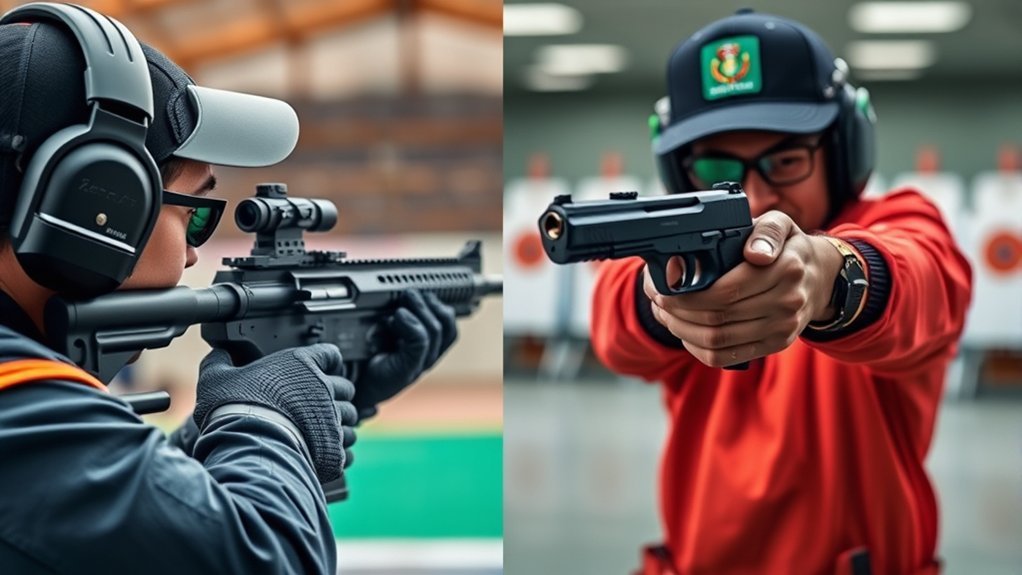
The easiest way to compare NRA and ISSF competition is to look at what each event actually demands. Some formats prioritize slow-fire precision and position stability. Others add timed strings, rapid stages, moving targets, steel targets, or elimination pressure.
What are the main Olympic-style shooting events?
- Rifle: 10 m Air Rifle and 50 m Rifle 3 Positions emphasize position stability, shot process, and repeatability.
- Pistol: 10 m Air Pistol emphasizes precision, while the 25 m Olympic pistol events use timed or rapid series and event-specific scoring.
- Shotgun: Trap and Skeet challenge target pickup, timing, visual tracking, and consistency on flying clay targets.
- Mixed team: The LA28 program uses 10 m Air Rifle Mixed Team, 10 m Air Pistol Mixed Team, and Trap Mixed Team.
How do NRA competition formats differ?
High Power Rifle commonly uses the classic four-stage full-distance National Match Course: standing slow-fire at 200 yd, rapid sitting or kneeling at 200 yd, rapid prone at 300 yd, and prone slow-fire at 600 yd. The 2026 NRA rulebook also allows reduced-distance versions of the National Match Course.
Action Pistol includes Practical, Barricade, Moving Target, and Falling Plate among its approved courses. A full four-event aggregate has a maximum score of 1920, although sanctioned aggregate matches may include at least two of those events. Metallic Silhouette scores hits by knocking over chickens, pigs, turkeys, and rams at class-specific distances.
Precision Pistol, often called Bullseye, focuses on one-handed pistol accuracy through slow-fire, timed-fire, and rapid-fire stages. Outdoor competition commonly uses 25- and 50-yard targets. Smallbore Rifle has its own position, target, distance, and equipment rules.
How do targets and distances compare?
- Target types: NRA disciplines may use paper rings, X-rings, steel plates, moving targets, or silhouettes. ISSF uses standardized paper or electronic target systems plus clay targets for shotgun.
- Distances: The classic NRA High Power NMC uses 200-, 300-, and 600-yard firing lines, with reduced-distance alternatives allowed. Common Olympic ISSF rifle and pistol distances are 10 m, 25 m, and 50 m.
- Scoring detail: NRA ring-scored disciplines commonly record X-counts for tie-breaking, while ISSF uses event-specific integer, decimal, hit-miss, or target-count systems.
- Positions: Standing, kneeling, sitting, and prone appear in rifle competition, while barricades, movers, timed series, and other discipline-specific requirements appear in selected formats.
Scoring systems and rules
Both organizations reward accuracy, but there is no single NRA scoring system or single ISSF scoring system. Each discipline has its own course of fire and scoring rules. That is why scores from one event should not be treated as directly comparable with scores from another.
Current as of September 22, 2026: The ISSF Rules page lists the 2026 Rule Book, Second Print July 2026, effective July 1, 2026. ISSF rifle and pistol scoring varies by event and stage: air-rifle qualification uses decimal scoring, many pistol qualification stages use integer scoring, selected finals use decimal scoring, 25 m finals use event-specific hit-miss procedures, and shotgun counts targets hit. Current NRA rulebooks are discipline-specific; 2026 editions are published for High Power Rifle, Precision Pistol, Smallbore Rifle, and several other programs, while the current Action Pistol rulebook is the February 2025 revision.
A strong score in one rule system does not automatically translate to the other. NRA and ISSF matches can differ in timing, targets, position work, scoring, equipment control, and finals procedures.
How do tie-breaks work?
In many NRA ring-scored matches, X-counts help separate competitors with the same point total, although the exact procedure depends on the discipline. ISSF tie procedures are also event-specific and may use shoot-offs, inner tens, countback procedures, or other rules defined for the event. Always check the current rulebook and match program rather than assuming one tie-break system applies everywhere.
What changed in ISSF finals for 2026?
The 2026 ISSF rule changes standardized individual Olympic finals around eight finalists, including events that previously used six. The three Olympic mixed-team events—10 m Air Rifle, 10 m Air Pistol, and Trap—now send the top four teams into one medal final instead of using separate gold- and bronze-medal matches. Event-specific scoring still differs: some rifle and pistol finals use decimal scoring, selected 25 m pistol finals use hit-miss systems, and shotgun finals count targets hit.
Equipment regulations
- Firearms: Each rulebook defines permitted firearm types, dimensions, weights, sights, triggers, calibers, or configurations for the event.
- Ammunition: Ammunition requirements vary by discipline, and local range rules may add restrictions for safety or target protection.
- Protective gear: Follow the host range and match bulletin for eye- and hearing-protection requirements.
- Shooting clothing: ISSF rifle clothing is subject to detailed construction, fit, thickness, and stiffness requirements. The 2026 rules revised rifle-clothing regulations and stiffness tolerances.
Warning: Never assume equipment that passes one match will pass another. A legal setup in one NRA discipline may not meet ISSF equipment-control rules, and a local match bulletin or range rule may be more restrictive than the general national or international rulebook.
Consult the official rule pages for the latest specifics: ISSF Rules and NRA Rule Books.
What equipment should you verify before a match?
- Weight and dimensions: Confirm the exact limits for your rifle, pistol, sights, accessories, and event category.
- Trigger requirements: Some events specify minimum trigger weights or other trigger-related tests.
- Sights and optics: Rules differ on metallic sights, scopes, red dots, and other sighting systems.
- Shooting clothing: ISSF rifle jackets, trousers, gloves, and shoes may be checked under formal equipment-control procedures.
- Match bulletin: Read the host event’s bulletin for local procedures, reporting times, equipment inspection, and range-specific requirements.
Training and preparation strategies
Build practice around the exact course of fire rather than treating “NRA” or “ISSF” as one discipline. Work on fundamentals such as stance, natural point of aim, sight picture, breathing, follow-through, and trigger control, then reproduce the timing, positions, targets, and commands used in your event. Keep practice within the rules and safety procedures of your range.
Pro Tip: Practice against the same target type, timing, position sequence, and match commands you will face in competition. Generic accuracy work helps, but rulebook-specific preparation reduces surprises on match day.
How should you prepare for an NRA match?
- High Power Rifle: Practice the positions and timing used in your exact course, including transitions between slow- and rapid-fire stages where applicable.
- Action Pistol: Practice only the approved courses and handling procedures that your range permits, including the positions and target sequences used in the scheduled event.
- Metallic Silhouette: Focus on consistent position, follow-through, and target-to-target rhythm under the applicable rulebook.
- Precision Pistol: Build a repeatable one-handed position and a consistent routine for slow-, timed-, and rapid-fire strings.
How should you prepare for an ISSF match?
- Air Rifle and Air Pistol: Prioritize repeatable setup, sight alignment, hold stability, shot process, and recovery between shots.
- 50 m Rifle 3 Positions: Practice equipment setup and repeatable transitions among kneeling, prone, and standing.
- 25 m Pistol events: Reproduce the exact event timing and ready-position procedures specified in the current rulebook.
- Trap and Skeet: Practice the target presentations and timing used in the scheduled event while following range safety procedures.
Which system fits your competition goal?
Start with the matches you can actually enter. If your local calendar centers on High Power, Precision Pistol, Action Pistol, Silhouette, or another NRA discipline, train to that NRA rulebook. If your goal is international or Olympic-style rifle, pistol, or shotgun, use the current ISSF rules and your national federation’s event procedures.
Before buying specialized equipment, check four things: the exact event name, the local range distance, the current equipment rules, and the match bulletin. Many competitors participate in both systems, but equipment and training choices should be based on the specific event rather than the organization name alone.
Glossary
- Decimal scoring
- A scoring method used in selected ISSF events and stages in which each full ring is divided into tenths; a center shot can score from 10.0 to 10.9.
- X-count
- A separate count of center-ring hits used in many NRA ring-scored disciplines for ranking or tie-breaking under the applicable rulebook.
- Elimination final
- A final in which lower-ranked athletes or teams are progressively removed according to the event’s defined sequence until the medals are decided.
- National Match Course
- A common NRA High Power course. The classic full-distance version uses 200-, 300-, and 600-yard stages, while current rules also permit approved reduced-distance versions.
- Hit-miss scoring
- A scoring method in which a shot or target either meets the defined hit standard or does not, used in formats such as plates, silhouettes, shotgun, and selected ISSF pistol finals.
Frequently Asked Questions
What is the biggest difference between NRA and ISSF competitions?
NRA covers a broad mix of U.S. disciplines such as High Power Rifle, Precision Pistol, Action Pistol, Silhouette, and Smallbore, with discipline-specific scoring and courses. ISSF standardizes international rifle, pistol, and shotgun events, including Olympic formats, with detailed equipment control and event-specific qualification and finals procedures.
Do ISSF events always use decimal scoring?
No. Scoring depends on the event and stage. Air-rifle qualification uses decimal scoring, many pistol qualification stages use integer scoring, selected rifle and pistol finals use decimal scoring, 25 m pistol finals use event-specific hit-miss procedures, and shotgun events count targets hit.
How is NRA Action Pistol scored?
NRA Action Pistol includes courses such as Practical, Barricade, Moving Target, and Falling Plate. A full four-event aggregate has a maximum score of 1920. NRA guidance also allows sanctioned aggregate matches containing at least two of those events, so not every Action Pistol match is a four-event 1920-point aggregate.
What are typical NRA High Power distances?
The classic full-distance National Match Course uses 200 yards for standing and rapid sitting or kneeling, 300 yards for rapid prone, and 600 yards for slow prone. The 2026 NRA rules also permit approved reduced-distance versions, so some sanctioned courses can be fired on shorter ranges with the specified reduced targets.
What gear checks are common in ISSF rifle?
ISSF rifle equipment control can cover firearm dimensions and weight, clothing, footwear, gloves, and other event-specific equipment. The 2026 rules also changed rifle-clothing regulations and stiffness tolerances, so competitors should check the current rulebook rather than relying on older equipment guidance.
Can beginners shoot NRA or ISSF-style matches?
Yes. Entry requirements depend on the club, federation, and event. Beginners should identify a specific local match first, read its rulebook and bulletin, and confirm equipment and range requirements before buying specialized gear.
Which rulebook should I read first?
Start with the rulebook for the exact match you plan to enter. For U.S. disciplines such as High Power, Action Pistol, Precision Pistol, or Silhouette, use the applicable NRA rulebook. For international or Olympic-style rifle, pistol, or shotgun, use the current ISSF rulebook plus the event bulletin from the organizer or national federation.
What changed in ISSF finals for 2026?
The 2026 ISSF rules revised several Olympic finals. Individual Olympic finals now use eight athletes. The Olympic mixed-team events in 10 m Air Rifle, 10 m Air Pistol, and Trap send the top four teams into one medal final instead of separate gold- and bronze-medal matches. Scoring within those finals remains event-specific.
Sources
- ISSF Rules — current ISSF rulebook and governing regulations. The rules page lists the 2026 Second Print effective July 1, 2026.
- ISSF 2026 Rulebook Changes — official summary of the revised Olympic finals, mixed-team format, and rifle-clothing changes.
- ISSF LA28 Mixed Team Finals Update — confirms the four-team medal-final format for 10 m Air Rifle, 10 m Air Pistol, and Trap Mixed Team.
- NRA Rule Books — official current rulebooks for High Power Rifle, Precision Pistol, Action Pistol, Silhouette, Smallbore, and other disciplines.
- NRA Action Pistol — official NRA overview of Action Pistol aggregate events and approved core courses.
