In the world of competitive shooting, the choice between IPSC and IDPA can feel like choosing between a finely tuned Formula 1 car and a rugged off-road vehicle. Each sport presents its own set of rules and challenges, tailored to different styles and philosophies of shooting. As you explore their unique frameworks, you’ll discover how their scoring systems, equipment requirements, and competition formats shape the experience for participants. What nuances might surprise you as you compare them?
Key Takeaways
- Philosophy: IPSC focuses on athletic speed and precision (“freestyle”), while IDPA focuses on solving defensive scenarios using concealment.
- Scoring: IPSC uses “Hit Factor” (points divided by time); IDPA uses “Time Plus” (raw time plus penalty seconds added for misses).
- Gear: IPSC allows specialized “race” gear in some divisions; IDPA strictly requires practical, daily-carry equipment.
Overview of IPSC Rules and Regulations
When you plunge into the world of IPSC (International Practical Shooting Confederation), you’ll notice that its rules are designed to push the limits of athletic performance and firearm manipulation. Central to these rules is the emphasis on freestyle problem solving. Unlike defensive shooting, IPSC rarely dictates how you must engage a target (e.g., from cover), allowing you to find the fastest, most efficient solution.
Competitors are classified into divisions based on equipment, ranging from the “Open” division (optical sights, compensators, race holsters) to “Production” (stock firearms). As of 2026, the Production Optics division has become one of the most popular, bridging the gap between stock guns and red-dot technology. Safety is paramount, with strict disqualification rules for breaking the 180-degree muzzle angle.
Overview of IDPA Rules and Regulations
While exploring the domain of IDPA (International Defensive Pistol Association), you’ll find that its rules and regulations prioritize practicality and simulation. IDPA requires the use of a concealment garment (like a vest or jacket) for most stages, ensuring competitors face challenges similar to concealed carry situations.
IDPA stages use fault lines to enforce the use of cover, penalizing shooters who expose themselves to “threat” targets. Recent rule updates have modernized the sport, now allowing Appendix Inside Waistband (AIWB) carry and specific weapon-mounted lights, reflecting modern self-defense trends. The focus remains on tactical priority—typically engaging targets as they become visible or from near-to-far—rather than pure racing speed.
Scoring Systems: Hit Factor vs. Time Plus
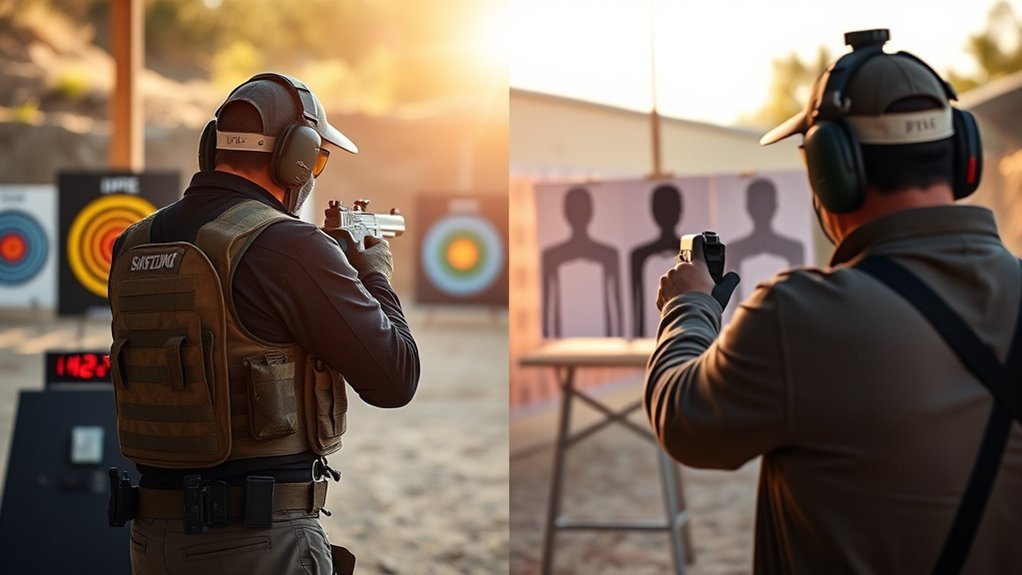
The most confusing aspect for beginners is usually the scoring. IPSC and IDPA utilize mathematically different systems that dictate how you should shoot.
In IPSC, the scoring method is Hit Factor. This is calculated by taking your total points on target and dividing them by your time. This means that if you are fast enough, you can sometimes “outrun” a poor hit. It rewards aggressive, high-speed shooting.
In contrast, IDPA uses Time Plus scoring. Your score is your raw time, plus strictly added seconds for inaccuracies (Points Down). For example, a hit outside the center zone might add 1 second to your time. This makes accuracy paramount; you cannot “blaze” through a stage with poor hits and expect to win, as the time penalties are severe.
Equipment and Gear Requirements
Understanding the equipment rules is critical before you buy your first competition holster. Both organizations have specific rules to guarantee fairness.
| Feature | IPSC (Practical) | IDPA (Defensive) |
|---|---|---|
| Holster Type | Varies. “Race” holsters allowed in Open; others require hip placement. | Must be suitable for all-day carry. No race holsters. AIWB allowed. |
| Concealment | Not required. Gear is worn openly. | Required. Vest or jacket must cover gear (except in specific classifiers). |
| Magazine Capacity | Division dependent (e.g., 15 rounds for Production). | Strict limits (usually 10 or 15 rounds) to simulate carry loads. |
| Reloading | Allowed anytime (Freestyle). Mags can be dropped. | Allowed mostly at slide-lock or behind cover. Restrictions on dropping loaded mags. |
Competition Formats and Stages
As you immerse yourself in the competition formats, you’ll notice distinct architectural differences. IPSC focuses on Courses of Fire that are often abstract. You might shoot through ports, run between shooting boxes, and engage 30+ rounds in a single stage. The challenge is athletic: How fast can you move and shoot?
IDPA focuses on Scenarios. A stage might describe a “carjacking” or “ATM robbery.” You will likely start seated or with your back to the targets. You must solve the problem using defensive tactics, such as slicing the pie (engaging targets while gradually exposing yourself from cover) and adhering to tactical priority.
Frequently Asked Questions
Which sport is more expensive to start?
Generally, IDPA is cheaper to start because it requires minimal “race” gear. You can often compete with your standard carry pistol, a sturdy belt, and a simple Kydex holster. IPSC can become expensive if you choose to enter gear-heavy divisions like Open.
Can I use the same gun for both?
Yes. A standard Glock 17, CZ Shadow 2, or Sig P320 can be used in both sports (e.g., IPSC Production/Production Optics and IDPA SSP/Carry Optics). However, you may need different holsters and magazine pouches to comply with the specific rules of each.
Which is better for new shooters?
Both are excellent. IDPA teaches valuable defensive concepts and cover usage, while IPSC builds incredible recoil management and gun handling speed. Many top-tier shooters compete in both to develop a well-rounded skill set.
Conclusion
In summary, whether you prefer the fast-paced athleticism of IPSC or the tactical realism of IDPA, each sport offers unique benefits. Some argue that IPSC is pure gaming, while others feel IDPA’s rules can be too subjective. Ultimately, as of 2026, both disciplines have evolved to be safer and more accessible than ever. The best approach? Attend a local match for each, bring your eye and ear protection, and see which community feels like home.
