Last updated: September 11, 2026 — revised with current NOAA habitat and catch-and-release guidance, current Florida snapper-regulation references, National Weather Service boating-safety guidance, and FDA seafood-safety guidance.
The most useful mangrove fishing tips are to fish moving water, cast accurately to structure, stay quiet, and choose a presentation that can work through roots without constant snags. Prioritize points, cuts, creek mouths, shaded root edges, drop-offs, docks, bridges, and current seams where bait is concentrated. Start with weedless artificials when you need to find active fish quickly, then slow down with live shrimp or small baitfish when fish are holding tight to cover. Treat dawn and dusk as helpful low-light windows, but let tide movement, bait presence, and local conditions decide where you fish first.
Quick Answer
To fish mangroves well, start with moving water and high-percentage structure. Cast quietly along shaded roots, cuts, points, drains, and current seams, using weedless paddletails or jerk shads to locate active fish. If fish are pressured or buried in cover, switch to live shrimp, pinfish, or other small baitfish. Dawn and dusk can help, but a productive incoming or outgoing tide with visible bait is usually a stronger reason to stay on a spot than the clock alone.
Key Takeaways
- Mangrove roots, shaded edges, drop-offs, bridges, docks, and grassy flats concentrate bait and predator fish.
- Moving water is the main timing cue; dawn and dusk can improve shallow-water opportunities, while seasonality varies by region and species.
- Weedless artificials help you cover water fast, while live bait shines when fish are picky or buried in cover.
- Use accurate casts, quiet movement, strong leaders, and quick hooksets to pull fish away from roots.
- Protect mangrove habitat by avoiding root damage, following local rules, and harvesting only what you can use.
At a Glance
| Best Time | Incoming or outgoing water with steady current; dawn and dusk can be an added advantage |
| Difficulty | Moderate, because accurate casting and snag control matter |
| Core Gear | 6–7 ft spinning rod, 2500–4000 reel, braid, fluorocarbon leader, weedless hooks, live bait, and soft plastics |
| Best Targets | Mangrove snapper, snook, redfish, juvenile tarpon, trout, jacks, and other ambush predators |
Why Mangroves Matter for Anglers

Mangroves are productive because their root systems create food, shelter, and nursery habitat. NOAA Fisheries notes that many popular fish species grow, forage, reproduce, and live around mangroves, while the roots provide shelter and feeding opportunities. For anglers, that makes root tangles, shade lines, current breaks, and nearby depth changes natural places to look for predator fish such as mangrove snapper, snook, redfish, juvenile tarpon, trout, and jacks.
Use structure as a filter instead of casting at every stretch of shoreline. Cast along edges, work coves methodically, and probe points where moving water funnels prey into roots. Watch the three Bs—birds, bait, and boils—to help identify active feeding zones, then confirm the pattern with current direction and depth.
Cast edges, work coves, and probe current funnels into roots. Watch birds, bait, and boils for feeding zones.
Expect snags. Choose terminal tackle and rigs that let you pull fish away from cover without tearing through roots or breaking off every few casts. You’ll move deliberately, prioritize quick hook sets, and apply controlled pressure before fish bury themselves in the structure.
Respect the system. Harvest selectively and follow local regulations, because size limits, bag limits, seasons, and gear rules can differ by species and water body. Treat mangroves as living habitat, not just fishing structure. Your success depends on reading structural cues while minimizing damage to roots, seagrass, shorelines, and shallow bottom habitat.
Current–Cover–Forage Check
- Current: Is water moving past a point, cut, drain, root edge, dock, or bridge?
- Cover: Is there shade, root structure, a depth change, grass, shell, or another ambush edge?
- Forage: Do you see bait flicking, shrimp activity, birds working, or surface boils?
A spot with two of these three signals deserves several accurate casts. When all three overlap, slow down and work it from more than one angle before moving.
Note: Mangrove roots are living habitat, not casting targets to damage. Avoid tying off to branches, breaking roots, or powering through shallow areas where prop wash can scar bottom habitat.
Mangrove Fishing Tips: Best Times, Tides, and Seasons
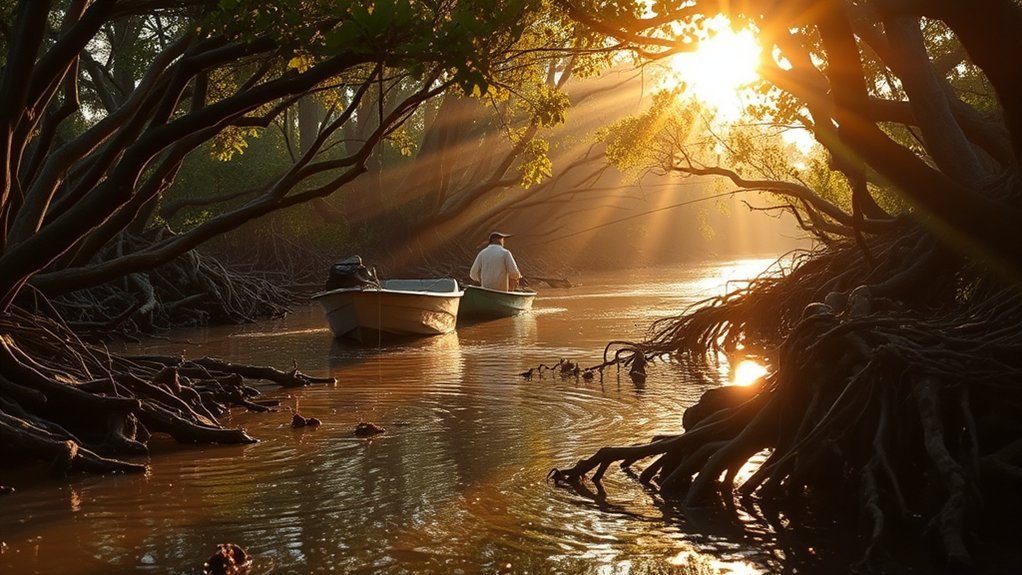
For mangrove fishing, moving water usually matters more than the clock. Incoming water can push fish and forage toward flooded edges, while outgoing water can concentrate bait at drains, creek mouths, points, and channel bends. Dawn and dusk can improve shallow-water opportunities, especially in clear or heavily pressured areas, but a quiet low-light period with no current may be less productive than steady tidal flow later in the day.
Seasonality is regional. In many Florida and Gulf areas, warm months can be productive for mangrove snapper and other inshore predators, but local water temperature, bait availability, rain, wind, and pressure can move the best bite earlier, later, shallower, or deeper.
Adjust location and depth as temperatures shift. Fish may slide into shallow shade during comfortable conditions, then drop to deeper edges, docks, bridges, channels, or nearby reefs when heat, cold fronts, or pressure changes affect the bite.
Peak Warm-Water Months
During warm-water periods, mangrove snapper commonly use reefs, rock piles, ledges, docks, bridges, seagrass, and mangrove roots. The Florida Fish and Wildlife Conservation Commission lists coastal structure such as reefs, mangroves, and seagrass as gray snapper habitat and notes that gray snapper spawn from June through August in Florida. Treat that timing as regional guidance rather than a universal calendar.
Use moving water and bait activity to refine the seasonal pattern. Present live bait or compact artificials tight enough to structure to reach fish, but avoid dragging rigs through roots or repeatedly breaking tackle off in habitat.
Prioritize stealthy approaches, precise casts, and controlled hooksets. Heavy boat noise, repeated lure splashes, and unnecessary pressure can shut down a shallow edge quickly, while overly light tackle can make it harder to turn fish before they reach roots.
Optimize trip timing and gear, then move freely between productive marks until you find a repeatable pattern. If one shoreline has bait but no strikes, check nearby depth changes, current seams, or shaded pockets before leaving the area completely.
Lunar and Tidal Cycles
New and full moons are associated with larger-range spring tides. NOAA Ocean Service explains that the sun, moon, and Earth are nearly aligned during those phases, producing a larger average tidal range. That does not guarantee a better bite at every mangrove shoreline, because local coastline shape, depth, wind, and weather affect how water actually moves.
Use the local tide chart as the practical tool. Note whether a spot produces on the first push of incoming water, the stronger middle portion of the tide, the outgoing drain, or the slower turn. Build your plan around observed current at that location rather than moon phase alone.
Do not let a seasonal rule override what you see. Water clarity, bait presence, wind direction, recent rain, temperature swings, and fishing pressure can all change where fish hold and how aggressively they feed.
Use structure-focused presentations on moving tides. Focus on edges, cuts, drains, creek mouths, shaded shorelines, and mangrove roots where bait funnels past waiting predators.
Move deliberately as the tide changes. If current dies, shift to a deeper edge or another area where water is still moving. If the water begins draining from a creek or flooded shoreline, reposition to the outlet instead of continuing to cast the now-empty edge.
| Tide Stage | Where to Look | Presentation |
|---|---|---|
| Incoming | Flooding root edges, points, cuts, and flat edges | Cast up-current and let a weedless lure or lightly weighted bait move naturally toward cover |
| High / slowing | Deep shade, undercut roots, docks, and nearby drop-offs | Slow down, shorten the cast, and keep the bait in the strike zone longer |
| Outgoing | Drains, creek mouths, points, potholes, and channel bends | Work with the flow so the lure or bait sweeps past the ambush point |
| Low / slack | Deeper holes, channels, bridges, and outside edges | Reach deeper water with only enough weight to maintain control; move if bait and current disappear |
Does Time of Day Matter for Mangrove Fishing?
Yes, but treat time of day as a secondary filter behind current, structure, and bait. Dawn and dusk can be excellent because lower light may let predators feed closer to exposed edges and can make a quiet approach easier. Night fishing around legal, safe access points can also be productive for mangrove snapper.
Midday is not automatically poor. Shade under mangroves, docks, bridges, and deeper edges can keep fish active, especially when current continues to move. During extreme heat or after a strong weather change, fish may shift deeper or farther into shade.
Combine low light with a moving tide when possible, but do not abandon a productive current seam simply because the sun is high.
Adjust bait and presentation seasonally as forage shifts. If shrimp are active, smaller natural baits and shrimp-style lures can shine. If finger mullet, sardines, or small baitfish are thick, paddletails, jerk shads, and live baitfish may draw stronger strikes.
Move if the bite is soft, but give each high-percentage edge enough accurate casts to test more than one angle, retrieve speed, or depth. A repeatable pattern matters more than covering miles of shoreline.
Top Mangrove Fishing Hotspots and Structure

Although mangrove snapper congregate across many Gulf, Caribbean, and Florida locations, targeted success comes from focusing on well-structured habitats. Reefs, rock piles, docks, bridges, grassy flats, mangrove-lined channels, creek mouths, and shaded root systems all collect prey.
You’ll prioritize spots where structure concentrates forage and funnels movement. Key West’s reefs and shipwrecks, Islamorada’s rock piles and bridges, and the Everglades’ tidal creeks are classic examples of structure-rich areas where mangrove habitat meets moving water.
- Seek ledges, rock piles, and wrecks where ambush predators hold.
- Work mangrove-lined channels and grassy flats that support crustaceans and baitfish.
- Target docks, bridges, and rocky outcrops where current and cover intersect.
- Look for creek mouths, drains, potholes, and deeper bends that connect shallow feeding areas to safe water.
- Fish shade lines, overhanging limbs, and small openings beneath roots where predators can pin bait.
You’ll move deliberately between these features, reading tide and depth to exploit feeding windows. When water rises, fish may push tight into root edges. When water falls, they may slide toward cuts, drains, troughs, and deeper pockets.
In Sarasota and Marco Island, focus estuarine edges and mangrove swamps where bait schools compress. In similar areas, oyster bars, seawalls, creek intersections, and potholes near grass can also hold fish when the tide moves.
Let structure dictate your boat position, casting angle, and retrieve. The goal is to present the bait where current delivers forage without forcing every cast directly into the roots.
Live Bait vs. Artificial Lures in Mangroves

When you need to cover ground quickly in mangroves, cast weedless artificial lures like paddletails or jerk shads rigged on weighted swimbait hooks. These lures help you search for feeding fish without constant snagging.
Use weedless presentations around roots, dock pilings, mangrove points, grass edges, and other snag-prone cover. Artificials help you learn the area faster because each cast can test a new angle, depth, or retrieve speed.
Reserve livebait for situations where fish are holding tight or showing subtle bites. Live shrimp, pinfish, small pilchards, finger mullet, or small baitfish can attract lethargic or finicky fish, even if it takes longer to confirm their presence.
[Amazon Products Picked for You]

WEEDLESS SWIMBAIT: The Strike King Final Copy Weedless swimbait bass fishing lure is the ultimate companion for anglers seeking durability, versatility, and performance

Weedless Design: The mega weedless design of the USA Bass Tackle Hand Poured Underspin Gill allows for a more natural presentation and reduces snagging when fishing around heavy cover or vegetation. The unique paddle-tail design provides an irresistible swimming action that triggers strikes from predatory fish.

BERKLEY POWERBAIT THE CHAMP SWIMMER KIT: Designed by two time Bassmaster Classic winner Jordan Lee, The Champ Swimmer is deadly on bass and walleye.
Covering Ground Quickly
Covering ground quickly in mangroves means choosing tactics that let you detect feeding fish fast. Live bait can be methodical but slow, while artificial lures let you probe more water per cast.
You’ll prioritize speed, pattern recognition, and efficient presentations to free your time on the water and find active fish before they relocate. Use paddletails and jerk shads to mimic wounded baitfish or fleeing shrimp. They trigger instinctive strikes across structure.
- Choose lures that scan distance quickly and reveal holding areas.
- Vary retrieve speed and cadence to map feeding zones efficiently.
- Carry a small range of lure sizes and weights so you can change depth and profile without overloading your tackle box.
- Change jig weight, hook size, or lure length before abandoning a productive-looking shoreline.
When fish are spread out or conditions are changing quickly, artificials usually let you test more water before committing to a spot.
Weedless Lure Options
If you want to minimize snags and still trigger hard strikes in tight mangrove pockets, pick weedless artificial rigs first and use live bait selectively where natural presentation matters.
You’ll favor weedless rigging on paddletails and jerk shads to slip through roots and mimic injured baitfish or fleeing shrimp. A weighted swimbait hook keeps the profile compact while helping the lure swim naturally through narrow lanes.
Artificial lures let you cover water fast, testing points and coves until you locate feeding fish. Prioritize clean weedless rigging, accurate placement, the right running depth, and a retrieve that matches the current before worrying about a specific brand or color.
Reserve live shrimp or pinfish when you need that subtle, natural cadence. Keep rigs light with a small hook, short leader, or minimal weight so the bait drifts naturally instead of dragging in an unnatural line.
Work both methods strategically. Push ground quickly with artificials, then refine with live bait where fish concentrate.
When To Use Livebait
Decide between live bait and artificials based on whether you need to search quickly or present natural motion. Use paddletails and jerk shads to cover water and locate feeding fish fast, then switch to live shrimp or pinfish to entice wary snapper in shallow pockets or tight structure where scent and subtle movement matter.
You’ll want artificials to map flats and edges efficiently. Weedless paddletails resist snags and mimic injured prey. When you’ve located holding fish, deploy live bait on a free line, small hook, or light split shot to maximize natural action and scent for snapper fishing.
- Use artificials first to search and trigger reaction strikes.
- Switch to live bait in shallow, structured zones.
- Rig live shrimp minimally weighted for the most natural movement.
- Use stronger leaders when fish keep breaking off in roots or barnacle-covered cover.
Use artificials to search, then use live bait to slow down on fish you have already located.
Recommended Lures and Rigging Techniques

When you’re fishing mangroves, choose artificial lures like paddletails and jerk shads to quickly expose feeding fish and let you change presentation without rebaiting. Favor lures that mimic injured baitfish or fleeing shrimp, and vary retrieve speed to read strikes.
Use weedless rigging techniques to stay mobile along roots and reduce snags. Texas-style soft plastics and weedless swimbait hooks are practical defaults. For deeper pockets or outgoing tides, switch to weighted swimbait hooks to control depth and maintain natural action.
Match hook size to the bait instead of using one size everywhere. Around open-bottom structure, deeper channels, bridges, or reef edges, a Carolina rig or knocker-style rig can help reach depth. In dense mangrove roots, those bottom-contact rigs can snag more easily, so a free-lined or lightly weighted presentation is often easier to control.
For live shrimp, hook lightly through the shell or tail area so the bait can still move naturally, taking care not to damage vital tissue. For pinfish or other small baitfish, place the hook so the bait swims without spinning. In heavy roots, use a leader length and tackle strength that let you turn the fish quickly without sacrificing all control.
Good rigging is about control: stay weedless where snags are likely, add only enough weight to reach the strike zone, and change depth before changing every other part of the setup.
Pro Tip: Cast past the target, then bring the lure into the strike zone. Landing directly on top of shallow fish can spook them before the lure ever starts working.
[Amazon Products Picked for You]

Secure Twist Lock System: Features a reliable screw lock (twist lock) mechanism that firmly anchors your soft plastic swimbaits, preventing them from sliding or spinning during casts and retrieves.

【WEEDLESS DESIGN】Bombrooster Swimbait Weighted Hook is perfect for weedless rigging with soft plastic baits. It resists getting stuck in weeds, grass, or rocks, and the extra-wide gap offset circle hook improves hook-up ratios.

IDEAL FOR RIGGING SOFT SWIMBAITS --The XFISHMAN Weighted Swimbait Hooks with Baits locker Centering-Pin Spring are designed for weedless-style rigging of larger plastics like swimbaits, flukes, tubes, and creature baits.
Tackle, Line, and Terminal Gear for Mangrove Fishing
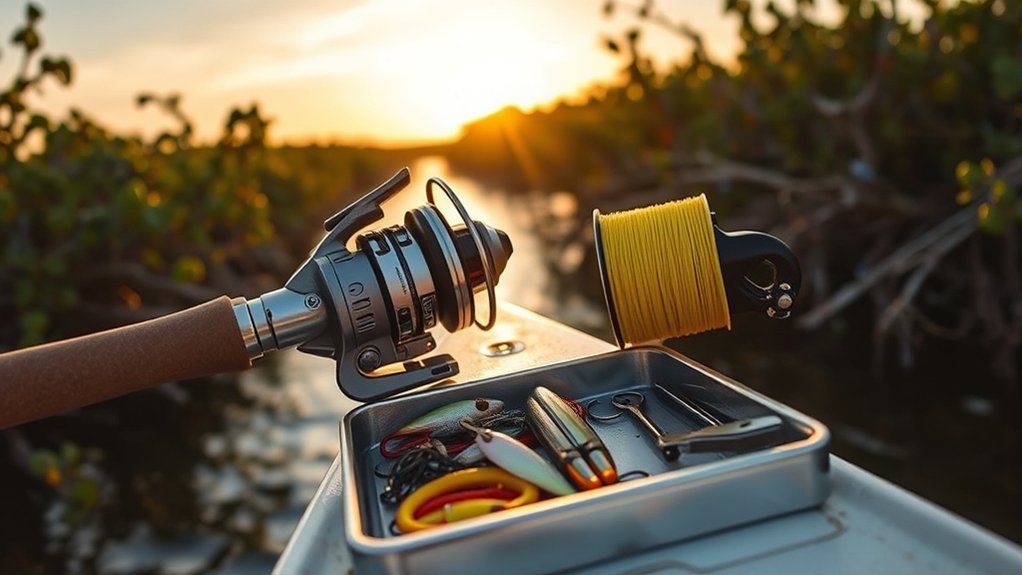
A practical starting point is a 6–7 foot medium or medium-heavy spinning rod with a 2500–4000 reel, but match the setup to your target species, lure weight, and cover. A light outfit that works for small snapper may be underpowered for larger snook or tarpon around heavy roots.
20 lb braid with a 20–30 lb fluorocarbon leader is a workable inshore starting range for many mangrove situations, not a universal rule. Use lighter leader when clear water and small fish demand finesse; use heavier abrasion-resistant leader when barnacles, oysters, bridge pilings, thick roots, or larger fish make break-offs likely.
Rig soft plastics weedless around roots. For natural bait, match hook style to the species and local rules; some fisheries require specific hook types or gear. Check the regulations for the water you are fishing before you rig.
[Amazon Products Picked for You]

Durable Construction: This fishing jig features a corrosion-resistant lead weight paired with a high-carbon steel hook, ensuring durability and maintaining sharpness even after vigorous battles, providing worry-free use in salty marine conditions.

2 arm 12pcs white nylon monofilament leaders,main leader test 90lb, arm leader test 55lb, keep hooks free of leader.

OMNI-WICK: Moisture-wicking technology for the outdoors. Omni-Wick pulls moisture from the skin into the fabric where it spreads across the surface to accelerate evaporation—for fast drying, enhanced next-to-skin comfort.
Light Spinning Setups
One solid general-purpose setup is a 6–7 ft medium or medium-heavy spinning rod matched to a 2500–4000 reel with a smooth drag. Pair it with 20 lb braid and a 20–30 lb fluorocarbon leader when that line class fits the fish and cover you expect.
For live bait, choose a sharp hook that matches the size of the shrimp or baitfish rather than defaulting to one hook size. Live shrimp and pinfish are versatile options around mangrove structure because they can be presented naturally with little weight.
Keep the setup simple enough that you can retie quickly after abrasion or a break-off.
- 6–7 ft medium or medium-heavy rod
- 2500–4000 reel with smooth drag
- 20 lb braid plus 20–30 lb fluorocarbon leader
- Weedless swimbait hooks, small live-bait hooks, split shot, and a few compact jig heads
Weedless Terminal Rigs
Because mangroves are a tangle of roots and snags, you should fish with weedless terminal rigs that keep bait and lures running clean through structure while still hooking fish reliably.
Use a weighted swimbait hook for artificial presentations. It lets you fish paddletails or jerk shads weedless, imitating injured baitfish or fleeing shrimp while sliding through roots.
Braid provides sensitivity and a small diameter, while a fluorocarbon leader can add abrasion resistance and lower visibility. Inspect the leader after contact with roots, shell, barnacles, dock hardware, or fish teeth, and retie when you feel rough spots or nicks.
When you go live bait, use the lightest practical weight that still reaches the strike zone. Too much weight can make bait drag unnaturally or bury into snags; too little can leave it above the fish in deep or fast-moving water.
Keep knots strong, leaders short enough to prevent tangles, and choose weights that hold depth without killing the bait’s movement.
Keep the terminal setup simple, inspect it often, and retie before abrasion turns into a lost fish.
Effective Casting and Presentation Strategies

When fishing mangroves, cast parallel to points and coves so you place lures where predator fish and baitfish concentrate. Present them weedless and low-profile to reduce snags and avoid spooking shallow fish.
Prioritize precise casting, bait placement, and stealth. Use weedless paddletails or jerk shads that run clean through cover. A low sidearm or skip cast can help place a lure beneath overhanging branches when you have the control to do it safely. Keep your silhouette low, move slowly, and reduce boat noise before you reach the target.
- Vary retrieve cadence: twitch, twitch-pause, steady swim, or slow crawl to imitate injured bait.
- Target edges and pockets beside roots where ambush predators stack.
- Rig weedless and fish low to reduce hang-ups and maintain natural presentation.
- Cast up-current when possible so the lure or bait drifts naturally with the flow.
- Make repeated casts from different angles before leaving a high-percentage pocket.
You’ll read conditions and adapt retrieve speed rather than relying on one motion. A fast retrieve can trigger reaction bites, while a slow fall or pause can tempt fish that follow but refuse to commit.
Practice accurate parallel casts so the lure stays in the strike zone longer. Fewer rushed casts usually mean fewer tangles, cleaner presentations, and more time fishing instead of rerigging.
Reading Water: Birds, Bait, and Boils

After you’ve mastered casting and quiet presentation, start scanning for the three Bs: birds, bait, and boils. These signs help you locate active fish more efficiently.
Use birds as a clue, not proof. Diving gulls, terns, pelicans, and other feeding birds can reveal concentrated baitfish patches, but the target fish may be deeper, off to one side, or absent. Note the birds’ drift, then confirm the pattern with visible bait, current, and depth.
Watch bait closely. Surface flicks, jumps, nervous water, or tight schools reveal where energy is concentrated. That is where strikes often start.
Boils are stronger confirmation that predators are feeding near the surface. Instead of casting directly into the center of the disturbance, place the lure just beyond or beside it and bring the presentation through the active water to reduce the chance of spooking fish or fouling the lure.
Birds suggest bait. Bait shows life. Boils confirm active surface feeding. Read all three with current and structure before you commit.
Read these cues together. If birds circle but bait is sparse, current or depth may have shifted prey below detection. Adjust range and depth.
If bait is visible without boils, predators may be suspended, inactive, or feeding below the surface. Use subsurface presentations, slow-sinking lures, or lightly weighted live bait.
Reading these cues together helps you decide whether to stay, change depth, change presentation, or move instead of blind-casting an unproductive shoreline.
Boat, Safety, and Navigation Tips in Mangrove Areas

If you’re heading into mangroves, use a vessel suited to the water and carry reliable navigation and safety gear. Check the marine forecast before departure, monitor tides, carry region-specific charts or electronic navigation, and wear properly fitted life jackets. The National Weather Service recommends checking current marine forecasts and warnings before boating.
Plan your route before entering narrow creeks, note your safe exit depth, and avoid relying on the incoming track alone when a falling tide could leave that route too shallow on the way back.
Prioritize boat safety. Inspect the vessel, secure loose gear, carry the safety equipment required for your boat and operating area, and make sure everyone knows what to do if someone falls overboard or the boat grounds.
Keep communications ready. A VHF marine radio is useful where coverage and operating rules allow, while a satellite messenger or personal locator device can add redundancy in remote areas. Leave a float plan with a reliable person ashore; the U.S. Coast Guard recommends float plans for small craft as well as larger boats.
Pack drinking water, sun and insect protection, a first-aid kit, backup propulsion appropriate to the craft, and any required visual distress or signaling equipment. Quiet tools such as a push pole or trolling motor can help you maneuver without unnecessary prop wash in shallow habitat.
- Shallow-draft hulls reduce grounding risk.
- GPS plus charts improve route certainty.
- Wear properly fitted life jackets and carry the safety and signaling equipment required for your vessel and operating area.
- A push pole or trolling motor helps you fish quietly and avoid prop damage.
- A float plan gives someone ashore your route, launch point, vessel details, and expected return time.
Warning: Mangrove channels can become shallow fast on a falling tide. Check your tide window before entering narrow creeks, and avoid running on plane through unfamiliar water.
Handling, Cleaning, and Cooking Your Catch

Handle fish you plan to release as little as possible. NOAA Fisheries recommends keeping air exposure brief, handling fish only with wet hands, avoiding the eyes and gills, and using wet knotless or rubber nets when a net is needed. Avoid dry towels or cloth that can remove protective mucus.
For fish you legally keep, get them chilled quickly and keep raw seafood cold. Follow the possession and cleaning rules for the species and water you are fishing before filleting.
In the kitchen, prevent cross-contamination by keeping raw seafood away from ready-to-eat foods and cleaning hands, knives, cutting boards, dishes, and counters after contact with raw fish. Marinate seafood in the refrigerator rather than at room temperature.
For cooking, the U.S. Food and Drug Administration recommends cooking most seafood to an internal temperature of 145°F (63°C). If a thermometer is not available, fish should be opaque and separate easily with a fork.
| Step | Action | Purpose |
|---|---|---|
| Release handling | Use wet hands and minimize air exposure | Reduce stress and damage to protective mucus |
| Kept fish | Chill promptly and follow local cleaning rules | Protect quality and preserve legal compliance |
| Kitchen prep | Separate raw seafood and clean tools and surfaces | Reduce cross-contamination |
| Cooking | Cook most seafood to 145°F (63°C) | Reach the FDA safe-cooking benchmark |
Frequently Asked Questions
What is the best bait for mangrove fishing?
Live shrimp is one of the most versatile baits around mangroves, and pinfish, finger mullet, pilchards, and other small local baitfish can also work near structure. Use weedless artificials first when you need to cover water quickly, then switch to live bait when fish are holding tight, pressured, or biting softly.
What is the 90/10 rule in fishing?
The 90/10 rule is an informal angling heuristic, not a scientific law or fixed ratio. The practical idea is that a small share of available water often produces most bites. In mangroves, use that idea to prioritize current seams, shaded root pockets, drains, drop-offs, bait concentrations, docks, bridges, and other places where current, cover, and forage overlap.
How do you catch fish in mangroves?
Catch fish in mangroves by finding moving water around roots, points, cuts, creek mouths, docks, and depth changes, then presenting a weedless lure or natural bait quietly through the strike zone. Cast parallel to cover when possible, watch for bait and surface activity, and apply controlled pressure quickly after the hookup so fish do not reach heavy roots.
What time of day do mangrove snapper bite?
Mangrove snapper can feed throughout the day, but dawn, dusk, and night often provide useful low-light windows. Moving water is usually the stronger timing cue. If current, bait, and structure line up at midday, keep fishing; if the tide goes slack at sunrise, consider moving to a place with better water movement.
What tide is best for mangrove fishing?
There is no single best tide for every mangrove shoreline, but moving incoming or outgoing water is usually more useful than slack water. Fish flooding edges and root lines on the rise; on the fall, focus on drains, creek mouths, points, and channel bends where bait is pulled out of shallow cover.
What line should you use around mangrove roots?
A common setup is 20 lb braided main line with a 20–30 lb fluorocarbon leader. Use lighter leader in clear water and heavier leader around barnacles, oysters, docks, bridges, and thick roots. Check the leader often for abrasion.
Are artificial lures or live bait better in mangroves?
Both work. Artificial lures are better for searching because they cover water quickly and resist snags when rigged weedless. Live bait is better when fish are pressured, inactive, or tucked deep into cover. A smart plan is to search with lures, then slow down with live bait once you find fish.
Conclusion
Successful mangrove fishing comes down to a repeatable sequence: find moving water, identify cover and forage, approach quietly, make accurate casts, and adjust depth or bait before abandoning a good-looking spot. Use artificials to search and live bait to slow down once you locate fish. Before every trip, check the tide, marine forecast, access rules, and species regulations, then protect the habitat by avoiding root damage and unnecessary prop wash. That approach gives you a better chance to catch fish without turning a productive shoreline into damaged habitat.
Sources
- NOAA Fisheries — mangrove habitat value, fish use of mangrove roots, and low-impact fishing practices
- NOAA Fisheries — current catch-and-release handling guidance, including wet hands and minimal air exposure
- NOAA Ocean Service — how new and full moons relate to larger-range spring tides
- Florida Fish and Wildlife Conservation Commission — current Florida snapper regulations and location-specific harvest rules
- Florida Fish and Wildlife Conservation Commission — gray (mangrove) snapper habitat and Florida spawning-season reference
- National Weather Service — boating safety, marine forecasts, weather awareness, and emergency planning
- U.S. Coast Guard — float-plan guidance for recreational boaters and small craft
- U.S. Food and Drug Administration — seafood handling, cross-contamination prevention, storage, and 145°F cooking guidance