
Yes — but the term is easy to misread. Machine gun reticles do exist, and the most common one today is measured in MOA (minutes of angle), not “mil” or “mild.” The current standard is the Trijicon MGRS reflex sight, built for crew-served weapons like the M2 .50 caliber and M240, using a 35 MOA segmented circle paired with a 3 MOA center dot. Here’s what that reticle actually is, how it works, and how it differs from the MIL and MOA reticles on a typical rifle scope.
Quick Answer
Yes, machine gun reticles exist — they’re just measured in MOA, not “mil.” The Trijicon MGRS is the current issue reflex sight for the M2 and M240, using a 35 MOA segmented circle with a 3 MOA dot so gunners can aim with both eyes open. There’s no separate “mild” reticle category; that name appears to be a mix-up between “MIL” (milliradian) reticles and machine gun optics, which are two different things.
Key Takeaways
- Machine gun reticles are real, but they use MOA measurements, not the MIL (milliradian) system found on many precision rifle scopes.
- The Trijicon MGRS is the current machine gun reflex sight for the M2 and M240, with a 35 MOA segmented circle and 3 MOA dot.
- The design lets gunners keep both eyes open for wider situational awareness while engaging a target.
- Interchangeable range dials adjust the reticle for the specific weapon and cartridge it’s mounted on.
- These are crew-served weapon optics, not consumer rifle scopes, and aren’t sold through typical retail channels.
What Does “Machine Gun Reticle” Actually Mean?
A machine gun reticle is the aiming pattern built into an optic designed for a crew-served weapon, rather than a rifle carried and fired by one person. The name “mild machine gun reticle” doesn’t refer to an official product category. It most likely comes from confusing two unrelated terms: MIL, short for milliradian, a unit used on many long-range rifle scopes, and machine gun optics, which are measured in MOA instead.
In practice, machine gun reticles are built around two goals: helping a gunner find a target fast, and keeping the point of aim visible without forcing them to close one eye or lose peripheral vision. That’s why the design looks different from a typical rifle scope crosshair.
Inside the Trijicon MGRS: Today’s Standard Machine Gun Reticle
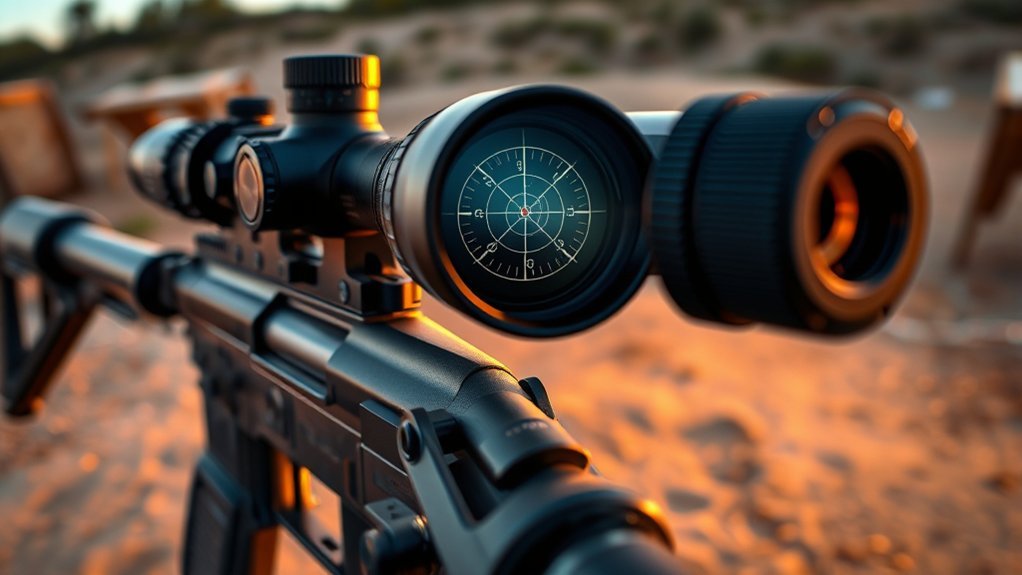
The Trijicon MGRS (Machine Gun Reflex Sight) is the reflex sight currently built for the M2 (.50 caliber) and M240 (.308/7.62) machine guns. It’s a non-magnified optic, meaning it doesn’t zoom in on the target, and it relies on a distinctive reticle rather than a fine crosshair.
Reticle Design and MOA Measurements
The MGRS reticle is a 35 MOA segmented circle around a 3 MOA center dot. The large circle is easy to pick up quickly with both eyes open, while the smaller dot gives a more precise aiming point once the target is acquired. Two interchangeable range dials are supplied, one calibrated for the M2 and one for the M240, so the reticle’s holdover matches the ballistics of each weapon and caliber.
Build, Adjustment Range, and Power
The housing is machined from 7075-T6 forged aluminum, and the sight offers 100 MOA of total elevation and azimuth adjustment. It’s nitrogen-purged for fog resistance, rated for submersion, and runs on a single CR123 battery with separate day and night-vision brightness settings. Three accessory rails let units add a laser or laser rangefinder without replacing the sight itself.
Pro Tip: If you’re shopping for a personal rifle scope rather than researching military optics, check whether the reticle is MOA or MIL (mrad) before buying — mixing a MIL reticle with MOA turret clicks (or the reverse) makes holdover math needlessly confusing.
How This Reticle Design Improves Target Acquisition
Machine guns are typically used for suppressive or area fire at a squad or vehicle level, not single precision shots, so the reticle is built for speed over pinpoint accuracy. The wide 35 MOA circle is visible in peripheral vision, letting the gunner track a target with both eyes open instead of closing one eye to look through a narrow tube. The 3 MOA dot in the center still gives a clear aim point for the actual shot.
Manufacturers describe this as improving first-round hit probability: the gunner spends less time hunting for the reticle and more time watching the target and surrounding area. That matters more on a crew-served weapon, where situational awareness for the whole gun team is part of the job.
A Short History of Machine Gun Optics
Reflex-style sights go back further than most people expect. Optician Howard Grubb patented a reflector “reflex” sight around 1900, using a collimator to project an illuminated aiming mark that stayed aligned regardless of small changes in eye position — the same basic idea modern reflex sights still use.
The next major jump came in 1975, when the Swedish company Aimpoint released the first commercial electronic red dot sight. Military interest grew through the following decades, and in 2000 the U.S. Armed Forces adopted the Aimpoint CompM2 as the M68 Close Combat Optic for rifles.
Machine guns took a separate optics path. Units fielded ELCAN’s M145 optical sight, with reticles built specifically for the M240 and M249, before Trijicon’s MGRS became the newer reflex-sight option for the M2 and M240. The core idea hasn’t changed much: a simple, durable reticle that a gunner can use quickly under pressure.
Machine Gun Reticles vs. Civilian Rifle Scope Reticles
The biggest difference between a machine gun reticle and most rifle scope reticles is the measurement system and the goal behind the design.
- Measurement units: Machine gun optics like the MGRS use MOA (minutes of angle). Many long-range and tactical rifle scopes instead use MRAD, also called “mil” — Primary Arms has a clear breakdown of how MOA and MIL compare if you’re choosing between the two for a scope purchase.
- Purpose: Machine gun reticles favor speed and a wide field of view over precision holdover marks. Rifle scope reticles built for hunting or precision shooting (duplex, BDC, or mil-dot patterns) are designed for a single, aimed shot at a known distance.
- Dot size: A typical rifle red dot, like an Aimpoint Comp-series sight, uses a small 2 MOA dot for precise aiming. The MGRS’s 3 MOA dot and 35 MOA ring are noticeably larger, matching the machine gun’s role in area suppression rather than a single precision shot.
Machine gun optics like the MGRS also aren’t sold as ordinary consumer products. They’re priced and distributed for military and law enforcement procurement rather than retail rifle scope shelves.
Frequently Asked Questions
How Many Clicks Is 1 Mil at 100 Yards?
It depends on the scope’s click value, not the distance. If a scope adjusts in 0.1 mil increments, 1 full mil equals 10 clicks, at any range. What changes with distance is how much that adjustment moves your point of impact — 1 mil covers about 3.6 inches at 100 yards.
Do Navy SEALS Use EOTECH or Aimpoint?
Both. Naval Special Warfare units have fielded EOTech holographic sights and Aimpoint red dot sights, and the choice often comes down to the specific weapon platform and mission rather than one brand replacing the other.
What Was the Worst Submachine Gun in WWII?
The U.S. M3 “Grease Gun” is frequently named as one of the weaker submachine guns of World War II. It’s commonly criticized for a slow rate of fire, a flimsy folding stock, and reliability issues compared to contemporaries like the Thompson or the German MP40.
Can You Legally Own an MP40?
In the U.S., owning a fully automatic MP40 is legal only if it’s a pre-1986 weapon already registered on the National Firearms Act registry, transferred through an ATF Form 4 with a $200 tax stamp and background check. Registration numbers are fixed, so new transferable machine guns can’t be added to that list — and several states restrict or ban civilian machine gun ownership entirely, so state law matters as much as federal law.
Conclusion
“Mild machine gun reticles” aren’t a real, separate category — but machine gun reticles themselves are, and they’re built around clear priorities: fast target acquisition, a wide field of view with both eyes open, and durability for a weapon system rather than a single shooter. The Trijicon MGRS’s 35 MOA circle and 3 MOA dot is the clearest current example, and it’s measured in MOA, not MIL. If you’re shopping for your own rifle scope rather than researching machine gun optics, that MOA-versus-MIL distinction is the detail worth carrying over.
Sources:
- Trijicon — MGRS Machine Gun Reflex Sight specifications
- Trijicon — MGRS product family page
- Aimpoint — company history
- Primary Arms — MIL vs. MOA guide
- Aimpoint — Comp-series red dot sights
Last checked: September 29, 2026.
