
To hang a stroller in the garage safely, fold it, confirm its stored weight and folded shape, choose a hook or rail system with a published load rating above that weight, and fasten the system to a mounting surface approved by the hardware manufacturer. For framed walls, fastening into studs or a stud-spanning backer is the simplest everyday setup. Keep the stroller low enough to lift without reaching above shoulder height and clear of cars, doors, garage tracks, walkways, heat sources, and chemicals.
Last updated: September 22, 2026 — reviewed against current CPSC stroller guidance, OSHA lifting guidance, a current Rubbermaid garage-hook specification, and Lowe’s anchor guidance.
Quick Answer
Fold and dry the stroller, verify its weight, use a mount with a published load rating above the stored load, and install it exactly as the mount and fastener manufacturers specify. Prefer studs, solid wood backing, concrete, or masonry; if you must use hollow-wall anchors, verify that the anchor is rated for your exact wall material and the way the stroller projects from the wall. Store the stroller below shoulder-lift height when practical.
Safety scope: CPSC stroller rules cover stroller design and performance, but they do not provide a universal wall-hanging method for every model. Check your stroller manual before choosing a support point, and follow the mounting hardware manufacturer’s installation instructions. CPSC carriage and stroller guidance.
Key Takeaways
- Use hooks, brackets, or rails with a published load rating above the stroller’s total stored weight, including anything left attached.
- For framed walls, prefer wall studs or a stud-spanning wood backer. For concrete, brick, or block, use fasteners approved for that material and load direction.
- Fold and clean the stroller before hanging it to reduce bulk, protect fabric, and prevent garage dirt from building up.
- Keep accessories in labeled baskets, bins, or shelves near the stroller so outings are faster and less stressful.
- Check hooks, brackets, anchors, and stroller straps regularly so the setup stays secure over time.
At a Glance
| Time Required | Varies by wall type, hardware, and whether a backer board or masonry anchors are needed |
| Difficulty | Easy to moderate, depending on wall type |
| Tools Needed | Stud finder, drill, drill bits, level, measuring tape, pencil, screws, anchors, and heavy-duty stroller hooks |
| Cost | Varies by hook, rail, backer board, fasteners, and wall material |
Which Garage Stroller Storage Setup Fits Your Use?
The best storage method depends on how often you use the stroller, how heavy and bulky it is when folded, and what mounting surfaces are available. Use this decision table before drilling:
| Situation | Practical setup | Why it fits |
|---|---|---|
| Daily-use compact or full-size stroller | Two padded wall hooks or an adjustable rail fastened to studs or solid backing | Keeps the stroller reachable without using floor space |
| Heavy double or jogging stroller | Lower wall storage or a floor-standing storage zone | Reduces awkward lifting and the need to raise a bulky stroller overhead |
| Rental or no-drill garage | Floor stand, designated parking zone, or a manufacturer-rated over-door hanger that does not stop the door from closing and latching | Avoids relying on adhesive hooks for a bulky hanging load |
| Occasional backup stroller | Rated overhead system fastened into structural framing, if the manufacturer allows the application | Frees wall and floor space when frequent access is not important |
Why Hang a Stroller in the Garage?
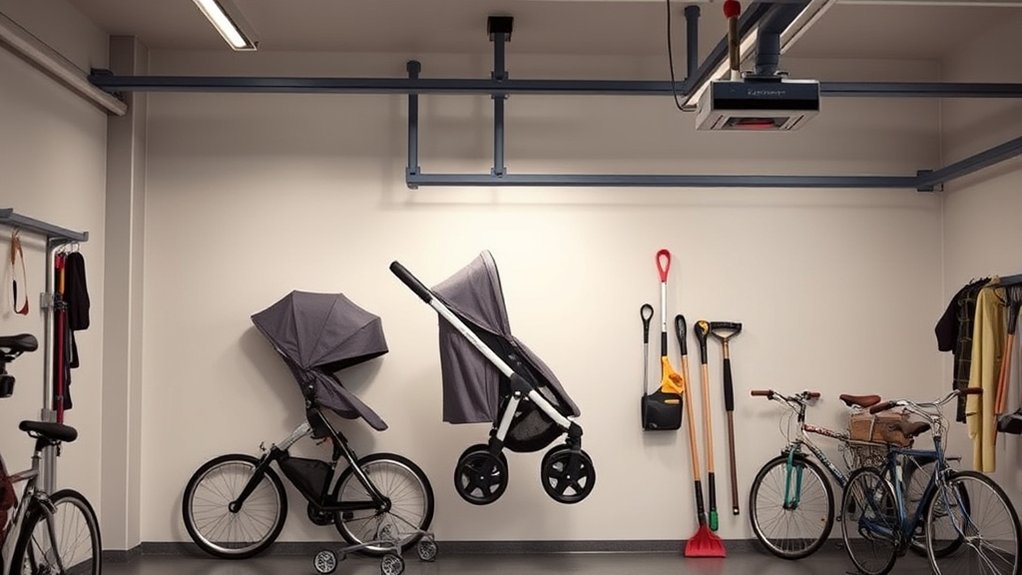
Wall storage is most useful when the stroller is used often but blocks a walking or parking path when left on the floor. Hanging a folded stroller can recover floor space and keep it away from puddles, oil spots, and sharp tools, but the storage point must still be easy to reach and strong enough for repeated loading and unloading.
Wall-mounted storage solutions work best when the folded stroller has a clear structural contact point and the hardware can be mounted to a suitable surface. A compact umbrella stroller may work with a smaller hook, while a bulky jogging or double stroller may be safer and easier to handle on lower wall hooks or in a floor-standing storage zone.
Keep the stroller’s rain cover, cup holder, travel bag, and other loose accessories in a nearby bin or basket rather than hanging them from the stroller. This keeps the stored load predictable and makes it easier to inspect the frame and mount.
Note: Before choosing a wall mount, fold your stroller and measure its folded height, width, depth, and weight. These numbers help you choose the right hook size, spacing, and mounting height.
What Type of Wall Mount Should You Use?
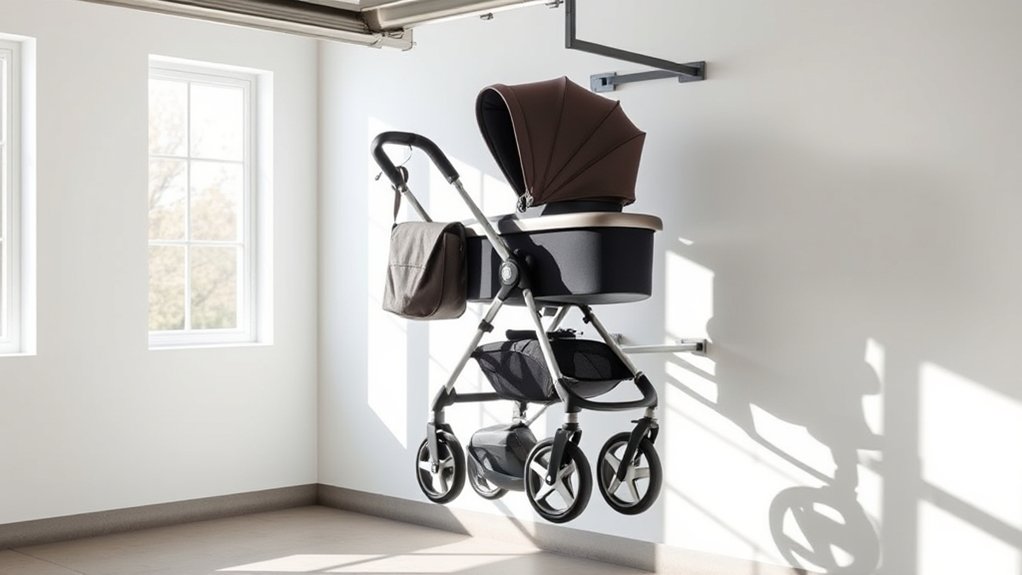
Choose a wall mount kit by load rating, hook shape, mounting method, and the stroller’s folded geometry. The hook should support a solid part of the frame without pressing on fabric, brake cables, wheel-release controls, canopy parts, or soft handle padding.
Use hardware with a published load rating above the stroller’s actual stored weight. As a current example of how specific those ratings can be, Rubbermaid lists its FastTrack Utility Hook at up to 50 lb when used with the compatible FastTrack system. That figure applies to that product and system only; do not assume another hook, anchor, or wall installation has the same capacity. Rubbermaid FastTrack Utility Hook specifications.
Also consider hook shape and projection. Wide padded hooks can reduce metal-on-metal rubbing, while narrower hooks may fit compact folded frames. A rail system can make spacing easier to adjust later, but the rail, hooks, screws, and wall connection all need to be used within their published limits.
Finally, match the fastener to the wall type. For framed walls, fastening into studs or a wood backer spanning studs is the simplest choice for a frequently handled stroller. Hollow-wall anchors vary widely by anchor type, wall material, wall thickness, and how far the load projects from the wall. Lowe’s notes that anchor capacity depends on those conditions and that using multiple anchors does not automatically multiply capacity. Lowe’s drywall-anchor guide. For concrete, brick, or block, follow the fastener manufacturer’s instructions for that base material.
What to Check Before You Hang a Stroller
Before installing hooks, inspect both the stroller and the garage wall. This small step prevents mistakes and helps you avoid a weak or awkward setup.
- Stroller weight: Check the manual, product label, or manufacturer details so you know what the hooks must support.
- Folded size: Fold the stroller completely and measure the shape it makes when stored.
- Frame contact points: Decide which part of the stroller frame can safely rest on the hooks without pressing against wheels, fabric, brake cables, or handle padding.
- Wall strength: Find studs in framed walls or verify that the chosen anchor is approved for the exact concrete, brick, block, or hollow-wall material.
- Clearance: Make sure the stroller will not block doors, cars, storage cabinets, outlets, garage controls, or walking paths.
- Lifting comfort: Choose a height that lets you keep the stroller close to your body and avoid finishing the lift above shoulder height. OSHA’s workplace ergonomics guidance recommends keeping manual lifts roughly between mid-thigh and shoulder height when practical. OSHA manual-lifting guidance.
Warning: Do not hang a stroller from loose trim, hollow paneling, adhesive hooks, garage-door tracks, pipes, conduit, or hardware with no clear load rating. If you are mounting through drywall, use studs, structural backing, or an anchor specifically rated by its manufacturer for the wall material and projected load.
How Do You Install Stroller Hooks or Brackets?
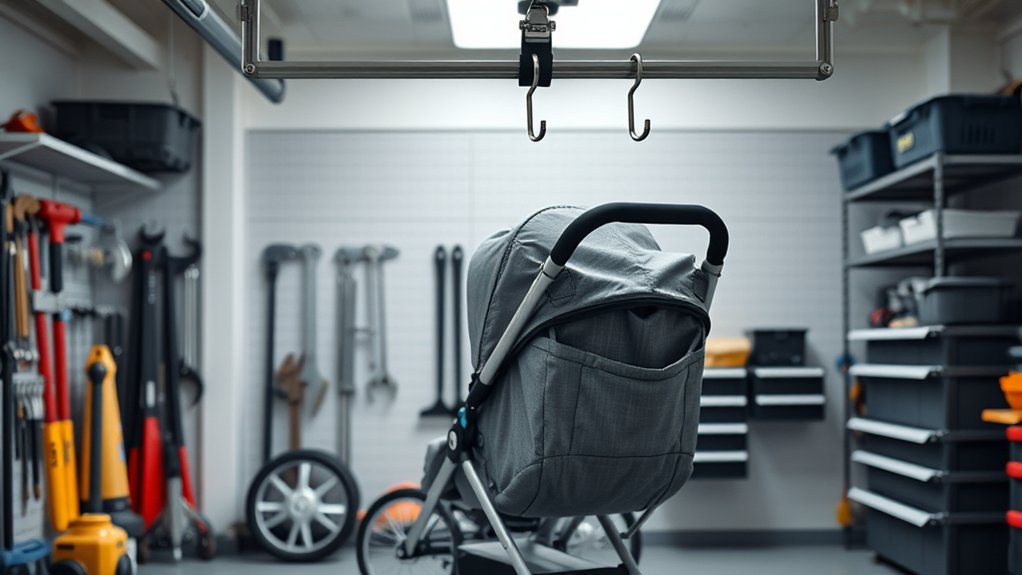
Install the wall mount kit according to the hook, rail, and fastener manufacturers’ instructions. For a framed wall, locate studs or use a properly installed backer spanning studs. For masonry, use a fastener approved for the exact base material. Do not mix hardware from different systems unless the manufacturers allow it.
Use a stud finder to locate studs if you are mounting into a framed wall. Mark the hook locations with a pencil, then use a level to keep the hooks aligned. Good alignment prevents the stroller from tilting or sliding to one side. If the stroller needs two hooks, space them so the stroller frame rests evenly across both contact points.
Use screws or anchors designed for the wall material and the mount. Wider padded hooks may suit bulky frames, while narrower hooks may suit compact folds, but fit matters more than stroller category. Mount the hooks at an accessible height that lets you keep the folded stroller close to your body and avoid an overhead lift.
After installation, verify that every fastener is seated correctly and that the mount does not wiggle or pull away from the wall. For the first hang, keep the stroller only a few inches above the floor while you check for shifting, twisting, or contact with fragile stroller parts. Do not exceed the published rating or improvise a load test beyond the manufacturer’s instructions. Recheck the hardware periodically and after any impact or unusual movement.
Simple Step-by-Step Installation
- Fold and measure the stroller. Check the best hanging position before drilling.
- Identify the approved mounting surface. Locate studs or backing, or confirm the correct masonry or hollow-wall fastener for the mount.
- Hold the stroller near the wall. Confirm that doors, shelves, and car space will not be blocked.
- Mark hook placement. Use a level so the hooks line up evenly.
- Drill or install anchors as directed. Use the bit size, embedment, and fastener method specified for the hardware and wall material.
- Fasten the hooks or brackets. Tighten the screws firmly without stripping them.
- Check before full use. Confirm the hardware is seated, then make the first hang close to the floor and watch for movement.
- Add accessory storage nearby. Use baskets, shelves, or bins for stroller gear.
Pro Tip: Take a quick photo of the folded stroller against the wall before installing hooks. It helps you visualize the best height and spacing before you drill permanent holes.
How Should You Store Stroller Accessories?
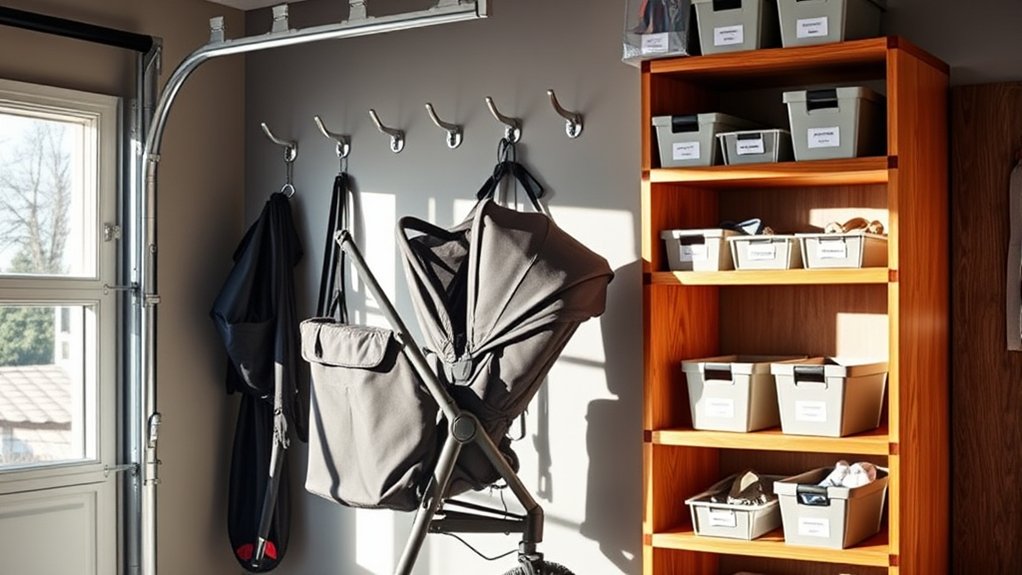
Use vertical shelf space for loose stroller accessories so those items do not add weight or swing from the stored stroller. Group rain covers, toys, cup holders, travel bags, and cleaning supplies in labeled bins, then keep the most-used items between waist and chest height.
Utilize Vertical Shelf Space
Vertical shelves can keep diaper bags, toys, blankets, rain covers, stroller fans, cup holders, and maintenance tools off the floor and separate from the stroller mount.
Consider adjustable shelving units to accommodate different accessory sizes. Adjustable shelves make it easier to customize your storage as your child grows and your gear changes. Use clear bins or baskets on the shelves to group smaller items by purpose, such as weather gear, cleaning supplies, toys, and travel accessories.
Make sure your shelves are securely mounted or stable enough to prevent tipping, especially in a busy garage. Keep the most-used items at chest or waist height, and store rarely used items higher up. Regularly assess and reorganize shelf contents so the setup stays efficient.
Store Accessories in Baskets
Baskets are useful for organizing stroller accessories because they keep small parts together and make it obvious when something is missing. On wall-mounted shelves, use labeled or clear baskets for diaper bags, toys, stroller covers, snack containers, and travel blankets.
This type of basket organization keeps your garage tidy and saves time when preparing for outings. Use a mix of basket sizes to fit different accessories and maximize vertical space. Position the baskets at a height that is reachable for adults but not easily accessible to small children if the basket contains cleaning wipes, tools, straps, or small parts.
Regularly declutter these baskets to keep only essential items. Remove outgrown toys, expired wipes, broken clips, and loose parts you no longer need. A cleaner accessory zone makes the whole garage feel easier to use.
Implement Adjustable Shelving Units
Adjustable shelving can be configured around different basket sizes and stroller accessories. Use shelving designed for garage storage, follow its published load limits, and anchor tall units when the manufacturer requires it.
With adjustable shelves, you can create specific areas for each stroller or child. One shelf can hold rain covers and cold-weather gear, another can hold toys and travel bags, and another can hold cleaning supplies. This reduces clutter and makes it easier to grab what you need quickly.
As your gear changes, move shelves or bins rather than piling accessories on the stroller itself. Keep frequently used items within easy reach and store rarely used items higher only when they are light enough to handle comfortably.
How Can You Use Garage Wall Space Efficiently?
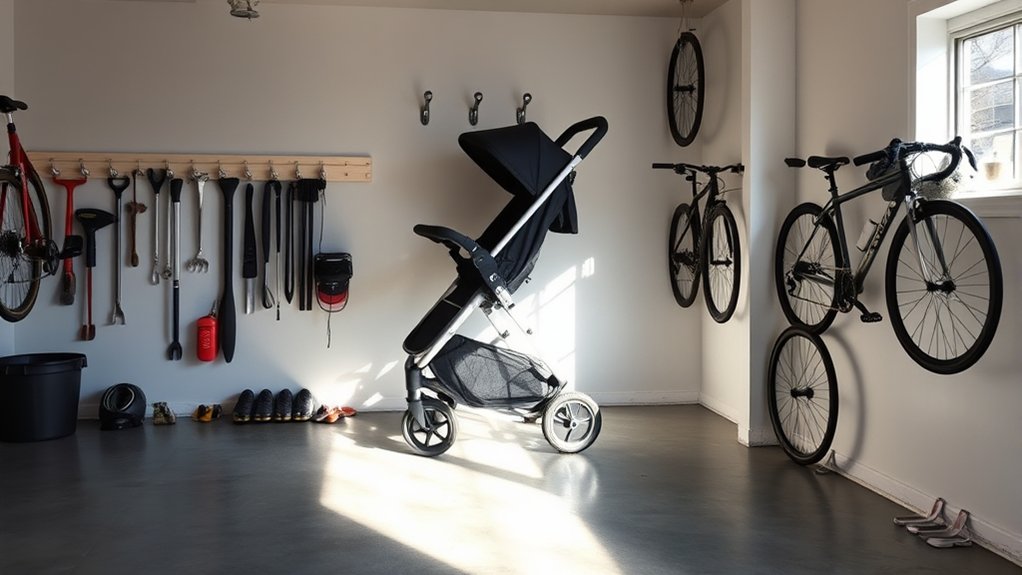
Use vertical storage to recover floor space without creating a new hazard at head or shoulder level. Adjustable hooks can help you fine-tune spacing, but leave enough clearance for the folded stroller, nearby doors, the parked vehicle, and the path you use to lift it down.
Create simple zones: baby gear in one area, tools in another, and seasonal storage elsewhere. Do not place sharp tools, leaking containers, or heavy objects where they can strike or fall onto the stroller.
Match the storage method to what you are actually hanging:
| Storage Need | Selection Check |
|---|---|
| Bulky or heavy stroller | Use a lower position and a rated mount that supports the folded shape without an overhead lift |
| Compact stroller | Use a rated hook or rail that supports a structural point without crushing fabric or controls |
| Bags and accessories | Store separately in bins, baskets, or shelves so they do not add to the stroller’s hanging load |
What If Wall Hooks Do Not Fit Your Garage?
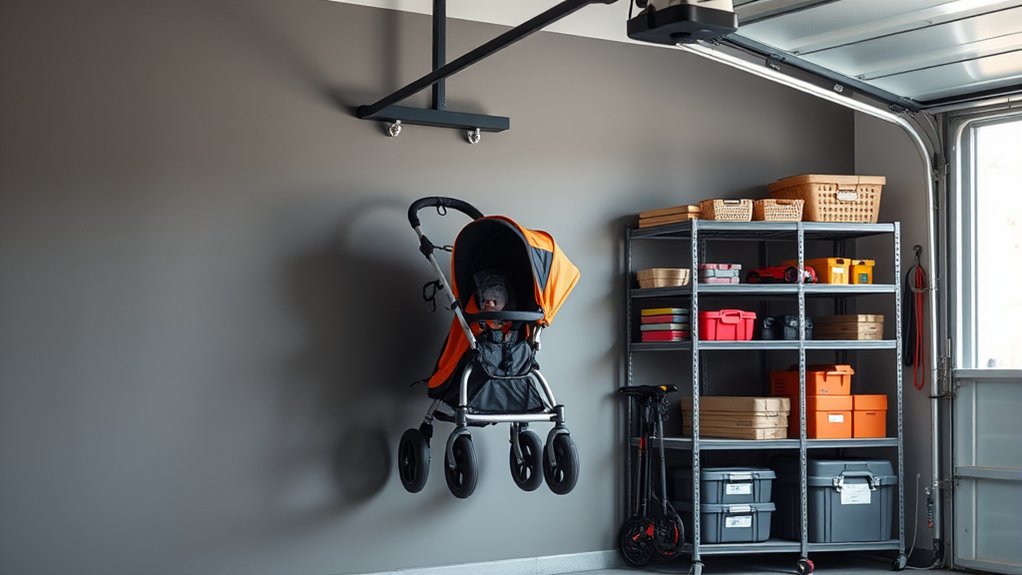
Wall hooks are not the only option. A rail or slatwall system, a floor-standing rack, a designated parking zone, an over-door hanger with a published stroller-compatible load rating, or an indoor storage spot may fit better depending on your wall type, rental rules, stroller weight, and how often you use it.
Slatwall garage systems can make hook spacing easier to change, but only use hooks and accessories the slatwall manufacturer rates for the system. For a compact stroller, a mudroom, closet, laundry room corner, or floor stand may be more convenient than garage wall storage.
If indoor storage is available, a closet or mudroom usually avoids the temperature swings, dust, and moisture common in garages. If the stroller must stay in a garage or sheltered outdoor area, clean and dry it first, keep it away from standing water and chemicals, and follow the stroller manufacturer’s storage instructions.
Wall Hooks vs. Ceiling Storage
Wall hooks are usually easier and safer for daily use because the stroller stays within reach. Ceiling storage can work for a stroller used only occasionally, but it requires more lifting and may be less convenient for parents who need quick access.
If you use overhead storage, use a purpose-built system with a published rating and fasten it to structural framing exactly as the manufacturer directs. Do not improvise attachment points on garage-door tracks, pipes, conduit, or finish materials. Avoid hanging a stroller directly over a parked car, walkway, child play area, or anything fragile.
Which DIY Stroller Storage Ideas Are Safer?
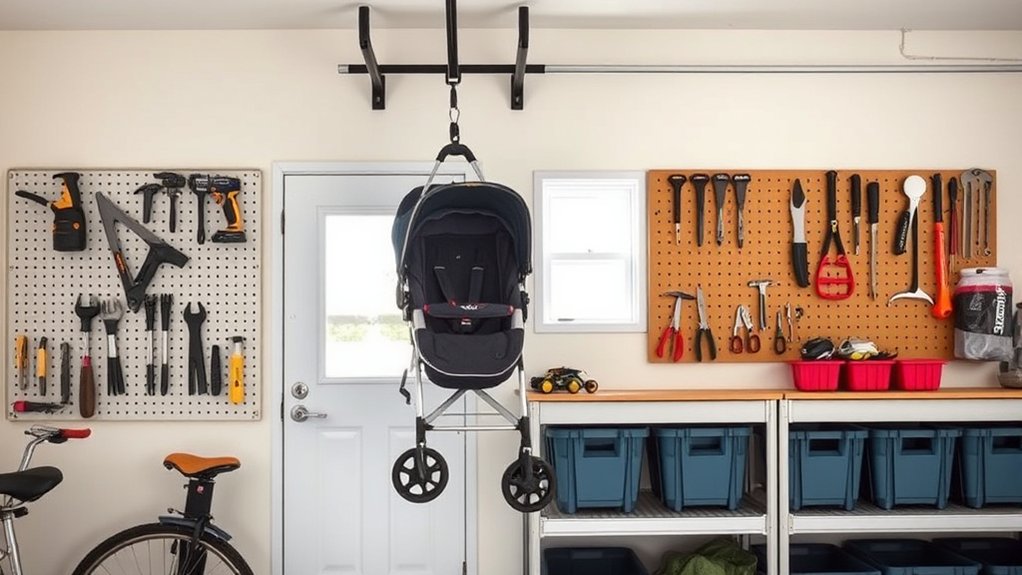
A budget setup can still use rated components. One simple approach is a wood backer secured across wall studs with compatible rated hooks attached to the backer. This can make hook spacing easier to match to the folded stroller, but the backer, screws, hooks, and installation all need to suit the expected load.
Repurposed shelving or crates are better used for accessories than for suspending a stroller unless their load rating and anchoring are known. If you use a slatwall or rail system, stay within the manufacturer’s listed capacities and use compatible hardware.
Do not suspend a stroller from improvised bungee cords, rope, nails, or unknown straps. Elastic cords can shift and release, and unlisted hardware gives you no reliable working-load reference. If overhead storage is necessary, use a purpose-built system rated for the load and installed into structural framing as directed.
Warning: A DIY setup is only as strong as its weakest component. Use hardware with published ratings, install it into an approved structural surface, and do not count multiple anchors together unless the mounting-system manufacturer explicitly allows that calculation.
How Do You Keep Garage Stroller Storage Safe and Organized?
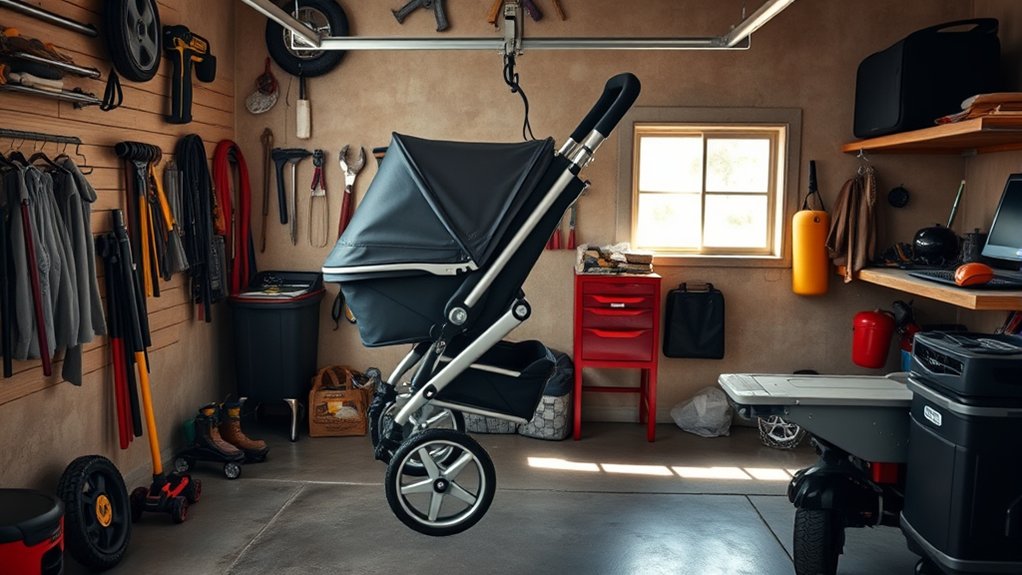
Once the mount is installed, keep the area around it clear and make inspection part of the storage routine. The goal is not just to free floor space; it is to keep the stroller easy to remove without striking nearby shelves, tools, or the vehicle.
Match hook spacing and shape to the folded stroller rather than assuming one hook style fits every model. Keep accessories nearby, but avoid piling loose items on the stroller because that changes the stored load and can press on fabric, controls, or folding joints.
Recheck the setup whenever the stroller changes, accessories are added, or the mount is moved. A compact travel stroller, a full-size stroller, and a double stroller can have very different folded shapes and lifting demands, so a setup that worked for one may not be suitable for the next.
Simple Maintenance Routine
- Weekly: Shake out crumbs, leaves, and loose dirt from the stroller before hanging it.
- Monthly: Wipe the frame and wheels, then inspect the wall mount, screws, anchors, rail connection, and surrounding wall for movement or damage.
- Seasonally: Reorganize baskets, remove unused accessories, and confirm that the stroller and mount still match the stored weight and folded shape.
- After wet outings: Let the stroller dry before hanging it to reduce odor, mildew risk, and garage grime.
Common Mistakes to Avoid
A stroller wall storage setup is simple, but a few mistakes can make it unsafe or frustrating. Avoid these common problems before they happen:
- Mounting too high: If you have to lift the stroller above your shoulders, daily use becomes uncomfortable and risky.
- Using unlisted hooks: Decorative hooks or hardware with no published load rating give you no reliable basis for matching the mount to the stroller.
- Using the wrong wall connection: Screws or anchors that are not rated for the wall material and projected load can loosen or fail.
- Blocking walkways: A stroller that sticks out too far can become a hazard in a narrow garage.
- Hanging the stroller dirty or wet: Dirt, moisture, and road salt can shorten the life of fabric, wheels, and metal parts.
- Forgetting accessories: A stroller may be off the floor, but loose cup holders, covers, toys, and bags can still create clutter.
Related Guides
Frequently Asked Questions
Can I hang any stroller model using wall mounts?
Not every stroller should hang from the same type of mount. Check the stroller’s weight, folded shape, manual, and structural contact points first. The wall system must also be rated for the stored load and installed on an approved mounting surface.
Can I hang a stroller on drywall?
Do not assume drywall itself can carry a bulky stroller. For framed walls, fastening into studs or a stud-spanning backer is the simplest option. If a hollow-wall anchor is necessary, use only one whose manufacturer rates it for your exact wall material, wall thickness, and load application.
How much weight can stroller wall mounts support?
Capacity depends on the hook or rail, its fasteners, the wall material, and the installation method. Use the published working or load rating for the complete mounting system and choose a rating above the stroller’s total stored weight. Do not assume multiple anchors automatically multiply capacity.
Should I hang the stroller by the handlebar or the frame?
Use a structural contact point only if the stroller manufacturer does not prohibit that storage method. Do not assume a padded or adjustable handlebar is designed to carry the stroller’s full weight. Avoid contact with fabric, canopy parts, brake cables, wheel-release buttons, and small plastic components.
How high should I hang a stroller?
Hang it only as high as needed to clear the floor while keeping the lift comfortable. For a stroller you use often, avoid a setup that makes you finish the lift above shoulder height, twist while lifting, or stand on a box or ladder.
What if my stroller is too heavy or awkward to lift?
Use lower wall storage, a floor-standing rack, or a designated floor parking zone instead of forcing an overhead lift. A storage system should reduce clutter without making everyday lifting harder.
How do I clean a stroller before hanging it?
Remove crumbs and loose debris, clean removable fabric according to its care label, and wipe the frame and wheels using the stroller manufacturer’s cleaning instructions. Let the stroller dry fully before storage, especially after rain, snow, or washing.
Can I store a stroller in the garage year-round?
A garage can work if the stroller stays clean, dry, secure, and away from leaks, chemicals, sharp tools, pests, and damaging temperature extremes. Check the stroller manual for any model-specific storage limits or maintenance instructions.
Conclusion
The safest way to hang a stroller in the garage is to match the mount to the stroller’s stored weight and folded shape, fasten the system to an approved structural surface, and keep the lifting height comfortable. Before drilling, check clearance for the car, garage door, shelves, and walkway. After installation, make the first hang close to the floor and recheck the hardware periodically.
If the stroller is heavy, awkward, or incompatible with a secure wall mount, use lower wall storage or a floor-standing option instead. The best garage setup is the one that clears the floor without creating a harder lift or a new falling-object hazard.
Sources
- U.S. Consumer Product Safety Commission — Carriages and Strollers Business Guidance — current federal stroller safety and performance context.
- OSHA — Heavy Lifting Guidance — workplace ergonomics guidance on keeping manual lifts within a more comfortable vertical range and avoiding twisting.
- Lowe’s — How to Install Drywall Anchors — anchor-selection guidance covering wall type, load capacity, and installation limits.
- Rubbermaid — FastTrack Utility Hook — manufacturer example of a garage hook with a published 50 lb capacity when used with its compatible system.

