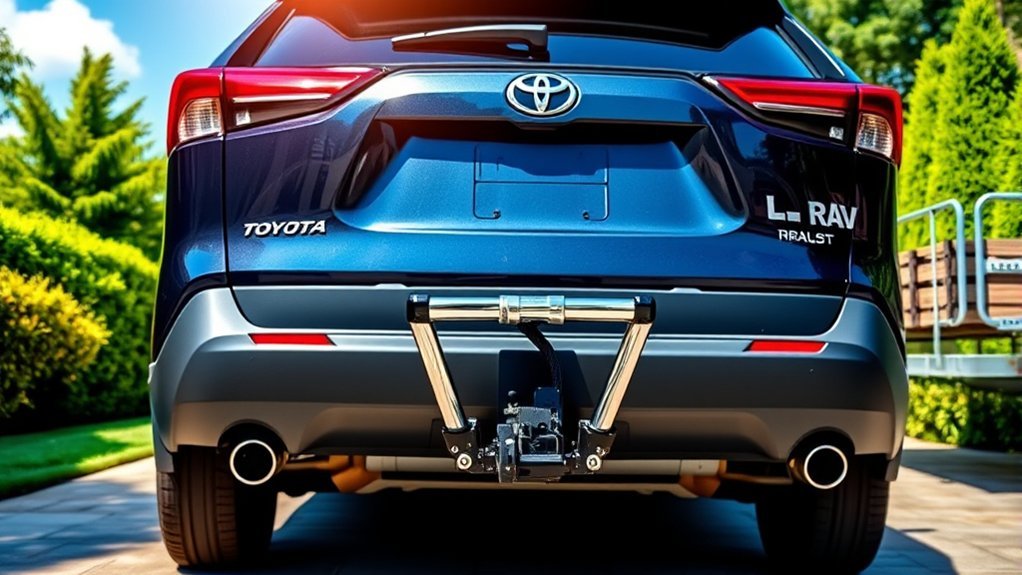
Yes, a Toyota RAV4 can pull a trailer, but its limit depends on the model year, trim, drivetrain, market, and how the vehicle is loaded. Before connecting a utility trailer, boat, or camper, confirm the exact rating in your owner’s manual and calculate the trailer’s fully loaded weight, tongue weight, and effect on vehicle payload.
Quick Answer
A Toyota RAV4 can tow a properly equipped trailer. Current 2026 U.S. models are rated for up to 3,500 pounds in qualifying configurations, while many earlier RAV4s have lower limits. Your exact owner’s manual, payload label, hitch rating, and fully loaded trailer weight determine what you can safely tow.
Key Takeaways
- Toyota advertises up to 3,500 pounds of towing capacity for qualifying 2026 RAV4 configurations, but lower-rated versions are also available.
- The outgoing 2025 U.S. RAV4 was generally rated at 1,500 pounds for gas models, 1,750 pounds for Hybrid models, and 2,500 pounds for the Plug-in Hybrid.
- Compare the trailer’s fully loaded weight, not only its advertised dry weight, with the limits for the vehicle, hitch, ball mount, ball, and trailer.
- Tongue weight, passengers, luggage, accessories, and hitch-mounted cargo all consume the RAV4’s available payload.
- An aftermarket hitch, anti-rattle pin, brake controller, or weight-distribution system does not increase Toyota’s published towing capacity.
At a Glance
| Time Required | About 30–60 minutes to verify ratings and inspect an existing setup; installation takes longer |
| Difficulty | Moderate; professional hitch, wiring, or brake-controller installation may be appropriate |
| Tools Needed | Owner’s manual, vehicle payload label, trailer specifications, tire gauge, torque wrench when specified, and access to a suitable scale |
| Cost | Free to verify existing ratings; hitch, wiring, brake equipment, weighing, and installation costs vary |
What’s the Towing Capacity of Your RAV4?

Your RAV4’s towing capacity is not one number that applies to every vehicle bearing the name. Toyota changes ratings between generations, powertrains, drivetrains, trims, and sales markets.
For the current U.S. lineup, Toyota advertises the 2026 RAV4 with a maximum towing capacity of up to 3,500 pounds. “Up to” is important because not every configuration receives the maximum rating.
Toyota separately states that the 2026 RAV4 Plug-in Hybrid SE, Woodland, and XSE can tow 3,500 pounds. Check Toyota’s current specification sheet for other trims because equipment and ratings can differ.
| Model and configuration | Published maximum | Important note |
|---|---|---|
| 2026 RAV4 Hybrid | Up to 3,500 lb | The exact rating depends on configuration; some versions are rated lower. |
| 2026 RAV4 Plug-in Hybrid SE, Woodland, and XSE | 3,500 lb | Confirm the rating for the exact trim before selecting a trailer. |
| 2025 gas-only RAV4 | Up to 1,500 lb | Applies to the outgoing 2025 U.S. lineup; do not apply it automatically to another year. |
| 2025 RAV4 Hybrid | Up to 1,750 lb | Payload and hitch limits may reduce what a particular loaded vehicle can handle. |
| 2025 RAV4 Plug-in Hybrid | Up to 2,500 lb | This outgoing-model rating should not be confused with the redesigned 2026 PHEV. |
| Earlier RAV4 models | Varies | Use the manual for the exact model year, engine, drivetrain, and market. |
Warning: Never select a trailer using a capacity remembered from another RAV4, a dealership advertisement, or a general online chart. The towing section in your exact model-year manual and the ratings attached to your equipment control.
How to Find Your Exact RAV4 Towing Rating
- Identify the model year and trim. Check the registration, VIN information, purchase documents, or Toyota account rather than relying on exterior appearance.
- Confirm the powertrain and drivetrain. Hybrid, Plug-in Hybrid, FWD, and AWD versions may receive different ratings.
- Open the correct towing section. Use Toyota’s owner’s-manual library and select the exact year and model.
- Read every related limitation. Look for the maximum trailer weight, tongue weight, gross combination weight, axle limits, speed restrictions, required equipment, and prohibited hitch types.
- Check the driver-door label. This label provides vehicle-specific tire and loading information, including the combined occupant-and-cargo limit.
- Inspect every towing component. The receiver, ball mount, hitch ball, coupler, fasteners, and trailer must each have adequate ratings.
Note: Specifications can differ outside the United States. Use documentation issued for the country where your vehicle was originally sold.
How to Calculate What Your RAV4 Can Actually Tow
The maximum trailer-weight rating is only one part of the calculation. Your setup must remain within every vehicle, axle, payload, hitch, and trailer limit at the same time.
Use Loaded Trailer Weight, Not Dry Weight
A trailer’s dry or unloaded weight may exclude batteries, propane cylinders, water, accessories, dealer-installed equipment, tools, food, sporting gear, and personal cargo. Use the trailer’s expected departure weight or weigh it after loading.
The number that matters is not what the empty trailer weighs. It is what the complete vehicle-and-trailer combination weighs when you leave for the trip.
Calculate Available Payload
The RAV4’s payload must cover occupants, luggage, loose equipment, aftermarket accessories, and the downward load applied at the hitch.
Available payload = vehicle’s occupant-and-cargo limit − occupants − cargo − accessories − hitch load
For example, adding passengers, coolers, roof cargo, and a hitch-mounted carrier may leave too little payload for the trailer’s tongue weight even when the trailer itself remains below the advertised towing maximum.
Understand the Main Weight Ratings
- Trailer GVWR: The maximum allowed weight of the loaded trailer.
- Vehicle GVWR: The maximum allowed weight of the loaded RAV4.
- GAWR: The maximum allowed weight on an individual axle.
- GCWR: The maximum allowed combined weight of the loaded vehicle and trailer when Toyota specifies one.
- Tongue weight: The downward force the trailer places on the hitch.
- Hitch rating: The receiver manufacturer’s maximum trailer and tongue-weight limits.
The lowest applicable limit is the one you must follow. A 3,500-pound receiver does not permit a 3,500-pound trailer when the vehicle is rated for less, and a high vehicle rating does not permit an underrated ball mount or coupler.
Measure and Adjust Tongue Weight
Conventional trailers often use a tongue weight near 10–15% of loaded trailer weight as a general starting range. However, the exact Toyota manual and trailer manufacturer’s instructions take priority.
Too little tongue weight can contribute to instability. Too much can overload the hitch, rear axle, tires, or vehicle payload. Use a suitable tongue-weight scale or a certified weighing method instead of estimating by appearance.
Pro Tip: Load the vehicle and trailer as they will be used, including passengers, water, fuel, batteries, propane, and gear. Then weigh the setup and keep the scale ticket with your towing records.
Top 10 Safety Tips for Towing With Your RAV4
- Verify the exact ratings. Confirm the towing, payload, axle, combination, and tongue-weight limits for your specific RAV4.
- Weigh the loaded trailer. Do not rely only on a brochure’s dry-weight figure or an estimate based on trailer size.
- Stay within available payload. Include passengers, luggage, accessories, roof cargo, the hitch assembly, and hitch load.
- Use correctly rated hardware. Match the receiver, ball mount, hitch ball, coupler, pin, fasteners, and trailer ratings.
- Connect safety equipment properly. Attach crossed safety chains as directed, secure the coupler, and test the latch and pin.
- Test lights and brakes. Confirm turn signals, running lights, brake lights, trailer brakes, controller operation, and the breakaway system when equipped.
- Inspect tires and wheels. Set cold tire pressures to the applicable labels, examine tread and sidewalls, and check wheel-fastener torque as instructed.
- Load the trailer for stability. Keep heavy cargo low, secure it against movement, and distribute weight according to the trailer manufacturer’s instructions.
- Change your driving habits. Reduce speed, leave more following distance, allow wider turns, brake earlier, and practice backing in an open area.
- Stop and recheck the setup. Inspect the coupler, chains, wiring, cargo, tires, and wheel fasteners after the first few miles and during longer trips.
Warning: If the trailer begins to sway, keep the steering as steady as possible, ease off the accelerator, avoid an abrupt steering correction, and slow gradually when conditions allow. Pull over safely and correct the loading, tire, speed, or equipment problem before continuing.
Choosing the Right Trailer for Your RAV4 Towing Capacity
A RAV4 is best suited to trailers whose loaded weight, tongue weight, frontal area, and equipment needs stay comfortably within the exact vehicle limits. The trailer’s length or marketing category alone does not establish compatibility.
[Amazon Products Picked for You]
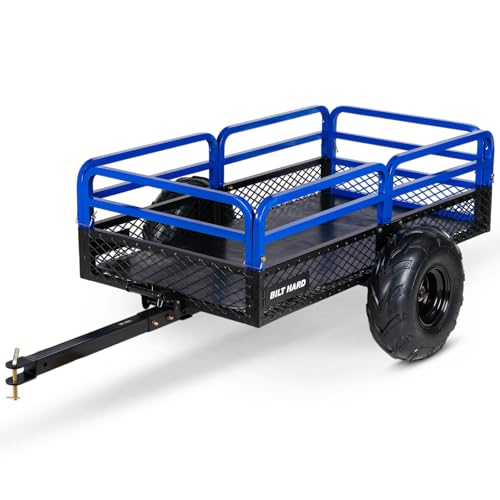
High Capacity Trailer: Our ATV metal trailer can carry up to 1,500 lb of cargo, featuring railings on all four sides and a storage capacity of 11 cu ft for yard waste. Gather more wood, soil, or debris in a single trip, reducing the need for frequent hauling. Tackle your yard work in one go with this high‑capacity trailer.

LARGE LOAD CAPACITY: 1500lb; 15 cu.ft of hauling capacity
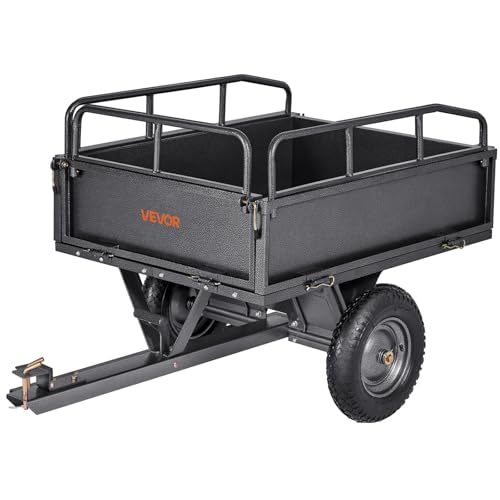
Universal Compatibility: Featuring a 0.47"/12mm pin, this garden trailer is compatible with various equipment, including tractors, ATVs, UTVs, and lawnmowers. It easily connects, providing an ideal hauling solution to enhance efficiency and reduce operation time.
Small Utility Trailers
A compact utility trailer may work well for landscaping supplies, camping equipment, furniture, or a small recreational vehicle. Include the weight of ramps, spare tires, toolboxes, tie-down equipment, and cargo in the total.
Teardrop and Micro Campers
Some teardrop, micro, and compact pop-up campers fit within certain RAV4 ratings, but apparently similar models can have very different dry weights and GVWRs. Batteries, propane, water, air conditioners, awnings, and dealer options can substantially increase departure weight.
Small Boats and Watercraft
Count the boat, trailer, engine, fuel, batteries, anchors, safety equipment, and onboard gear. Boat-trailer tongue weight and axle placement can also differ from those of a utility trailer.
When a Trailer Is Too Large
Choose a more capable tow vehicle when the loaded trailer approaches or exceeds any RAV4 limit, requires prohibited equipment, places excessive load on the rear axle, or leaves too little payload for passengers and cargo.
A larger tow vehicle may also be the better choice for frequent mountain travel, extreme heat, long-distance towing, strong crosswinds, or a tall travel trailer with substantial aerodynamic drag.
Best Accessories to Optimize Towing With Your RAV4
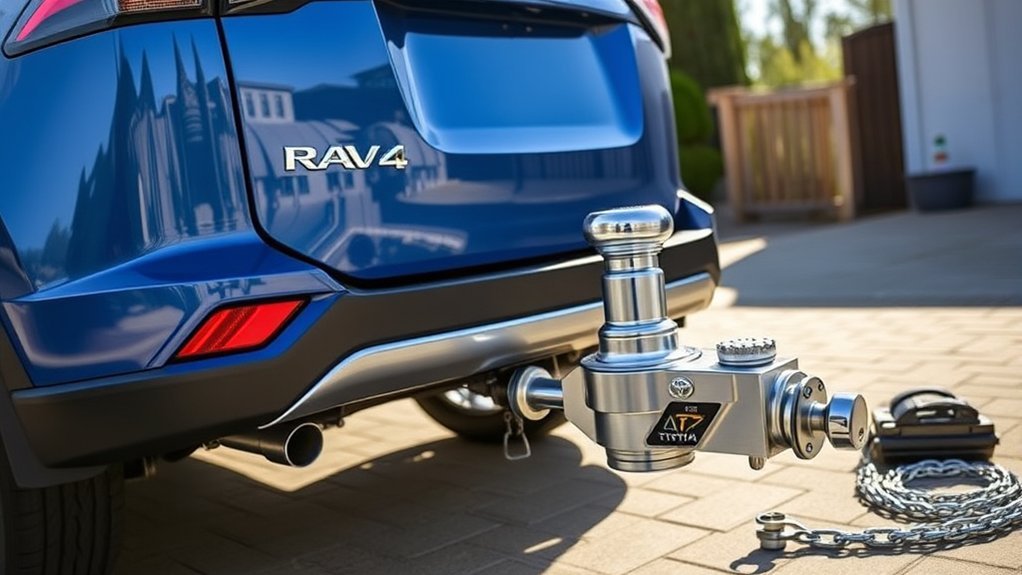
The right accessories can improve connection, visibility, measurement, and legal compliance. They cannot increase the limits Toyota assigns to the vehicle.
- Vehicle-specific receiver hitch: Use a properly rated receiver designed for the exact model year and powertrain.
- Correct ball mount: Select a rated rise or drop that keeps the trailer reasonably level when loaded.
- Correct hitch ball: Match the coupler’s ball size and ensure the ball’s shank and weight rating suit the ball mount.
- Vehicle-specific wiring harness: Use the connector required for the trailer’s lights and braking equipment.
- Brake controller: Install a compatible controller when the trailer, manual, or applicable law requires controlled trailer brakes.
- Tongue-weight scale: Measure hitch load instead of relying on an estimate.
- Extended mirrors: Add legal, stable towing mirrors when the trailer blocks the required rearward view.
- Torque wrench and tire gauge: Use them according to the vehicle, hitch, wheel, and trailer instructions.
- Anti-rattle device: A compatible device may reduce receiver movement and noise, but it is not a trailer-sway remedy.
Products such as Let’s Go Aero trailers, GearSpace® 34 or GearDeck® carriers, and Silent Hitch Pin® devices may suit some configurations. Check their exact dimensions, attachment method, vehicle fitment, tongue-weight effect, and published ratings before use.
Note: A hitch-mounted cargo carrier is not a trailer. The carrier, adapter, and cargo place their weight directly on the receiver and consume vehicle payload and hitch tongue-weight capacity.
[Amazon Products Picked for You]

DEPENDABLE STRENGTH — This trailer hitch is rated for 4,500 lbs. gross trailer weight, 675 lbs. tongue weight, 4,500 lbs. weight distribution capacity and 675 lbs. weight distribution tongue weight (limited to lowest-rated towing component)

Compatibility: Compatible with 2006-2018 Toyota RAV4. Please confirm your vehicle model before purchasing

【COMPATIBLE WITH】— The TangMiGe Class 3 Trailer Hitch offers a custom, factory fit on select model years of the Toyota RAV4 2019 2020 2021 2022 2023 2024 2025, RAV4 Prime/Venza 2021 2022 2023 2024, Lexus NX Excludes F Sport 2022 2023 2024 2025 2026, Easy to install
Can You Tow Without a Factory Tow Package?
You may be able to tow without a factory tow package when Toyota permits towing for your exact vehicle and you install all required equipment correctly. This may include a receiver hitch, ball mount, hitch ball, wiring harness, and trailer-brake equipment.
An aftermarket hitch does not raise the RAV4’s published towing capacity. It only provides a connection point within the limits of the vehicle and the hitch itself.
Have the installation inspected by a Toyota dealer or qualified towing-equipment installer when you are unsure about fitment, wiring, fastener torque, bumper modifications, sensor interference, or brake-controller compatibility.
Trailer Brakes, Wiring, and Legal Requirements
Do not assume that every small trailer needs brakes or that every trailer below a certain universal weight can operate without them. Requirements vary by jurisdiction, trailer design, model-year instructions, and operating conditions.
A simple lighting-only trailer may use a four-way connector. A trailer with electric brakes commonly needs additional wiring, a compatible brake controller, and potentially a breakaway system. Hydraulic surge-brake trailers use a different braking arrangement.
Before traveling, confirm:
- The trailer manufacturer’s brake requirements
- Toyota’s instructions for your exact RAV4
- The laws in every state, province, or country on your route
- The connector and controller required by the trailer
- Correct breakaway-switch and battery operation when equipped
Test the lights and braking system before entering traffic. Trailer brakes should engage smoothly and must not lock prematurely or leave the RAV4 doing all the braking.
Weight-Distribution Hitches and Sway Control
Do not install a weight-distribution hitch solely because it fits the receiver opening. Use one only when Toyota’s manual for your exact vehicle and the receiver manufacturer both permit it.
A weight-distribution hitch changes how hitch load is transferred through the combination, but it does not increase Toyota’s trailer, payload, axle, or combination-weight limits. Incorrect setup can place unwanted stress on a unibody vehicle, receiver, or trailer frame.
Sway-control equipment also cannot compensate for excessive speed, poor loading, low tongue weight, overloaded tires, loose components, or an unsuitable trailer. Correct the underlying cause before towing again.
[Amazon Products Picked for You]

LEVEL TOWING — Distributes trailer tongue weight across the tow vehicle and trailer to help level the load, improve control and smooth the ride; includes sway control kit #17200 to help reduce trailer sway.

Helps limit lateral trailer movement to reduce sway

Enhanced Structural Integrity: Forged from high-tensile alloy steel, offering superior deformation resistance. The design ensures structural integrity even in harsh conditions, preventing metal fatigue and fractures. It guarantees all-weather security for long-distance towing, snow-resistant, wind-resistant, and heavy-duty usage.
Assessing the Toyota RAV4 for Your Towing Needs
The RAV4 can be a practical tow vehicle for light utility work and compact recreational trailers when the complete setup remains within all applicable ratings.
| A RAV4 may be suitable when | Consider another tow vehicle when |
|---|---|
|
|
Do not treat AWD as an automatic towing-capacity upgrade. AWD can improve traction when starting on some slippery surfaces, but the published rating still depends on the exact model and configuration.
Maintenance and Driving Tips for RAV4 Towing
Before Each Trip
- Check the RAV4 and trailer tires when cold, including the trailer spare.
- Inspect tire condition, wheel fasteners, coupler parts, safety chains, and wiring.
- Verify that cargo remains secured and cannot shift during braking or cornering.
- Test all lights, trailer brakes, the controller, and the breakaway system when equipped.
- Confirm mirrors provide the legally required view.
- Check fluids and follow Toyota’s towing-related maintenance schedule.
While Driving
- Accelerate smoothly and leave substantially more following distance.
- Brake earlier because the combination needs more room to slow.
- Take wider turns so the trailer does not strike curbs or roadside objects.
- Reduce speed before curves, descents, rough roads, and crosswind-exposed areas.
- Use the transmission and drive-mode guidance in the owner’s manual on grades.
- Avoid cruise control when terrain, weather, traffic, or traction makes constant speed unsuitable.
- Watch vehicle temperature and warning indicators, particularly in heat or on long climbs.
After Towing
Inspect the tires, brakes, hitch fasteners, wiring, coupler, and trailer wheel bearings at the intervals specified by their manufacturers. Frequent towing may place the vehicle under a more demanding maintenance schedule than ordinary commuting.
Towing also increases energy use. Expect lower gasoline fuel economy and reduced electric range because the powertrain must move more weight and overcome additional aerodynamic resistance.
Related Guides
Frequently Asked Questions
Can I tow a trailer if my RAV4 does not have a factory tow package?
Possibly. First confirm that Toyota permits towing for your exact model year and configuration. You will then need correctly rated, compatible equipment such as a receiver, ball mount, hitch ball, wiring, and any required trailer-brake components. Adding this equipment does not increase Toyota’s published rating.
What types of trailers are compatible with a Toyota RAV4?
Depending on the exact rating, a RAV4 may handle a compact utility trailer, small boat trailer, personal-watercraft trailer, lightweight pop-up, teardrop, or micro camper. Compatibility depends on fully loaded weight, tongue weight, payload, frontal area, required equipment, and every component rating rather than trailer type alone.
Does towing affect RAV4 fuel economy or electric range?
Yes. Added weight, rolling resistance, hills, speed, wind, and the trailer’s frontal area increase the energy needed to travel. Expect lower gasoline fuel economy and, on a Plug-in Hybrid, less electric-only range than you receive without a trailer.
Are there specific maintenance tips for towing with a RAV4?
Follow the towing or special-operating-condition schedule in your model-year manual. Regularly inspect vehicle and trailer tires, brakes, fluids, hitch hardware, wiring, wheel fasteners, coupler parts, safety chains, and trailer wheel bearings. Address warning lights, unusual temperatures, vibration, or braking changes before towing again.
Can I use a weight-distribution hitch with my RAV4?
Do not assume that you can. Use a weight-distribution hitch only when Toyota’s manual for your exact RAV4 and the receiver manufacturer explicitly approve it. The system must be set up correctly and cannot increase the vehicle’s trailer, payload, axle, tongue-weight, or combination-weight limits.
Does AWD increase a RAV4’s towing capacity?
Not automatically. Some AWD configurations receive a higher published rating, while others do not. AWD may improve starting traction in certain conditions, but you must use the towing capacity assigned to the exact year, trim, drivetrain, and powertrain.
Does installing a stronger hitch increase the RAV4 towing capacity?
No. A stronger hitch may have a rating above the vehicle’s limit, but Toyota’s published towing, payload, axle, and combination limits still control. The safe maximum is always determined by the lowest-rated part of the complete setup.
Does my RAV4 trailer need its own brakes?
It depends on trailer weight, trailer design, Toyota’s instructions, and applicable law. A brake-equipped trailer may require compatible wiring, a controller, and a working breakaway system. Verify the rules for every jurisdiction on your route rather than relying on one universal weight threshold.
Conclusion
A Toyota RAV4 can pull a trailer when the vehicle, trailer, hitch, loading, and safety equipment all match. Current qualifying 2026 configurations can tow up to 3,500 pounds, while many earlier models have lower limits.
Start with the exact owner’s manual, calculate the fully loaded trailer and vehicle weights, and verify payload, tongue weight, axle limits, and every towing component. When the combination approaches a controlling limit or does not leave enough capacity for people and cargo, choose a lighter trailer or a more capable tow vehicle.
Sources
- Toyota 2026 RAV4 — current U.S. model information and advertised maximum towing capacity
- Toyota 2026 RAV4 Plug-in Hybrid — current Plug-in Hybrid trims and towing information
- Toyota Owner’s Manuals and Warranty Information — model-year-specific towing instructions, restrictions, and maintenance guidance
- SAE International J2807 — standardized performance requirements for tow-vehicle and trailer-weight ratings
